
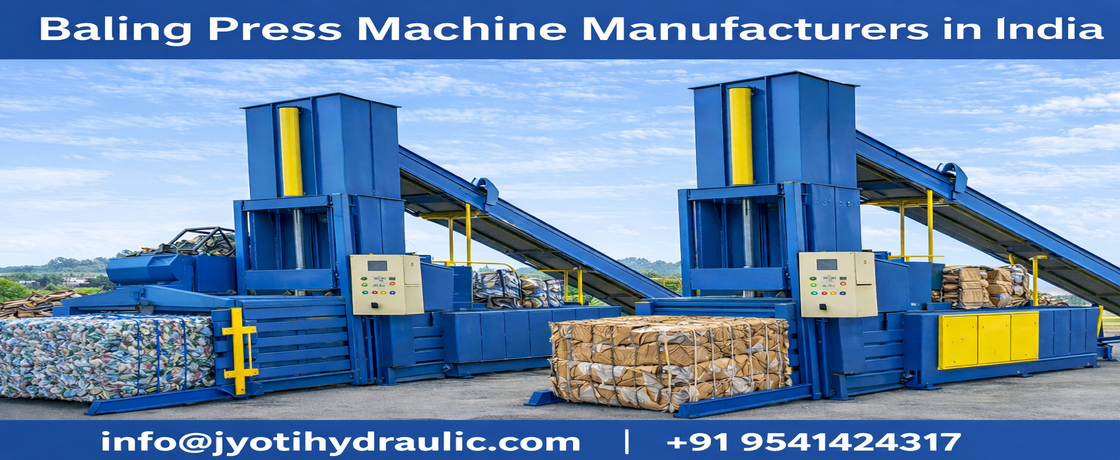
Jyoti Hydraulic has established itself as a trusted industrial manufacturer providing advanced hydraulic baling solutions designed specifically for modern recycling plants and waste management facilities. As industries continue to generate massive quantities of cardboard packaging, managing this waste efficiently has become a critical operational challenge. Loose cardboard cartons, corrugated boxes, and packaging materials quickly accumulate in warehouses, logistics centers, and recycling plants, occupying valuable space and increasing handling costs.
A Cardboard Baler Machine is an industrial solution designed to compress large volumes of cardboard waste into compact, dense bales that are easy to store, transport, and recycle. These machines play a crucial role in modern waste management systems by improving operational efficiency, reducing logistics costs, and enabling effective recycling processes.
Today, industries are actively searching for reliable Carton Baling Machines Manufacturer in India that can deliver durable, high-performance machines capable of operating continuously in demanding industrial environments. Alongside cardboard balers, companies often rely on experienced Baling Machine Manufacturers in India and Scrap Baling Machine Manufacturers in India to install integrated waste processing systems that can handle cardboard, paper, plastics, and metal scrap.
This comprehensive industrial guide provides detailed insights into cardboard baler machines, including their design, working principles, technical specifications, industrial applications, advantages, machine selection criteria, and emerging industry trends.
Industry Overview: Growth of Recycling and Packaging Waste Management
The global packaging industry has experienced rapid growth over the past decade due to the expansion of e-commerce, retail distribution networks, and global supply chains. As a result, cardboard and corrugated packaging materials are now among the most commonly generated industrial waste materials.
Cardboard is widely used because it is:
-
Lightweight
-
Durable
-
Recyclable
-
Cost-effective for shipping and packaging
However, once used, these cartons quickly accumulate in massive quantities across industries such as:
-
Logistics and transportation
-
Online retail warehouses
-
Food processing industries
-
Consumer goods manufacturing
-
Pharmaceutical packaging
-
Electronics distribution
In recycling plants, cardboard waste is one of the primary recyclable materials processed daily. Without compression equipment, handling this waste becomes inefficient because loose cartons occupy significant storage space and require frequent transportation.
To address this challenge, recycling facilities rely heavily on equipment developed by Scrap Baling Machine Manufacturers in India, which compress waste materials into standardized bales suitable for recycling industries.
In addition to cardboard recycling, modern recycling plants also process:
-
Paper waste
-
Plastic scrap
-
PET bottles
-
Aluminum cans
-
Industrial metal scrap
Many PET Bottle Baling Press Machine Manufacturers in India now provide multi-material baling systems capable of processing plastic bottles alongside cardboard waste, making recycling plants more efficient and profitable.
With increasing environmental awareness and stricter waste management regulations, the demand for industrial baling machines is expected to grow significantly in the coming years.
Technical Insights: Working Principle of Cardboard Baler Machines
A cardboard baler machine is a hydraulic compression system designed to reduce the volume of cardboard waste by applying extremely high pressure inside a reinforced compression chamber.
The machine transforms loose cardboard cartons into tightly compressed rectangular bales that can be easily transported to recycling facilities.
Key Components of a Cardboard Baler Machine
1. Hydraulic Power Pack
The hydraulic power unit is the core of the baling machine. It generates the pressure required to compress cardboard waste.
It typically includes:
-
High-pressure hydraulic pump
-
Electric motor
-
Oil reservoir tank
-
Pressure control valves
-
Directional control valves
The hydraulic system allows the machine to generate compression forces ranging from 10 tons to more than 150 tons, depending on the machine size.
2. Compression Ram
The ram is a heavy steel plate connected to the hydraulic cylinder. During operation, it moves downward (in vertical machines) or forward (in horizontal machines) to compress cardboard materials.
The compression ram ensures uniform pressure distribution, producing dense and well-formed bales.
3. Baling Chamber
The chamber is the enclosure where cardboard waste is loaded before compression. It is designed with heavy-duty steel plates to withstand high pressure.
The size of the chamber determines:
-
Bale dimensions
-
Production capacity
-
Material handling efficiency
Industrial machines often have large chambers capable of handling oversized cardboard cartons without pre-cutting.
4. Bale Tying System
After compression, the bale must be secured using steel wires or plastic straps. This tying system ensures that the bale retains its shape after removal from the machine.
5. Bale Ejection Mechanism
Once the bale is tied, the machine ejects it using either:
-
Hydraulic ejector systems
-
Manual removal mechanisms
-
Conveyor-based automatic ejection
6. Electrical Control Panel
Modern machines are equipped with advanced control panels that regulate:
-
Compression cycles
-
Pressure limits
-
Safety interlocks
-
Emergency stop systems
Some advanced machines also include PLC-based automation for improved operational efficiency.
Types of Cardboard Baler Machines Used in Recycling Plants
Different industries require different types of baling machines depending on their waste generation volume.
Vertical Cardboard Baler
Vertical balers are compact machines commonly used in small to medium facilities.
Features:
-
Small footprint
-
Economical operation
-
Manual or semi-automatic loading
-
Bale weight typically between 80 kg and 300 kg
They are widely used in retail stores, warehouses, and small recycling units.
Horizontal Cardboard Baler
Horizontal balers are designed for high-volume waste processing.
Key characteristics include:
-
Continuous feeding system
-
Large compression capacity
-
Automatic bale tying options
-
Bale weights up to 800 kg or more
These machines are commonly used in large recycling plants and logistics centers.
Fully Automatic Baling Systems
Fully automatic balers integrate conveyor feeding systems and automated bale tying mechanisms.
Advantages include:
-
Continuous operation
-
Minimal manual labor
-
High production rates
-
Consistent bale density
Leading Baling Machine Manufacturers in India design these machines for large-scale industrial recycling facilities.
Industrial Applications of Cardboard Baler Machines
Cardboard balers are used in a wide range of industries where packaging waste is generated in large quantities.
Recycling Plants
Recycling facilities use balers to compress cardboard waste collected from multiple sources.
E-Commerce Warehouses
Online retail companies generate enormous volumes of cardboard packaging daily. Balers help manage this waste efficiently.
Retail and Supermarket Chains
Retail stores use cardboard balers to compress packaging waste from product deliveries.
Manufacturing Industries
Factories receiving raw materials in cartons rely on balers to maintain organized waste management systems.
Logistics and Distribution Centers
Distribution hubs process thousands of shipping cartons daily, making balers essential for waste compression.
Major Benefits of Cardboard Baler Machines
Installing a cardboard baler machine offers several operational, financial, and environmental advantages.
1. Massive Space Reduction
Loose cardboard takes up excessive space. Baling machines can reduce the volume of cardboard waste by 80% to 90%.
2. Lower Waste Handling Costs
Compressed bales are easier to transport and require fewer trips to recycling facilities.
3. Improved Workplace Safety
Organized waste handling reduces clutter and minimizes workplace hazards.
4. Higher Recycling Revenue
Recycling companies prefer well-compressed bales because they are easier to process and transport.
5. Increased Operational Efficiency
Automated baling machines significantly reduce manual labor and improve productivity.
6. Environmental Sustainability
Cardboard recycling reduces landfill waste and supports circular economy initiatives.
These advantages explain why industries increasingly depend on machines supplied by reliable Carton Baling Machines Manufacturer in India.
Buying Guide: How to Choose the Right Cardboard Baler
Selecting the right cardboard baler machine requires evaluating several important technical parameters.
Waste Volume
Estimate the daily amount of cardboard waste generated in your facility.
Small facilities: Vertical balers
Large recycling plants: Horizontal automatic balers
Bale Density and Weight
Higher compression force produces denser bales, which improves transportation efficiency.
Typical bale weights include:
-
100 kg to 200 kg for small machines
-
300 kg to 500 kg for medium machines
-
600 kg to 800 kg for large industrial machines
Machine Build Quality
Industrial machines should feature:
-
Heavy-duty steel construction
-
Industrial-grade hydraulic cylinders
-
Durable electrical components
Power Consumption
Energy-efficient hydraulic systems reduce operating costs.
After-Sales Support
Choose manufacturers who provide:
-
Installation services
-
Technical support
-
Spare parts availability
Working with experienced Scrap Baling Machine Manufacturers in India ensures reliable machine performance and long-term support.
Future Trends in Cardboard Baling Technology
The recycling industry is adopting new technologies to improve efficiency and sustainability.
Smart Monitoring Systems
Modern machines now include sensors and digital monitoring systems that track performance and maintenance needs.
Energy Efficient Hydraulics
Advanced hydraulic systems reduce energy consumption while maintaining high compression forces.
IoT Enabled Machines
IoT technology allows operators to monitor machine performance remotely.
Integrated Recycling Systems
Future recycling plants will integrate sorting systems, conveyors, and balers into fully automated waste processing lines.
These technological advancements are being implemented by innovative Baling Machine Manufacturers in India to support modern recycling infrastructure.
Conclusion
Cardboard baler machines have become an indispensable part of modern recycling operations and industrial waste management systems. By compressing bulky cardboard packaging into dense bales, these machines help industries save space, reduce waste handling costs, and improve recycling efficiency.
From small retail facilities to large recycling plants, cardboard balers provide an effective solution for managing packaging waste in an environmentally responsible manner.
Choosing a high-quality machine from experienced Carton Baling Machines Manufacturer in India ensures long-term durability, operational efficiency, and better return on investment.
As recycling technologies continue to evolve, cardboard balers will remain a key component in building sustainable waste management systems worldwide.
Frequently Asked Questions (FAQ)
What materials can a cardboard baler machine compress?
Cardboard balers can compress corrugated cartons, paper waste, packaging materials, and sometimes plastic packaging.
What is the average capacity of a cardboard baler?
Machine capacity varies from 100 kg to 800 kg per bale, depending on the machine size and hydraulic pressure.
Are cardboard balers suitable for small businesses?
Yes. Small vertical balers are ideal for retail stores, supermarkets, and warehouses that generate moderate cardboard waste.
How much pressure does a cardboard baler generate?
Industrial balers typically generate compression forces ranging from 10 tons to over 150 tons.
How often should a baler machine be maintained?
Regular maintenance should be performed every 3 to 6 months to ensure smooth hydraulic operation and long machine life.
Get Expert Cardboard Baling Solutions
Looking for a reliable cardboard baler machine for your recycling plant or industrial facility?
Our team of experts can help you select the most suitable machine based on your operational requirements.
📧 Email: info@jyotihydraulic.com
📞 Call: +91 9541424317
✔ Request a customized quotation
✔ Get technical consultation from industry experts
✔ Discover high-performance industrial baling machines
Contact Jyoti Hydraulic today to upgrade your recycling efficiency with advanced cardboard baler technology.


