
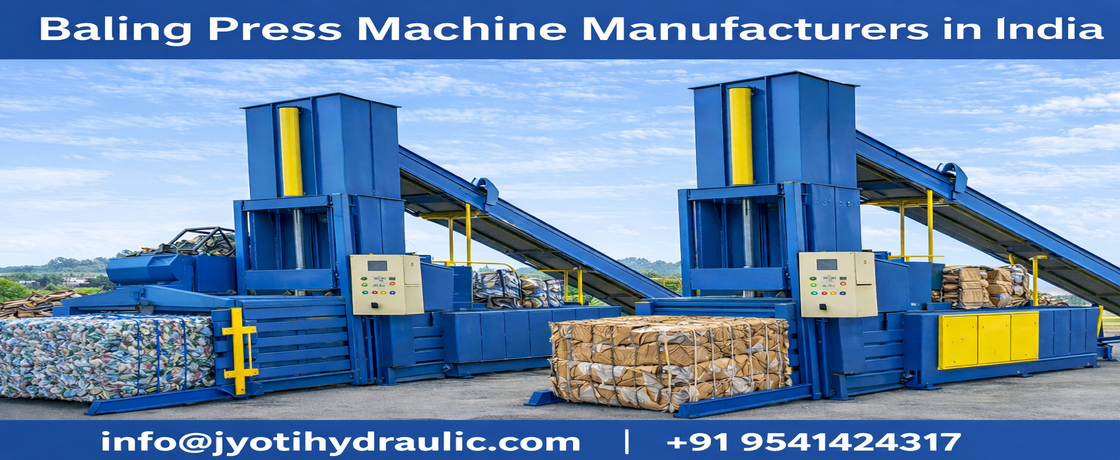
Jyoti Hydraulic stands among the most dependable names in the recycling and waste management industry as a leading baling press machine manufacturer, offering technologically advanced solutions designed to improve compaction efficiency across multiple materials. In industries where managing scrap volume, transportation cost, and material handling efficiency directly impacts profitability, the double action baling press machine plays a critical role in transforming loose waste into dense, uniform, and logistics-friendly bales.
From steel scrap yards to paper recycling plants and plastic recovery units, modern operations demand machines that deliver consistency, power, and long-term durability. Double action baling technology answers that demand with superior compression capability and improved bale stability.
Understanding the Double Action Baling Press Machine
A double action baling press machine is a hydraulic compaction system engineered to apply pressure from two different directions — typically horizontal and vertical. This dual compression approach ensures that material is compacted more efficiently compared to single-direction baling systems.
Unlike traditional balers that compress waste from only one axis, this machine:
• Eliminates internal air pockets
• Produces tighter bales
• Increases material density
• Enhances bale handling safety
This makes it particularly suitable for compressing diverse recyclable materials such as:
• Heavy steel scrap
• Loose waste paper
• Bulky cartons
• Elastic PET bottles
The result is optimized storage, easier transportation, and improved resale value of recyclable materials.
Technical Working Principle
The efficiency of a double action baling press machine lies in its synchronized hydraulic compression system.
Operational flow includes:
-
Waste material is fed into the compression chamber
-
Horizontal ram applies inward force
-
Vertical ram follows with downward compression
-
Simultaneous pressure removes void space
-
Material is compacted into uniform high-density bales
This two-stage compression process:
• Maximizes compaction ratio
• Prevents bale loosening
• Reduces rebound effect in plastic materials
• Improves structural integrity of finished bales
For industries handling mixed-density waste, this technology ensures consistent results regardless of material variation.
Role in Modern Recycling Ecosystems
Today’s recycling infrastructure is driven by efficiency and sustainability. Industries face challenges such as:
• Limited storage space
• High transport cost
• Increasing scrap volume
A double action baling press machine addresses these challenges by converting loose, space-consuming waste into compact units that are easy to store, stack, and transport.
This contributes to:
• Reduced warehouse clutter
• Improved workflow efficiency
• Lower handling cost
• Enhanced environmental compliance
For businesses aiming to streamline operations, choosing the right baling press machine manufacturer becomes essential.
Material-Specific Applications
Steel Scrap Processing
Steel waste is dense and irregular in shape. Double compression:
• Reduces scrap volume significantly
• Improves furnace feeding efficiency
• Simplifies material transport
Dense steel bales also reduce loading and unloading time.
Waste Paper Recycling
Paper waste, though lightweight, occupies large storage areas.
Double action baling ensures:
• Higher packing efficiency
• Better moisture resistance during storage
• Improved handling during shipment
This directly benefits recycling plants by increasing throughput.
Carton & Corrugated Box Compaction
Warehouses generate large volumes of carton waste.
Using a double action baling press machine helps:
• Reduce storage space
• Maintain organized facilities
• Lower disposal expenses
Uniform bale size improves stackability.
PET Bottle Recycling
Plastic bottles are challenging due to their elastic nature.
Double-direction compression:
• Prevents expansion after compaction
• Removes trapped air
• Produces stable bales
This improves downstream recycling processes like shredding and washing.
Advantages Over Conventional Baling Systems
Compared to single-action balers, a double action system delivers:
• Superior compaction density
• Improved bale uniformity
• Reduced cycle time
• Enhanced operational efficiency
Most importantly, it minimizes material spring-back — especially in plastics — ensuring long-term bale stability.
Key Features to Evaluate
When selecting equipment from a baling press machine manufacturer, industrial buyers should consider:
• Hydraulic pressure capacity
• Compression force balance
• Structural frame strength
• Chamber dimensions
• Energy consumption efficiency
Machines designed with industrial-grade hydraulics provide long service life and consistent performance.
Manufacturing Expertise Matters
Partnering with an experienced baling press machine manufacturer ensures:
• Reliable engineering
• Application-specific design
• Reduced downtime
Manufacturers with deep industry knowledge can tailor machines to match operational requirements across recycling sectors.
Performance Approach by Jyoti Hydraulic
Jyoti Hydraulic integrates practical industrial insights into machine design.
Focus areas include:
• Heavy-duty hydraulic components
• Optimized compression geometry
• Durable structural build
Every double action baling press machine is engineered to deliver high output while maintaining operational efficiency.
Operational Impact
Industries using advanced baling solutions benefit from:
• Faster waste processing
• Reduced storage dependency
• Improved resale value
Additionally, compact bales simplify:
• Transportation planning
• Material inventory management
Cost Efficiency & ROI
Investing in a double action baling press machine supports long-term savings through:
• Lower logistics cost
• Reduced labor involvement
• Improved material recovery value
Higher bale density leads to better freight utilization and warehouse optimization.
Maintenance & Longevity
Machines designed with robust hydraulics and reinforced frames offer:
• Stable long-term performance
• Reduced maintenance interruptions
• Predictable operational lifecycle
This ensures consistent productivity across recycling operations.
Strategic Importance of Choosing the Right Machine
Selecting a high-quality double action baling press machine from a reliable baling press machine manufacturer directly influences:
• Operational efficiency
• Scrap management quality
• Long-term profitability
It is a critical investment for industries aiming to improve recycling workflows.
Conclusion
As recycling industries evolve, the need for advanced compaction systems continues to grow. A double action baling press machine offers a powerful solution for handling steel scrap, waste paper, cartons, and PET bottles with precision and efficiency.
With industry-focused engineering and performance-driven design, Jyoti Hydraulic supports businesses in building structured, cost-effective recycling operations.

