
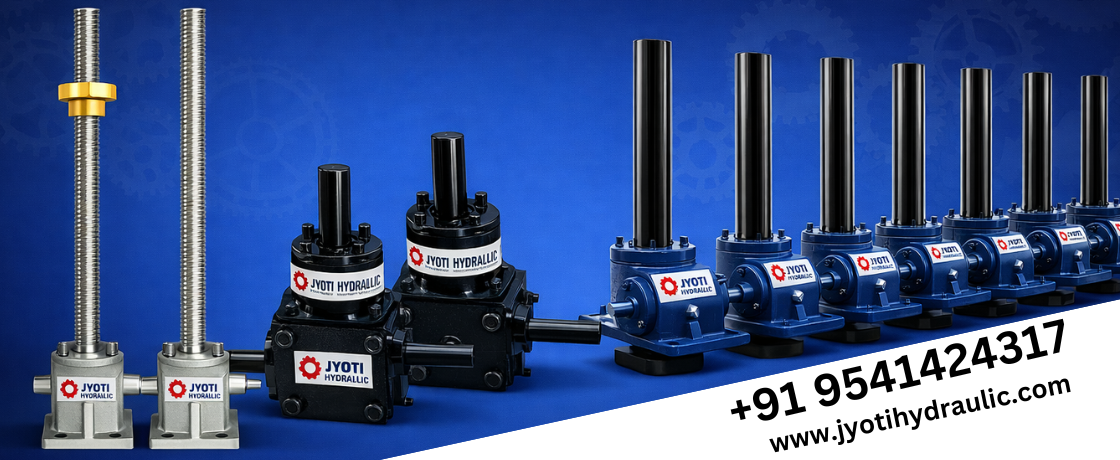
Jyoti Hydraulic understands that choosing a lifting jack involves more than checking its capacity. A jack must fit beneath the load, reach the required height and allow controlled movement throughout the lift. For buyers considering Bottle Screw Jacks, a three-stage arrangement can offer additional reach within a compact assembly. However, its suitability depends on the actual load, available clearance and operating conditions. These practical details should guide the purchase before price becomes the deciding factor.
Industry Overview: Where Mechanical Lifting Fits
Workshops, fabrication units and maintenance departments often need occasional lifting or height adjustment without installing a powered system. Mechanical screw jacks can suit these tasks because their operation is straightforward and manual models need no electrical supply.
However, a compact jack is not automatically suitable for every heavy load. Buyers should distinguish maintenance lifting from continuous production duties, which may require a different drive arrangement, operating speed or duty rating.
Understanding the Three-Stage Mechanism
A mechanical screw jack converts rotational input into linear movement through engaged threads. Turning the operating mechanism advances or retracts the lifting assembly.
A three-stage configuration generally uses extending sections to increase available travel relative to its closed height. Before ordering, confirm exactly how the manufacturer defines each stage, how extension occurs and whether the rated capacity applies throughout the stated lifting range.
Thread lead—the distance travelled per revolution—affects lifting speed and operating effort. Finer movement can help with positioning, but lifting performance also depends on thread geometry, friction, lubrication and any gearing.
Do not assume that every screw mechanism is self-locking. Resistance to back-driving depends on the design and operating conditions; follow the manufacturer’s instructions for load retention.
Specifications That Deserve Attention
When comparing a Bottle Screw Jacks Manufacturer, request a dimensional drawing and a model-specific technical sheet covering:
- Rated capacity: Permissible load under the specified operating conditions.
- Closed height: Minimum space needed to position the jack.
- Maximum height: Highest permitted operating position.
- Usable travel: Available movement between the stated limits.
- Base and saddle dimensions: Contact areas beneath the jack and against the load.
- Operating effort: Handle force or input torque at the rated load.
- Operating limits: Permitted orientation, extension restrictions and maintenance requirements.
These details prevent a common purchasing mistake: selecting sufficient tonnage but discovering that the jack cannot fit or reach the lifting point.
Applications and Practical Benefits
Depending on model approval, Bottle Screw Jacks may serve vehicle maintenance, machinery positioning, agricultural equipment servicing and fabrication work. Each application needs suitable lifting points and a stable arrangement.
Their practical attraction is controlled adjustment without a separate power source. A staged design can also reduce storage space compared with equipment offering similar reach in a taller, non-telescoping body.
The trade-off is manual effort and lifting time. For frequent cycles or coordinated lifting at several points, discuss whether a powered or synchronized system would be more appropriate.
Buying Guide: Match the Jack to the Job
Start with the load reaction at the lifting point—not simply the machine’s total weight divided by the number of jacks. Uneven weight distribution can place substantially different loads on individual supports.
Next, measure the available clearance and required lift. Check handle access too: a jack that fits beneath a machine may still be impossible to operate beside surrounding structures.
Provide photographs or drawings when requesting advice. Include operating frequency, environmental exposure and any restricted access. Ask for inspection documentation, spare-part availability and written operating instructions alongside the quotation.
Price in India: Compare Complete Quotations
There is no single meaningful price without a confirmed model. Capacity, lifting range, materials, machining requirements and order quantity can influence cost.
Request an itemized quotation stating the model, dimensions, included accessories, taxes, freight, delivery period and warranty terms. Comparing these details is more useful than comparing headline prices for jacks with different capabilities.
Safe Use and Maintenance
Position the jack on a firm, level foundation with proper saddle contact. Never work beneath a load supported only by a jack; install appropriately rated independent supports before access.
Inspect for damaged threads, deformation and corrosion. Follow the specified lubrication schedule and stop using equipment that binds, slips or shows abnormal movement.
Frequently Asked Questions
Does three-stage mean three times the capacity?
No. Stage count describes the extension arrangement, not a capacity multiplier.
Are bottle screw jacks hydraulic?
Mechanical screw versions lift through threaded movement. Confirm the mechanism rather than relying on the bottle-shaped appearance.
What determines the correct model?
Load at the lifting point, clearance, required travel and operating conditions.
Conclusion: Request the Right Lifting Solution
Contact Jyoti Hydraulic with your load and dimensional requirements. Request a detailed quotation and expert consultation to select a suitable three-stage lifting arrangement.
📧 info@jyotihydraulic.com
📞 +91 9541424317


