
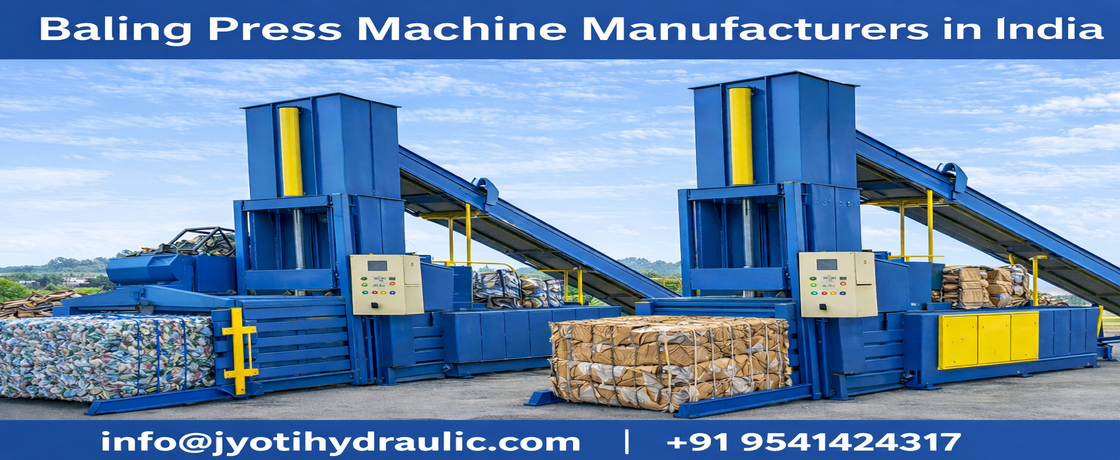
Jyoti Hydraulic stands at the center of India’s fast-evolving waste handling and recycling ecosystem, where automation, compaction efficiency, and material recovery now matter more than ever. As industries, recyclers, packaging plants, municipalities, and scrap processors deal with rising volumes of PET bottles and mixed scrap, the demand for a high-performance Baling Press Machine has increased sharply. In this landscape, businesses are not just looking for equipment—they are looking for durability, output consistency, lower handling costs, and long-term service support from trusted Indian manufacturers.
Introduction
India’s recycling and scrap management sector has transformed from a labor-heavy process into a more organized, technology-driven industry. PET bottles, iron scrap, paper waste, plastic films, textile cuttings, and metal offcuts all require systematic compaction before storage, transport, and resale. This is where an automatic PET bottle baling machine becomes essential.
A quality baler reduces the volume of loose waste, converts it into dense and manageable bales, and improves downstream logistics. Whether the buyer is searching for PET Bottle Baling Press Machine Manufacturers in India, Iron Scrap Baling Machine Manufacturers in India, or reliable Scrap Baling Machine Manufacturers in India, the real decision depends on technical capability, machine design, and after-sales confidence.
For businesses that handle recyclable waste daily, a baling machine is not just a utility machine—it is a productivity asset.
Industry Overview
India generates a large volume of post-consumer plastic waste and industrial scrap every day. PET bottles alone come from beverage plants, hospitality chains, retail outlets, airports, railway stations, event venues, and municipal collection centers. Similarly, iron and steel scrap comes from fabrication shops, foundries, engineering plants, automobile workshops, and demolition yards.
Loose scrap presents several challenges:
- It occupies excessive floor space
- Transportation becomes inefficient and expensive
- Material segregation becomes harder
- Inventory handling slows down
- Workplace safety and cleanliness are affected
That is why baling systems have become indispensable across the recycling value chain. Modern Indian manufacturers are designing machines for higher throughput, better bale density, reduced operator dependency, and smoother integration with existing material handling lines.
Today, buyers evaluating Scrap Baling Machine Manufacturers in India are not merely comparing price. They are comparing:
- Compaction force
- Bale output per hour
- Automation level
- Power efficiency
- Structural durability
- Service response
- Customization capability
This shift shows how mature the Indian market has become.
Why Automatic PET Bottle Baling Machines Matter
PET bottles are lightweight but highly voluminous. Without compaction, they occupy a disproportionate amount of storage and transportation capacity. This directly affects profitability for recyclers and waste aggregators.
An automatic PET bottle baler solves this problem by compressing bottles into tight, transport-ready bales. The machine helps in:
- Volume reduction
- Better warehouse management
- Lower freight cost per kilogram
- Easier inventory counting
- Faster recycling chain movement
- Cleaner plant operations
For large collection centers and processing units, automation becomes even more important. Manual or semi-automatic methods may work at low volumes, but once the inflow increases, consistency becomes difficult. Automatic systems improve repeatability, speed, and labor efficiency.
That is why serious buyers increasingly prefer experienced PET Bottle Baling Press Machine Manufacturers in India who understand actual plant conditions rather than offering generic machines.
Technical Insights: What Makes a Good Baling Press Machine?
A high-performing Baling Press Machine is a combination of structural engineering, hydraulic efficiency, safety design, and process intelligence. The best machines are not just powerful—they are balanced in design.
1. Hydraulic Power and Compaction Force
The heart of a baler is its hydraulic system. A properly designed hydraulic circuit ensures:
- Stable pressure generation
- Controlled ram movement
- Faster cycle time
- Reduced oil heating
- Longer seal and valve life
For PET bottle baling, compaction must be forceful enough to produce dense and stable bales without unnecessarily increasing cycle time. For iron scrap, the requirement becomes more demanding due to the higher resistance of material.
This is why buyers comparing Iron Scrap Baling Machine Manufacturers in India should pay close attention to hydraulic cylinder design, pump quality, operating pressure, and structural frame strength.
2. Machine Frame and Chamber Construction
A baler experiences significant internal stress during every compression cycle. The machine body must therefore be made from robust steel sections, thick plate construction, and precision-welded reinforcements.
Important factors include:
- Chamber wall thickness
- Ram face strength
- Guide arrangement
- Anti-deformation design
- Long-term resistance to fatigue
Poor structural design may reduce machine life, especially in scrap yards where machines run continuously.
3. Automation and Control System
Automatic balers typically include PLC-based control systems, sensor-assisted operation, and user-friendly control panels. Better automation helps in:
- Repeatable bale size
- Safer machine operation
- Lower manual intervention
- Reduced cycle variation
- Better productivity tracking
Advanced systems may also offer auto-feed coordination, bale full indication, fault alerts, and emergency shutdown logic.
4. Bale Density and Bale Size Consistency
The commercial value of a bale is not only determined by the material but also by its density and handling quality. Dense, uniform bales are easier to stack, transport, and process in the next stage.
For PET bottle recyclers, denser bales mean more kilograms per truckload. For scrap handlers, uniform bales simplify yard logistics and furnace charging preparation in some operations.
5. Safety Features
A professional-grade baler should include:
- Emergency stop buttons
- Safety interlocks
- Pressure relief protection
- Guarded moving zones
- Reliable electrical protection
- Safe door locking mechanism
Industrial buyers should never ignore safety when selecting a machine supplier.
6. Power Consumption and Maintenance Design
The right machine balances productivity with energy efficiency. Oversized systems may consume unnecessary power, while undersized systems fail to deliver required output. Good manufacturers optimize hydraulic power packs and control logic to minimize idle losses.
Maintenance-friendly design also matters. Easy access to valves, filters, cylinders, and electrical components reduces downtime and simplifies service.
Applications of Automatic PET Bottle and Scrap Baling Machines
A high-quality Baling Press Machine serves a broad range of industries. Its utility extends well beyond waste recycling plants.
PET Bottle Applications
- Plastic recycling units
- Beverage bottling companies
- Packaging waste processors
- Material recovery facilities
- Municipal waste management centers
- Warehouses handling returned packaging
Scrap Applications
- Fabrication shops
- Automobile dismantling units
- Engineering industries
- Metal recycling yards
- Foundries
- Industrial plants with regular metal offcuts
Other Materials Commonly Baled
- Cardboard and corrugated boxes
- Paper waste
- Textile waste
- Plastic film and woven sacks
- Aluminum cans
- Mixed dry recyclables
This broad usability is one reason why buyers often begin their search with Scrap Baling Machine Manufacturers in India, then narrow the choice based on material type and production volume.
Benefits of Investing in the Right Baler
Choosing the right baling system delivers measurable operational and financial benefits.
Reduced Transportation Cost
Compressed material takes up much less space, allowing more weight per trip and lowering logistics cost.
Better Storage Efficiency
Dense bales free up warehouse floor space and help organize inventory more systematically.
Improved Labor Productivity
Automatic and semi-automatic systems reduce manual handling, lifting, and bundling effort.
Higher Material Value
Clean, compact, and standardized bales are easier to sell and often preferred by downstream recyclers.
Cleaner and Safer Workplace
Loose scrap and bottles create clutter, dust, and tripping risk. Baling improves housekeeping standards.
Faster Material Movement
From collection to dispatch, compacted bales are easier to load, count, and manage.
Long-Term ROI
A well-built machine pays for itself through savings in labor, transport, storage, and process efficiency.
Buying Guide: How to Select the Right Manufacturer
When choosing among PET Bottle Baling Press Machine Manufacturers in India or Iron Scrap Baling Machine Manufacturers in India, buyers should move beyond brochure language and focus on performance realities.
1. Define Your Material Type
PET bottles, iron scrap, aluminum, paper, and textile waste all behave differently under compression. The machine should be matched to the material’s compressibility, abrasiveness, and required bale density.
2. Assess Daily Throughput
Estimate how many kilograms or tons you process per shift. This helps determine chamber size, hydraulic power, and cycle speed.
3. Choose the Right Automation Level
Low-volume operators may prefer semi-automatic systems, while large recyclers benefit from fully automatic or conveyor-integrated solutions.
4. Check Build Quality
Inspect steel quality, fabrication finish, hydraulic brand selection, control panel layout, and machine stability.
5. Ask About Bale Dimensions
Bale size should suit your transport vehicles, storage racks, and buyer requirements.
6. Review Service Support
Availability of spares, installation guidance, maintenance support, and operator training can significantly affect total ownership experience.
7. Look for Customization Capability
A good manufacturer should adapt the machine based on your plant layout, material flow, loading method, and output needs.
8. Compare Lifecycle Cost, Not Just Purchase Price
A cheaper machine with frequent downtime, oil leakage, low density, or weak service is costlier in the long run.
Future Trends in the Indian Baling Machine Industry
The Indian baling machine market is moving toward smarter, more efficient, and application-specific systems.
Increased Automation
More plants are demanding auto-feed, auto-eject, and integrated control systems to reduce labor dependency.
Smart Monitoring
IoT-ready panels, cycle counters, maintenance alerts, and performance diagnostics are becoming more relevant.
Energy-Efficient Hydraulics
Manufacturers are improving pump selection, oil cooling logic, and hydraulic efficiency to reduce operating costs.
Custom Machines for Specialized Scrap
Instead of one-size-fits-all machines, industries now prefer balers tailored for PET, ferrous scrap, non-ferrous scrap, or packaging waste.
Stronger Focus on Recycling Infrastructure
As sustainability compliance and waste segregation improve, the demand for dependable Indian baling equipment will continue to rise.
Conclusion
An automatic PET bottle baling machine is no longer just an optional recycling tool—it is a strategic investment for businesses that want better waste handling, lower logistics costs, cleaner operations, and improved material value. The same is true for industrial scrap processing, where dense and uniform bales directly improve storage and transport efficiency.
When evaluating PET Bottle Baling Press Machine Manufacturers in India, Iron Scrap Baling Machine Manufacturers in India, or broader Scrap Baling Machine Manufacturers in India, decision-makers should focus on machine engineering, application suitability, service support, and long-term performance. A well-designed Baling Press Machine should deliver reliability under real operating conditions, not just on paper.
The right manufacturer does more than supply a machine—they provide a compaction solution aligned with your business goals.
FAQs
1. What is an automatic PET bottle baling machine?
An automatic PET bottle baling machine is a hydraulic compaction system that compresses loose PET bottles into dense, tied bales for easier handling, storage, and transportation.
2. Why is bale density important in PET bottle recycling?
Higher bale density reduces storage space, lowers transportation cost, and improves handling efficiency throughout the recycling chain.
3. How is a PET bottle baler different from an iron scrap baler?
PET bottle balers are designed for lightweight, compressible material, while iron scrap balers require much stronger structural frames and higher compaction force to handle dense and rigid metal scrap.
4. What should I check before buying from Scrap Baling Machine Manufacturers in India?
You should review material compatibility, machine capacity, automation level, chamber size, hydraulic design, build quality, service support, and spare availability.
5. Which industries commonly use a Baling Press Machine?
Recycling plants, scrap yards, fabrication units, beverage companies, warehouses, municipalities, paper processors, and textile industries commonly use baling machines.
6. Is an automatic baler better than a manual or semi-automatic baler?
For medium to high-volume operations, automatic balers offer better productivity, more consistent bale output, lower labor dependency, and improved safety.
7. How much maintenance does a baling machine need?
Routine maintenance usually includes hydraulic oil checks, filter cleaning or replacement, inspection of hoses and seals, lubrication of moving parts, and periodic electrical and safety checks.
8. Can one baler handle multiple materials?
Some balers can handle multiple recyclable materials, but machine selection should always be based on the most demanding material and the required output specifications.
Contact Jyoti Hydraulic for the Right Baling Solution
Looking for trusted PET Bottle Baling Press Machine Manufacturers in India or expert support for scrap compaction systems?
Get in touch with Jyoti Hydraulic for:
- Expert consultation
- Customized machine recommendations
- Technical guidance
- Competitive quotations
- Reliable after-sales support
📧 info@jyotihydraulic.com
📞 +91 9541424317
Reach out today to contact our team, request a quotation, and get expert consultation for the ideal baling solution for your business.


