
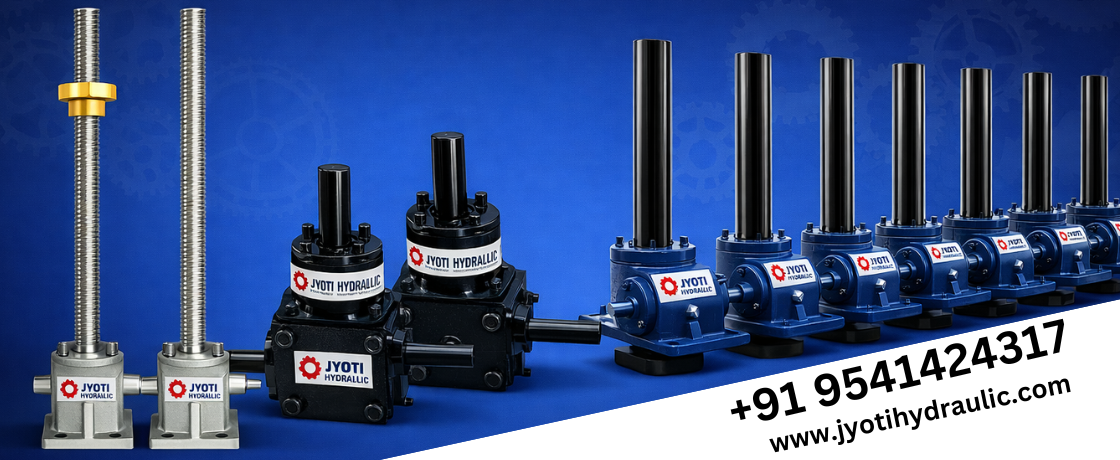
Jyoti Hydraulic designs industrial lifting and motion-control solutions for applications where heavy loads need to be raised, lowered, positioned, or held with controlled mechanical movement. Among these solutions, Classic Worm Gear Screw Jacks are widely used because of their compact construction, high mechanical advantage, and ability to provide dependable linear movement. They are particularly useful in machinery where hydraulic or pneumatic actuation may not be practical and where several lifting points need to operate together.
What Is a Worm Gear Screw Jack?
A Worm Gear Screw Jack is an electromechanical or manually operated lifting device that converts rotary motion into linear motion. Its primary components include a worm shaft, worm wheel, lifting screw, nut, thrust bearings, and a rigid housing.
Depending on the design, the screw can either move vertically through the jack body or rotate while a travelling nut moves along the screw. This flexibility allows screw jacks to be integrated into lifting tables, conveyors, industrial fixtures, machine assemblies, and synchronized positioning systems.
How Does a Classic Worm Gear Screw Jack Work?
The working principle starts when rotary input is supplied through an electric motor, geared motor, handwheel, or connecting shaft. This rotation drives the worm shaft, which engages with the worm wheel.
The worm gear arrangement reduces rotational speed while increasing available torque. The worm wheel then operates the screw mechanism, converting rotary movement into slow and controlled linear travel.
The lifting screw moves the attached load upward or downward according to the direction of rotation. The screw pitch or lead directly influences the travel speed and mechanical advantage. A finer lead generally provides slower, more controlled movement, while a larger lead produces faster linear travel.
For applications involving several lifting points, multiple screw jacks can be linked using couplings, drive shafts, and bevel gearboxes. This allows a single motor to operate an entire lifting system while maintaining coordinated movement.
Important Technical Factors
Correct selection involves much more than choosing a jack based on load capacity. Experienced Worm Gear Screw Jack Manufacturers evaluate several operating conditions.
Load and safety margin: Both static and dynamic loads should be considered to prevent premature component failure.
Travel length: Long screws operating under compression must be checked for buckling because allowable load can decrease as unsupported screw length increases.
Duty cycle: Frequent operation generates frictional heat within the screw, nut, and gearing. High-duty applications require careful speed and thermal evaluation.
Side loading: Screw jacks are primarily intended for axial loading. External guides should be used where machinery can impose significant lateral forces.
Operating speed: Excessively high screw speed can increase wear and temperature, reducing operating life.
Industrial Applications
Classic Worm Gear Screw Jacks are suitable for a broad range of industrial equipment, including:
- Adjustable conveyor systems
- Industrial lifting tables
- Steel and metal processing machinery
- Automotive assembly fixtures
- Packaging and filling machines
- Furnace doors and lifting platforms
- Printing and paper machinery
- Textile production equipment
- Material handling systems
- Heavy-duty positioning assemblies
One major advantage is synchronized lifting. For example, a large rectangular platform can be supported by four screw jacks mechanically connected to one drive. This arrangement helps distribute movement across multiple lifting points and provides controlled platform positioning.
Benefits of Classic Worm Gear Screw Jacks
These systems remain popular because they offer a combination of high load-handling capability and mechanical simplicity. Their key advantages include controlled linear positioning, compact installation, multiple drive options, easy integration with synchronized systems, and dependable performance in demanding industrial machinery.
Motorized versions can also be combined with limit switches, encoders, PLC controls, and position sensors for automated equipment.
How to Select the Right Screw Jack
Before contacting Worm Gear Screw Jack Manufacturers, buyers should define the maximum load, required travel, lifting speed, operating frequency, mounting orientation, number of lifting points, and environmental conditions.
For long-travel applications, screw buckling calculations are particularly important. In frequent-cycle applications, lubrication, heat generation, and expected operating time should also be evaluated.
Selecting the jack according to actual working conditions instead of nominal load alone can significantly improve system reliability and service life.
Future of Screw Jack Systems
Traditional screw jack technology is increasingly being integrated with servo motors, PLCs, encoders, and condition-monitoring systems. These developments allow manufacturers to achieve better position control, automated synchronization, overload monitoring, and preventive maintenance while retaining the mechanical advantages of the classic worm gear design.
Conclusion
Classic Worm Gear Screw Jacks provide a practical solution for industrial lifting and accurate positioning. Their performance depends on correct engineering of load, screw length, speed, duty cycle, alignment, and drive configuration.
Jyoti Hydraulic can assist industries in selecting a Worm Gear Screw Jack according to specific machine and operating requirements.
Frequently Asked Questions
What is the main purpose of a worm gear screw jack?
It converts rotary input into controlled linear movement for lifting, lowering, positioning, or supporting industrial loads.
Can multiple screw jacks operate together?
Yes. Several jacks can be mechanically synchronized using shafts, couplings, and gearboxes.
Can worm gear screw jacks be motorized?
Yes. They can be driven using electric motors or geared motors and integrated with automated controls.
What information is needed for screw jack selection?
Load capacity, travel length, operating speed, duty cycle, installation orientation, and working environment are the main selection parameters.
Need Help Selecting the Right Screw Jack?
Contact Jyoti Hydraulic for application-based recommendations, technical consultation, and customized quotations for industrial screw jack systems.
📧 info@jyotihydraulic.com
📞 +91 9541424317
Request your quotation today and discuss your lifting or positioning application with our technical team.


