
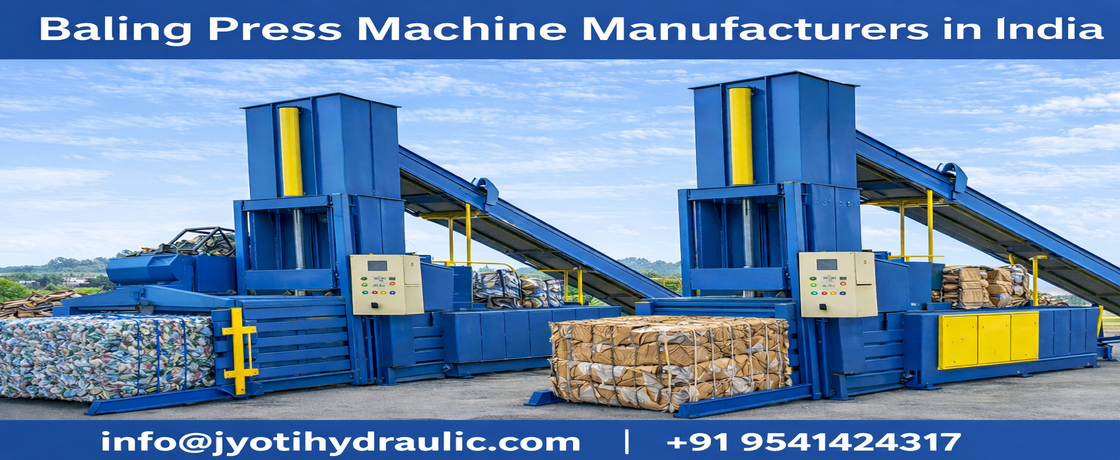
Jyoti Hydraulic is a trusted name in industrial hydraulic machinery, offering advanced baling solutions for businesses that need faster waste handling, higher bale density, reduced manpower, and better recycling efficiency. In 2026, the demand for fully automatic horizontal auto-tie baling machines is increasing rapidly because industries are no longer treating waste as a disposal problem. Instead, recyclable waste such as corrugated cartons, paper, plastic, textile scraps, and metal scrap is now viewed as a recoverable resource that can reduce costs, generate resale value, and support sustainable operations.
A fully automatic horizontal auto-tie baling machine is one of the most efficient systems for compressing loose waste into compact, uniform, easy-to-handle bales. It is especially useful for industries that generate bulk recyclable material every day and cannot depend on manual waste handling. Whether it is an e-commerce warehouse dealing with carton waste, a paper mill processing paper trim, a plastic recycling unit handling PET bottles, or a scrap yard managing industrial scrap, an automatic horizontal baler improves the complete waste management cycle.
This detailed buying guide explains the working principle, technical features, applications, benefits, selection factors, future trends, and frequently asked questions related to fully automatic horizontal auto-tie baling machines.
Introduction: Why Automatic Baling Machines Matter in 2026
Industrial waste management has changed significantly over the last decade. Earlier, many businesses used manual labor or basic compactors to manage waste. However, increasing production volumes, rising labor costs, limited storage space, and stricter environmental expectations have pushed industries toward automated recycling equipment.
A fully automatic horizontal auto-tie baling machine is designed for continuous operation. It automatically feeds, compresses, ties, and discharges bales with minimum human intervention. This makes it suitable for high-volume facilities where waste generation is constant throughout the day.
The biggest advantage of this machine is consistency. It produces uniform bales that are easier to store, stack, transport, and sell to recyclers. For businesses looking for reliable Carton Baling Machines Manufacturer in India, Scrap Baling Machine Manufacturers in India, or experienced Baling Press Machine Manufacturers, understanding the technology behind these machines is essential before making an investment.
Industry Overview: The Growing Need for High-Capacity Baling Systems
India’s recycling and waste processing industry is expanding as more sectors adopt circular economy practices. Manufacturing plants, retail chains, logistics companies, FMCG units, packaging companies, and recycling businesses generate large quantities of recyclable waste every day.
The most common industrial waste materials include:
- Corrugated carton boxes
- OCC waste
- Paper trimming waste
- Plastic films
- PET bottles
- HDPE and LDPE waste
- Textile cutting waste
- Foam and packaging waste
- Aluminum and light metal scrap
- Industrial production scrap
Loose waste occupies large space and increases handling cost. For example, carton waste is lightweight but bulky. Plastic bottles have high volume but low density. Scrap materials can be difficult to move and store without proper compression. A horizontal auto-tie baler solves these problems by converting loose waste into dense, compact bales.
Industries are also focusing on traceable and organized recycling systems. Instead of dumping recyclable material randomly, companies now prefer structured waste processing lines that include conveyors, shredders, sorting systems, balers, and storage systems. This shift has increased the importance of technically advanced baling equipment.
What Is a Fully Automatic Horizontal Auto-Tie Baling Machine?
A fully automatic horizontal auto-tie baling machine is an industrial hydraulic press that compresses recyclable waste into rectangular bales. The term “horizontal” refers to the direction of compression, where the hydraulic ram pushes material horizontally inside the compression chamber. The term “auto-tie” means that the machine automatically ties the bale using wire or strapping without manual intervention.
This machine usually includes:
- Main hydraulic pressing chamber
- Hydraulic power pack
- Feeding hopper
- Conveyor feeding system
- PLC control panel
- Automatic tying unit
- Bale discharge system
- Safety interlocks
- Sensors and limit switches
- Oil cooling system
- Electrical control cabinet
The machine is built for continuous-duty industrial use. It can be installed as a standalone unit or integrated into a complete waste processing line.
How Does a Horizontal Auto-Tie Baler Work?
The working process is systematic and highly automated.
1. Material Feeding
Waste material is loaded into the machine through a conveyor, hopper, or feeding chute. In large plants, a belt conveyor continuously transfers material from the sorting area to the baler.
2. Chamber Filling
Sensors monitor the quantity of material inside the compression chamber. Once the required filling level is reached, the machine automatically starts the pressing cycle.
3. Hydraulic Compression
The hydraulic ram applies high pressure to compress loose material into a dense block. The compression force depends on machine capacity and material type.
4. Bale Length Control
PLC programming controls the bale length according to the user’s requirement. This ensures consistent bale dimensions.
5. Automatic Tying
Once the bale reaches the desired size, the auto-tie system wraps and secures it using wires or straps. This eliminates manual tying and improves production speed.
6. Bale Discharge
The finished bale is pushed out of the machine automatically. Operators can then move it using forklifts, pallet trucks, or conveyor systems.
This continuous process improves productivity and reduces downtime.
Deep Technical Insights Before Buying
Choosing the right machine requires more than comparing price. Buyers must evaluate technical parameters that directly affect performance, maintenance, safety, and return on investment.
1. Pressing Force
Pressing force is usually measured in tons. It determines how strongly the machine can compress material.
Typical pressing force ranges include:
- 40–60 tons for medium-density materials
- 80–120 tons for high-volume carton, paper, and plastic waste
- 150 tons or above for heavy-duty industrial applications
Higher pressing force produces denser bales, but the right force depends on the material. A carton baler does not always need the same pressure as a metal scrap baler.
2. Bale Size and Bale Weight
Bale size affects storage, transport, and resale value. Standard rectangular bales are easier to stack and load in trucks or containers.
Bale weight depends on:
- Material density
- Compression pressure
- Bale dimensions
- Moisture level
- Feeding consistency
Dense and uniform bales reduce transportation cost because more material can be loaded in less space.
3. Throughput Capacity
Throughput refers to how much material the machine can process per hour. This is one of the most important buying factors.
A business generating 2 tons of carton waste daily does not need the same machine as a recycling plant processing 50 tons per day. Oversized machines increase capital cost, while undersized machines create bottlenecks.
4. Hydraulic System Quality
The hydraulic system is the heart of the baler. A reliable hydraulic system ensures smooth pressing, consistent force, and long operating life.
Important components include:
- Hydraulic cylinders
- Hydraulic pumps
- Directional control valves
- Pressure relief valves
- Oil filtration system
- Hydraulic hoses
- Cooling system
- Seal kits
Good hydraulic design reduces leakage, overheating, pressure loss, and maintenance problems.
5. PLC Control System
A modern automatic baler should have a PLC-based control panel. PLC automation improves accuracy, safety, and operational control.
Useful PLC features include:
- Auto/manual operation modes
- Bale length adjustment
- Cycle counter
- Fault display
- Emergency stop logic
- Sensor-based operation
- Overload protection
- Maintenance alerts
For industries planning long-term automation, PLC-controlled machines are a better investment.
6. Auto-Tie Mechanism
The auto-tie system is critical in fully automatic horizontal balers. It ensures every bale is tied properly without manual labor.
A good auto-tie mechanism should offer:
- Reliable wire feeding
- Accurate knotting or twisting
- Strong bale holding
- Low wire wastage
- Easy maintenance access
- Compatibility with suitable wire grade
Poor tying systems can lead to loose bales, machine stoppage, and higher operating cost.
7. Machine Structure and Fabrication
Industrial balers handle high pressure and continuous impact. Therefore, machine body strength is extremely important.
Buyers should check:
- Main frame thickness
- Chamber plate quality
- Welding strength
- Wear plate design
- Ram alignment
- Guide rail durability
- Anti-vibration structure
A weak frame may cause deformation, misalignment, oil leakage, and frequent breakdowns.
8. Safety Features
A fully automatic baler should include multiple safety systems, such as:
- Emergency stop buttons
- Safety guards
- Door interlocks
- Overload protection
- Electrical protection
- Hydraulic pressure safety valve
- Warning alarms
- Sensor-based fault detection
Safety is not optional in heavy hydraulic machinery. It protects operators and reduces accident risks.
Applications of Fully Automatic Horizontal Auto-Tie Baling Machines
Carton and Corrugated Box Waste
E-commerce warehouses, packaging units, retail chains, and logistics companies generate large volumes of carton waste. A horizontal baler compresses bulky carton waste into neat bales that can be sold to recyclers. This is why many businesses search for a reliable Carton Baling Machines Manufacturer in India to manage OCC and cardboard waste efficiently.
Paper Mills and Printing Units
Paper mills, newspaper facilities, and printing presses use balers to compress paper trim, rejected paper rolls, and mixed paper waste. Dense paper bales are easier to store and transport.
Plastic Recycling Plants
Plastic waste has high volume and low density. Balers are used for PET bottles, plastic films, woven sacks, HDPE containers, and LDPE sheets. Compression reduces storage space and improves handling efficiency.
Textile and Garment Industry
Garment manufacturing units produce fabric cuttings, cotton waste, yarn waste, and rejected textile material. Baling makes these materials easier to recycle or transport.
Metal Scrap Processing
Some horizontal balers are designed for light and medium metal scrap. Businesses often compare different Scrap Baling Machine Manufacturers in India to find machines suitable for aluminum scrap, tin sheets, MS offcuts, and production scrap.
Municipal and Commercial Recycling
Recycling centers and waste management companies use automatic balers to process mixed recyclable waste after sorting.
Key Benefits of Fully Automatic Horizontal Auto-Tie Balers
1. Higher Productivity
Automatic feeding, pressing, tying, and discharge allow continuous operation. This improves daily output and reduces waiting time.
2. Reduced Labor Dependency
Manual tying and handling require workers. Auto-tie systems reduce manpower requirements and improve operational consistency.
3. Better Space Utilization
Loose waste occupies excessive floor space. Baling reduces volume significantly and keeps the workplace organized.
4. Lower Transportation Cost
Dense bales allow more material to be transported in each truckload. This reduces logistics cost and improves profit margins.
5. Improved Scrap Value
Recyclers prefer clean, dense, and uniform bales. Proper baling can improve the resale value of recyclable waste.
6. Cleaner and Safer Workplace
Organized waste handling reduces clutter, fire risk, pest issues, and manual lifting hazards.
7. Strong Return on Investment
Although automatic balers require higher initial investment, they save money through labor reduction, transport savings, improved scrap value, and faster processing.
Complete Buying Guide: How to Select the Right Machine
Understand Your Material Type
The first step is to identify the material you need to bale. Carton, plastic, textile, paper, and metal scrap behave differently under compression. The machine design must match the material.
Calculate Daily Waste Volume
Estimate your daily and monthly waste generation. Also consider seasonal peaks and future business expansion.
Choose the Right Pressing Force
Do not select a machine only by tonnage. A reliable manufacturer will recommend pressing force based on material type, bale density requirement, and production volume.
Check Feeding Method
For high-volume operations, conveyor feeding is recommended. Manual feeding may not be suitable for continuous industrial use.
Evaluate Automation Level
A fully automatic machine should include auto feeding, auto pressing, auto tying, and auto discharge. Semi-automatic models may be cheaper but require more manpower.
Inspect Electrical and Hydraulic Components
Choose machines with reliable motors, control panels, sensors, valves, pumps, and cylinders. Component quality affects performance and maintenance cost.
Ask About Customization
Different industries need different bale sizes, chamber dimensions, conveyor lengths, power ratings, and output capacities. Good Baling Press Machine Manufacturers offer customized solutions instead of one-size-fits-all machines.
Review After-Sales Support
After-sales service is extremely important for hydraulic machinery. Check whether the manufacturer provides installation, operator training, spare parts, AMC support, and technical assistance.
Compare Total Cost, Not Only Price
Low-cost machines may result in higher maintenance, lower productivity, and poor bale quality. Always evaluate total lifecycle cost.
Why This Machine Supports Modern Industrial Search Intent
In 2026, buyers are not only searching for products. They are searching for complete solutions. Search engines and AI-powered answer platforms prefer content that explains practical problems, technical details, buying decisions, and real industrial use cases.
For businesses searching terms like Carton Baling Machines Manufacturer in India, Scrap Baling Machine Manufacturers in India, and Baling Press Machine Manufacturers, the intent is usually commercial and technical. Buyers want to know:
- Which machine is suitable for their industry?
- What capacity should they choose?
- How much automation is required?
- What maintenance is involved?
- How does the machine improve ROI?
- Which manufacturer can provide reliable support?
This is why detailed, experience-based information is important. A well-engineered baling machine is not just a waste compactor. It is a productivity system, recycling asset, space-saving solution, and cost-control tool.
Maintenance Tips for Long Machine Life
To keep a fully automatic horizontal baler running efficiently, regular maintenance is essential.
Important maintenance practices include:
- Check hydraulic oil level regularly
- Replace hydraulic oil as recommended
- Clean oil filters
- Inspect hoses and fittings for leakage
- Check wire tying system alignment
- Lubricate moving parts
- Inspect electrical connections
- Monitor ram movement
- Clean sensors and limit switches
- Train operators properly
Preventive maintenance reduces breakdowns and increases machine life.
Future Trends in Baling Machine Technology
Smart Monitoring
Future balers will use IoT systems to track performance, production data, energy use, and maintenance needs.
Energy-Efficient Hydraulics
Servo hydraulic systems and intelligent motor controls will reduce electricity consumption.
AI-Based Sorting Integration
Balers may be integrated with AI sorting systems to separate material before compression.
Remote Diagnostics
Manufacturers will increasingly offer remote troubleshooting for PLC-controlled machines.
Complete Recycling Automation
Instead of standalone machines, industries will prefer complete lines with conveyors, shredders, magnetic separators, sorting systems, and balers.
Conclusion
A fully automatic horizontal auto-tie baling machine is a smart investment for industries that generate large volumes of recyclable waste. It improves productivity, reduces labor cost, saves storage space, lowers transport expenses, and increases recycling value. In 2026, businesses need machines that are not only powerful but also automated, energy-efficient, safe, and easy to maintain.
Choosing the right manufacturer is equally important. A dependable manufacturer understands material behavior, hydraulic design, automation requirements, and industry-specific challenges. Whether you need carton baling, plastic baling, paper waste compression, textile waste management, or scrap handling, the right machine can transform your waste management process into a profitable and organized system.
For businesses searching for reliable Carton Baling Machines Manufacturer in India, trusted Scrap Baling Machine Manufacturers in India, or experienced Baling Press Machine Manufacturers, Jyoti Hydraulic offers practical, performance-driven solutions designed for modern industrial needs.
FAQ Section
1. What is a fully automatic horizontal auto-tie baling machine?
It is an industrial hydraulic machine that compresses recyclable waste into compact bales and automatically ties them using wire or straps without manual tying.
2. Which materials can be processed in this machine?
It can process carton waste, paper waste, plastic bottles, plastic films, textile waste, foam waste, packaging waste, and selected types of light metal scrap.
3. Why is a horizontal baler better for high-volume waste?
Horizontal balers are suitable for continuous feeding and large-volume processing. They offer higher throughput than many vertical balers.
4. What is the role of the auto-tie system?
The auto-tie system automatically secures each bale, reducing labor cost and increasing operating speed.
5. How do I choose the correct baler capacity?
Capacity depends on material type, daily waste volume, desired bale size, working hours, and future expansion plans.
6. Is a fully automatic baler suitable for carton waste?
Yes. It is highly suitable for corrugated boxes, OCC waste, and packaging waste, especially in warehouses, logistics hubs, and packaging units.
7. Can this machine reduce transport cost?
Yes. By compressing loose waste into dense bales, it allows more material to be transported in each load.
8. What maintenance is required?
Regular maintenance includes hydraulic oil checks, filter cleaning, lubrication, wire tying inspection, sensor cleaning, and electrical inspection.
9. Is PLC control important in modern balers?
Yes. PLC control improves automation, accuracy, safety, fault diagnosis, and production consistency.
10. Why should I choose an experienced manufacturer?
Experienced manufacturers provide better machine design, customization, installation support, spare parts, and after-sales service.
Contact Jyoti Hydraulic for Expert Baling Solutions
Looking for a powerful, reliable, and fully automatic horizontal auto-tie baling machine for your industry?
Get expert guidance from Jyoti Hydraulic and choose the right baling solution for your material, capacity, and production needs.
📧 info@jyotihydraulic.com
📞 +91 9541424317
Contact today to request a quotation, discuss your technical requirements, and get expert consultation for the most suitable baling machine for your business.


