
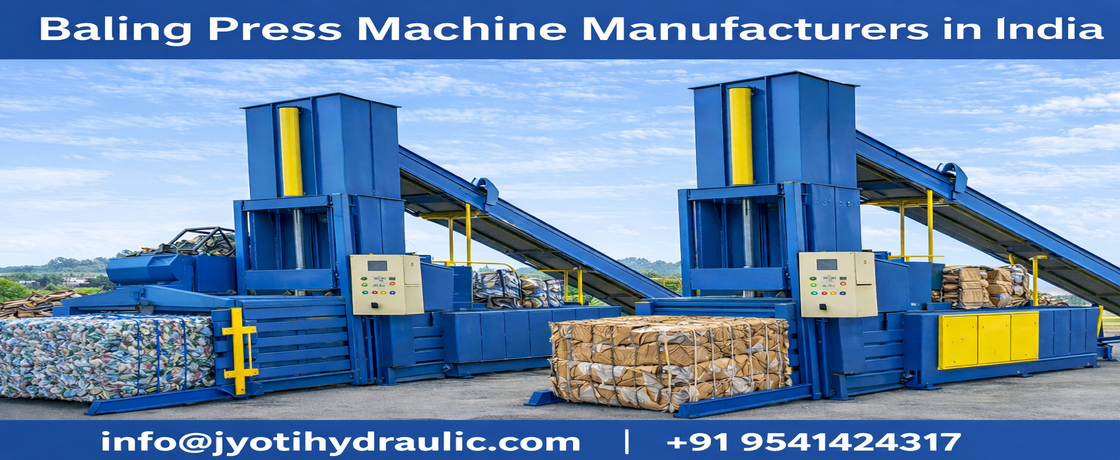
Jyoti Hydraulic stands at the forefront of advanced waste handling solutions, and the garbage baler machine has emerged as one of the most practical technologies for industries seeking cleaner operations, lower logistics costs, and more efficient scrap management. In a manufacturing environment where waste is generated every day in the form of paper, plastic, metal offcuts, packaging residue, and municipal solid waste, uncontrolled disposal leads to high storage requirements, operational disorder, and revenue loss. A well-designed baling system transforms scattered waste into dense, manageable, transport-friendly bundles, helping businesses improve housekeeping, reduce environmental impact, and unlock value from recyclable materials.
Introduction
Waste is no longer treated as a useless by-product in modern industry. It is now a material stream that can be sorted, processed, compacted, transported, and monetized. This shift has increased the importance of machinery that can handle high waste volumes with speed, reliability, and safety. Among such systems, the garbage baler machine plays a vital role.
A baler compresses loose waste into compact bales using hydraulic force. These bales are easier to store, stack, move, and sell. Whether it is recyclable packaging material, industrial scrap, discarded metal, or municipal waste, the right baling equipment improves operational efficiency across the waste management cycle. Businesses evaluating Baling Press Machine solutions today are not only looking for compression power but also for durability, energy efficiency, automation, ease of maintenance, and suitability for their exact material type.
This is why buyers increasingly seek trusted Garbage Baler Machine Manufacturers in india who understand Indian industrial conditions, material variability, power supply patterns, operating environments, and service expectations.
Industry Overview
India’s industrial growth, urbanization, and rise in organized waste recovery have created strong demand for baling systems. Manufacturing plants, warehouses, recycling yards, metal processing units, paper mills, automobile dismantling operations, textile units, and municipal contractors all require practical methods to control waste volume.
Traditionally, loose waste occupied excessive floor space and led to high transportation costs because trucks carried more air than material. Manual bundling was inconsistent and labor-intensive. With stricter environmental practices and a stronger recycling economy, companies now need mechanical compaction systems that deliver repeatable bale density and faster handling.
This demand has also expanded specialized product categories. For example:
- General garbage and dry waste balers for packaging and municipal streams
- Paper and plastic balers for recycling operations
- Metal scrap balers for ferrous and non-ferrous materials
- Heavy-duty units from Scrap Baling Machine Manufacturers in India for industrial scrap yards
- High-force solutions from Iron Scrap Baling Machine Manufacturers in India for dense ferrous scrap compaction
As the recycling value chain becomes more organized, balers are no longer viewed as optional equipment. They are increasingly seen as essential infrastructure for waste volume reduction and material recovery.
What Is a Garbage Baler Machine?
A garbage baler machine is a hydraulic compression unit designed to reduce the volume of waste materials by applying high pressure inside a chamber. The machine gathers loose waste, compresses it into a block, and secures the bale using straps, wires, or bands. Depending on the type, the machine may operate vertically, horizontally, semi-automatically, or fully automatically.
The purpose is straightforward: convert loose, irregular waste into dense, standardized output that is easier to handle downstream.
Main Components of a Baler
A typical Baling Press Machine includes:
- Hydraulic cylinder: Generates the compressive force
- Compression chamber: Holds the waste during compaction
- Hydraulic power pack: Contains motor, pump, oil tank, valves, and filtration system
- Ram or platen: Presses material downward or forward
- Control panel: Manual, PLC-based, or sensor-integrated control system
- Bale ejection system: Removes compressed bale from the chamber
- Tying arrangement: Secures the bale for transport and storage
In heavy-duty variants used by Iron Scrap Baling Machine Manufacturers in India, reinforced structures, hardened wear plates, high-tonnage cylinders, and robust hydraulic circuits are essential for handling rigid and abrasive metal scrap.
Technical Insights: How the Technology Works
The core principle of a garbage baler machine is hydraulic compaction. Hydraulic fluid is pressurized by a pump and directed into a cylinder. The cylinder moves the ram, which exerts force on the waste. When the material reaches the required density, the bale is tied and ejected.
Key Technical Parameters Buyers Should Understand
1. Compression Force
Compression force is usually measured in tons. Lower-tonnage machines are suitable for paper, cardboard, fabric, and plastic film, while metal scrap balers require significantly higher force. Bale density and output consistency depend heavily on this parameter.
2. Chamber Size
The chamber dimensions determine how much material can be loaded per cycle. Larger chambers improve productivity when bulk waste is generated continuously.
3. Bale Density
Higher bale density means better transport efficiency, lower storage requirements, and greater scrap value in many cases. However, density depends on material characteristics, moisture level, particle size, and machine pressure.
4. Cycle Time
Cycle time affects hourly throughput. Faster hydraulic response and optimized valve control improve machine productivity without sacrificing compaction quality.
5. Power Consumption
Efficient hydraulic design, correct motor sizing, and optimized duty cycles reduce energy costs over time. This matters especially for plants running multiple shifts.
6. Build Quality
Frame rigidity, weld strength, cylinder finish, seal quality, hose routing, and wear resistance directly affect machine life. Serious buyers often prefer reputed Scrap Baling Machine Manufacturers in India because machine performance depends as much on fabrication discipline as on design.
7. Automation Level
Modern machines may include:
- Auto-start and stop
- Bale-full indicators
- PLC controls
- Interlocks and emergency stop systems
- Automatic tying assistance
- Load sensing and pressure feedback
For large-scale facilities, automation reduces labor dependency and improves output uniformity.
Applications Across Industries
One reason the garbage baler machine has wide market acceptance is its versatility. It can be tailored for different sectors and material streams.
1. Recycling Plants
Recyclers use balers to compress cardboard, plastic bottles, films, paper waste, textile leftovers, and segregated dry garbage. Dense bales increase vehicle payload efficiency and simplify inventory handling.
2. Manufacturing Units
Factories generate packaging waste, trims, rejected materials, offcuts, and process scrap. A baler keeps production areas clean and creates a systematic waste evacuation process.
3. Metal Processing and Scrap Yards
Heavy-duty balers from Iron Scrap Baling Machine Manufacturers in India are widely used for iron scrap, sheet offcuts, light structural scrap, metal turnings, and dismantled components. Compact bales reduce handling complexity and improve furnace feed logistics in some downstream applications.
4. Warehouses and Logistics Hubs
Large warehouses accumulate corrugated boxes, shrink wrap, PET packaging, and straps. A baler minimizes waste volume and improves housekeeping compliance.
5. Municipal and Institutional Waste Management
Hotels, malls, apartment complexes, hospitals, educational campuses, and urban waste collection points use garbage balers to reduce dry waste bulk before transport.
6. Textile and Garment Industry
Fabric cuttings, yarn waste, finishing waste, and packaging residue can be compacted effectively, reducing the clutter common in high-output textile environments.
Benefits of Using a Garbage Baler Machine
Lower Waste Volume
The most obvious advantage is volume reduction. Loose waste can be compressed dramatically, allowing facilities to use storage space more efficiently.
Reduced Transportation Costs
Compressed bales mean fewer trips, better truck loading efficiency, and lower fuel expense per ton of waste moved.
Improved Workplace Cleanliness
A disciplined baling process reduces scattered waste, fire hazards, blocked pathways, and pest attraction in storage areas.
Better Scrap Value Realization
Properly baled recyclable materials are easier to weigh, classify, store, and sell. Buyers often prefer compact, standardized lots.
Labor Efficiency
Manual collection and bundling are time-consuming. A machine-based system streamlines waste handling and reduces repeated manual intervention.
Safer Operations
Modern balers include safety guards, emergency stops, interlocks, and structured loading procedures. This reduces the risks associated with ad hoc waste handling.
Environmental Compliance
Organizations under sustainability pressure benefit from improved segregation, compact storage, and easier movement of recyclable materials through formal channels.
Buying Guide: How to Choose the Right Baling Press Machine
Selecting the correct machine requires more than comparing tonnage and price. A poor match leads to low productivity, maintenance issues, and disappointing bale quality.
Evaluate Your Waste Type
Start by identifying the exact material:
- Dry mixed garbage
- Cardboard and paper
- Plastic film and bottles
- Textile waste
- Aluminium or non-ferrous scrap
- Iron scrap and steel offcuts
This is critical because a machine designed for soft packaging waste will not perform well in demanding metal scrap applications.
Assess Daily Waste Volume
Estimate how much waste is generated per shift or per day. Low-volume operations may need a compact vertical baler, while large facilities require high-throughput horizontal or customized hydraulic systems.
Check Bale Size Requirements
Downstream transport, forklift handling, warehouse racking, and recycler preferences may influence bale dimensions. Standardized bale size can simplify logistics.
Review Machine Duty Cycle
If the machine will run continuously, select a heavy-duty configuration with adequate cooling, robust hydraulics, and industrial-grade components.
Prioritize Build Integrity
Ask about:
- Steel section thickness
- Cylinder make and seal quality
- Pump and valve brand
- Power pack design
- Pressure rating
- Service accessibility
Experienced Garbage Baler Machine Manufacturers in india usually provide better engineering clarity on these points.
Consider Safety and Maintenance
Look for accessible maintenance points, hydraulic filtration, overload protection, emergency stop functions, and proper operator guarding.
Verify After-Sales Support
Machine uptime depends heavily on service response, spare parts availability, and technical guidance. This is especially important for plants in remote industrial belts.
Match Automation to Your Team
Do not overbuy automation if your operation is small, but do not underinvest if your waste volume is high. The ideal solution balances throughput, manpower, and budget.
Future Trends in Waste Compression Technology
The baling machine industry is evolving rapidly. Buyers are increasingly looking beyond simple compression and toward integrated waste management systems.
Smarter Controls
PLC and HMI-based control panels are becoming more common, enabling easier monitoring, diagnostics, and production tracking.
Energy-Efficient Hydraulics
Variable displacement pumps, optimized circuits, and load-based control are helping reduce energy consumption in continuous-duty operations.
Material-Specific Customization
Manufacturers are designing machines for distinct waste streams rather than offering one-size-fits-all solutions. This improves performance and bale quality.
IoT and Predictive Maintenance
Advanced machines may soon offer remote condition monitoring, fault alerts, pressure trend analysis, and service scheduling support.
Stronger Focus on Recycling Economics
As recycling markets mature, balers will be evaluated not just as waste equipment, but as profit-enabling assets that improve recoverable material value.
Conclusion
The garbage baler machine has become an indispensable solution for industries that want to control waste, reduce operational costs, improve workplace hygiene, and strengthen recycling efficiency. From dry waste and packaging residue to industrial scrap and metal offcuts, the right Baling Press Machine can deliver measurable returns in space utilization, transport savings, and material recovery.
For businesses comparing equipment from Garbage Baler Machine Manufacturers in india, Scrap Baling Machine Manufacturers in India, or Iron Scrap Baling Machine Manufacturers in India, the smartest approach is to focus on material suitability, hydraulic performance, structural quality, safety, and long-term service support. A baler is not merely a compression machine; it is a productivity tool that directly affects the economics of waste handling.
Frequently Asked Questions (FAQ)
1. What is a garbage baler machine used for?
A garbage baler machine is used to compress loose waste into compact bales for easier storage, transportation, and recycling. It is widely used in factories, warehouses, recycling facilities, and municipal waste handling operations.
2. How is a Baling Press Machine different from manual waste bundling?
A Baling Press Machine provides controlled hydraulic compression, producing denser and more uniform bales. Manual bundling is inconsistent, labor-intensive, and inefficient for medium to high waste volumes.
3. Can one baler handle both general waste and metal scrap?
Not always. Soft waste such as cardboard and plastic requires different chamber design and force levels compared to metal scrap. Heavy-duty machines from Iron Scrap Baling Machine Manufacturers in India are specifically designed for tougher materials.
4. What factors affect bale density?
Bale density depends on material type, moisture level, compression force, chamber size, ram design, and the number of compression cycles.
5. Which industries commonly use scrap baling machines?
Common users include recycling yards, automotive units, engineering industries, foundries, warehouses, packaging plants, textile units, and municipal waste contractors.
6. Why is after-sales service important when buying from Scrap Baling Machine Manufacturers in India?
Even a well-built machine needs periodic maintenance, spare parts, hydraulic support, and technical troubleshooting. Fast service support reduces downtime and protects production continuity.
7. Is a baler a good investment for small and medium businesses?
Yes, especially if the business generates regular waste or recyclable scrap. Even a modest baler can reduce transport frequency, improve cleanliness, and recover value from waste streams.
8. What should I ask a manufacturer before purchasing?
Ask about machine tonnage, chamber size, cycle time, power consumption, safety systems, hydraulic component quality, service support, installation assistance, and material-specific suitability.
Request a Quote or Expert Consultation
Looking for a reliable garbage baler or heavy-duty scrap compression solution for your facility? Connect with Jyoti Hydraulic for expert guidance, machine selection support, and a competitive quotation tailored to your industry needs.
Contact now for:
- Expert consultation
- Product recommendations
- Custom machine quotation
- Technical support and buying guidance
📧 info@jyotihydraulic.com
📞 +91 9541424317


