
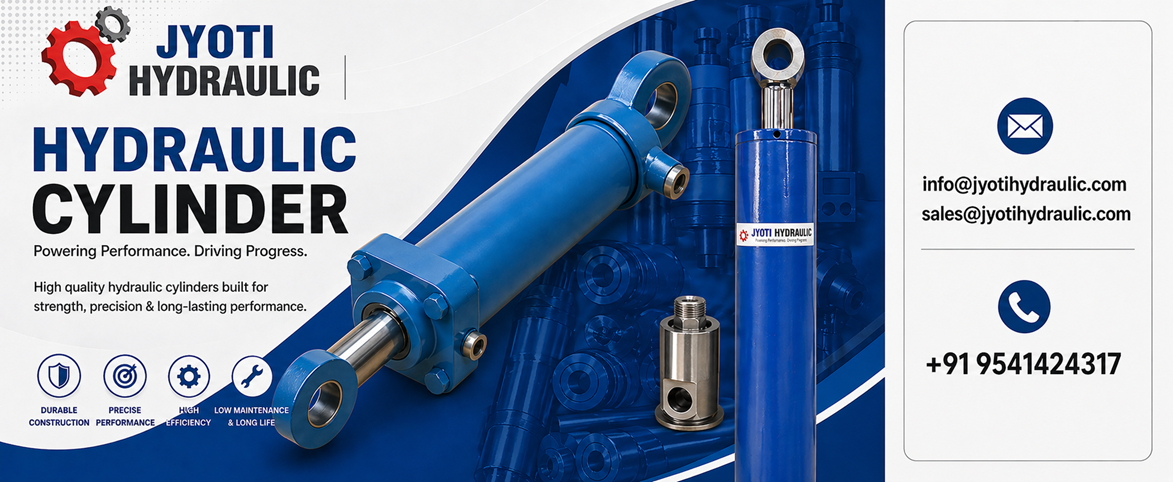
Jyoti Hydraulic understands that a hydraulic cylinder is not just a mechanical component; it is a critical power unit that decides how safely, smoothly, and efficiently a machine performs under load. In industries such as construction, manufacturing, agriculture, material handling, mining, steel processing, and automation, even a small cylinder failure can stop production, damage equipment, or create safety risks. That is why quality and durability are not optional in hydraulic cylinder manufacturing. They must be engineered at every stage, from design and material selection to machining, sealing, assembly, testing, and final inspection.
As industries demand higher productivity and lower downtime, the role of a reliable Hydraulic Cylinder Manufacturer in India has become more important than ever. Customers today do not only look for a cylinder that fits their machine; they look for a cylinder that performs consistently in real working conditions, handles pressure without leakage, resists wear, and delivers long service life.
Industry Overview: Why Quality Matters in Hydraulic Cylinders
India’s industrial growth has created strong demand for hydraulic systems across multiple sectors. Heavy-duty machines now operate for longer hours, often in dusty, hot, corrosive, or high-pressure environments. This makes hydraulic cylinder quality a direct factor in equipment performance.
A poor-quality cylinder may work during initial installation but can soon develop problems such as oil leakage, rod scoring, seal failure, jerky movement, overheating, internal bypass, or bending under load. These issues increase maintenance cost and reduce machine efficiency.
On the other hand, a well-manufactured hydraulic cylinder improves machine uptime, operator safety, energy transfer, and long-term reliability. This is especially important for buyers searching for Industrial Hydraulic Cylinder Manufacturers in India who can deliver application-specific, durable, and tested hydraulic solutions.
Technical Insights: How Manufacturers Build Durable Hydraulic Cylinders
The durability of a hydraulic cylinder starts with its design. A professional manufacturer studies the working pressure, load direction, stroke length, mounting type, operating speed, duty cycle, temperature range, and environmental exposure before finalizing the cylinder specifications. This engineering approach ensures the cylinder is not under-designed or over-designed.
1. Correct Material Selection
The cylinder barrel, piston rod, piston, gland, end caps, and seals must be selected according to the application. High-quality seamless steel tubes are commonly used for barrels because they offer strength, pressure resistance, and dimensional stability. The inner surface of the barrel must be properly honed to reduce friction and support smooth piston movement.
The piston rod is equally important. It usually undergoes hard chrome plating or suitable surface treatment to improve corrosion resistance, hardness, and seal compatibility. If the rod surface is rough, soft, or poorly coated, it can damage seals quickly and cause leakage.
2. Precision Machining
Hydraulic cylinders require very accurate machining. Bore size, rod diameter, piston clearance, groove dimensions, thread quality, and mounting alignment must stay within strict tolerances. CNC machining, honing, grinding, and polishing help achieve the required accuracy.
Precision machining reduces friction, improves sealing, prevents uneven wear, and ensures smooth movement. In high-pressure applications, even a small error in alignment can create side loading, seal damage, and premature failure.
3. Seal Selection and Compatibility
Seals are the control point of hydraulic performance. They prevent oil leakage, maintain pressure, and protect the system from contamination. A reliable manufacturer selects seals based on pressure, temperature, hydraulic fluid type, speed, and working environment.
For example, cylinders used in high-temperature applications need seals that can resist heat. Cylinders used in dusty environments require effective wipers to stop dirt from entering the system. In double acting cylinders, seals must perform effectively during both extension and retraction strokes.
This is one reason why experienced Double Acting Hydraulic Cylinder Manufacturers in India pay special attention to piston seals, rod seals, wear rings, and guide elements. Double acting cylinders work under pressure from both sides, so balanced sealing and proper internal clearance are essential.
4. Strong Welding and Structural Integrity
Many hydraulic cylinders include welded parts such as mounting brackets, ports, end connections, and base structures. Weak welding can become a failure point when the cylinder operates under high load or repeated pressure cycles.
Quality manufacturers follow controlled welding procedures, proper joint preparation, and inspection methods to ensure strength. Good welding improves fatigue resistance and prevents cracks, leakage, or structural deformation.
5. Surface Finishing and Corrosion Protection
Hydraulic cylinders often work outdoors or in aggressive industrial environments. Moisture, chemicals, dust, and temperature changes can reduce cylinder life. To improve durability, manufacturers use protective coatings, painting, chrome plating, and surface treatments.
A smooth rod surface protects seals, while a properly painted outer body prevents rust. These finishing steps may look simple, but they make a major difference in long-term performance.
Testing: The Real Proof of Quality
A hydraulic cylinder should never be judged only by appearance. Testing is what confirms whether it is ready for industrial use. Reputed manufacturers conduct multiple inspections before dispatch.
Pressure testing checks whether the cylinder can handle working pressure safely. Leak testing confirms that seals, ports, welds, and joints are properly assembled. Stroke testing ensures that the piston moves smoothly from one end to the other without jerks or abnormal sound. Dimensional inspection verifies bore, rod, mounting, and stroke accuracy.
For heavy-duty applications, testing becomes even more important because cylinders may operate under continuous load, shock load, or uneven working conditions. A tested cylinder gives buyers confidence that the product is ready for actual field performance.
Applications of Hydraulic Cylinders
Hydraulic cylinders are used wherever controlled linear force is required. Major applications include construction equipment, hydraulic presses, material handling machines, agricultural machinery, mining equipment, steel plant machinery, injection molding machines, lifting systems, tippers, cranes, trailers, industrial automation systems, and special purpose machines.
Different applications require different cylinder designs. A cylinder used in a press machine may need high force and rigidity, while a cylinder used in mobile equipment may need compact design, shock resistance, and fast response. This is why custom manufacturing capability is valuable.
Benefits of Choosing a Quality Hydraulic Cylinder Manufacturer
Working with an experienced Hydraulic Cylinder Manufacturer in India offers practical business benefits. The right manufacturer helps reduce breakdowns, improve production efficiency, lower maintenance cost, and extend machine life.
Quality cylinders also improve safety because they are designed to handle the required pressure and load. They reduce oil leakage, protect surrounding components, and support smoother machine operation. For OEMs and industrial buyers, consistent cylinder quality also improves brand reputation and customer satisfaction.
Buying Guide: How to Select the Right Hydraulic Cylinder
Before buying a hydraulic cylinder, customers should evaluate the application carefully. Key points include operating pressure, required force, bore size, rod diameter, stroke length, mounting style, working speed, hydraulic oil type, temperature, duty cycle, and environmental conditions.
Buyers should also check whether the manufacturer provides customization, technical support, proper testing, quality inspection, and after-sales assistance. Price is important, but selecting the cheapest cylinder can become expensive later if it causes downtime, leakage, or repeated replacement.
For industrial use, it is always better to choose experienced Industrial Hydraulic Cylinder Manufacturers in India who understand practical machine conditions and can recommend the right design.
Future Trends in Hydraulic Cylinder Manufacturing
The future of hydraulic cylinders is moving toward smarter, more efficient, and more durable designs. Sensor-based cylinders, predictive maintenance, improved sealing materials, advanced coatings, and energy-efficient hydraulic systems are becoming more relevant. Industries are also looking for customized cylinders that can work reliably in compact machines, automated systems, and high-cycle operations.
Manufacturers who combine traditional engineering strength with modern technology will continue to lead the market.
Conclusion
Quality hydraulic cylinder manufacturing is a complete process that combines engineering knowledge, material science, precision machining, sealing technology, surface protection, assembly skill, and strict testing. A durable cylinder is not produced by chance; it is built through control at every stage.
Jyoti Hydraulic focuses on delivering reliable, application-based hydraulic cylinder solutions for industries that cannot afford frequent breakdowns or poor performance. Whether you need standard cylinders, customized cylinders, heavy-duty cylinders, or double acting cylinders, choosing the right manufacturing partner is essential for long-term productivity and safety.
FAQs
1. What makes a hydraulic cylinder durable?
A hydraulic cylinder becomes durable when it is made with quality steel, precision machining, proper seals, strong welding, corrosion protection, and complete pressure testing.
2. Why are double acting hydraulic cylinders widely used?
Double acting cylinders provide force in both forward and return strokes, making them suitable for machines that need controlled movement in both directions.
3. How do I choose the right hydraulic cylinder manufacturer?
Choose a manufacturer with technical experience, customization capability, quality testing, reliable materials, and industry-specific knowledge.
4. What causes hydraulic cylinder leakage?
Leakage may occur due to worn seals, damaged rods, poor machining, contamination, excessive pressure, or improper installation.
5. Why is testing important before delivery?
Testing ensures that the cylinder performs safely under pressure, moves smoothly, and does not leak during operation.
Contact Jyoti Hydraulic
Looking for a dependable hydraulic cylinder solution for your machinery or industrial application? Get expert guidance, request a quotation, or discuss your custom hydraulic cylinder requirements with Jyoti Hydraulic today.
📧 info@jyotihydraulic.com
📞 +91 9541424317
Contact Jyoti Hydraulic now for expert consultation and high-quality hydraulic cylinders engineered for strength, durability, and reliable performance.


