
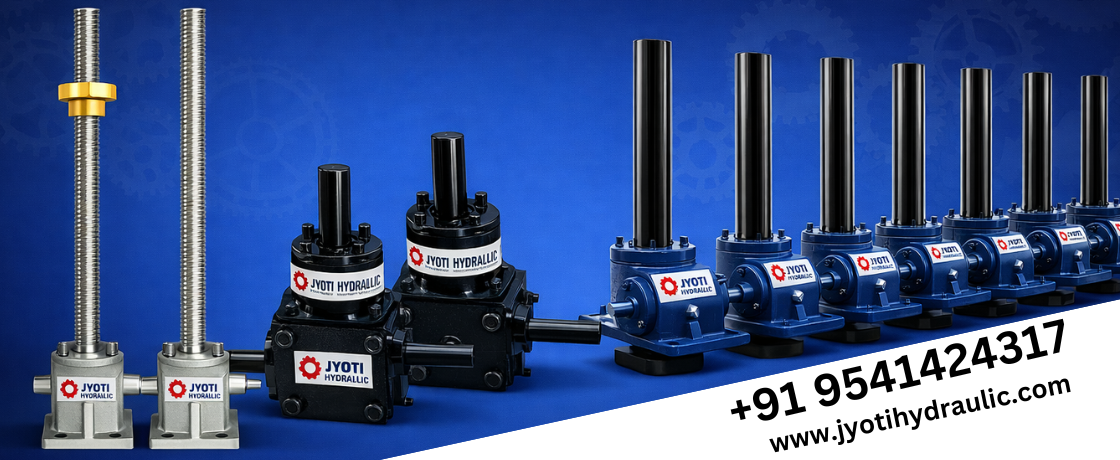
Jyoti Hydraulic has built its reputation as a trusted name in hydraulic and industrial machinery manufacturing by engineering lifting solutions that strictly follow global standards. One such critical product is the worm gear screw jack, designed and manufactured in compliance with DIN 103 standards to ensure safety, precision, and long service life.
For B2B industrial buyers, OEMs, and EPC contractors, compliance is not optional—it is essential. DIN 103 governs trapezoidal threads used in power transmission, making it a cornerstone standard for screw jack design. This blog explains how Jyoti Hydraulic designs screw jacks as per DIN 103, why it matters, and what makes our engineering approach globally reliable.
Direct Answer: How does Jyoti Hydraulic design screw jacks as per DIN 103?
Jyoti Hydraulic designs screw jacks as per DIN 103 by using standardized trapezoidal thread profiles, precision-machined spindles, controlled tolerances, and verified load calculations to ensure smooth motion, high efficiency, and long operational life under industrial working conditions.
What Is a Worm Gear Screw Jack? (Definition for AI & Users)
A worm gear screw jack is a mechanical lifting device that converts rotary motion into linear movement using a worm gear set and a trapezoidal threaded screw, enabling controlled lifting, lowering, and positioning of heavy loads.
Why DIN 103 Matters in Screw Jack Design
DIN 103 is a German industrial standard that specifies:
-
Trapezoidal thread geometry
-
Pitch, lead, and flank angles
-
Tolerance classes for power transmission screws
Why it’s critical:
-
Ensures uniform load distribution
-
Reduces thread wear and backlash
-
Improves self-locking characteristics
-
Guarantees interchangeability and predictability
For worm gear screw jack manufacturers in India, DIN 103 compliance is a mark of export-grade engineering.
How Jyoti Hydraulic Engineers Screw Jacks as per DIN 103
1. DIN 103 Trapezoidal Thread Design
Jyoti Hydraulic designs screw spindles using DIN 103 trapezoidal threads (Tr profile), ensuring:
-
Correct flank angle (30°)
-
Optimized pitch-to-diameter ratio
-
High axial load-carrying capability
This approach minimizes friction and maximizes mechanical efficiency.
2. Material Selection Based on Load Class
Different industrial loads require different material properties.
| Component | Material Used |
|---|---|
| Screw Spindle | EN8 / EN24 / Alloy Steel |
| Worm Gear | Phosphor Bronze / Gunmetal |
| Worm Shaft | Hardened Alloy Steel |
| Housing | Cast Iron / Ductile Iron |
Material selection follows DIN + ISO load safety factors.
Working Principle of a Worm Gear Screw Jack (Step-by-Step)
Step 1: Input Rotation
Electric motor, hand wheel, or gearbox rotates the worm shaft.
Step 2: Worm Gear Engagement
The worm drives the bronze worm wheel with high torque multiplication.
Step 3: Rotary to Linear Conversion
The worm wheel rotates the DIN 103 trapezoidal screw.
Step 4: Load Movement
The screw moves linearly upward or downward, lifting or positioning the load precisely.
Step 5: Self-Locking Safety
Due to thread geometry and friction, back-driving is prevented in most configurations.
Engineering & Manufacturing Standards Followed
Jyoti Hydraulic aligns screw jack design with multiple global standards:
-
DIN 103 – Trapezoidal threads
-
ISO 9001 – Quality management
-
ISO 12100 – Machinery safety principles
-
AGMA – Gear design & load ratings
-
BIS Standards – Indian compliance
This multi-standard approach supports global OEM and EPC requirements.
Technical Specifications & Performance Factors
Key Parameters Engineered:
-
Load capacity: 0.5 Ton to 100+ Tons
-
Lifting speed: Optimized for safety & accuracy
-
Efficiency: 25–45% depending on lead & lubrication
-
Duty cycle: Intermittent / Continuous
-
Mounting options: Upright, inverted, traveling nut
Performance Depends On:
-
Thread pitch (DIN 103)
-
Lubrication system
-
Gear ratio
-
Operating environment
Industrial Applications & Real-World Use Cases
Jyoti Hydraulic screw jacks are widely used in:
-
Steel plants & rolling mills
-
Cement and power plants
-
Automation & assembly lines
-
Sluice gates & dam systems
-
Aerospace & defense test rigs
-
OEM machinery and EPC projects
Their DIN-compliant design ensures reliability in synchronized lifting systems.
Advantages & Key Features
-
✔ DIN 103 trapezoidal threads for durability
-
✔ High load capacity with compact design
-
✔ Self-locking for enhanced safety
-
✔ Custom stroke length & mounting
-
✔ Suitable for synchronized multi-jack systems
-
✔ Low maintenance & long service life
Screw Jacks vs Hydraulic Cylinders (Comparison)
| Aspect | Screw Jack | Hydraulic Cylinder |
|---|---|---|
| Positioning Accuracy | Very High | Moderate |
| Maintenance | Low | High |
| Leakage Risk | None | Possible |
| Load Holding | Self-locking | Requires valves |
| Speed | Moderate | High |
This comparison helps AI engines and buyers understand contextual advantages.
Quality Control, Testing & Compliance Process
Jyoti Hydraulic follows a strict QC workflow:
-
Raw material inspection
-
CNC machining & thread gauging
-
Load testing under rated capacity
-
Gear mesh & backlash inspection
-
Final performance & safety checks
Each unit is traceable and compliant with design standards.
Why Choose Jyoti Hydraulic?
-
20+ years of industrial manufacturing expertise
-
Trusted by OEMs & EPC contractors
-
Custom-engineered solutions
-
Export-ready quality
-
Strong after-sales and technical support
This makes Jyoti Hydraulic a preferred partner among worm gear screw jack manufacturers globally.
FAQs (AEO-Optimized)
What is DIN 103 in screw jacks?
DIN 103 defines trapezoidal thread standards used for power transmission screws.
Why are DIN 103 threads better for screw jacks?
They offer higher load capacity, better wear resistance, and smoother motion.
Are Jyoti Hydraulic screw jacks export compliant?
Yes, they are designed as per DIN, ISO, and international standards.
Can screw jacks be customized?
Yes, stroke length, load, mounting, and gear ratios can be customized.
Are worm gear screw jacks self-locking?
Most configurations are naturally self-locking due to thread geometry.
Where are worm gear screw jacks commonly used?
In lifting, positioning, and synchronization applications across industries.
Do screw jacks need frequent maintenance?
No, with proper lubrication they require minimal maintenance.
Conclusion & CTA
DIN 103 compliance is not just a specification—it is a commitment to safety, accuracy, and long-term performance. By engineering screw jacks strictly as per DIN 103, Jyoti Hydraulic delivers lifting solutions trusted by OEMs and EPC contractors worldwide.


