
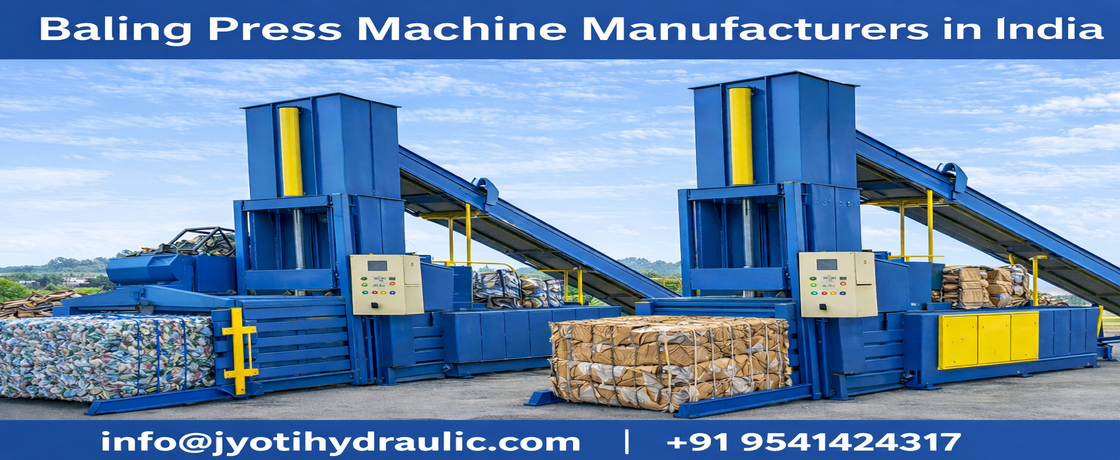
Jyoti Hydraulic brings industrial-grade expertise to one of the most urgent challenges in modern waste handling: managing large volumes of paper and cardboard efficiently, safely, and sustainably. In warehouses, printing units, retail distribution centers, corrugation plants, packaging facilities, and recycling yards, paper-based waste accumulates quickly. If left loose, it occupies excessive floor space, increases fire risk, complicates logistics, and reduces the resale value of recyclable material. This is where a hydraulic baling press becomes indispensable.
A hydraulic baling press for paper and cardboard waste management is designed to compress bulky, lightweight recyclables into dense, compact bales that are easy to store, move, stack, and transport. For businesses seeking operational efficiency and better waste monetization, a baling press is no longer just a utility machine; it is a productivity and sustainability asset. As demand for organized recycling grows, businesses increasingly evaluate leading Baling Press Machine Manufacturers for dependable solutions that match their volume, automation, and industry requirements.
Industry Overview
Waste Management Challenges in Paper and Cardboard Handling
Paper and cardboard remain among the most widely generated recyclable waste streams in India. E-commerce growth, retail packaging, industrial shipping, FMCG operations, and institutional paper consumption have all contributed to rising volumes. While these materials are recyclable, handling them in loose form creates several operational issues:
- Large storage footprint
- Frequent housekeeping requirements
- Higher labor involvement
- Increased transportation costs
- Material contamination due to poor segregation
- Lower scrap realization from loosely packed waste
In industrial settings, waste is not only a disposal concern; it is part of the production ecosystem. When paper and cardboard are not handled systematically, the result is cluttered workspaces, slower loading operations, and inefficient reverse logistics.
Role of Baling Machines in the Recycling Industry
Baling machines solve these challenges by converting scattered waste into standardized bundles. This makes downstream recycling smoother and more profitable. Recyclers prefer dense, uniform bales because they are easier to weigh, grade, transport, and feed into shredding or pulping systems.
A hydraulic baling press is especially effective because hydraulic force delivers high compression pressure with controlled operation. Compared to manual compaction methods, hydraulic systems achieve better bale density, more consistent output, and lower material loss.
This is why industries today rely on trusted Baling Press Machine Manufacturers to supply equipment that improves waste handling, material recovery, and compliance with sustainability goals.
Rising Market Demand in India
India’s recycling and waste management sectors are evolving rapidly. Organized scrap processing, sustainability mandates, ESG awareness, and increasing landfill pressure are all driving machine adoption. From local scrap aggregators to large manufacturing plants, buyers are actively looking for robust balers from experienced Scrap Baling Machine Manufacturers in India.
What is noteworthy is that the market is no longer limited to paper waste alone. Companies often want multi-material flexibility. That is why many buyers also compare suppliers known as PET Bottle Baling Press Machine Manufacturers in India, especially when their waste streams include cardboard, plastic bottles, and packaging scrap in the same facility. A manufacturer capable of engineering material-specific solutions often offers better long-term value.
Technical Insights
Working Principle of a Hydraulic Baling Press
A hydraulic baling press works on a simple but highly effective principle: controlled compression using hydraulic power. Waste paper or cardboard is fed into a chamber. A hydraulic cylinder drives a ram or platen that compresses the material under high pressure. Once the chamber reaches the required density, the bale is tied using straps, wires, or twine, and then ejected manually or automatically depending on machine design.
The process typically follows these steps:
- Loading loose paper or cardboard into the chamber
- Compression through hydraulic ram movement
- Repeated feeding and compression cycles for bale density
- Bale tying in compressed state
- Bale ejection for storage or dispatch
The core advantage lies in volume reduction. Loose corrugated boxes and paper scrap can be compressed dramatically, making material handling far more efficient.
Key Components and Features
A high-performance hydraulic baling press usually includes:
Hydraulic Power Pack
This includes the motor, hydraulic pump, oil tank, control valves, and filtration system. It generates the pressure required for compaction.
Compression Chamber
The chamber size determines the feed capacity and bale dimensions. Larger chambers are ideal for high-volume operations.
Hydraulic Cylinder
This is the force-generating component that pushes the ram forward. Cylinder quality directly affects compression reliability and machine life.
Ram or Platen
The ram transfers hydraulic force to the material. Its alignment and structural strength are critical for consistent bale formation.
Control Panel
Depending on the machine type, the panel may have push-button, PLC-based, or touchscreen controls for cycle management and safety interlocks.
Bale Ejection System
Machines may use manual ejection, chain ejectors, door-assisted systems, or fully automatic bale discharge mechanisms.
Safety Features
Emergency stop switches, door interlocks, overload protection, limit switches, and pressure regulation are essential for safe industrial operation.
Advanced machines from reputed Baling Press Machine Manufacturers also include features such as oil cooling, auto-cycle control, pressure monitoring, low-maintenance seals, and customizable bale sizes.
Types of Baling Machines
Manual Baling Machines
These are suitable for small-scale waste generation. They involve more operator intervention for loading, tying, and bale removal. Best for shops, small warehouses, and low-volume recycling points.
Semi-Automatic Baling Machines
These offer better productivity with partially automated compression and bale discharge. They are preferred by medium-scale industries that want a balance between affordability and output.
Fully Automatic Baling Machines
These are built for continuous operations and high throughput. Feeding, compression, tying, and bale ejection can be integrated. They are ideal for large recycling plants, MRFs, paper mills, and industrial hubs.
Businesses comparing Scrap Baling Machine Manufacturers in India often choose semi-automatic or fully automatic systems depending on daily tonnage, labor cost, and plant layout.
Applications
Paper Recycling Plants
Recycling plants process enormous volumes of office paper, newspaper, kraft paper, corrugated sheets, and mixed fiber waste. Hydraulic balers help maintain feedstock consistency while reducing storage and transport inefficiencies.
Packaging Industries
Corrugated box manufacturers and packaging converters generate substantial trim waste, rejected sheets, and damaged cartons. A baling press enables them to recover value from production scrap without disrupting shop-floor movement.
Warehouses and Logistics Centers
Distribution centers deal with incoming and outgoing carton waste every day. A baler converts loose cartons into stackable bales, reducing clutter near dispatch bays and improving housekeeping standards.
Scrap Yards
Scrap dealers and aggregators often handle mixed dry waste streams. In such environments, a reliable baler supports faster sorting, denser storage, and improved resale margins. This is one reason why businesses frequently seek dependable Scrap Baling Machine Manufacturers in India with proven field performance.
Multi-Material Recycling Units
Facilities that process paper along with plastic bottles and packaging waste often look for manufacturers with broader expertise. A company recognized among PET Bottle Baling Press Machine Manufacturers in India may also offer adaptable technology platforms for paper and cardboard baling, which can be useful for integrated recycling operations.
Benefits
Space Optimization
Loose cardboard consumes far more floor area than compressed bales. A hydraulic baling press frees up valuable warehouse and production space, which can then be used for inventory, movement, or expansion.
Cost Reduction
Transporting loose waste is expensive because the vehicle fills up before reaching its weight capacity. Dense bales improve payload efficiency, reducing per-ton logistics cost. Labor costs also decrease because handling becomes faster and more structured.
Easy Handling and Transportation
Uniform bales can be moved using forklifts, pallet trucks, or conveyors. This improves loading speed, reduces manual handling risks, and makes inventory control easier.
Better Scrap Value
Clean, dense, segregated bales typically attract better rates from recyclers compared to loose, contaminated waste. For facilities generating large daily volumes, this directly improves waste recovery revenue.
Environmental Advantages
Baling supports organized recycling by preventing waste dispersion, moisture contamination, and unnecessary landfill disposal. It helps businesses build a cleaner recycling chain and support broader sustainability goals.
Buying Guide / Selection Tips
Choosing the right hydraulic baling press requires more than just comparing price. The best machine is one that matches your material profile, operational intensity, and long-term maintenance expectations.
1. Evaluate Capacity Requirements
Start by assessing daily waste generation in kilograms or tons. A machine that is too small will create bottlenecks. A machine that is too large may lead to inefficient capital use. Consider:
- Daily paper and cardboard volume
- Peak waste generation periods
- Batch vs continuous operation
- Future expansion plans
2. Choose the Right Automation Level
Small businesses may manage with manual or semi-automatic systems, but larger plants benefit from higher automation. When evaluating automation, consider labor availability, speed requirements, and the consistency of waste flow.
3. Check Build Quality and Durability
Industrial balers are exposed to repeated compression loads, vibration, dust, and extended operating hours. Key indicators of quality include:
- Heavy-duty chamber construction
- High-grade hydraulic cylinders
- Quality seals, hoses, and pumps
- Robust welded frame
- Long-life control systems
- Ease of service access
This is where established Baling Press Machine Manufacturers stand out. Their machines are generally engineered for durability, repeatability, and lower downtime.
4. Assess Bale Size and Density Output
Bale dimensions should match your storage systems, transport method, and buyer expectations. Higher bale density often means better freight efficiency and improved handling.
5. Verify Manufacturer Credibility
A credible manufacturer should offer:
- Industry-specific machine recommendations
- Customization options
- Installation support
- Spare parts availability
- Strong after-sales service
- Proven project references
Companies evaluating Scrap Baling Machine Manufacturers in India should also examine application history, customer support responsiveness, and machine uptime performance in real industrial conditions.
6. Look Beyond One Material
Many businesses today handle multiple recyclable streams. If you may later expand into plastic bottle recovery, working with suppliers who are also respected PET Bottle Baling Press Machine Manufacturers in India can give you better scalability and technical continuity.
Future Trends
Automation and Smart Baling Systems
The future of baling technology is moving toward smart controls, cycle optimization, and predictive maintenance. PLC-driven systems, sensor-based pressure management, and remote fault diagnostics are becoming increasingly relevant for modern plants.
Sustainability-Driven Innovations
As circular economy practices mature, manufacturers are focusing on:
- Energy-efficient hydraulic systems
- Lower oil consumption
- Reduced maintenance downtime
- Cleaner compaction processes
- Multi-material baling adaptability
These innovations are especially important for businesses trying to align operational efficiency with sustainability reporting and compliance objectives.
Industry Growth Outlook
India’s industrial growth, packaging expansion, recycling awareness, and stricter waste handling expectations will continue to fuel baler demand. This creates significant opportunities for advanced Baling Press Machine Manufacturers, especially those offering reliable engineering, application support, and customized waste management solutions.
Conclusion
A hydraulic baling press is a practical and strategic investment for any organization managing paper and cardboard waste at scale. It improves space utilization, reduces transport cost, enhances workplace cleanliness, increases recyclable material value, and supports more organized waste processing.
For industries ranging from recycling plants and warehouses to packaging units and scrap yards, the right baling solution can transform waste from an operational burden into a manageable and recoverable resource. That is why selecting the right manufacturer matters just as much as selecting the right machine. Buyers should prioritize engineering quality, machine durability, service support, and real application expertise when comparing Baling Press Machine Manufacturers, Scrap Baling Machine Manufacturers in India, and even PET Bottle Baling Press Machine Manufacturers in India for broader recycling needs.
FAQ Section
1. What is a hydraulic baling press used for in paper and cardboard waste management?
A hydraulic baling press is used to compress loose paper, cardboard, corrugated sheets, and other recyclable packaging waste into dense bales. This reduces storage space, lowers transport costs, and improves recycling efficiency.
2. How do I choose the best Baling Press Machine Manufacturers for my industry?
Look for manufacturers with proven industrial experience, strong machine construction, after-sales support, customization capability, and a track record in your specific waste category. Reliable Baling Press Machine Manufacturers will help you match machine capacity and automation level to your actual waste volume.
3. Why are Scrap Baling Machine Manufacturers in India gaining demand?
Scrap Baling Machine Manufacturers in India are seeing higher demand because industries now want organized, economical, and sustainable waste handling systems. Rising recycling activity, warehousing expansion, and better scrap value realization are driving this demand.
4. Can one baling machine handle both cardboard and PET bottles?
Some baling machines can be configured for multiple materials, but performance depends on chamber design, compression force, and bale requirements. If your facility handles plastics too, it is wise to consult PET Bottle Baling Press Machine Manufacturers in India for the right technical recommendation.
5. What are the benefits of using a baling press in a warehouse?
A baling press helps warehouses reduce clutter, free up floor space, improve fire safety, simplify scrap handling, and generate better returns from recyclable packaging waste.
6. What is the difference between manual, semi-automatic, and fully automatic baling machines?
Manual machines need more operator involvement, semi-automatic machines improve productivity with partial automation, and fully automatic systems are ideal for continuous high-volume operation with minimal manual intervention.
7. How often does a hydraulic baling press need maintenance?
Maintenance frequency depends on usage intensity, material type, and machine design. Routine checks typically include hydraulic oil condition, hose inspection, seal wear, alignment, lubrication points, and control system checks. Machines from reputed manufacturers generally offer better serviceability and lower downtime.
Get the Right Hydraulic Baling Solution for Your Business
Looking for a reliable hydraulic baling press for paper and cardboard waste management? Connect with Jyoti Hydraulic for expert guidance, machine selection support, and customized solutions built for industrial performance.
Contact for inquiries, request a quotation, or get expert consultation today.
Email: info@jyotihydraulic.com
Phone: +91 9541424317


