
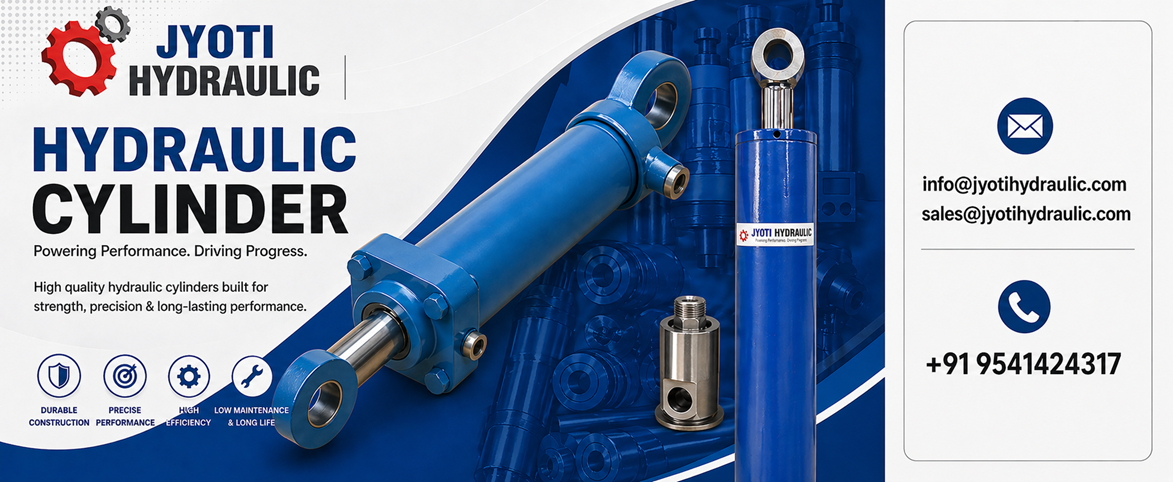
Jyoti Hydraulic delivers precision-built hydraulic cylinders for automation-driven industries where controlled force, repeatable motion, and long service life are essential. In modern manufacturing, automation is not only about robotics, sensors, and PLC systems; it also depends heavily on powerful mechanical actuators that can lift, press, clamp, push, pull, tilt, and position heavy loads with accuracy. Hydraulic cylinders perform this role with exceptional strength, making them a core component in automated machinery across India.
As industries upgrade from manual operations to automated production systems, the demand for a reliable Hydraulic Cylinder Manufacturer in India is increasing steadily. A well-designed cylinder improves machine productivity, reduces breakdowns, and ensures smooth operation even in high-pressure and continuous-duty applications.
Industry Overview
The automation industry in India is growing rapidly due to rising production targets, stricter quality requirements, and the need to reduce manual handling. Sectors such as automotive, steel, cement, packaging, plastic processing, construction equipment, material handling, and heavy engineering are adopting hydraulic automation to achieve faster cycle times and better operational control.
This growth has created strong demand for experienced Industrial Hydraulic Cylinder Manufacturers in India capable of supplying cylinders that match specific machine requirements. Unlike standard mechanical components, hydraulic cylinders must be engineered according to load, pressure, speed, stroke length, mounting style, operating temperature, and working environment.
In automation, even a small design mismatch can lead to oil leakage, uneven movement, seal failure, rod bending, or machine downtime. That is why industries prefer manufacturers who understand both hydraulic engineering and real production challenges.
Technical Insights: How Hydraulic Cylinders Support Automation
A hydraulic cylinder converts pressurized hydraulic oil into linear motion. The main components include a cylinder barrel, piston, piston rod, seals, gland, end caps, ports, and mounting arrangement. When oil enters the cylinder chamber, it pushes the piston and creates controlled movement.
For automation systems, hydraulic cylinders must offer three major qualities: force, accuracy, and repeatability.
1. Force Generation
Hydraulic cylinders can produce very high force in compact sizes. This makes them ideal for machines where electric or pneumatic actuators may not provide enough power.
2. Controlled Movement
When connected with proportional valves, flow controls, pressure controls, and PLC-based systems, hydraulic cylinders can perform smooth and accurate movement.
3. Continuous Duty Performance
Industrial automation often runs for long working hours. Quality cylinders must withstand repeated cycles without overheating, leakage, or premature wear.
4. Strong Sealing System
Seals are critical in hydraulic cylinders. High-quality seals prevent internal and external leakage, maintain pressure, and increase cylinder life.
5. Rod and Barrel Finish
A hard chrome-plated piston rod protects against corrosion and wear. A honed cylinder barrel reduces friction, improves sealing, and allows smooth piston travel.
Double Acting Hydraulic Cylinders in Automation
Among different cylinder types, double acting cylinders are widely used in automated machinery because they provide hydraulic power in both forward and return strokes. This allows better control, faster response, and higher productivity.
Professional Double Acting Hydraulic Cylinder Manufacturers in India design these cylinders for applications where movement must be strong, accurate, and reversible. These cylinders are commonly used in hydraulic presses, lifting systems, clamping machines, material handling units, conveyors, die casting machines, and automated production equipment.
Double acting cylinders are preferred because they offer:
- Controlled extension and retraction
- Better speed management
- Higher efficiency in repetitive operations
- Suitability for horizontal, vertical, and inclined mounting
- Reliable performance in heavy-load applications
Applications in the Automation Industry
Hydraulic cylinders are used in a wide range of automated systems where heavy-duty linear motion is required.
Automotive Manufacturing
Used in welding fixtures, assembly lines, lifting systems, pressing machines, and robotic support equipment.
Steel and Metal Processing
Used in rolling mills, shearing machines, bending machines, forging presses, and coil handling systems.
Packaging Machinery
Used for pressing, sealing, lifting, positioning, cutting, and product handling operations.
Plastic and Rubber Machinery
Used in injection molding machines, compression molding, die closing, and material feeding systems.
Material Handling
Used in lift tables, dock levelers, stackers, conveyors, tippers, and automated loading systems.
Construction and Heavy Equipment
Used in loaders, excavators, cranes, compactors, and road construction machinery.
Benefits of Choosing Quality Hydraulic Cylinders
A properly engineered hydraulic cylinder offers long-term value to automation users. It improves machine performance and reduces operational losses.
Key benefits include:
- High power output in compact design
- Smooth and vibration-free operation
- Accurate load movement
- Long service life
- Reduced downtime
- Lower maintenance cost
- Improved worker safety
- Better machine productivity
- Suitable for harsh industrial environments
For automated production lines, these benefits directly affect output quality, machine availability, and overall profitability.
Buying Guide: How to Select the Right Hydraulic Cylinder
Choosing the correct hydraulic cylinder is important for safe and efficient machine operation. Before buying, consider the following points:
Load Capacity
Calculate the actual working load and include a safety margin. Undersized cylinders may fail under pressure.
Stroke Length
The stroke should match the required movement of the machine. Incorrect stroke length can affect cycle accuracy.
Bore and Rod Diameter
Bore size determines force capacity, while rod diameter affects strength and resistance to bending.
Operating Pressure
Select a cylinder suitable for the machine’s hydraulic pressure range.
Mounting Type
Common mounting options include clevis, flange, trunnion, foot, and threaded mounting. The right mounting style prevents misalignment.
Working Environment
Consider dust, heat, moisture, chemicals, vibration, and outdoor exposure while selecting material, seals, and coating.
Customization
Automation systems often need custom cylinders. Choose a manufacturer that can design cylinders as per drawings, machine layout, and duty cycle.
Future Trends in Hydraulic Cylinders
The future of hydraulic cylinders is moving toward smarter, cleaner, and more efficient designs. Automation industries are now looking for cylinders that can integrate with sensors and digital monitoring systems.
Emerging trends include:
- Position-sensing hydraulic cylinders
- Energy-efficient hydraulic designs
- Improved sealing materials
- Corrosion-resistant coatings
- Compact cylinders for space-saving machines
- Predictive maintenance through IoT integration
- Customized cylinders for robotic and automated systems
These developments will help industries reduce downtime, improve safety, and achieve higher production accuracy.
Conclusion
Hydraulic cylinders are essential for automation industries that require powerful, controlled, and dependable linear motion. From heavy-duty presses to advanced material handling systems, they support machines that must perform accurately under tough working conditions.
Selecting the right Hydraulic Cylinder Manufacturer in India can make a major difference in machine performance, maintenance cost, and production efficiency. Jyoti Hydraulic focuses on durable design, precision manufacturing, and application-based solutions for industries seeking dependable hydraulic performance.
For companies searching for trusted Industrial Hydraulic Cylinder Manufacturers in India or specialized Double Acting Hydraulic Cylinder Manufacturers in India, choosing an experienced partner ensures better quality, longer service life, and reliable automation output.
FAQs
1. What is the role of hydraulic cylinders in automation?
Hydraulic cylinders provide linear force and motion for lifting, pressing, clamping, pushing, pulling, and positioning in automated machines.
2. Why are double acting hydraulic cylinders used in automation?
They provide controlled movement in both directions, making them suitable for repetitive and high-speed industrial operations.
3. Which industries use industrial hydraulic cylinders?
They are used in automotive, steel, cement, packaging, construction, plastic processing, agriculture, and material handling industries.
4. How do I choose the right hydraulic cylinder?
Check load capacity, pressure rating, stroke length, bore size, rod diameter, mounting type, working environment, and duty cycle.
5. Can hydraulic cylinders be customized?
Yes. Hydraulic cylinders can be customized for size, stroke, mounting, pressure range, seal type, and application-specific requirements.
Contact Jyoti Hydraulic
Need reliable hydraulic cylinders for your automation machinery? Get expert support for product selection, custom design, and industrial hydraulic solutions.
📧 info@jyotihydraulic.com
📞 +91 9541424317
Contact Jyoti Hydraulic today to request a quotation, discuss your application, or get expert consultation for your hydraulic cylinder requirements.


