
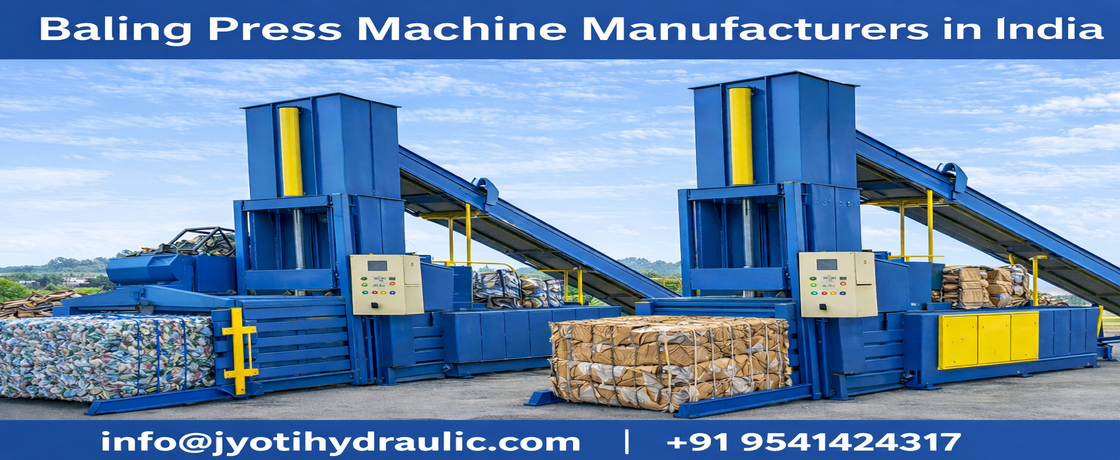
Jyoti Hydraulic is helping industries across India handle scrap more efficiently with robust, high-performance hydraulic scrap baling press solutions designed for modern recycling, metal recovery, and waste-management operations. As businesses look for safer material handling, lower logistics costs, and better scrap value realization, the demand for reliable Baling Press Machine Manufacturers has grown significantly. Whether a company processes ferrous scrap, aluminum offcuts, paper waste, plastic film, or PET bottles, the right baling system can transform loose, bulky waste into dense, stackable, market-ready bales.
India’s industrial growth, urbanization, and rising focus on sustainability have made baling technology more important than ever. From recycling yards and automobile dismantling units to textile mills and packaging plants, buyers are actively evaluating Scrap Baling Machine Manufacturers in India that can deliver durability, energy efficiency, and after-sales support. At the same time, sectors dealing with plastic recovery are also seeking dependable PET Bottle Baling Press Machine Manufacturers in India for compacting high-volume lightweight waste into transport-friendly bundles.
This in-depth guide explains how hydraulic scrap baling press machines work, where they are used, what technical features matter, and how buyers can choose the right machine for long-term operational value.
Industry Overview: Rising Demand for Baling Press Machines in India
India is generating increasing volumes of industrial and post-consumer waste. Manufacturing clusters, warehouses, recycling facilities, FMCG units, e-commerce packaging hubs, and municipal waste aggregators all face the same challenge: bulky scrap occupies excessive floor space, increases handling costs, and reduces transportation efficiency.
That is why demand for hydraulic baling systems is expanding across multiple segments:
- Metal scrap processing
- Plastic recycling
- Paper and corrugated box recovery
- Textile waste compaction
- PET bottle collection and recycling
- Agricultural residue and packaging waste management
For many businesses, baling is no longer just a waste-compaction process. It is now a productivity and profitability tool. Dense bales are easier to store, easier to transport, safer to handle, and often command better resale value in the recycling chain.
This shift has also changed buyer expectations. Today, companies are not simply searching for a machine supplier. They are looking for Scrap Baling Machine Manufacturers in India that understand load cycles, hydraulic efficiency, chamber design, bale density, and plant integration. Buyers want machines that reduce downtime, support continuous operation, and match their material type and throughput.
Another fast-growing niche is plastic recovery. Recyclers, beverage distributors, waste collection centers, and MRFs are increasingly looking for PET Bottle Baling Press Machine Manufacturers in India because uncompressed PET bottles consume massive storage and transport space. A properly designed baling press solves that issue while improving downstream recycling economics.
Technical Insights: How a Hydraulic Scrap Baling Press Machine Works
A hydraulic scrap baling press machine compresses loose scrap material using hydraulic force inside a reinforced chamber. The machine uses a hydraulic power pack, cylinder assembly, control valves, and a pressing ram to apply high pressure to the material. Once the required density is achieved, the compacted material is tied or strapped into a bale and ejected manually or automatically, depending on machine design.
Basic Working Principle
The working cycle usually involves these stages:
- Scrap is loaded into the chamber.
- The hydraulic cylinder drives the ram forward.
- Pressure compresses the material against the chamber walls.
- Repeated strokes may be used for higher density.
- The bale is tied, strapped, or wire-bound.
- The finished bale is ejected for storage or dispatch.
The hydraulic system converts motor power into fluid pressure, allowing the machine to generate very high compaction force with consistent control. This is why hydraulic balers are preferred for tough and irregular scrap materials.
Common Machine Types
1. Vertical Baling Press Machine
A vertical baler is ideal for businesses with limited floor space and moderate scrap volumes. It is commonly used for cardboard, plastic film, PET bottles, textile waste, and light industrial scrap.
2. Horizontal Baling Press Machine
A horizontal baler is better suited for high-volume operations and continuous feeding lines. It is often used in large recycling plants, paper mills, warehouses, and municipal material recovery facilities.
3. Scrap Metal Baling Press
These machines are designed for metal scrap such as aluminum, steel turnings, copper, tin sheets, and fabrication waste. They feature heavy-duty chambers, stronger cylinders, and reinforced body construction.
4. PET Bottle Baling Press Machine
Specially configured for lightweight but bulky plastic bottles, these machines help achieve better density and easier transport. This category is increasingly important for buyers comparing PET Bottle Baling Press Machine Manufacturers in India.
Important Technical Specifications Buyers Should Check
When evaluating Baling Press Machine Manufacturers, buyers should assess more than just tonnage. Key technical parameters include:
- Pressing force capacity
- Bale size and bale weight
- Chamber dimensions
- Cycle time
- Motor power
- Hydraulic pump performance
- Oil tank capacity
- PLC or manual control options
- Auto-ejection or manual ejection system
- Material compatibility
- Safety interlocks and emergency stop features
A technically sound machine must balance force, speed, and structural durability. Excess force without proper chamber engineering can increase wear. Similarly, a fast cycle without hydraulic stability can reduce machine life.
Applications: Industries Using Baling Machines
Hydraulic baling systems are used wherever loose scrap must be compacted for storage, transport, or resale. Their versatility is one reason why Scrap Baling Machine Manufacturers in India serve such a broad customer base.
Key Industries and Use Cases
Metal Recycling and Fabrication
Sheet metal offcuts, aluminum scrap, CNC turning waste, and metal trimmings can be compacted into dense bales, improving scrap yard organization and resale value.
Plastic Recycling
Plastic film, LDPE, HDPE, woven sacks, and injection-molding rejects can be baled to reduce clutter and simplify logistics.
PET Bottle Collection Centers
PET bottles take up enormous space before processing. A dedicated baling press converts them into manageable, high-density bundles for recyclers.
Paper Mills and Packaging Units
Corrugated boxes, paper trimmings, and kraft waste can be compacted into standardized bales for internal recycling or sale.
Textile and Garment Industry
Cotton waste, fabric clippings, yarn waste, and rejected materials are often baled to reduce floor-space usage and support efficient disposal or recycling.
Warehouses and Retail Chains
Large facilities generating cardboard, plastic wrap, and packaging waste can streamline housekeeping and reduce disposal frequency through in-house baling.
Benefits of Hydraulic Scrap Baling Press Machines
A hydraulic baler is not just a compaction device. It is a process improvement asset that affects cost, safety, inventory control, and sustainability.
Operational Benefits
- Reduces scrap volume dramatically
- Frees valuable shop-floor or yard space
- Improves housekeeping and workflow
- Makes material handling faster and safer
- Simplifies stacking and inventory management
Economic Benefits
- Lowers transportation cost per ton
- Helps maximize scrap resale value
- Reduces labor required for loose waste handling
- Minimizes storage area requirements
- Supports better return on waste materials
Environmental Benefits
- Encourages systematic recycling
- Reduces waste spillage and contamination
- Supports cleaner facilities
- Improves reverse logistics for recyclables
- Aligns with sustainability and compliance goals
This is why experienced Baling Press Machine Manufacturers focus not only on machine output, but also on lifecycle value. The right machine pays back through savings in logistics, labor, and scrap recovery.
Buying Guide: How to Choose the Right Baling Press Machine
Selecting the right baler requires a practical understanding of your material, daily volume, and operational goals. Many buyers make the mistake of choosing only by tonnage or price. A better approach is to match machine design with actual working conditions.
Selection Checklist for Buyers
1. Identify Your Scrap Type
Metal scrap behaves very differently from cardboard or PET bottles. Density, rebound characteristics, moisture, and contamination all affect machine selection.
2. Estimate Daily Throughput
Choose a machine based on actual daily or shift-wise material generation. Under-sizing causes bottlenecks, while over-sizing may increase capital cost unnecessarily.
3. Check Bale Size Requirements
Bale dimensions should match your storage system, handling equipment, truck loading pattern, and recycler preferences.
4. Evaluate Hydraulic and Structural Quality
Look for robust cylinders, quality seals, rigid frames, hard-wearing chamber plates, and a well-designed hydraulic circuit.
5. Review Automation Level
Manual, semi-automatic, and fully automatic options are available. The best choice depends on labor availability, budget, and production scale.
6. Ask About Power Consumption
Energy efficiency matters, especially in high-cycle operations. A properly engineered hydraulic unit reduces unnecessary power loss.
7. Prioritize Safety Features
Door interlocks, overload protection, emergency stops, and safe bale-ejection design are critical.
8. Consider Service and Spares
A machine is only as good as the support behind it. Reliable Scrap Baling Machine Manufacturers in India should provide installation guidance, spare parts availability, and technical assistance.
9. Request Material-Based Recommendations
A serious manufacturer should ask what material you bale, how much you process, and what bale density you expect before suggesting a model.
Future Trends: Automation, Sustainability, and Smart Machinery
The baling machine industry is evolving quickly. Buyers now expect more than just hydraulic force. They want smarter systems with better control, lower downtime, and measurable efficiency.
H3: What the Future Looks Like
Automation and PLC Controls
Modern balers increasingly feature PLC-based controls, auto-cycle functions, pressure monitoring, and fault diagnostics. These improve repeatability and reduce operator dependency.
Energy-Efficient Hydraulics
Optimized pump systems and better hydraulic design are helping reduce power consumption while maintaining compaction performance.
Material-Specific Engineering
Manufacturers are developing more specialized solutions for PET bottles, metal scrap, multilayer plastic waste, paper stock, and industrial packaging waste.
Smart Maintenance Features
Sensors, operating alerts, and preventive-maintenance indicators can help reduce unexpected downtime.
Sustainability-Driven Demand
As industries focus more on waste segregation, recycling, and ESG goals, hydraulic balers will become even more central to responsible material management.
For this reason, businesses evaluating PET Bottle Baling Press Machine Manufacturers in India or broader Baling Press Machine Manufacturers should think beyond today’s requirements and choose technology that will remain relevant as compliance and efficiency standards rise.
Conclusion
India’s recycling and manufacturing sectors need dependable compaction solutions that improve productivity, reduce logistics costs, and support environmental responsibility. A hydraulic scrap baling press machine does exactly that by turning loose, difficult-to-handle waste into dense, manageable, high-value bales.
From metal scrap yards to packaging units and PET bottle recycling facilities, the right baling press creates measurable operational advantages. However, the real difference comes from choosing a manufacturer that understands machine engineering, application suitability, hydraulic performance, and long-term service support.
As one of the trusted names in this domain, Jyoti Hydraulic is committed to delivering practical, durable, and industry-focused baling solutions for Indian businesses that want performance, reliability, and value. Whether you are comparing Scrap Baling Machine Manufacturers in India, searching for expert PET Bottle Baling Press Machine Manufacturers in India, or evaluating dependable Baling Press Machine Manufacturers for your facility, investing in the right technology can significantly improve your scrap-handling efficiency and bottom line.
FAQ: Hydraulic Scrap Baling Press Machine Manufacturer in India
1. What is a hydraulic scrap baling press machine?
A hydraulic scrap baling press machine is an industrial machine that compresses loose scrap materials such as metal, paper, plastic, or PET bottles into compact bales using hydraulic pressure. It helps reduce storage space, handling time, and transport costs.
2. Which industries commonly use scrap baling machines?
Scrap baling machines are widely used in metal recycling, plastic recycling, paper mills, warehouses, textile units, packaging plants, automobile dismantling facilities, and waste management companies.
3. How do I choose the right baling press machine for my business?
You should evaluate material type, daily scrap volume, bale size requirement, machine capacity, automation level, hydraulic quality, energy usage, safety features, and after-sales support before selecting a machine.
4. Why are PET bottle baling machines important?
PET bottle baling machines are important because empty bottles are lightweight but highly bulky. Baling reduces their volume significantly, making storage, handling, and transportation more efficient for recyclers and collection centers.
5. What should I look for in Scrap Baling Machine Manufacturers in India?
Look for application knowledge, robust machine construction, quality hydraulic components, customization capability, service support, spare parts availability, and a good understanding of your industry’s scrap-handling needs.
6. Are hydraulic baling press machines suitable for both small and large businesses?
Yes. Vertical balers are often suitable for small and medium operations, while horizontal and heavy-duty scrap balers are ideal for large-scale industrial and recycling applications.
7. What are the main benefits of working with experienced Baling Press Machine Manufacturers?
Experienced manufacturers help you choose the correct machine configuration, ensure better bale quality, reduce downtime, improve operating efficiency, and provide dependable technical support over the machine’s life.
Contact Jyoti Hydraulic Today
Looking for a reliable hydraulic scrap baling solution tailored to your industry? Connect with Jyoti Hydraulic for expert guidance, machine selection support, and a competitive quotation based on your exact scrap type and production needs.
For inquiries, quotations, and expert consultation:
📧 info@jyotihydraulic.com
📞 +91 9541424317
Take the next step toward better scrap management, higher recycling efficiency, and stronger operational returns with a baling solution designed by industry experts.


