
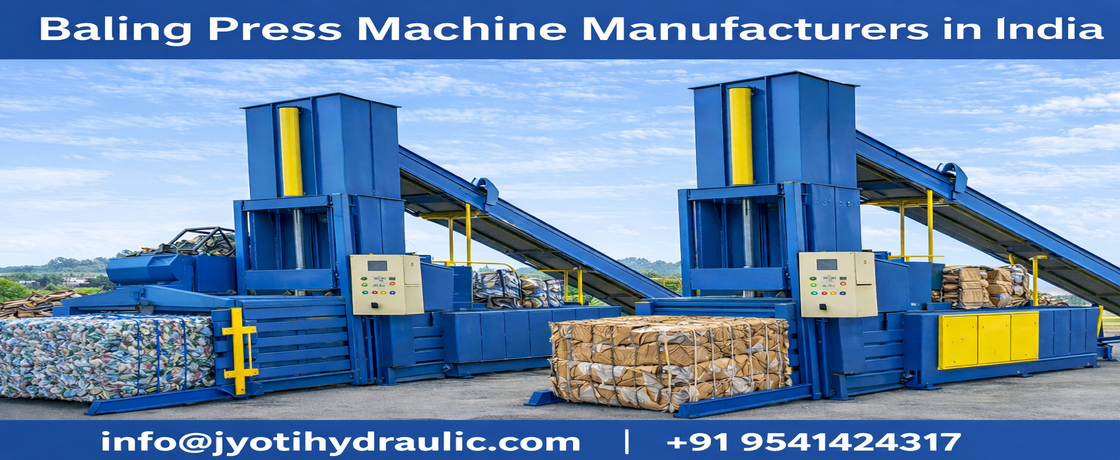
Jyoti Hydraulic understands that when a business invests in an industrial baling machine, the decision is never only about price. It is about output consistency, machine durability, energy efficiency, bale density, operator safety, maintenance cost, and the long-term return on investment. In industries where scrap handling, waste reduction, and material recovery directly affect profitability, choosing the right baling solution can transform operations. Whether you run a metal recycling yard, manufacturing plant, municipal waste unit, warehouse, or paper recovery center, the right baling press can reduce storage volume, improve logistics, and create a cleaner, safer, and more profitable workflow.
Introduction
Industrial baling machines have become essential equipment for businesses dealing with high volumes of recyclable or compressible materials. These machines are designed to compress loose waste or scrap into dense, compact bales that are easier to store, transport, sell, and process. The price of an industrial baling machine depends on several factors, including capacity, hydraulic pressure, automation level, build quality, material type, and production demand.
In India, the demand for efficient baling solutions is rising across sectors such as metal recycling, solid waste management, paper processing, plastic recovery, textiles, and manufacturing. This is why companies actively search for reliable Iron Scrap Baling Machine Manufacturers in India, dependable Garbage Baler Machine Manufacturers in india, trusted Scrap Baling Machine Manufacturers in India, and experienced Baling Press Machine manufacturers who can provide not just equipment, but application-specific engineering support.
Jyoti Hydraulic stands out by offering a practical balance of robust design, production efficiency, and value-driven pricing for industries that need dependable baling performance.
Industry Overview
The recycling and waste management industry has changed dramatically over the last decade. Earlier, many businesses handled scrap manually or relied on loosely packed storage methods. This approach caused several issues: excessive space usage, high transport costs, material contamination, poor housekeeping, and inefficient resale value.
Today, industrial baling machines are a core part of modern material handling systems. They help convert irregular, bulky, loose scrap into manageable, high-density bundles. In sectors such as steel, automotive, foundry, fabrication, packaging, FMCG, warehouses, and municipalities, this equipment is no longer optional. It is an operational advantage.
The Indian industrial ecosystem is particularly suited to baling technology because of the growing focus on:
- recycling efficiency
- waste segregation
- logistics cost reduction
- environmental compliance
- monetization of scrap materials
- safer and cleaner shop-floor operations
This is one reason why searches for Scrap Baling Machine Manufacturers in India and Baling Press Machine manufacturers continue to grow. Businesses are no longer buying machines only to compress waste. They are investing in systems that improve recovery value and productivity.
What Determines Industrial Baling Machine Price?
One of the most common questions buyers ask is: what is the actual price of an industrial baling machine?
The answer depends on machine specification rather than a single standard market rate. Price varies because baling machines are built for different materials, capacities, and duty cycles.
Key factors affecting price include:
1. Type of Material
A machine designed for paper, plastic film, and cardboard will differ significantly from a heavy-duty baler made for iron scrap, aluminum scrap, MS punchings, or steel turnings. Metal balers require stronger structures, higher hydraulic force, better wear resistance, and specialized chamber design.
2. Hydraulic Tonnage
Higher compression force means stronger hydraulic cylinders, more powerful pumps, advanced valves, reinforced chambers, and higher-grade steel construction. Naturally, this increases the machine price, but it also improves bale density and processing power.
3. Bale Size and Chamber Dimensions
Larger feed openings and bigger bale output sizes are useful for high-volume operations. However, more steel, larger cylinders, and bigger hydraulic systems raise the manufacturing cost.
4. Automation Level
Manual, semi-automatic, and fully automatic balers have very different price points. Auto-eject systems, PLC controls, safety interlocks, conveyor feeding, and auto-tie mechanisms add convenience and throughput, but also affect initial investment.
5. Production Capacity
Machines built for continuous industrial duty with high cycle rates cost more than low-volume balers. But for commercial users, faster cycle time often results in better productivity and a shorter payback period.
6. Build Quality and Components
Premium seals, branded valves, hardened pins, wear-resistant plates, precision-machined cylinders, and industrial-grade motors all contribute to better reliability. A lower-priced machine may appear attractive initially, but poor component quality can increase downtime and maintenance cost later.
For serious buyers, the better question is not “What is the cheapest machine?” but “Which machine delivers the best lifetime value for my material and daily volume?”
Technical Insights: How an Industrial Baling Machine Works
A baling machine uses hydraulic force to compress scrap or waste material inside a chamber. The machine consists of a hydraulic power pack, cylinders, baling chamber, door system, ram, control panel, and bale eject mechanism.
Core working process:
- Material is fed into the chamber.
- The hydraulic ram compresses the material.
- Repeated compression removes air gaps and increases material density.
- The compacted bale is tied, locked, or ejected depending on machine design.
- The bale is then ready for storage, transport, or sale.
Important technical parameters buyers should assess:
Compression Force
Measured in tons, this determines how effectively the machine can compact material. Higher tonnage is critical for tougher materials like iron scrap and industrial metal offcuts.
Cycle Time
This refers to the time required for a complete compression cycle. Faster cycle times improve productivity, especially in continuous scrap generation environments.
Bale Density
Denser bales reduce transportation cost and improve resale value. Good baler design ensures uniform compression and shape stability.
Hydraulic System Efficiency
An energy-efficient hydraulic system reduces heat generation, saves power, and improves component life. Properly designed manifolds, flow control, and pressure settings are essential.
Structural Strength
Heavy-duty balers must withstand repeated pressure loads. The chamber, ram face, hinges, and base frame should be made from high-strength steel with proper reinforcement.
Safety Features
Reliable industrial balers should include emergency stop systems, guarded moving parts, overload protection, pressure monitoring, and operator-friendly controls.
This technical understanding is why many buyers specifically compare Iron Scrap Baling Machine Manufacturers in India on engineering depth, not just pricing.
Applications of Industrial Baling Machines
Industrial balers are used across a wide range of sectors because loose material handling is inefficient in almost every industry.
Common applications include:
Metal Recycling
Iron scrap, steel scrap, aluminum scrap, copper scrap, sheet cuttings, punchings, and fabrication leftovers can be compressed into dense bales for easier transport and furnace charging.
Municipal and Solid Waste Handling
Urban waste collection centers and processing units use balers to compress mixed dry waste, cardboard, plastics, and packaging materials. This makes Garbage Baler Machine Manufacturers in india increasingly relevant in public and private waste management projects.
Manufacturing Plants
Factories producing regular metal or packaging scrap use balers to keep shop floors cleaner and reduce manual scrap handling.
Warehousing and Logistics
Large warehouses generate cardboard, plastic wrap, and packaging waste daily. Baling improves storage discipline and lowers disposal cost.
Paper and Plastic Recycling
Recyclers handling paper, cartons, PET bottles, HDPE containers, and film waste use balers to increase loading efficiency and streamline downstream sorting.
Textile and Agro Industries
Fabric waste, cotton waste, fiber residues, and crop-related packaging waste can also be compacted for better material handling.
Because material type differs widely, the best Baling Press Machine manufacturers offer machine customization rather than one-size-fits-all models.
Benefits of Investing in an Industrial Baling Machine
1. Reduced Storage Space
Loose scrap takes up huge space. Baling can reduce material volume dramatically, allowing better use of the facility.
2. Lower Transportation Cost
Compact, high-density bales reduce the number of trips needed for transport and improve truck loading efficiency.
3. Higher Scrap Value
Well-compacted, uniform bales are often easier to sell and more attractive to recyclers and processors because they are cleaner and easier to handle.
4. Better Workplace Safety
Scattered scrap can create trip hazards, fire risks, and operator injuries. Baled material is easier to stack and manage safely.
5. Improved Operational Discipline
A baling machine creates a systematic scrap-handling routine, which improves housekeeping and production flow.
6. Labor Efficiency
Manual collection and repeated shifting of loose waste consumes time and manpower. Baling reduces handling frequency.
7. Support for Sustainability Goals
Baling helps businesses improve recycling rates, reduce landfill burden, and align with environmental responsibility initiatives.
8. Faster Return on Investment
For companies generating significant scrap volume, savings in transport, space, labor, and improved resale value often justify the investment quickly.
Buying Guide: How to Choose the Right Baling Machine
Selecting the right baler requires technical clarity. A mismatch between machine design and actual material conditions can result in poor bale quality, high wear, and slower production.
Consider these points before buying:
Know Your Material
Is it iron scrap, sheet cutting, turning scrap, paper, cardboard, plastic film, or municipal dry waste? Material behavior determines chamber design and compression force.
Estimate Daily Throughput
How many kilograms or tons of material do you need to process per shift? Undersized machines create bottlenecks, while oversized systems may increase unnecessary capital cost.
Check Bale Handling Requirements
Do you need manual bale removal, hydraulic ejection, conveyor output, or forklift-friendly bale sizes?
Assess Space and Power Availability
Machine footprint, motor capacity, and installation layout should match your facility conditions.
Ask About Customization
The best Scrap Baling Machine Manufacturers in India usually offer customized chamber size, power pack configuration, automation features, and feeding arrangements.
Review Maintenance Support
Availability of spare parts, service response time, and technical support matter just as much as machine price.
Compare Lifetime Cost, Not Only Purchase Cost
A low-cost machine with frequent breakdowns can become expensive over time. Focus on structural durability, hydraulic quality, and productivity.
Demand Real Technical Discussion
A serious manufacturer will ask about scrap density, feed rate, duty cycle, operating environment, and end-use. That is a sign of genuine engineering capability.
Future Trends in Industrial Baling
The baling machine industry is moving toward smarter, safer, and more energy-efficient systems. Future-ready buyers are already looking beyond conventional hydraulic compression.
Emerging trends include:
Automation and PLC Integration
Modern balers increasingly feature programmable controls, automatic sequence operation, fault diagnostics, and production monitoring.
Energy-Efficient Hydraulic Design
Variable displacement pumps and optimized hydraulic circuits help reduce power consumption.
IoT-Based Monitoring
Advanced systems may allow remote health monitoring, maintenance alerts, and machine performance analysis.
Material-Specific Engineering
Instead of generic machines, more buyers want balers optimized for specific scrap categories such as metal punchings, PET waste, carton waste, or mixed municipal recyclables.
Stronger Safety Compliance
As factories become more safety-conscious, demand for guarded operations, interlocks, and safer control layouts is increasing.
Integrated Recycling Lines
In larger facilities, balers are being connected with conveyors, shredders, sorting lines, and storage systems for end-to-end material management.
These trends show why choosing an experienced manufacturer today can protect your investment for years ahead.
Why Businesses Choose Jyoti Hydraulic
Jyoti Hydraulic focuses on practical industrial performance. Businesses need machines that work reliably under actual shop-floor conditions, not just on paper specifications. From metal scrap management to waste volume reduction, an efficiently designed baling machine can lower operational cost while improving handling discipline and material value.
For buyers searching for Iron Scrap Baling Machine Manufacturers in India, Garbage Baler Machine Manufacturers in india, Scrap Baling Machine Manufacturers in India, and dependable Baling Press Machine manufacturers, the priority should be engineering credibility, strong after-sales support, and the ability to recommend the right machine for the right application.
Conclusion
Industrial baling machines are no longer just waste-handling equipment. They are productivity tools, cost-saving assets, and important components of modern recycling and manufacturing infrastructure. The right machine can reduce storage pressure, cut logistics cost, improve scrap monetization, and create a safer, more organized facility.
Price matters, but true value lies in selecting a machine that matches your material type, production load, and long-term business goals. A durable, well-engineered baler delivers better performance, better resale handling, and fewer operational headaches over time. For industries serious about efficient scrap and waste management, investing in the right baling solution is a strategic move.
FAQ Section
1. What is the average industrial baling machine price in India?
The price depends on machine type, tonnage, automation level, chamber size, and material application. Light-duty balers generally cost less, while heavy-duty metal scrap balers cost more because they require stronger hydraulic and structural systems.
2. Which industries use industrial baling machines the most?
Metal recycling, manufacturing, waste management, warehousing, paper recycling, plastic recycling, textiles, and municipalities are among the major users.
3. How do I choose between a scrap baler and a garbage baler?
The choice depends on the material. Scrap balers are built for metal density and high compression force, while garbage balers are typically designed for lighter, bulkier waste streams such as cardboard, paper, plastic, and dry municipal waste.
4. Why is bale density important?
Higher bale density improves storage efficiency, reduces transport cost, and often increases scrap resale value because the material is easier to handle and load.
5. Are hydraulic baling machines energy efficient?
Yes, when properly designed. Efficient hydraulic circuits, quality pumps, and correct machine sizing help reduce energy loss and improve operating efficiency.
6. What maintenance does a baling machine require?
Routine maintenance usually includes checking hydraulic oil, seals, hoses, cylinder condition, wear plates, fasteners, electrical controls, and lubrication points. Preventive maintenance is essential for long service life.
7. Can a baling machine be customized?
Yes. Reputed manufacturers often customize chamber size, hydraulic pressure, bale size, feeding arrangement, control type, and automation level based on the user’s material and throughput.
8. Why should I buy from experienced baling machine manufacturers?
Experienced manufacturers understand material behavior, machine duty cycles, structural design, and hydraulic engineering. This leads to better machine life, safer operation, and more reliable performance.
Contact Jyoti Hydraulic Today
Looking for the right industrial baling solution for your business? Get in touch with Jyoti Hydraulic for expert consultation, machine selection guidance, and a competitive quotation tailored to your application.
📧 Email: info@jyotihydraulic.com
📞 Call: +91 9541424317
Contact now to request a quotation, discuss your material handling requirements, and get professional support from industry experts who understand baling technology in real operating conditions.


