
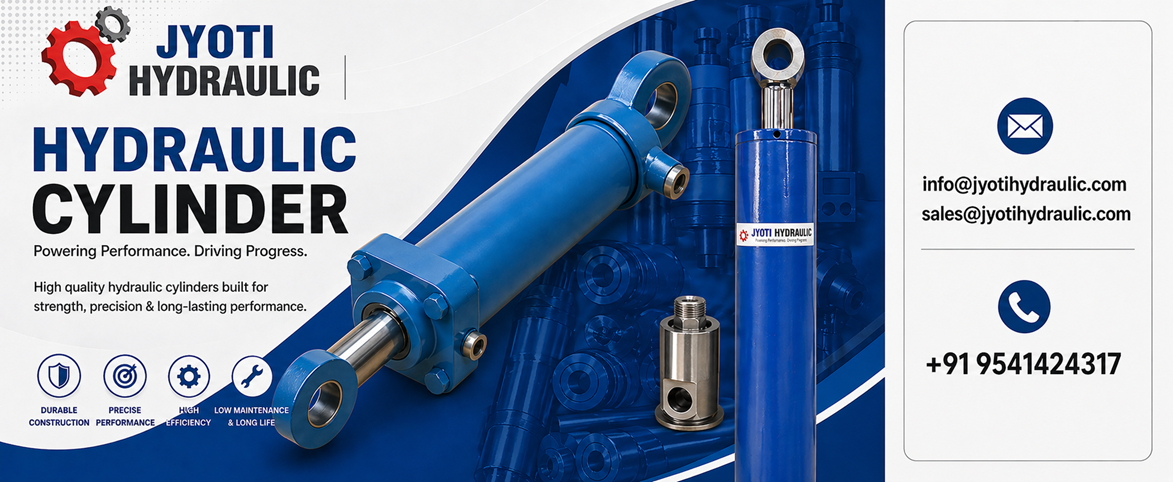
Jyoti Hydraulic has earned recognition as a dependable name in the hydraulic industry by focusing on precision engineering, durable manufacturing, and application-based hydraulic cylinder solutions for demanding industrial environments. When industries invest in hydraulic cylinders, they are not simply buying a mechanical component; they are choosing the force-generating heart of their machinery. A poor-quality cylinder can lead to leakage, downtime, unsafe operations, high maintenance costs, and reduced machine life. That is why selecting the right Hydraulic Cylinder Manufacturer in India is a critical decision for any business operating in manufacturing, construction, agriculture, mining, material handling, steel, cement, or heavy engineering sectors.
Hydraulic cylinders are widely used wherever controlled linear motion and high pushing or pulling force are required. From lifting heavy loads to pressing, clamping, tilting, pushing, pulling, bending, and positioning, hydraulic cylinders perform some of the toughest jobs in industrial systems. However, not all cylinders are designed equally. The quality of raw material, machining accuracy, seal selection, rod finishing, welding strength, pressure testing, and customization capability directly affect performance.
This blog explains what you must know before buying industrial hydraulic cylinders, how to evaluate manufacturers, what technical factors matter, and why choosing experienced Industrial Hydraulic Cylinder Manufacturers in India can improve productivity, reliability, and long-term cost efficiency.
Introduction to Industrial Hydraulic Cylinders
A hydraulic cylinder is a mechanical actuator that converts hydraulic energy into linear mechanical force. It works by using pressurized hydraulic fluid to move a piston inside a cylinder barrel. This movement generates powerful linear motion, which can be used to lift, press, push, pull, or control industrial machinery.
In simple terms, hydraulic cylinders allow machines to perform heavy-duty tasks with precision and power. They are used in equipment where electric motors or pneumatic systems may not provide enough force or control.
Industrial hydraulic cylinders are available in multiple designs, including single acting cylinders, double acting cylinders, tie-rod cylinders, welded cylinders, telescopic cylinders, mill-duty cylinders, custom hydraulic cylinders, and heavy-duty hydraulic cylinders. Among these, double acting cylinders are highly preferred in industrial applications because they provide controlled force in both extension and retraction strokes. This is why many buyers specifically search for Double Acting Hydraulic Cylinder Manufacturers in India when they need reliable two-way force movement.
Industry Overview: Hydraulic Cylinder Manufacturing in India
India has become a strong manufacturing hub for hydraulic cylinders due to the rapid growth of infrastructure, automation, agriculture mechanization, construction equipment, heavy machinery, and industrial production. The demand for hydraulic systems has increased across sectors such as steel plants, cement plants, plastic molding machines, earthmoving equipment, mining machinery, machine tools, presses, cranes, trailers, hydraulic power packs, and special purpose machines.
A professional Hydraulic Cylinder Manufacturer in India must now meet higher expectations than ever before. Buyers are no longer looking only for low-cost products. They want cylinders that offer long service life, leak-proof operation, dimensional accuracy, consistent performance, and compatibility with demanding working conditions.
Modern industries need hydraulic cylinders that can handle:
High pressure operation
Continuous duty cycles
Dusty and abrasive environments
Shock loads and side loads
Temperature variations
Heavy load lifting
Precise movement control
Low maintenance operation
Custom mounting requirements
As industrial machines become more advanced, hydraulic cylinder manufacturing also requires better engineering standards. Manufacturers must use CNC machining, honed tubes, induction-hardened rods, high-quality seals, accurate welding, pressure testing, and strict quality inspection to deliver reliable products.
Technical Insights: What Makes a Hydraulic Cylinder Reliable?
Before buying a hydraulic cylinder, it is important to understand the technical features that define performance and durability. A cylinder may look simple from the outside, but its internal design and manufacturing quality determine how well it performs under pressure.
1. Cylinder Barrel Quality
The cylinder barrel is the main body in which the piston moves. It must have a smooth internal surface to reduce friction and prevent seal damage. Honed or skived and roller-burnished tubes are commonly used for high-quality hydraulic cylinders. A poor internal finish can cause leakage, jerky movement, heat generation, and premature seal failure.
2. Piston Rod Strength and Finish
The piston rod transfers force from the piston to the machine. It must be strong, straight, and resistant to wear and corrosion. Good manufacturers use chrome-plated or induction-hardened rods to improve surface hardness and service life. A rough or poorly plated rod can damage seals and cause oil leakage.
3. Seal Selection
Seals are among the most critical parts of a hydraulic cylinder. They prevent fluid leakage and maintain pressure. Different applications require different seal materials depending on pressure, speed, temperature, fluid type, and operating environment. High-quality seals reduce maintenance and improve cylinder efficiency.
4. Piston and Guide Arrangement
The piston must fit accurately inside the barrel and maintain proper alignment during movement. Guide rings or wear rings help prevent metal-to-metal contact and absorb side loads. In heavy-duty applications, proper guiding is essential to avoid scoring, uneven wear, and cylinder failure.
5. Mounting Design
Hydraulic cylinders are available with different mounting styles such as clevis mount, flange mount, trunnion mount, foot mount, eye mount, and custom mounting arrangements. The right mounting style depends on the machine structure and load direction. Incorrect mounting can create misalignment and side load, reducing cylinder life.
6. Working Pressure Rating
Industrial hydraulic cylinders are designed for specific working pressures. Selecting a cylinder with inadequate pressure capacity can be dangerous and may lead to leakage, deformation, or failure. Buyers should always check working pressure, test pressure, bore size, rod diameter, and safety factor before finalizing a cylinder.
7. Welding and Assembly Quality
For welded hydraulic cylinders, welding strength is crucial. Weak welding can fail under pressure or shock loads. Proper assembly, alignment, torque control, and testing ensure smooth operation and long service life.
8. Testing and Quality Control
A reliable manufacturer performs pressure testing, leakage testing, dimensional inspection, stroke verification, surface finish checks, and performance testing before dispatch. This is one of the most important reasons to choose experienced Industrial Hydraulic Cylinder Manufacturers in India rather than unknown suppliers.
Applications of Industrial Hydraulic Cylinders
Hydraulic cylinders are used across a wide range of industries because they deliver high force in a compact design. Some common applications include:
Construction Equipment
Hydraulic cylinders are used in excavators, loaders, backhoe loaders, bulldozers, compactors, cranes, and concrete machinery. They help lift, tilt, dig, push, and control heavy attachments.
Agriculture Machinery
Tractors, harvesters, seeders, balers, trailers, and agricultural implements use hydraulic cylinders for lifting, steering, tilting, and depth control.
Material Handling Equipment
Forklifts, scissor lifts, hydraulic lifts, dock levelers, stackers, trolleys, and loading platforms depend on hydraulic cylinders for safe and controlled movement.
Industrial Presses
Hydraulic presses require powerful cylinders for pressing, forming, bending, punching, molding, and compression operations. Cylinder accuracy directly affects product quality.
Steel and Cement Plants
Heavy-duty cylinders are used in furnace systems, rolling mills, kiln equipment, conveyors, gates, crushers, and material handling systems.
Mining and Earthmoving
Mining equipment operates in harsh environments where cylinders must withstand shock loads, dust, vibration, and high pressure.
Plastic and Rubber Machinery
Injection molding machines, compression molding machines, and rubber processing machines use hydraulic cylinders for clamping, injection, and movement control.
Special Purpose Machines
Custom machines often require customized cylinders designed according to stroke length, bore size, mounting style, load capacity, speed, and operating cycle.
Benefits of Choosing Quality Hydraulic Cylinders
Selecting high-quality hydraulic cylinders provides several long-term advantages for industrial users.
Higher Machine Productivity
A well-designed cylinder ensures smooth, powerful, and consistent movement. This helps machines operate efficiently and reduces production delays.
Reduced Downtime
Leakage, rod bending, seal damage, and barrel scoring can stop operations unexpectedly. Quality cylinders reduce breakdown frequency and improve machine availability.
Better Safety
Hydraulic systems often handle heavy loads. A weak or poorly designed cylinder can create serious safety risks. Properly tested cylinders improve operator and equipment safety.
Longer Service Life
Good material, accurate machining, proper sealing, and correct design increase the life of the cylinder even in demanding environments.
Lower Maintenance Cost
Although high-quality cylinders may cost more initially, they save money over time by reducing repairs, oil leakage, seal replacement, and machine stoppage.
Better Load Control
Hydraulic cylinders provide controlled movement, which is important in lifting, pressing, tilting, and positioning applications.
Customization Advantage
Experienced manufacturers can design cylinders as per application needs instead of offering only standard sizes. This is especially useful for OEMs and heavy industries.
Buying Guide: What to Check Before Selecting a Hydraulic Cylinder Manufacturer
Choosing the right manufacturer is as important as choosing the right cylinder. Before placing an order, buyers should evaluate several practical and technical factors.
1. Check Manufacturing Experience
Experience matters in hydraulic cylinder manufacturing. A manufacturer that understands different industrial applications can recommend the right design, material, seals, mounting, and pressure rating.
2. Ask About Customization Capability
Every machine may not work with standard cylinders. You may need custom bore size, stroke length, rod diameter, mounting type, port size, pressure rating, or special coating. Choose a manufacturer that can provide tailor-made solutions.
3. Review Material Quality
Ask about the type of tube, rod, piston material, gland material, seals, and welding process used. Good raw material is the foundation of cylinder performance.
4. Confirm Pressure Testing
Never buy hydraulic cylinders without proper testing. The manufacturer should perform pressure and leakage testing before delivery.
5. Understand Application Requirements
Before ordering, provide complete details such as:
Required load capacity
Working pressure
Stroke length
Bore diameter
Rod diameter
Mounting style
Operating speed
Oil temperature
Duty cycle
Environmental conditions
Machine type
Required end fittings
The more accurate your data, the better the cylinder design will be.
6. Evaluate Seal Quality
Cheap seals are one of the biggest reasons for hydraulic leakage. Ask whether the seals are suitable for your operating pressure, temperature, and fluid.
7. Check Surface Finish and Coating
Rod surface finish and chrome plating quality affect seal life. In outdoor or corrosive environments, additional coating or protection may be required.
8. Look for After-Sales Support
A dependable manufacturer should provide technical support, repair guidance, replacement parts, and service assistance when required.
9. Compare Total Value, Not Only Price
The lowest-priced cylinder may become expensive if it fails frequently. Compare quality, testing, design support, service life, and reliability before making a decision.
10. Choose Industry-Specific Expertise
For heavy-duty applications, select manufacturers who understand your industry. For example, cylinders for construction equipment differ from cylinders used in presses or steel plants. Experienced Double Acting Hydraulic Cylinder Manufacturers in India can help design the right cylinder for two-way industrial motion control.
Double Acting Hydraulic Cylinders: Why They Are Widely Preferred
Double acting hydraulic cylinders use hydraulic pressure for both extension and retraction. This makes them more versatile than single acting cylinders, which use pressure in one direction and depend on gravity, spring force, or external load for return movement.
Double acting cylinders are preferred because they offer:
Controlled movement in both directions
Better speed and force control
Higher operational accuracy
Improved productivity
Suitability for automated systems
Reliable performance in horizontal, vertical, and inclined positions
Industries use double acting cylinders in presses, lifting machines, material handling systems, mobile equipment, industrial automation, clamping systems, and construction machinery. When selecting Double Acting Hydraulic Cylinder Manufacturers in India, buyers should check design accuracy, seal arrangement, pressure capacity, rod strength, and testing process.
Future Trends in Industrial Hydraulic Cylinders
The hydraulic cylinder industry is evolving with modern manufacturing and automation needs. Some important trends include:
Smart Hydraulic Cylinders
Industries are moving toward sensor-integrated hydraulic cylinders that can monitor position, pressure, temperature, and performance. These cylinders help improve automation and predictive maintenance.
Energy-Efficient Hydraulic Systems
Manufacturers are focusing on reducing energy loss through improved sealing, low-friction design, better fluid flow, and optimized cylinder sizing.
Advanced Surface Coatings
Better rod coatings are being used to improve corrosion resistance, wear resistance, and performance in harsh environments.
Compact High-Force Designs
Machines are becoming more compact, so hydraulic cylinders must deliver higher force in limited space.
Custom Engineering for OEMs
OEMs increasingly need cylinders designed specifically for their equipment. This creates demand for manufacturers with strong design and fabrication capabilities.
Predictive Maintenance
With industrial IoT and machine monitoring, hydraulic cylinders may soon be tracked for leakage, seal wear, pressure loss, and performance issues before failure occurs.
Why Manufacturer Selection Matters
A hydraulic cylinder failure can affect an entire production line or machine fleet. This means the manufacturer you choose has a direct impact on your operational reliability. A professional manufacturer does more than supply a cylinder. They understand your machine, working pressure, load requirements, environment, safety needs, and maintenance expectations.
Reliable Industrial Hydraulic Cylinder Manufacturers in India focus on engineering, not just fabrication. They provide practical recommendations, design support, quality checks, and long-term value. Whether you need a standard industrial cylinder or a customized heavy-duty hydraulic cylinder, the right manufacturer can help you reduce downtime and improve machine performance.
Conclusion
Buying an industrial hydraulic cylinder is a technical decision that should be based on quality, application suitability, design accuracy, and manufacturer expertise. A hydraulic cylinder may seem like a simple component, but it plays a major role in machine safety, productivity, and reliability.
Before buying, evaluate the cylinder’s bore size, stroke length, rod diameter, pressure rating, seal quality, mounting type, material strength, surface finish, and testing standards. Also, choose a manufacturer that understands your application and can provide customized solutions.
If you are searching for a trusted Hydraulic Cylinder Manufacturer in India, or looking for experienced Double Acting Hydraulic Cylinder Manufacturers in India and reliable Industrial Hydraulic Cylinder Manufacturers in India, make sure you partner with a company that values precision, durability, and practical engineering support.
A well-designed hydraulic cylinder is not just a spare part. It is an investment in smoother operations, safer machinery, and better industrial performance.
FAQ Section
1. What is an industrial hydraulic cylinder?
An industrial hydraulic cylinder is a mechanical actuator that converts hydraulic pressure into linear force. It is used in machines for lifting, pushing, pulling, pressing, clamping, tilting, and positioning heavy loads.
2. How do I choose the right hydraulic cylinder?
To choose the right hydraulic cylinder, consider load capacity, working pressure, bore size, stroke length, rod diameter, mounting style, duty cycle, operating environment, seal type, and application requirements. It is best to consult an experienced manufacturer before finalizing the design.
3. What is the difference between single acting and double acting hydraulic cylinders?
A single acting cylinder uses hydraulic pressure in one direction only, while the return movement happens through gravity, spring, or external force. A double acting cylinder uses hydraulic pressure for both extension and retraction, making it suitable for controlled movement in both directions.
4. Why are double acting hydraulic cylinders popular in industries?
Double acting hydraulic cylinders are popular because they provide better control, higher productivity, reliable two-way movement, and suitability for automation, pressing, lifting, and material handling applications.
5. What industries use hydraulic cylinders?
Hydraulic cylinders are used in construction, agriculture, mining, steel, cement, material handling, machine tools, plastic machinery, rubber machinery, hydraulic presses, trailers, cranes, and special purpose machines.
6. What causes hydraulic cylinder leakage?
Common causes of leakage include worn seals, damaged piston rods, poor surface finish, contaminated hydraulic oil, excessive pressure, misalignment, incorrect seal selection, and poor manufacturing quality.
7. Can hydraulic cylinders be customized?
Yes. Hydraulic cylinders can be customized based on bore size, stroke length, rod diameter, pressure rating, mounting style, port size, seal type, material, coating, and machine application.
8. Why is pressure testing important before buying a hydraulic cylinder?
Pressure testing confirms that the cylinder can safely handle its rated working pressure without leakage or failure. It is an essential quality check before dispatch.
9. What should I ask a hydraulic cylinder manufacturer before placing an order?
You should ask about material quality, manufacturing process, seal brand or grade, pressure testing, customization options, delivery time, application support, warranty, and after-sales service.
10. How can I increase the life of a hydraulic cylinder?
Use clean hydraulic oil, maintain proper alignment, avoid overloading, inspect seals regularly, protect the piston rod from damage, operate within rated pressure, and follow preventive maintenance practices.
Call To Action
Need a durable, precision-engineered hydraulic cylinder for your industrial application?
Contact Jyoti Hydraulic today to discuss your requirements, request a quotation, or get expert consultation for standard and customized hydraulic cylinders.
📧 info@jyotihydraulic.com
📞 +91 9541424317


