
Jyoti Hydraulic understands a challenge that every serious steel recycler, scrap trader, and industrial unit faces every day: loose iron scrap takes up too much space, creates handling chaos, increases transportation costs, and slows down operations at every stage. When bulky scrap piles start consuming valuable yard area, labor productivity falls, vehicle loading becomes inefficient, and material value gets diluted simply because it is not processed in the right form. For businesses that deal with ferrous scrap at scale, this is not a small inconvenience. It is a direct hit on profitability, safety, and supply chain efficiency.
The Growing Pressure in Scrap Handling
India’s steel recycling ecosystem is evolving rapidly. As infrastructure growth, automotive production, fabrication industries, and engineering manufacturing continue to expand, the volume of iron and steel scrap generated across sectors is also rising. Yet many businesses still struggle with outdated scrap handling methods.
The problem is clear. Unprocessed iron scrap is irregular, sharp, bulky, and difficult to stack. It occupies excessive floor space, complicates storage planning, and creates unnecessary risk for workers. The agitation is even greater when transport enters the picture. More trips, underutilized truck loads, higher diesel costs, and avoidable labor hours all add up. Then comes the final setback: poorly managed scrap often receives a lower market rate compared to dense, well-packed bales.
This is where the right Baling Press Machine becomes more than a machine. It becomes a strategic investment.
Steel Recycling Industry Overview in India
India is one of the fastest-growing steel markets in the world, and recycled steel is becoming increasingly important for long-term sustainability and resource efficiency. Secondary steel production depends heavily on efficient scrap collection, sorting, and processing. That means the role of advanced baling equipment is becoming more critical than ever.
Steel recycling is no longer just about waste disposal. It is about creating a structured material stream that is easy to store, transport, trade, and melt. Recycling iron scrap helps reduce mining dependency, lowers energy usage in steelmaking, and supports environmentally responsible manufacturing practices.
For this reason, industrial buyers are actively searching for reliable Iron Scrap Baling Machine Manufacturers in India and experienced Scrap Baling Machine Manufacturers in India who can provide durable, high-output solutions for modern recycling operations.
What is an Iron Scrap Baler Machine?
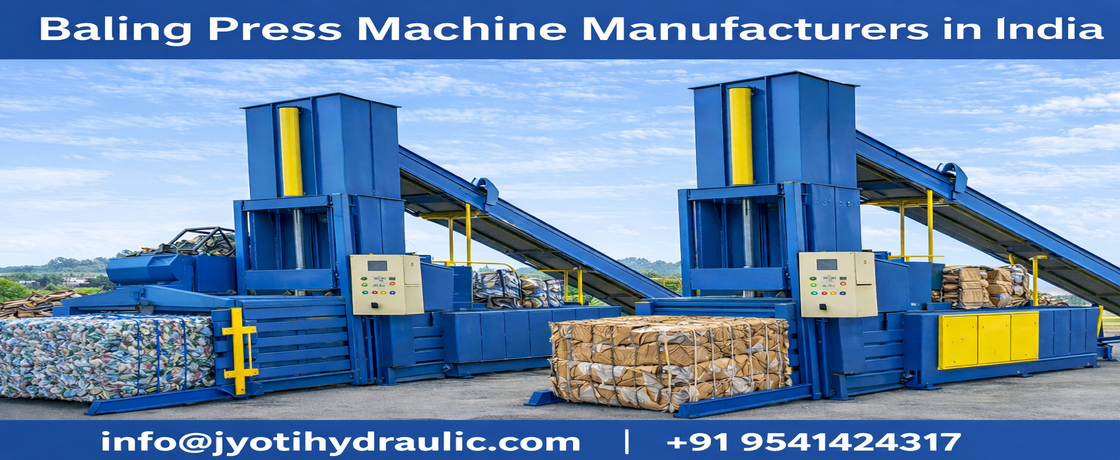
An iron scrap baler machine is a hydraulic compression system designed to compact loose iron or steel scrap into dense, uniform bales. These bales are easier to store, safer to handle, and far more cost-effective to transport.
Working Principle
The working mechanism is straightforward but highly engineered. Scrap material is fed into the baling chamber. A hydraulic system then applies immense pressure through one or more compression rams. This force compresses the material into a compact block or bale. Once the required density is achieved, the bale is ejected and made ready for dispatch or further processing.
The value of this process lies in standardization. Instead of dealing with scattered, low-density scrap, operators get manageable bales with better loading efficiency and improved resale potential.
Types of Iron Scrap Baler Machines
Manual Scrap Baler Machines
These are generally suitable for smaller operations with limited scrap volume. They require more operator involvement and are often chosen by businesses with budget constraints and basic processing requirements.
Semi-Automatic Scrap Baler Machines
These machines balance output and affordability. They offer higher efficiency than manual systems while retaining some operator control. Many medium-sized scrap yards and manufacturing units prefer this category.
Fully Automatic Scrap Baler Machines
Designed for high-volume industrial operations, these machines reduce manual dependency, improve cycle consistency, and support continuous scrap processing. For large recycling facilities and steel plants, fully automatic systems deliver maximum throughput and operational discipline.
Technical Insights: What Makes a High-Performance Baling Press Machine?
When industrial buyers evaluate a baler, surface-level features are not enough. Long-term performance depends on engineering depth, hydraulic reliability, and operational suitability.
Hydraulic System
The hydraulic system is the heart of any iron scrap baler machine. It controls the compression force, cycle stability, ram movement, and overall machine response. A well-designed hydraulic circuit ensures smoother operation, consistent pressure, and lower wear over time.
High-quality cylinders, robust seals, precision valves, and reliable hydraulic pumps all influence machine life and compression efficiency. Inferior hydraulic systems may look adequate initially, but they often lead to leakage, inconsistent bale density, higher downtime, and rising maintenance costs.
Compression Force and Tonnage
Compression force is one of the most important technical parameters. It determines how effectively the machine can compact tough ferrous scrap. Depending on the application, tonnage requirements vary widely.
Light fabrication scrap may require moderate force, while heavy iron offcuts, sheet bundles, structural rejects, or turning scrap may demand a much stronger system. Buyers should always match machine tonnage with the density and hardness of the scrap they intend to process.
The wrong tonnage selection leads to poor bale formation, excessive cycle time, and premature machine strain.
Bale Size and Density
Bale size matters for more than just appearance. It affects logistics, furnace feeding, storage planning, and resale convenience. A high-quality scrap baler should produce bales with consistent dimensions and optimal density.
Denser bales mean:
-
Better use of truck capacity
-
Lower freight cost per ton
-
Improved yard organization
-
Easier mechanical handling
-
Better acceptance by downstream buyers
In industrial scrap management, bale density is directly linked to commercial value.
Power Consumption
Energy efficiency is becoming a major consideration for modern recycling facilities. A poorly designed machine may consume excessive power during each compression cycle, increasing operating costs over time.
Advanced balers are engineered to deliver high compression with controlled power usage. Efficient hydraulic flow design, optimized motor selection, and intelligent cycle control help reduce electricity consumption without compromising output.
Automation Features
Automation is changing the way scrap is processed. Today’s industrial buyers are increasingly looking for features such as:
-
PLC-based controls
-
Auto-cycle operation
-
Remote diagnostics
-
Safety interlocks
-
Auto-ejection systems
-
Overload protection
-
Pressure monitoring
These features improve consistency, reduce operator dependence, and make the machine more reliable in demanding production environments.
Key Applications of Iron Scrap Baler Machines
Steel Plants
Steel plants generate and consume large amounts of ferrous scrap. A baler helps standardize in-house scrap handling and improves feeding efficiency for recycling loops.
Scrap Yards
For scrap dealers and aggregators, space and transport efficiency are essential. A baling press machine helps convert loose, difficult material into saleable, stackable inventory.
Recycling Industries
Recycling companies need faster material movement, better density, and improved safety. Iron scrap balers help create a clean, process-ready scrap stream.
Manufacturing Units
Engineering workshops, fabrication units, automotive plants, and metal processing companies all generate iron scrap. Installing a baler turns waste handling from a cost burden into an operational advantage.
Major Benefits of Using an Iron Scrap Baler Machine
1. Massive Volume Reduction
Loose scrap consumes a disproportionate amount of space. Baling reduces volume significantly, freeing up valuable yard and warehouse area.
2. Easier Transportation
Dense bales allow more material per trip. This improves truck utilization and reduces logistics costs.
3. Lower Labor Dependency
Manual scrap handling is time-consuming and risky. A baler reduces repeated loading, sorting, and shifting efforts.
4. Increased Scrap Value
Well-compacted scrap often commands better prices because buyers prefer dense, uniform, easy-to-handle material.
5. Better Workplace Safety
Sharp, scattered scrap creates injury risk and clutter. Baled material is safer to store, move, and manage.
6. Faster Operations
From collection to dispatch, baling simplifies the scrap flow and keeps the yard more organized.
Buying Guide: How to Choose the Right Scrap Baling Machine
Choosing the right machine is not just about price. It is about matching the equipment to your business model, scrap profile, and long-term production targets.
Evaluate Scrap Volume
Start with daily or monthly scrap generation. Low-volume units do not need oversized systems, while high-volume scrap yards should avoid under-capacity machines that become bottlenecks.
Understand Material Type Compatibility
Not all iron scrap behaves the same way. Sheet scrap, punchings, turnings, cast iron pieces, and heavy structural scrap all compress differently. Your machine must be compatible with the material you process most frequently.
Check Machine Durability
A baler for industrial use must be built with a heavy-duty frame, wear-resistant chamber construction, premium hydraulic components, and dependable electrical systems. Long service life depends on structural strength.
Ask About Bale Output and Cycle Time
Buyers should compare not just pressure, but actual operational productivity. Faster cycle times and consistent bale formation directly improve ROI.
Review After-Sales Support
Even the best machine needs periodic service, spare parts, and technical guidance. Strong after-sales support minimizes downtime and protects production continuity.
Assess Manufacturer Credibility
This is where supplier selection becomes critical. Experienced Iron Scrap Baling Machine Manufacturers in India do more than sell a product. They understand applications, recommend correct configurations, and support the machine throughout its lifecycle.
Why Choose Jyoti Hydraulic
In a market crowded with equipment suppliers, buyers need a partner they can trust for performance, durability, and technical integrity. That is where Jyoti Hydraulic stands apart.
Industry Expertise
Jyoti Hydraulic brings deep domain understanding of hydraulic compression technology and industrial scrap processing requirements. This helps customers choose machines based on real operational needs, not generic catalog claims.
Quality Assurance
Machine reliability begins with quality manufacturing. From hydraulic components to frame fabrication and system integration, every detail matters in industrial machinery. Jyoti Hydraulic focuses on consistent build quality designed for rigorous use.
Custom Solutions
No two scrap operations are identical. Different industries generate different types of ferrous waste. Jyoti Hydraulic offers tailored solutions based on material type, volume, plant layout, and automation goals.
Trusted by Industry
Industrial buyers value suppliers who understand uptime, safety, output, and service responsiveness. Jyoti Hydraulic’s reputation is built on delivering practical, dependable, and productivity-driven baling solutions.
For buyers searching for dependable Scrap Baling Machine Manufacturers in India, choosing a specialist with proven technical capability can make a major difference in long-term results.
Future Trends in the Scrap Baling Industry
The scrap recycling industry is moving toward smarter and more efficient operations. The next generation of balers will focus on three major shifts.
Automation-Driven Productivity
As labor costs rise and industrial buyers demand more predictable output, automatic and semi-automatic balers will become the norm.
Smart Machines with IoT Integration
Remote monitoring, predictive maintenance alerts, pressure analytics, and digital performance dashboards are expected to become more common in advanced systems.
Energy-Efficient Hydraulic Systems
Power optimization will be a strong buying factor. Machines that deliver high bale density with lower electricity consumption will gain preference in competitive markets.
These trends reinforce one key message: the iron scrap baler is no longer just a utility machine. It is becoming a smart asset in the steel recycling value chain.
Conclusion
An iron scrap baler machine plays a decisive role in improving efficiency, safety, and profitability in the steel recycling industry. From reducing scrap volume and transport costs to increasing bale value and streamlining material handling, the machine delivers measurable business benefits across steel plants, scrap yards, recyclers, and manufacturing units.
For companies serious about operational excellence, choosing the right Baling Press Machine is a strategic move. And when that decision involves selecting among the best Iron Scrap Baling Machine Manufacturers in India, experience, machine quality, customization capability, and after-sales support should lead the evaluation.
Jyoti Hydraulic brings together engineering expertise, industrial insight, and buyer-focused solutions to help businesses modernize scrap processing with confidence.
FAQs
1. What is the price of an iron scrap baler machine in India?
The price depends on machine capacity, tonnage, automation level, chamber size, and custom features. Small and mid-range machines are generally more affordable, while high-capacity automatic systems involve a higher investment. The best way to get an accurate estimate is to request a customized quotation based on your scrap type and production requirement.
2. Which industries use scrap baling machines?
Scrap baling machines are widely used in steel plants, recycling industries, scrap yards, metal fabrication units, automotive plants, engineering workshops, foundries, and manufacturing facilities that generate iron or steel scrap.
3. How do I choose the right baler for my business?
You should evaluate daily scrap volume, scrap material type, required bale size, available floor space, automation preference, power availability, and expected production output. Also compare the credibility and after-sales support of the manufacturer.
4. What is the maintenance cost of a scrap baling machine?
Maintenance cost varies depending on machine quality, operating hours, hydraulic system design, and service discipline. A well-built machine with quality components usually has lower long-term maintenance costs and fewer breakdowns.
5. What is bale density in a scrap baler machine?
Bale density refers to how tightly the scrap is compressed into a compact bale. Higher density means better storage efficiency, lower transportation cost, easier handling, and often better resale value.
6. Is a fully automatic baler better than a semi-automatic baler?
It depends on your production scale. Fully automatic balers are ideal for high-volume operations seeking faster throughput and lower labor dependency. Semi-automatic balers are suitable for medium-scale units looking for a balance between control and efficiency.
7. Can one machine handle different types of iron scrap?
Many machines can process multiple forms of ferrous scrap, but compatibility depends on design and compression force. It is important to discuss your exact material mix with the manufacturer before purchase.
Take the Next Step with Jyoti Hydraulic
Bulky scrap is costing you more than space. It is costing you money, time, safety, and operational efficiency. Do not let inefficient scrap handling slow down your growth when a high-performance baling solution can transform your recycling process.
Get in touch with Jyoti Hydraulic today for a fast quotation, expert machine recommendation, and application-specific consultation.
📧 info@jyotihydraulic.com
📞 +91 9541424317
Whether you need a reliable Baling Press Machine, want guidance from experienced Iron Scrap Baling Machine Manufacturers in India, or are comparing top Scrap Baling Machine Manufacturers in India, now is the time to act. Contact Jyoti Hydraulic today and secure the right solution before rising scrap volumes create bigger operational losses.


