
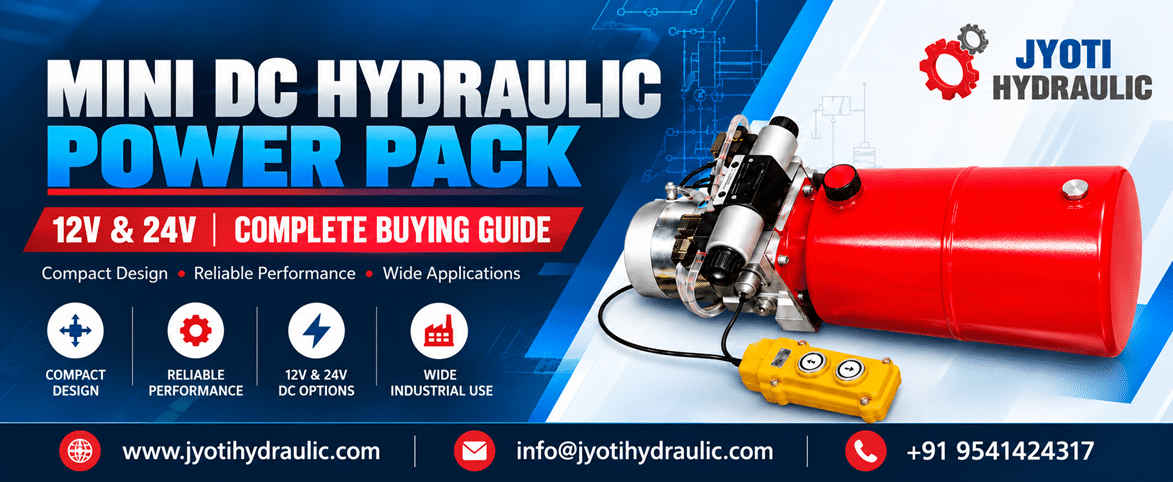
Jyoti Hydraulic brings this buying guide to help equipment owners, engineers, and procurement teams select compact hydraulic power systems. A Mini DC Hydraulic Power Pack converts energy from a battery or compatible DC supply into hydraulic power for lifting, clamping, tipping, and positioning equipment.
The choice between 12V and 24V starts with your machine’s electrical supply. At comparable electrical input power, a 24V system draws approximately half the current of a 12V system. However, voltage alone does not determine lifting capacity, pressure, or speed. This 12V and 24V DC Hydraulic Power Pack guide explains the specifications, circuit choices, and installation requirements that matter before ordering.
What Is a Mini DC Hydraulic Power Pack?
A Mini DC Hydraulic Power Pack is a compact assembly that supplies hydraulic fluid to a cylinder or another actuator. It combines the components needed to convert electrical energy into controlled mechanical movement.
Typical components include:
- DC electric motor: Drives the pump.
- Hydraulic pump: Moves fluid through the circuit.
- Oil reservoir: Stores fluid and accommodates changing circuit volume.
- Manifold and control valves: Route fluid and control actuator operation.
- Pressure relief valve: Limits pressure in the circuit it protects.
- Electrical controls and solenoid valves: Provide switching and movement commands, where fitted.
- Connections and hoses: Connect the unit to the equipment; these may be supplied separately.
The exact arrangement depends on the application. Manufacturer documentation illustrates that compact power units can use different motor, valve, and circuit combinations; specifications must therefore be checked for the selected model.
How Does a Mini DC Hydraulic Power Pack Work?
The operating sequence is straightforward:
- The DC supply energizes the electric motor.
- The motor drives the hydraulic pump.
- The pump delivers fluid into the hydraulic circuit.
- Fluid pressure and flow operate the connected cylinder or actuator.
- Control valves direct movement and, where designed to do so, regulate speed.
- Fluid returns to the reservoir or is redirected according to the circuit design.
A pump primarily produces flow. Pressure develops when the load and circuit resist that flow.
A correctly selected, installed, and adjusted relief valve provides a flow path when its pressure setting is reached. It does not replace dedicated load-holding devices or mechanical supports. Prolonged operation against the relief valve wastes energy and generates heat.
Understanding 12V and 24V DC Hydraulic Power Pack Options
12V DC Hydraulic Power Pack
A 12V unit suits equipment with a compatible 12V supply, including some vehicle-mounted systems, compact lifting installations, and battery-powered machinery.
Check more than the battery’s nominal voltage. Starting current, loaded current, battery condition, cable length, connection quality, and motor duty cycle affect operation. An inadequate supply can cause voltage drop and unreliable performance.
24V DC Hydraulic Power Pack
A 24V unit suits compatible industrial vehicles, mobile machinery, and other installations with a suitable 24V supply.
Lower current for comparable electrical power can simplify some wiring requirements. Nevertheless, the motor, pump, controls, and protection must all match the installation. Required pressure, flow, load, and operating duration determine suitability—not voltage alone.
12V vs 24V DC Hydraulic Power Pack: Key Differences
Use this 12V and 24V DC Hydraulic Power Pack comparison as a starting point, then compare actual model data.
| Selection factor | 12V system | 24V system |
|---|---|---|
| Nominal electrical supply | Compatible 12V DC supply | Compatible 24V DC supply |
| Current at equal electrical input power | Approximately twice the current of 24V | Approximately half the current of 12V |
| Battery compatibility | Requires suitable 12V battery system and charging arrangement | Requires suitable 24V battery system and charging arrangement |
| Cables and connections | Higher current increases the importance of cable sizing and connection resistance | Lower comparable current can reduce wiring losses; sizing still requires calculation |
| Motor and pump | Match motor capability and pump displacement to the operating point | Apply the same selection process with a suitable 24V motor |
| Pressure and flow | Determined by component ratings and operating conditions | Not automatically higher because of supply voltage |
| Applications | Equipment designed around 12V electrical systems | Equipment designed around 24V electrical systems |
| Installation and maintenance | Check loaded voltage, terminals, protection, and fluid condition | Same checks, using components rated for 24V operation |
The relationship is electrical power = voltage × current. Comparing equal hydraulic output also requires considering motor and pump efficiency.
Main Applications of Mini DC Hydraulic Power Packs
Potential applications depend on the selected circuit and component ratings:
- Tail lifts and loading platforms: Require controlled lifting, lowering, and load retention.
- Tipper and dump bodies: Need force calculations that account for changing linkage geometry.
- Small lifting equipment: Requires suitable cylinder force, travel speed, and safety provisions.
- Vehicle-mounted equipment: Must tolerate vibration and the available electrical supply.
- Clamping and positioning systems: Need appropriate pressure control and holding behavior.
- Compact industrial machinery: Requires integration with machine controls and available space.
- Battery-powered mobile equipment: Must balance hydraulic performance with battery energy and charging.
- Special-purpose OEM systems: May require specific ports, mounting, valves, and controls.
For example, a gravity-return tipper and a powered positioning cylinder may need different valve circuits even when both use the same supply voltage.
Important Technical Specifications to Check Before Buying
Electrical supply and motor performance
Confirm 12V or 24V DC, allowable supply variation, motor power, and current consumption at the required operating point. Ask for starting-current information and recommended electrical protection.
Battery amp-hour capacity describes stored charge; it does not establish whether the battery can deliver the necessary peak current.
Pressure, flow, and cylinder dimensions
Operating pressure influences available force. Flow influences actuator speed.
Useful ideal relationships are:
- Force = pressure × effective piston area
- Speed = flow ÷ effective piston area
Using SI units, pressure is in pascals, area in square metres, force in newtons, and flow in cubic metres per second.
Cylinder bore determines piston area, while stroke determines travel and displaced oil volume. The rod reduces effective area during retraction. Actual calculations must account for friction, return pressure, mechanical geometry, and circuit losses.
For example, increasing cylinder bore can increase force at the same pressure, but it also requires more flow to maintain the same speed.
Reservoir and hydraulic circuit
Check usable oil volume across the complete cylinder stroke, adequate return space, and the approved mounting orientation. Nominal tank capacity alone is insufficient.
A single-acting cylinder uses hydraulic power in one direction and an external force, such as gravity or a spring, for return. A double-acting cylinder uses hydraulic power in both directions.
Confirm valve functions, port sizes, control method, lowering control, and any required load-holding arrangement.
Duty cycle, installation, and environment
Specify run time per operation, operations per hour, rest periods, and ambient temperature. Compact units may have intermittent-duty limits; use the selected model’s published duty information.
Check installation dimensions, mounting, ventilation, service access, fluid compatibility, viscosity requirements, dust, moisture, corrosion, and vibration exposure.
How to Choose the Right Mini DC Hydraulic Power Pack
Follow this practical buying checklist:
- Identify the application: Describe the machine and required movements.
- Determine actuator force: Include payload, mechanism geometry, friction, and design allowances.
- Establish pressure and flow: Match cylinder force and target travel time.
- Confirm supply voltage: Check the machine’s actual electrical architecture.
- Check battery capability: Verify energy capacity, peak current, charging, and expected voltage drop.
- Select the circuit: Confirm single-acting or double-acting operation and control requirements.
- Assess physical and thermal limits: Review reservoir volume, duty cycle, mounting, and available space.
- Define operating and service needs: Include environment, safety functions, documentation, and spare parts.
- Obtain technical confirmation: Request a hydraulic schematic, dimensional drawing, and performance data before ordering.
Ask whether quoted flow is available at your required pressure, rather than only at no load. Do not assume separate maximum-pressure and maximum-flow figures are achievable simultaneously.
Selecting solely by voltage or purchase price can leave you with insufficient speed, an overloaded electrical supply, or unsuitable operating duration.
Factors Affecting Mini DC Hydraulic Power Pack Price
Price depends on the complete configuration, including:
- 12V or 24V motor selection, motor power, and pump displacement.
- Required pressure and flow at the operating point.
- Reservoir capacity, material, and mounting arrangement.
- Manifold design, valves, and single-acting or double-acting operation.
- Control panel, remote controls, wiring, and electrical protection.
- Customization, installation scope, order quantity, and service requirements.
Compare quotations against the same specification. Confirm whether hoses, fittings, cables, controls, oil, freight, and commissioning are included.
A lower initial price may represent a different supply scope rather than an equivalent hydraulic solution.
Installation, Maintenance, and Safety Considerations
Incorrect installation or servicing can cause serious injury. Use competent personnel and follow the equipment manufacturer’s instructions.
- Verify supply voltage, wiring arrangement, and polarity where applicable.
- Use correctly rated cables, fuses, contactors, and electrical protection.
- Secure the unit and confirm port identification and hose ratings.
- Fill with the recommended hydraulic fluid and maintain cleanliness.
- Check fluid level in the manufacturer’s specified actuator position.
- Inspect hoses, fittings, terminals, and mounting points.
- Investigate unusual noise, overheating, slow movement, or leakage.
- Follow the specified inspection and maintenance schedule.
Before servicing, isolate electrical power, relieve stored hydraulic pressure, and mechanically support raised loads. Switching off the motor does not necessarily remove trapped pressure.
Never search for hydraulic leaks with bare hands. Escaping fluid can penetrate skin. Suspected injection injuries require immediate emergency medical attention, even when the wound appears small.
Why Choose Jyoti Hydraulic?
Jyoti Hydraulic is the brand featured in this guide. Its website lists dedicated 12V and 24V DC hydraulic power pack product pages, providing relevant starting points for a product enquiry. Confirm the exact configuration and current availability directly before ordering. Manufacturers, Price
Consulting a hydraulic equipment manufacturer helps buyers resolve compatibility questions before purchase. Share your voltage, pressure, flow, load, cylinder dimensions, and operating sequence so the proposed assembly can be assessed against the machine.
Request written confirmation of performance, duty limits, supplied accessories, documentation, and applicable service arrangements.
Frequently Asked Questions
1. What is a Mini DC Hydraulic Power Pack?
It is a compact motor, pump, reservoir, and valve assembly that uses DC electricity to supply hydraulic power to compatible actuators.
2. What is the difference between a 12V and 24V DC Hydraulic Power Pack?
The main difference is supply voltage. At equal electrical input power, 24V draws approximately half the current. Hydraulic performance depends on the complete assembly.
3. Can a 12V hydraulic power pack operate a hydraulic cylinder?
Yes, when its pressure, flow, oil capacity, and circuit suit the cylinder and load, and the electrical supply can support operation.
4. Is a 24V hydraulic power pack more powerful than a 12V model?
Not necessarily. Compare motor output, hydraulic performance at the required operating point, and duty rating rather than voltage alone.
5. How do I calculate the required pressure and flow rate?
Start with pressure = required force ÷ effective area and flow = desired speed × effective area. Include real-world losses and mechanism geometry.
6. What factors affect mini hydraulic power pack pricing?
Motor and pump selection, reservoir size, valves, controls, customization, quantity, and supply scope all influence price.
7. Which hydraulic power pack is suitable for battery-powered equipment?
Choose one compatible with the battery voltage, available current, required pressure and flow, operating frequency, and charging arrangement.
8. How often should a mini DC hydraulic power pack be maintained?
Follow the selected unit’s maintenance schedule. Inspection frequency depends on usage, environment, fluid condition, and the machine’s operating requirements.
9. What information should I provide when requesting a quotation?
Provide application, voltage, load, cylinder bore and stroke, pressure, flow or travel time, circuit type, duty cycle, mounting space, and quantity.
10. Can a mini DC hydraulic power pack be customized for a specific application?
Customization may be possible, depending on the supplier and design. Confirm proposed changes to the reservoir, valves, controls, ports, or mounting in writing.
Conclusion: Match the Power Pack to the Application
A suitable Mini DC Hydraulic Power Pack must match the machine’s voltage, pressure, flow, motor power, reservoir requirements, and duty cycle. Comparing a 12V and 24V DC Hydraulic Power Pack begins with electrical compatibility and ends with verified performance under the intended load.
Contact Jyoti Hydraulic with your application details to request product information, technical confirmation, and a quotation.
Jyoti Hydraulic
Email: info@jyotihydraulic.com
Phone: +91 9541424317
Website: jyotihydraulic.com


