
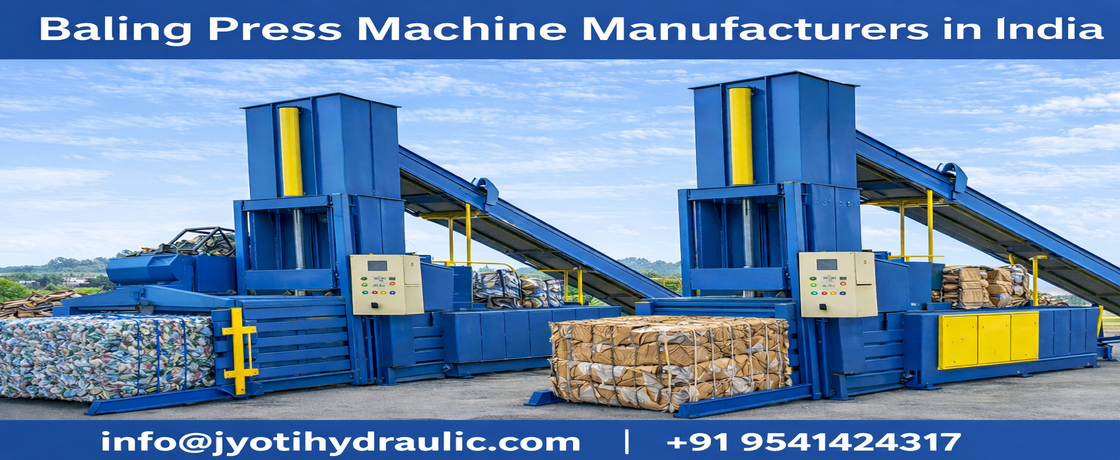
Jyoti Hydraulic brings a practical, engineering-first approach to waste compaction, and that matters because a baling machine is not merely a press—it is a productivity tool for recyclers, warehouses, municipalities, scrap yards, and manufacturing plants. When loose PET bottles are compressed into dense bales, businesses gain cleaner storage, easier handling, better truck utilization, and a more disciplined recycling workflow. Modern hydraulic PET bottle balers are widely offered in vertical and horizontal formats, and well-designed systems can reduce bottle volume by as much as 80–90%, which directly improves transport and storage economics.
Introduction
India’s waste-handling ecosystem is becoming more organized, and baling technology sits at the center of that shift. Buyers who search for PET Bottle Baling Press Machine Manufacturers in India, Garbage Baler Machine Manufacturers in India, or Scrap Baling Machine Manufacturers in India are usually trying to solve the same operational problem: too much low-density waste occupying too much floor space. PET bottles, plastic film, carton scrap, paper, raffia bags, textile cuttings, aluminum cans, and light metal scrap all become easier to store, sell, and transport once baled into standardized bundles. That is why choosing the right Baling Press Machine manufacturers has become a strategic decision rather than a basic equipment purchase.
Industry Overview
The Indian baling machine market serves a wide spectrum of users. Small warehouses and retail back-end operations often prefer compact vertical balers because they occupy less floor area and require a lower initial investment. Large recycling lines and high-volume material recovery facilities lean toward horizontal systems because they offer better automation, higher throughput, and more consistent bale output. In practical terms, vertical balers are commonly better for limited-space, moderate-volume operations, while horizontal balers make more sense when daily waste generation is high and continuous feeding is needed.
This is also why the market has become segmented. A PET bottle baler is not selected the same way as a heavy-duty scrap baler. PET bottles are bulky but light, so the machine must achieve good volume reduction without wasting power. Scrap metal balers, by contrast, need much higher force, stronger structures, thicker plates, and often multi-action compression. Garbage balers fall somewhere in between, depending on whether the material is dry waste, mixed plastic, packaging scrap, or municipal recyclable fractions. Reliable Scrap Baling Machine Manufacturers in India understand these differences and design machines around material behavior—not just tonnage numbers on a brochure.
Technical Insights: What Actually Makes a Good PET Bottle Baling Machine?
A PET baling press works on a simple principle: hydraulic force compresses loose bottles inside a chamber until the material reaches the target density, after which the bale is tied and ejected. But the real performance comes from the engineering details—cylinder sizing, frame rigidity, platen alignment, chamber dimensions, pump efficiency, and operator safety. Good machines are built to maintain repeatable compaction without excessive vibration, oil overheating, or structural distortion.
1. Pressing force and bale density
For PET bottles, a machine that is too small will produce loose, unstable bales; a machine that is oversized may raise capital and power cost without proportional benefit. Market listings in India show PET bottle balers in a broad range, including 25-ton, 50-ton, 60-ton, and 75-ton class machines, depending on design and application. Some vertical PET balers are listed with bale weights around 100–150 kg, while larger units can reach roughly 180–210 kg. Horizontal PET systems can also support higher throughput, such as around 1 ton per hour in certain semi-automatic configurations.
2. Vertical vs. horizontal design
A vertical PET baler is usually the right entry point for small and mid-sized operations. It is more compact, more affordable, and easier to install where ceiling height and access permit. A horizontal baler becomes attractive when feed volume is steady, labor optimization is important, or the buyer needs conveyor integration and faster cycle performance. In other words, the machine layout should match the waste profile—not the other way around.
3. Motor power, hydraulics, and pressure
Indian supplier listings show many PET and light-waste balers running in the 5 HP to 15 HP zone, while larger industrial baling press systems move much higher depending on chamber size and compression force. One horizontal PET configuration lists 150 bar hydraulic pressure and hydraulic bale ejection, which are relevant indicators of machine seriousness. A strong hydraulic circuit, correct oil cooling strategy, and quality valves matter far more in long-term ownership than headline tonnage alone.
4. Safety and controls
A modern baler should include more than a basic power unit and a push-button panel. Better systems increasingly use PLC-based controls, interlocks, emergency-stop architecture, and automated bale-ejection support. These features improve both operator safety and process consistency, especially in multi-shift environments. For high-throughput scrap or waste applications, these control-side upgrades are often what separates a low-cost machine from a reliable industrial asset.
Applications Across Industries
A well-built PET baler is useful in far more places than a traditional scrap yard. Beverage bottlers use it for post-consumer PET handling. Plastic recyclers use it to prepare inbound material for sorting and reprocessing. Warehouses and e-commerce hubs use balers for plastic packaging waste. Hotels, malls, educational campuses, and institutional facilities use smaller balers to control dry waste volume before dispatch. Municipal material recovery facilities use them to improve transport efficiency and site cleanliness. Meanwhile, Garbage Baler Machine Manufacturers in India and Scrap Baling Machine Manufacturers in India also serve paper mills, textile processors, plastic reprocessors, ferrous and non-ferrous scrap handlers, and industrial waste-management contractors.
Key Benefits of Investing in the Right Baling Press
The first benefit is obvious: space saving. Loose PET bottles are notoriously bulky, and baling converts scattered waste into stackable inventory. The second benefit is logistics efficiency. Denser bales allow more material per trip, which improves freight economics. The third benefit is workplace discipline—cleaner yards, easier segregation, and less manual handling chaos. The fourth is commercial value: uniform bales are easier to sell to downstream recyclers than mixed, loose waste. And finally, the right baler reduces dependency on ad-hoc waste disposal practices and supports a more measurable recycling process.
PET Bottle Baling Press Machine Price Guide in India
The most common buyer question is simple: What is the PET Bottle Baling Press Machine Price in India? The honest answer is that price varies sharply with tonnage, chamber size, automation level, motor power, machine orientation, bale weight target, and whether the machine is built for PET only or multi-material use.
Based on currently visible Indian seller and manufacturer listings, compact and entry-level PET bottle balers are often seen from around ₹2,00,000 to ₹3,00,000. Mid-range vertical PET balers frequently appear in the ₹3,00,000 to ₹5,60,000 zone. Larger single-box or higher-force PET machines can go above ₹5,40,000, especially when tonnage and bale weight increase. On the broader industrial side, general hydraulic baling press systems can start in the low lakhs for light-duty waste applications but extend to ₹10,50,000 and even ₹60,00,000 for large automatic triple-action heavy-duty configurations. Garbage baling press machine listings also appear in the lower range, such as around ₹1,55,000 for light-duty variants. These figures should be treated as indicative market references, not fixed quotations.
What drives the final price?
The final PET Bottle Baling Press Machine Price usually changes because of:
- Press capacity and cylinder force
- Vertical or horizontal layout
- Chamber size and bale dimensions
- Manual, semi-automatic, or automatic operation
- PLC controls, interlocks, and safety package
- Motor HP, hydraulic components, and power pack quality
- Single-box, double-box, or triple-action architecture
- Material grade and structural thickness
- Conveyor feeding, auto-tie, and bale ejection options
- Installation, freight, and after-sales service scope
So when buyers compare quotes from PET Bottle Baling Press Machine Manufacturers in India, they should compare the specification sheet line by line—not just the base number on the quotation.
Buying Guide: How to Select the Right Manufacturer
Match the machine to your waste stream
If your facility handles mainly PET bottles, do not overbuy a metal-oriented baler that consumes more power than needed. If your operation also handles plastic film, HDPE, corrugated cartons, or light packaging waste, ask for a multi-material-compatible design.
Calculate daily waste volume honestly
This is one of the most important filters. Moderate monthly waste can justify a vertical baler; sustained high-volume waste often justifies a horizontal unit. Buyers who underestimate volume usually regret it within a year.
Ask for bale output, not just press tonnage
A 50-ton machine from one supplier is not automatically equal to a 50-ton machine from another. Ask for:
- Bale size
- Average bale weight
- Cycle time
- Oil pressure
- Motor rating
- Chamber dimensions
- Ejection method
- Duty cycle suitability
Inspect the structural build
A good baler should have a rigid frame, quality weld integrity, reliable cylinder alignment, and industrial-grade hydraulic components. Weak frame design is a hidden cost because it affects compaction consistency and long-term maintenance.
Evaluate service support
For most buyers, after-sales service is where the real manufacturer difference shows up. Spare availability, commissioning quality, troubleshooting response, and preventive maintenance guidance matter as much as machine price.
Prefer application-driven consultation
The best Baling Press Machine manufacturers do not simply send a quote. They ask what material you press, how many kilograms per day you handle, what bale size you need, what floor space is available, and whether loading is manual or conveyor-based. That is the sign of an engineering-led supplier.
Future Trends in the Indian Baler Market
The next phase of baler adoption in India will be defined by smarter controls, safer operation, and higher automation. Buyers increasingly want PLC-based systems, improved interlocks, hydraulic bale ejection, and layouts that integrate with conveyors and sorting lines. At the heavy-duty end, triple-action compression is gaining importance where uniform high-density bales are required. Over time, machine selection will become less about “cheap vs expensive” and more about “lifecycle value vs downtime risk.”
Conclusion
For businesses comparing PET Bottle Baling Press Machine Manufacturers in India, the smartest buying approach is to look beyond brochure language and focus on engineering fit. The right machine should match your waste profile, produce consistent bale density, save floor space, improve transport economics, and remain serviceable for years. Whether you are evaluating Garbage Baler Machine Manufacturers in India, Scrap Baling Machine Manufacturers in India, or a dedicated PET baler supplier, the winning choice is the one that combines structural quality, hydraulic reliability, safety, and responsive support. A lower upfront price may look attractive, but a well-matched baler delivers far greater value through cleaner operations, lower handling cost, and better recycling efficiency.
FAQ
1. What is the average PET Bottle Baling Press Machine Price in India?
Indicative market listings show smaller PET balers starting around ₹2 lakh, many mid-range vertical units in the ₹3 lakh to ₹5.6 lakh bracket, and larger or more specialized machines going above that depending on tonnage and automation.
2. Which is better for PET waste: vertical or horizontal baler?
A vertical baler is usually better for limited space and moderate waste volume. A horizontal baler is more suitable for high-volume continuous operation, better automation, and larger throughput.
3. How do I compare PET Bottle Baling Press Machine Manufacturers in India?
Compare by application fit, bale size, bale weight, hydraulic design, control system, safety features, service support, and spare-parts availability—not only by quoted price.
4. Are garbage balers and scrap balers the same?
No. Garbage balers are generally designed for lighter and mixed dry waste streams, while scrap balers—especially metal scrap systems—require much heavier construction and often higher-force multi-action compression.
5. What materials can a baling press handle besides PET bottles?
Depending on design, baling presses can handle cardboard, paper, plastic film, raffia bags, textile waste, aluminum cans, and selected scrap materials.
6. What technical specifications should I ask for before buying?
Ask for pressing force, chamber size, bale size, bale weight, motor HP, hydraulic pressure, cycle time, automation grade, ejection method, and safety features.
7. Why do prices vary so much between manufacturers?
Because machines differ in force class, build quality, control systems, automation, material thickness, safety package, and application suitability. A baler made for light PET waste is very different from a triple-action scrap baler.
8. How can a baling machine improve profitability?
It reduces storage clutter, lowers transport cost per kilogram, improves bale saleability, and creates a more organized recycling flow. Better bale density can also reduce unnecessary freight movement.
Contact Jyoti Hydraulic for Quote & Expert Guidance
If you are planning to invest in a PET bottle baler, garbage baler, or scrap baling press, now is the right time to speak with an experienced team.
Contact Jyoti Hydraulic today to:
- Get expert consultation on the right machine for your application
- Request a customized quotation
- Compare vertical, horizontal, and heavy-duty baling options
- Discuss capacity, automation, and price requirements
📧 Email: info@jyotihydraulic.com
📞 Phone: +91 9541424317
Reach out now for a tailored recommendation and a competitive quote built around your actual waste-handling needs.


