
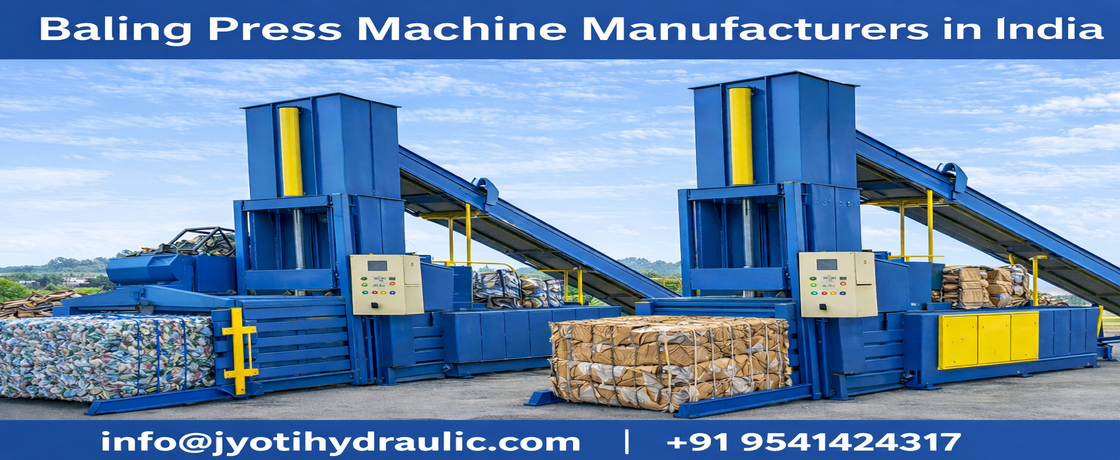
Jyoti Hydraulic offers PET bottle baling equipment for businesses that need to turn bulky bottle waste into manageable loads for storage and dispatch. At a collection centre or recycling yard, the challenge is easy to recognise: empty bottles occupy valuable floor space while contributing relatively little weight to each vehicle load. A PET Bottle Hydraulic Baling Press Machine addresses this handling problem by compressing loose bottles into secured bales that are easier to store, move and transport.
Choosing the right machine involves more than comparing pressing force. Bottle preparation, feeding arrangements, bale dimensions, operating hours and the recycler’s acceptance requirements all influence how effectively a baler performs in everyday use.
This guide explains how PET bottle baling works, where these machines are used, and what buyers should evaluate before investing.
What Is a PET Bottle Hydraulic Baling Press Machine?
A PET bottle hydraulic baling press uses a hydraulic cylinder and pressing plate to compress polyethylene terephthalate bottles inside a chamber. The compressed material is secured with suitable straps or wire, according to the machine design, before the finished bale is removed.
Its primary purpose is to reduce volume and consolidate material for handling. Baling does not wash bottles, separate different polymers or convert PET into recycled granules. Those processes belong to other stages of recycling.
This distinction matters when planning a facility. A baler can make a sorted bottle stream easier to transport, but it cannot turn contaminated mixed waste into clean recycling feedstock.
Industry Overview: Why PET Bottle Handling Matters
PET bottles pass through several stages between collection and reprocessing. Collection operators aggregate small quantities, scrap dealers consolidate loads, and recycling facilities prepare suitable material for further treatment.
At each stage, loose bottles create a mismatch between space and weight. A storage area may become crowded before much material has accumulated. Similarly, a vehicle can reach its usable volume before reaching its permitted payload.
A PET Bottle Baling Machine helps address this mismatch. It is particularly useful where bottles must wait for scheduled collection or travel from scattered collection points to a central recycling facility.
However, compacting material is only part of the job. Buyers may have different requirements for bottle colour, moisture, contaminants, bale dimensions and binding materials. Confirming these requirements before setting up the baling process helps prevent rejected loads and unnecessary rehandling.
For a growing collection business, the practical objective should be consistent, buyer-approved bales produced at a sustainable operating cost.
How Does a Hydraulic PET Bottle Baler Work?
Although operating sequences vary between models, the process generally follows five stages.
1. Inspect and Prepare the Bottles
Operators separate the intended PET stream from unsuitable materials. Glass, metal objects, batteries, aerosols and containers with hazardous residues must not enter an ordinary PET bottle baler.
Residual liquid should be managed through an appropriate collection and drainage process. Whether caps remain attached depends on the machine’s capabilities and the receiving recycler’s specifications.
Good preparation also makes performance more predictable. A batch containing mostly empty beverage bottles behaves differently from one containing mixed containers, residual liquids and unrelated packaging.
2. Feed the Compression Chamber
Bottles enter through a loading opening or an integrated feeding arrangement. The opening size, loading height and material delivery method affect how easily operators can maintain production.
A fast compression stroke offers limited benefit if employees spend most of their time opening bags, removing contamination or carrying bottles to the press.
The feeding arrangement should therefore be considered part of the overall production system.
3. Compress the Material
An electric motor drives the hydraulic pump. The hydraulic circuit directs pressurised oil to the cylinder, moving the pressing plate against the bottles.
The ram then retracts as required for further loading. Several loading and compression cycles may be needed to build one finished bale.
Depending on the machine, controls may manage parts of this sequence automatically. The exact operating procedure should always follow the manufacturer’s instructions.
4. Secure the Bale
The compressed bottles are tied using the specified binding material and approved procedure.
PET tends to recover some volume after compression. Correct strap or wire selection, placement and tension therefore matter to bale stability.
Manual and automatic tying arrangements work differently. Operators should use the procedure designed for the installed machine rather than adapting practices from another baler.
5. Discharge and Transfer the Bale
The completed bale is ejected or removed using the machine’s discharge system. Suitable handling equipment then transfers it to storage or dispatch.
This final movement deserves attention before installation. Even a correctly sized press can create a bottleneck if handling equipment cannot safely approach the discharge point.
Technical Insights That Affect Baling Performance
Pressing Force and Hydraulic Pressure Are Different
Hydraulic pressure describes pressure within the circuit. Pressing force depends on that pressure and the cylinder’s effective piston area.
The basic relationship is:
Force = Pressure × Effective piston area
However, force rating alone does not establish finished bale density. Chamber geometry, bottle condition, compression sequence and the way compressed material is retained also affect the result.
When comparing machines, ask for a demonstration using representative bottles. A force rating is useful engineering information, but it is not a substitute for observing the finished bale.
Trapped Air and Spring-Back Need Attention
Capped bottles can retain air, making compression more difficult. PET also tends to spring back after the pressing load is released.
Purpose-built perforators can puncture bottles before baling to help air escape. Such equipment is used in some PET baling installations, although it is not automatically necessary or included in every system. The appropriate arrangement depends on the bottle stream and baler design. us.hsm.eu
Before selecting a Hydraulic PET Bottle Baler, discuss whether the incoming bottles will be capped, uncapped, flattened or perforated.
Cycle Time Is Not the Same as Production Capacity
A quoted compression cycle may cover only the ram movement. Actual hourly production also includes:
- Loading the chamber.
- Repeated compression cycles.
- Tying the bale.
- Ejecting and moving the finished bale.
- Routine interruptions and material preparation.
A useful planning calculation is:
Required average throughput = Daily PET quantity ÷ Effective operating hours
For example, handling 1,200 kg over six effective processing hours requires an average output of 200 kg per hour.
This is an illustrative calculation, not a machine performance claim. A material trial should establish whether the proposed system can sustain the required output with the available labour.
Bale Density Must Suit Downstream Handling
Bale density is calculated by dividing bale mass by its external volume.
A denser bale may improve transport utilisation, but the receiving facility must still be able to handle and open it. Agree on acceptable dimensions, weight and binding material with the buyer.
The most useful bale is one that remains stable during transport and fits the next processing stage.
Hydraulic Reliability Depends on Operating Conditions
Oil contamination, excessive temperature and damaged seals can affect hydraulic performance. Maintenance access, filtration and cooling suitability therefore deserve attention during machine selection.
Discuss ambient temperature, shift length, dust exposure and cleaning practices with the supplier.
A short demonstration does not establish suitability for sustained operation in a hot, dusty collection yard. The hydraulic system should be assessed against the intended workload.
Applications of a PET Bottle Baling Machine
PET Recycling Facilities
Recycling facilities can use balers to consolidate sorted bottles before transfer to another processing location or to organise material awaiting further treatment.
Where bottles are processed onsite immediately, the facility should first establish whether baling adds value to its particular workflow.
Scrap Collection and Aggregation Yards
Scrap dealers receive bottles in varying quantities and conditions. Baling converts suitable incoming material into more consistent dispatch units.
Separate storage for different grades helps maintain quality and simplifies sales to buyers with specific material requirements.
Material Recovery Facilities
A baler can consolidate a separated PET stream after sorting.
It complements the sorting process; it does not replace it. Contaminants compressed into a bale remain contaminants and may become harder to identify before dispatch.
Beverage Production and Packaging Operations
Beverage facilities may use suitable baling equipment for approved PET bottle rejects or segregated bottle waste.
Filled rejects may require dedicated emptying and liquid-management equipment before baling. The press and surrounding handling process must be appropriate for the actual material.
Commercial Collection Centres
Campuses, hospitality facilities, events and retail collection networks may benefit from consolidated bottle handling when volumes justify an onsite machine.
The decision should consider collection frequency, available labour, storage restrictions and transport arrangements.
Benefits of Hydraulic PET Bottle Baling
Better Use of Storage Space
Compact bales can reduce the space occupied by accumulated bottles and make stock easier to organise.
Actual savings depend on the starting condition of the bottles, achieved bale density and safe storage layout. Bale stacking should follow the facility’s approved handling arrangements.
Improved Transport Utilisation
Where loose bottles fill a vehicle before reaching its permitted weight, baling can increase the amount of material carried per trip.
Savings depend on vehicle dimensions, payload limits, haulage charges and how efficiently the bales fit the available load space.
More Organised Material Handling
Defined bale units make weighing, stock identification and dispatch planning more straightforward.
Batch labels can distinguish collection dates, suppliers or material grades. This becomes particularly useful when a yard handles several streams of recyclable material.
Consistent Presentation to Buyers
Well-sorted, consistently prepared bales can simplify inspection and handling for the receiving recycler.
Baling alone does not guarantee a higher selling price. Contamination, polymer quality, colour mix and market conditions continue to influence commercial value.
Clearer Operating Cost Measurement
A baling operation can be assessed using cost per tonne processed.
Include electricity, labour, binding materials, maintenance and financing costs. Motor size alone does not reveal the total cost of production.
A machine with a larger motor may still have competitive energy use per tonne if it processes suitable material efficiently. Measurement under representative operating conditions is more useful than assumptions.
Buying Guide: How to Select the Right Machine
When evaluating a PET Bottle Baling Press Machine Manufacturer in India, begin with your operating requirements and ask suppliers to explain how their proposed configuration meets them.
| Selection factor | What to confirm |
|---|---|
| Daily bottle quantity | Average volume, seasonal peaks and expected growth |
| Input condition | Bottle sizes, caps, residual liquid and contamination |
| Sustained output | Production including feeding, tying and bale removal |
| Bale specification | Dimensions, weight range and buyer acceptance |
| Installation requirements | Floor suitability, access, electrical supply and maintenance clearance |
| Safety provisions | Guards, interlocks, emergency stops and secure discharge arrangements |
| Service support | Documentation, training, spare parts and written warranty terms |
Match the Machine Layout to the Workload
A vertical baler is often considered where space is limited and batch loading is practical.
A horizontal system may suit a larger, more continuous material flow, particularly where mechanised feeding is required.
These are general selection considerations. Actual output, staffing requirements and installation space depend on the specific machine design.
Request a Representative Material Trial
Provide bottles that reflect normal incoming waste.
Ask the supplier to record input weight, total elapsed time, operator involvement, finished bale dimensions and bale stability after release.
Also consider how the receiving recycler will handle and open the bale. A production trial should demonstrate practical suitability across the process.
Compare the Complete Installed Cost
A useful quotation should clearly define:
- The baling machine and included controls.
- Feeding and discharge accessories.
- The tying arrangement and required consumables.
- Freight and installation responsibilities.
- Commissioning and operator training.
- Warranty coverage and service terms.
Estimate payback using realistic net savings. Include ongoing operating costs and avoid assuming that every baled load will command a premium price.
Future Trends in PET Bottle Baling
When evaluating newer systems, useful features to consider include automated feeding, operating-hour counters, bale weighing and condition monitoring.
For larger facilities, these functions may help identify interruptions and maintain production records. Their value depends on whether the information is used to improve operations.
Energy management also deserves attention. Where suitable, demand-based pump control and automatic idle functions may reduce unnecessary running.
Automation should match the workload. A small collection centre may benefit most from straightforward controls and accessible maintenance. A high-volume facility may justify integrated feeding and production monitoring.
Confirm which features are included in the quoted model and which require additional equipment.
Conclusion
A PET Bottle Hydraulic Baling Press Machine can improve the way a business stores, handles and transports bottle waste. The strongest results come from matching the equipment to actual material conditions, available labour and the receiving recycler’s requirements.
Before ordering, establish the required hourly output, test representative bottles and compare the complete cost of operation. These steps provide a sound basis for investment and help prevent avoidable handling problems after installation.
Jyoti Hydraulic’s PET bottle baling range provides a starting point for discussing equipment requirements around your facility’s material flow and dispatch needs. jyotihydraulic.com
Frequently Asked Questions
1. What is the main purpose of a PET bottle baling machine?
It compresses loose PET bottles into secured bales for easier storage, handling and transport. It prepares material for logistics and further processing; it does not perform the complete recycling process.
2. Can PET bottles be baled with their caps on?
Some systems can handle capped bottles, particularly with suitable perforation or preparation equipment. Confirm the machine’s approved input conditions and the recycler’s requirements before deciding whether to remove caps.
3. How much pressing force is required for PET bottles?
There is no single force rating suitable for every operation. Bottle condition, chamber size, target bale characteristics and required throughput influence selection. A trial using your material is more informative than comparing force ratings alone.
4. Can the same machine bale cardboard or plastic film?
Only if the manufacturer approves those materials for the model. Different materials have different compression and retention characteristics. Keep recycling grades segregated unless the receiving buyer explicitly accepts a mixture.
5. What determines the price of a hydraulic PET bottle baler?
Press design, chamber size, automation, feeding equipment, tying arrangements, electrical components and installation scope influence price. Request an itemised quotation based on your operating requirements.
6. How can I assess whether a baler will save money?
Compare current storage, handling and transport costs with the proposed baling process. Subtract electricity, labour, binding materials, maintenance and financing costs from expected savings. Use demonstrated output and realistic dispatch volumes.
7. What information should I provide when requesting a quotation?
Share your daily PET quantity, bottle condition, working hours, available space, electrical supply and preferred bale dimensions. Photos or a representative material sample can help the supplier assess the application.
Contact Jyoti Hydraulic for Expert Consultation and a Quotation
Ready to improve your PET bottle handling and organise a more efficient dispatch process? Contact Jyoti Hydraulic to discuss your application, request a quotation and get expert consultation on a suitable baling configuration.
Share your daily bottle volume, site details and required bale size so the discussion starts with your actual operating needs.
📧 Email: info@jyotihydraulic.com
📞 Call: +91 9541424317
Request your quotation from Jyoti Hydraulic today and discuss the right PET bottle baling solution for your facility.


