
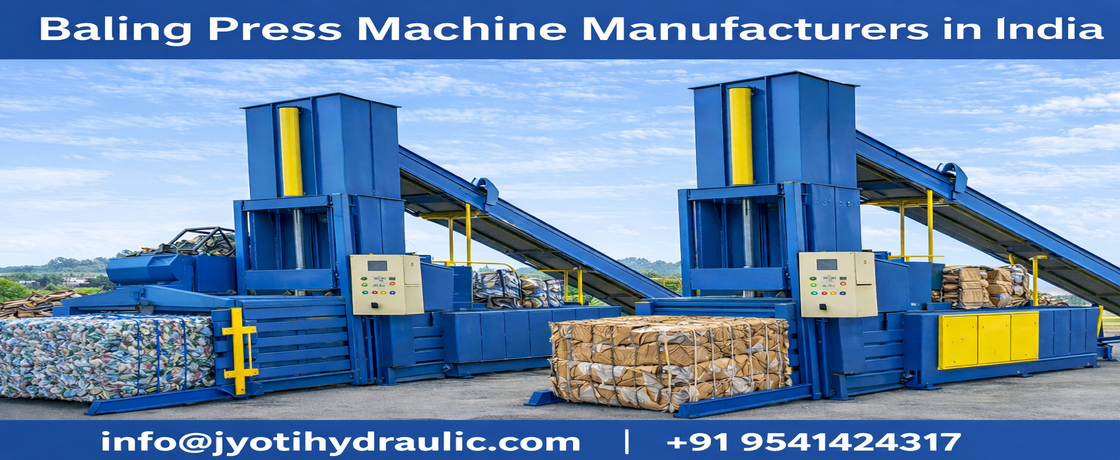
Jyoti Hydraulic stands at the forefront of waste handling and recycling equipment, delivering robust PET bottle press solutions engineered for the real demands of Indian recycling plants. In a market where volume, efficiency, and material recovery decide profitability, a reliable PET bottle baling system is not just a machine—it is a production asset. For recyclers, aggregators, MRF operators, plastic processors, and sustainability-driven businesses, the right PET bottle press machine improves storage efficiency, streamlines transportation, reduces manual handling, and supports consistent output quality. That is why businesses searching for PET Bottle Baling Press Machine Manufacturers in India increasingly prioritize proven engineering, durable hydraulic systems, and dependable after-sales support.
Introduction
India’s recycling ecosystem is evolving rapidly. With growing awareness around plastic waste management, stricter segregation practices, and higher demand for recycled PET flakes and granules, PET bottle handling has become a critical operational step. Loose bottles occupy excessive space, increase transport costs, and create inefficiencies across the collection-to-processing chain. A PET bottle press machine solves this problem by compressing lightweight plastic bottles into compact, manageable bales.
For recycling plants, this process directly impacts daily productivity. Well-compressed PET bales are easier to store, stack, load, and move. They also support better inventory discipline and cleaner plant layouts. This is where experienced Baling Press Machine Manufacturers bring real value—by designing systems that match plant capacity, labor availability, power conditions, and material characteristics.
Industry Overview: Recycling in India and the Role of PET Bottle Baling
India’s recycling sector includes scrap traders, waste collection centers, dry waste processing facilities, municipal contractors, plastic reclaimers, packaging waste handlers, and industrial recyclers. Among the many recyclable materials handled daily, PET bottles remain one of the most visible and commercially relevant streams. They come from beverage packaging, household consumption, hospitality, events, commercial establishments, and industrial packaging supply chains.
However, PET bottles present a clear operational challenge: high volume and low density. Without compression, they consume large storage areas and make logistics expensive. This affects every stage of the value chain:
- Collection centers struggle with space constraints
- Transporters move more air than material
- Sorting facilities face workflow bottlenecks
- Recycling plants receive inconsistent feedstock packaging
A PET bottle press machine addresses these issues by transforming scattered, bulky bottles into dense bales suitable for organized handling. This is why many recyclers looking for Scrap Baling Machine Manufacturers in India specifically seek machines optimized for PET, HDPE, LDPE films, paper-plastic combinations, and mixed dry waste.
In practical plant operations, baling is not merely a storage function. It is a process control point. Good baling improves downstream handling, supports better dispatch planning, and reduces contamination risk when material is secured properly.
Technical Insights: How a PET Bottle Press Machine Works
A PET bottle press machine, also called a PET bottle baling press, uses hydraulic force to compress loose plastic bottles inside a baling chamber. Once sufficient material is loaded, the compression ram applies pressure to reduce the volume drastically. The compressed mass is then tied using straps, wires, or manual tying material before being ejected as a compact bale.
Basic Working Principle
- Loose PET bottles are fed into the chamber
- The hydraulic ram compresses the material vertically or horizontally
- Repeated strokes increase density
- The bale is tied securely
- The finished bale is removed for stacking, transport, or further processing
Main Components
A high-quality PET bottle press machine typically includes:
- Heavy-duty steel chamber
- Hydraulic cylinder and power pack
- Compression ram or platen
- Electric motor and control panel
- Bale ejection mechanism
- Manual, semi-automatic, or automatic tying arrangement
- Safety interlocks and pressure control system
Common Technical Considerations
Depending on plant size and material load, machine specifications may vary in terms of:
- Bale size and bale weight
- Chamber dimensions
- Hydraulic pressure capacity
- Cycle time
- Motor rating
- Feed opening size
- Throughput per hour or per shift
- Manual or PLC-based controls
Leading PET Bottle Baling Press Machine Manufacturers in India design machines according to actual operating conditions rather than generic catalog standards. For example, a plant handling post-consumer PET bottles with labels and caps may need different chamber sizing and compression logic than a facility processing pre-sorted, crushed bottle scrap.
Vertical vs. Horizontal Baling Machines
Vertical balers are often preferred for moderate-volume operations, collection centers, warehouses, and smaller recycling units. They are compact, cost-effective, and easy to install.
Horizontal balers are more suitable for higher-throughput plants where faster feeding, larger bale output, and continuous operation are essential. These machines are often chosen by large recycling facilities and integrated waste processing units.
Applications: Where PET Bottle Press Machines Are Used
PET bottle press machines serve a wide range of industries and waste management operations. Their applications go well beyond conventional recycling yards.
Primary Use Areas
Recycling plants:
For densifying sorted PET bottles before shredding, washing, or dispatch.
Material Recovery Facilities (MRFs):
To compact segregated plastic streams into uniform bales.
Scrap collection centers:
To improve storage and reduce transport frequency.
Municipal solid waste processing units:
For handling recyclable dry waste fractions efficiently.
Warehouses and distribution centers:
For managing packaging waste and used bottles generated on-site.
Beverage and FMCG industries:
For internal waste compaction and reverse logistics programs.
Hospitality, institutions, and event waste management:
For controlling high-volume PET waste generation in limited spaces.
Recyclers that work with multiple waste streams also prefer versatile solutions from trusted Scrap Baling Machine Manufacturers in India, since the same machine platform can often be adapted for cardboard, plastic film, woven sacks, aluminum cans, and other recyclable scrap.
Key Benefits of a PET Bottle Press Machine
1. Significant Volume Reduction
PET bottles are bulky and difficult to store in loose form. A press machine compresses them into dense bales, freeing up valuable floor space and improving material handling efficiency.
2. Lower Transportation Cost
Compacted bales mean more material can be loaded per trip. This directly reduces fuel cost, labor cost, vehicle dependency, and dispatch complexity.
3. Better Plant Housekeeping
Loose bottles create clutter, dust accumulation, and workflow interruptions. Baled material helps maintain cleaner, safer, and more organized operating conditions.
4. Faster Material Movement
Bales are easier to stack, forklift, count, and dispatch. This supports better operational planning and inventory tracking.
5. Improved Commercial Value
Neatly packed bales are often easier to trade because buyers prefer consistent, manageable loads. Better bale quality can improve acceptance and reduce handling disputes.
6. Reduced Manual Handling Stress
A good baling press reduces repetitive handling of loose plastic waste, improving labor productivity and workplace safety.
7. Environmental Efficiency
Compaction supports smarter logistics, lower transport emissions per unit of material moved, and a more disciplined recycling process overall.
This is why businesses evaluating Baling Press Machine Manufacturers should look beyond price alone and focus on lifecycle efficiency.
Buying Guide: How to Choose the Right PET Bottle Press Machine
Selecting the right machine requires a practical understanding of your plant’s present and future needs. A machine that is too small creates bottlenecks. A machine that is oversized may increase unnecessary capital cost.
Key Factors to Consider
Material Type and Condition
Are you handling whole bottles, crushed bottles, labeled bottles, mixed PET scrap, or contaminated post-consumer waste? Material condition affects compression behavior and bale density.
Daily Throughput
Estimate how much PET waste you process per day or per shift. This helps determine the required chamber size, cycle speed, and motor capacity.
Bale Size Requirement
Consider what your downstream buyer, transporter, or warehouse can handle. Bale size should match logistics convenience and storage practices.
Space Availability
Floor layout matters. Vertical balers suit compact sites, while horizontal systems need more installation space and handling infrastructure.
Power Supply and Operational Stability
The machine should be suitable for your available electrical setup and local working conditions.
Automation Level
Manual machines are budget-friendly, but semi-automatic or automatic models improve consistency and reduce dependence on operator skill.
Build Quality
Look for thick plate construction, quality hydraulic seals, reliable cylinders, durable control panels, and strong weld integrity.
Service and Spare Support
A machine is only as good as the support behind it. Established PET Bottle Baling Press Machine Manufacturers in India typically offer commissioning assistance, maintenance guidance, spare parts, and troubleshooting support.
Customization Capability
Every plant is different. Choose a manufacturer that understands real process variation and can tailor the machine accordingly.
Future Trends in PET Recycling Machinery
The recycling machinery segment is moving toward smarter, safer, and more energy-efficient systems. Buyers today are more informed, and they expect machines that deliver performance as well as reliability.
Emerging Trends Include
Automation integration:
PLC controls, sensor-based operation, stroke optimization, and operator-friendly HMIs are becoming more common.
Energy-efficient hydraulics:
Modern hydraulic design reduces power wastage and improves operating efficiency.
Higher bale consistency:
Better pressure control and chamber engineering are enabling more uniform bale output.
Low-maintenance machine architecture:
Improved hose routing, accessible service points, and rugged components reduce downtime.
Multi-material adaptability:
Plants increasingly want one robust system that can handle PET bottles along with other recyclable scrap streams.
Safety-first designs:
Interlocks, emergency stop systems, guarded access points, and user-safe control layouts are becoming standard expectations.
For buyers comparing Scrap Baling Machine Manufacturers in India, future-readiness matters. A machine should not just solve today’s storage issue; it should support tomorrow’s capacity expansion and process discipline.
Conclusion
A PET bottle press machine is an essential investment for modern recycling plants in India. It improves storage efficiency, lowers logistics cost, enhances workflow control, and supports a more professional recycling operation. In an industry where margins depend on movement, density, and discipline, the right baling solution can make a measurable operational difference.
Businesses searching for PET Bottle Baling Press Machine Manufacturers in India, reliable Baling Press Machine Manufacturers, or trusted Scrap Baling Machine Manufacturers in India should prioritize engineering quality, customization capability, and service commitment. Jyoti Hydraulic brings all three together—delivering high-performance baling press solutions built for Indian recycling conditions and long-term industrial use.
Frequently Asked Questions
1. What is a PET bottle press machine used for?
A PET bottle press machine is used to compress loose PET bottles into compact bales for easier storage, handling, and transportation in recycling plants, collection centers, and waste processing units.
2. Why do recycling plants need a PET bottle baling press?
Recycling plants need a baling press because PET bottles are bulky and low-density. Baling reduces volume, saves storage space, lowers transport cost, and improves plant efficiency.
3. How do I choose the best PET Bottle Baling Press Machine Manufacturers in India?
Choose a manufacturer based on machine build quality, hydraulic performance, customization options, after-sales service, spare parts support, and understanding of actual recycling plant requirements.
4. What is the difference between a vertical baler and a horizontal baler?
A vertical baler is generally more compact and suitable for medium-volume operations, while a horizontal baler is ideal for larger recycling facilities requiring higher throughput and faster material handling.
5. Can a PET bottle press machine handle other scrap materials?
Yes, many machines from experienced Baling Press Machine Manufacturers can also handle cardboard, plastic film, woven bags, paper waste, and other recyclable scrap depending on design and application.
6. What maintenance does a PET bottle baling machine require?
Routine maintenance usually includes checking hydraulic oil, inspecting seals and hoses, tightening fittings, cleaning the chamber, lubricating moving parts, and monitoring electrical controls for smooth operation.
7. Why should I buy from established Scrap Baling Machine Manufacturers in India?
Established manufacturers typically provide stronger machine construction, better technical support, easier spare availability, and more reliable long-term performance, which reduces downtime and ownership cost.
Get in Touch with Jyoti Hydraulic
Looking for a dependable PET bottle press machine for your recycling plant? Connect with Jyoti Hydraulic for the right solution tailored to your material type, capacity, and plant layout.
Whether you need technical guidance, a customized machine recommendation, or a competitive commercial proposal, our team is ready to assist.
Contact us for inquiries, request a quotation, or get expert consultation today.
📧 info@jyotihydraulic.com
📞 +91 9541424317


