
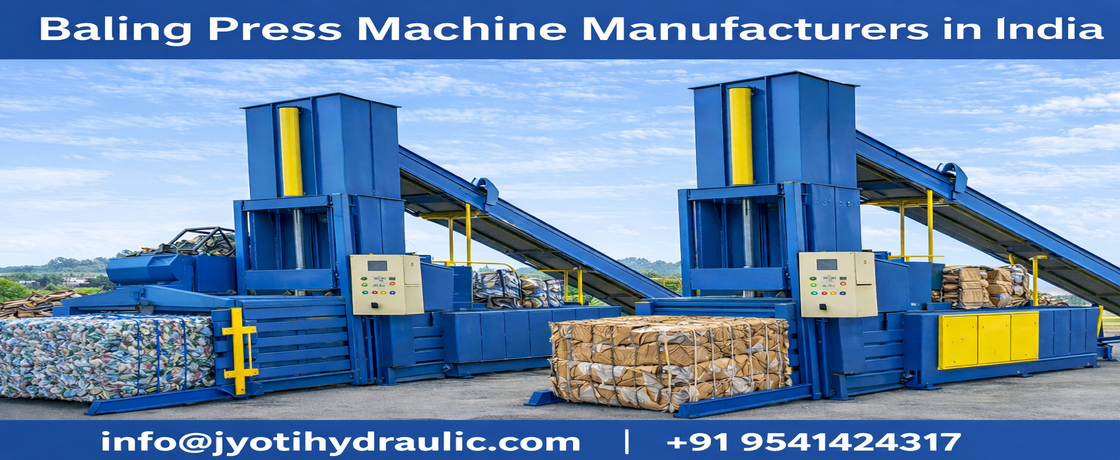
Jyoti Hydraulic stands at the intersection of industrial productivity and responsible waste handling, offering robust baling solutions built for the realities of Indian manufacturing, recycling, warehousing, packaging, and municipal solid-waste operations. As plastic consumption rises across FMCG, beverages, logistics, retail, and industrial packaging, businesses are under growing pressure to manage PET bottles and other plastic scrap efficiently. That is why demand is steadily increasing for PET Bottle Baling Press Machine Manufacturers in India, Scrap Baling Machine Manufacturers in India, and reliable Baling Press Machine Manufacturers that can deliver performance, durability, and long-term return on investment.
A plastic bottle baling machine is no longer just a waste-compaction unit. For modern plants, it is a strategic asset that reduces storage space, lowers transportation costs, improves housekeeping, supports EPR and recycling workflows, and creates a cleaner, safer, and more profitable waste stream. For industrial buyers and decision-makers, choosing the right baling press machine can directly influence operating efficiency, labor productivity, sustainability metrics, and resale value of recoverable scrap.
Plastic Waste Management Industry Overview: India and Global Trends
Plastic waste management has become a major industrial and policy priority worldwide. OECD reports that global plastic production doubled from 234 million tonnes in 2000 to 460 million tonnes in 2019, while plastic waste rose to 353 million tonnes; after losses in the recycling chain, only 9% of plastic waste was ultimately recycled. OECD also warns that without stronger action, annual plastics production, use, and waste generation could increase by around 70% by 2040 compared with 2020.
The urgency is equally visible in environmental policy. UNEP notes that plastic pollution remains a global challenge, and under a business-as-usual scenario, plastic waste is projected to nearly triple by 2060. UNEP’s 2024 waste outlook also reinforces that better collection, segregation, compaction, and circular waste systems are central to reducing environmental and economic losses.
In India, the picture is equally significant. The country’s packaging and plastics ecosystem is expanding rapidly, supported by growth in FMCG, beverages, food processing, pharmaceuticals, e-commerce, and organized retail. India became the world’s third-largest packaging market in 2024, according to IBEF, which means the volume of post-consumer and post-industrial packaging waste, including PET bottles, shrink wraps, rigid containers, and plastic film, is also scaling up quickly.
At the policy level, India’s circular economy and EPR ecosystem is also evolving. A 2026 PIB release reported 2,986 registered plastic-waste recyclers and 196.97 lakh metric tonnes of plastic waste recycled under the system referenced there, showing the increasing formalization of recycling infrastructure and compliance-driven waste handling.
For this reason, industrial users are increasingly investing in baling systems that can compress loose plastic bottles and scrap into dense, stackable bales for efficient storage, handling, dispatch, and recycling.
What Is a Plastic Bottle Baling Machine?
A plastic bottle baling machine is a hydraulic compaction system designed to compress PET bottles, HDPE containers, soft plastics, rigid plastic scrap, and other recyclable waste into compact bales. These bales are tied using straps or wires and then moved for storage, transport, or sale to recyclers.
The machine works on a simple but highly effective principle: hydraulic force is applied to a chamber filled with plastic waste, reducing its volume significantly. Once the desired density is achieved, the compressed material is tied and ejected as a bale.
Basic Working Principle
- Loose plastic bottles or scrap are loaded into the chamber.
- A hydraulic ram compresses the material under high pressure.
- Compression cycles continue until the required bale density is reached.
- The bale is tied manually, semi-automatically, or automatically depending on the machine design.
- The compacted bale is ejected for storage or transport.
This simple compaction process delivers major operational benefits. Plastic bottles are bulky but lightweight, so they consume excessive floor space and inflate logistics costs when handled in loose form. A baling press transforms this low-density waste into a valuable, tradable, and easy-to-manage material stream.
Technical Insights: Understanding Plastic Bottle Baling Machines
Industrial buyers should look beyond the basic machine label and evaluate technical suitability. The right machine depends on waste volume, bottle type, available space, labor model, throughput requirement, and downstream recycling needs.
Machine Types: Vertical, Horizontal, and Automatic Baling Systems
Vertical Plastic Bottle Baling Machine
Vertical balers are widely used in warehouses, retail back-end operations, small recycling yards, hotels, institutions, bottling units, and medium-scale manufacturing facilities.
Key characteristics:
- Compact footprint
- Front-loading or top-loading design
- Lower capital cost
- Suitable for moderate waste generation
- Manual or semi-automatic bale tying
These machines are ideal where floor space is limited and daily scrap generation is manageable.
Horizontal Baling Press Machine
Horizontal balers are preferred in larger industrial environments where continuous waste generation is high. These are commonly installed in recycling plants, beverage facilities, MRFs, packaging units, large distribution centers, and municipal processing lines.
Key characteristics:
- Higher throughput
- Continuous feeding capability
- Better suited for conveyor integration
- Improved bale uniformity
- Lower labor dependency for high-volume operations
Horizontal machines are excellent for businesses that need faster processing and more standardized bale output.
Automatic Baling Press Machine
Automatic balers are designed for large-scale, continuous-duty operations. They include PLC-based controls, auto-feed integration, auto-compaction cycles, and automatic tying systems.
Best suited for:
- Large recycling operations
- High-output packaging lines
- Municipal waste sorting facilities
- Beverage bottling and large FMCG plants
- Industrial scrap aggregation centers
For enterprises targeting process automation, data tracking, and lower manpower dependency, automatic balers offer strong long-term value.
Compression Force, Capacity, and Automation
Baling machines are typically evaluated by:
1. Compression Force
Compression force determines how effectively the machine can compact PET bottles and plastic scrap into dense bales. Higher-tonnage machines generally produce tighter bales, improving storage and transport efficiency.
2. Bale Size and Bale Weight
Bale dimensions should match your storage system, forklift handling capability, and transporter requirements. Overly large bales can create handling difficulties, while undersized bales reduce logistics efficiency.
3. Throughput Capacity
Capacity is often measured in kilograms or tonnes per hour, depending on waste type and machine configuration. This should align with your average and peak waste generation.
4. Automation Level
Options include:
- Manual feeding and tying
- Semi-automatic cycles
- PLC-controlled automatic operation
- Conveyor-fed continuous baling systems
A higher automation level usually improves consistency, safety, and labor productivity.
Key Components and Build Quality
A high-performance plastic bottle baling press machine should be built for continuous industrial use. Critical elements include:
Hydraulic Power Pack
The hydraulic system is the heart of the machine. Efficient cylinders, pumps, valves, and seals ensure smooth force generation and stable pressure performance.
Compression Chamber
The chamber must be designed for wear resistance and structural integrity, especially in facilities handling abrasive mixed plastic scrap.
Pressing Ram
A rigid, well-guided ram improves compression uniformity and reduces mechanical stress during repeated cycles.
Electrical and Control Panel
Advanced machines may include PLC control, interlocks, overload protection, auto-cycle settings, and emergency stop features for safer operation.
Bale Ejection System
Reliable ejection reduces downtime and improves operator convenience.
Structural Steel Fabrication
Heavy-duty steel construction improves machine life, dimensional stability, and resistance to fatigue under repeated compaction loads.
For industrial users, machine build quality is not a cosmetic issue. It directly affects uptime, maintenance cost, bale density, and lifecycle economics.
Applications Across Industries
A plastic bottle baling machine is used across a wide range of sectors because plastic waste is generated almost everywhere in organized industry.
Common industry applications include:
- Beverage plants for PET bottles and packaging scrap
- FMCG manufacturing for rigid and flexible plastic waste
- Pharmaceutical units for secondary packaging plastics
- Retail chains and malls for back-end bottle and carton recovery
- Warehousing and logistics hubs for stretch film, bottles, and packaging waste
- Hotels, hospitals, and institutions for segregated recyclable waste
- Plastic recycling units for feedstock preparation
- Municipal material recovery facilities for volume reduction before dispatch
- Airports, railway stations, and public facilities for centralized bottle collection
In all these applications, baling improves site cleanliness, reduces clutter, and makes recyclable waste commercially manageable.
Key Benefits and ROI of a Plastic Bottle Baling Machine
Industrial buyers typically evaluate equipment based on financial return, process advantage, and compliance value. A plastic bottle baling machine performs strongly in all three areas.
1. Major Space Savings
Loose PET bottles occupy excessive floor area. Baling can reduce storage volume dramatically, freeing up usable plant space for productive operations.
2. Lower Transportation Cost
Dense, uniform bales reduce the number of trips needed to move scrap to recyclers or aggregation points. This cuts freight cost per kilogram.
3. Better Scrap Value
Well-compacted, segregated plastic bales are easier for recyclers to handle and often command better commercial acceptance than loose, contaminated waste.
4. Improved Housekeeping and Safety
Waste piles create fire risk, workflow obstruction, and pest issues. Baling promotes a cleaner, safer industrial environment.
5. Labor Efficiency
A structured baling process reduces repeated handling, collection inefficiency, and manual bulk movement.
6. Sustainability and Compliance Support
Baling supports organized segregation, dispatch documentation, and circular economy practices. In a tightening compliance environment, this matters strategically.
7. Faster Waste Monetization
Instead of treating plastic waste as a disposal problem, baling helps convert it into a recoverable revenue stream.
Buying Guide: How to Select the Right Plastic Bottle Baling Machine
Choosing the right machine requires a practical evaluation of your current and future waste profile.
1. Assess Daily Waste Volume
Estimate:
- Daily PET bottle generation
- Peak seasonal load
- Mixed plastic vs. segregated plastic proportion
- Number of shifts
- Available storage time before dispatch
A machine that is too small will create bottlenecks. A machine that is oversized may increase capital cost without proportional returns.
2. Choose the Right Automation Level
Ask:
- Will the machine be operated by dedicated staff or shared manpower?
- Is continuous operation required?
- Do you want conveyor integration?
- Is bale consistency important for resale or downstream processing?
Low to medium volume facilities may prefer vertical or semi-automatic systems, while high-volume industrial operations may justify horizontal or fully automatic balers.
3. Evaluate Machine Construction
Focus on:
- Cylinder quality
- Steel thickness and frame design
- Hydraulic component quality
- Electrical safety
- Ease of servicing
- Availability of spare parts
A lower upfront price should never be the only buying criterion in industrial machinery.
4. Check Manufacturer Reliability
When shortlisting PET Bottle Baling Press Machine Manufacturers in India or Scrap Baling Machine Manufacturers in India, evaluate:
- Industry experience
- Installed machine base
- Engineering capability
- Customization options
- Service responsiveness
- Warranty support
- Delivery commitment
- Client reputation
The best Baling Press Machine Manufacturers are those who understand actual plant conditions, not just machine catalogues.
5. Consider Lifecycle Value, Not Only Purchase Price
A good machine pays for itself through:
- Lower waste handling cost
- Better scrap realization
- Reduced labor dependency
- Improved floor utilization
- Fewer transport cycles
- Higher uptime
That is the real ROI framework industrial buyers should use.
Why Choose Jyoti Hydraulic?
Jyoti Hydraulic is positioned to serve businesses that need industrial-grade baling systems with dependable performance, structural strength, and application-specific engineering. In a market crowded with generic equipment, the difference lies in understanding waste behavior, compaction requirements, user safety, and long-term serviceability.
What makes Jyoti Hydraulic a dependable choice?
- Strong focus on industrial hydraulic machinery
- Solutions designed for real waste-handling environments
- Durable fabrication and heavy-duty construction
- Machines suitable for PET bottles, plastic scrap, and other recyclables
- Practical engineering aligned with Indian industrial operating conditions
- Support for productivity, sustainability, and waste monetization goals
For buyers comparing PET Bottle Baling Press Machine Manufacturers in India, Scrap Baling Machine Manufacturers in India, and established Baling Press Machine Manufacturers, Jyoti Hydraulic offers the kind of focused expertise that matters in daily operations: machine reliability, bale quality, and application fit.
Future Trends in Waste Recycling and Baling Technology
The future of baling technology will be shaped by automation, traceability, energy efficiency, and circular-material recovery.
Key trends to watch:
Smart Automation
PLC and sensor-based systems will become more common for cycle optimization, fault alerts, and productivity monitoring.
Integrated Waste Lines
Baling machines will increasingly be integrated with conveyors, shredders, sorters, and material recovery systems.
Better Bale Standardization
As recycling becomes more formalized, processors will demand more consistent bale dimensions and density.
Energy-Efficient Hydraulics
Hydraulic systems will continue improving through better valve design, power optimization, and lower maintenance requirements.
EPR and Compliance-Driven Waste Handling
As recycling ecosystems become more structured, businesses will need cleaner segregation and more accountable material flow.
Circular Economy Infrastructure
Global and Indian policy signals both point toward stronger circularity systems, making plastic compaction and recovery equipment more important over time.
For industrial operators, this means baling is not a temporary fix. It is a foundational component of future-ready waste management infrastructure.
Conclusion
A plastic bottle baling machine is one of the most practical and high-impact investments for companies dealing with PET bottles, packaging waste, and recyclable plastic scrap. It reduces waste volume, cuts handling and transport cost, improves site discipline, strengthens sustainability efforts, and converts loose waste into a compact, saleable resource.
As the recycling ecosystem grows and compliance standards tighten, businesses need machinery that is engineered for performance, consistency, and industrial reliability. That is why selecting the right partner matters just as much as selecting the right machine.
If you are searching for trusted PET Bottle Baling Press Machine Manufacturers in India, dependable Scrap Baling Machine Manufacturers in India, or experienced Baling Press Machine Manufacturers, Jyoti Hydraulic offers the engineering mindset and industrial understanding needed to support efficient waste compaction and smarter material recovery.
FAQs
1. What is a plastic bottle baling machine used for?
A plastic bottle baling machine is used to compress PET bottles and other plastic waste into dense, compact bales for easier storage, transportation, and recycling.
2. Which industries need a PET bottle baling press machine?
Beverage plants, FMCG units, warehouses, retail chains, recycling plants, packaging units, hotels, hospitals, and municipal waste facilities commonly use PET bottle baling machines.
3. How do I choose the best PET Bottle Baling Press Machine Manufacturers in India?
Look for engineering quality, machine durability, hydraulic performance, customization capability, after-sales support, spare parts availability, and proven industrial experience.
4. What is the difference between a vertical and horizontal baling press machine?
A vertical baler is compact and suitable for moderate waste volumes, while a horizontal baler is designed for higher throughput, continuous feeding, and larger-scale industrial operations.
5. Why is a baling press machine important for plastic waste management?
It reduces waste volume, lowers transportation cost, improves storage efficiency, enhances workplace cleanliness, and supports organized recycling.
6. Do scrap baling machines improve ROI for industrial users?
Yes. Scrap baling machines reduce manual handling, improve scrap value, optimize storage space, and lower dispatch costs, which together improve overall return on investment.
7. Why should I work with experienced Scrap Baling Machine Manufacturers in India?
Experienced manufacturers understand real industrial applications, provide better machine design, ensure durable build quality, and offer more dependable support throughout the machine lifecycle.
Get the Best Industrial Solution Tailored to Your Needs Today
Looking for a powerful, reliable, and cost-effective plastic waste compaction solution for your plant, warehouse, recycling yard, or industrial facility?
Contact Jyoti Hydraulic today for expert guidance, technical consultation, and a competitive quotation tailored to your waste volume and application needs.
Email: info@jyotihydraulic.com
Phone: +91 9541424317
Make the smart move now—improve waste handling efficiency, reduce operating cost, and strengthen your sustainability performance with the right baling solution from Jyoti Hydraulic.


