
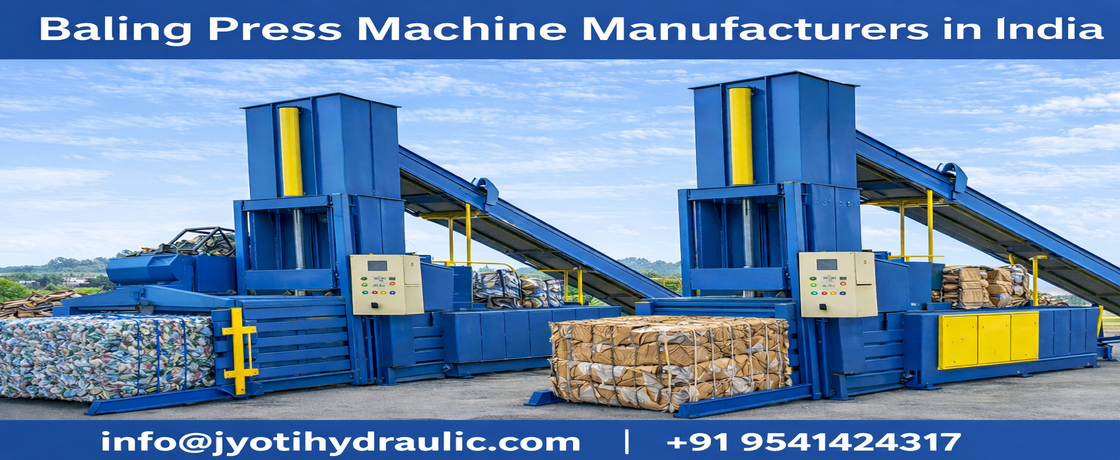
Jyoti Hydraulic understands that waste handling is no longer just a housekeeping task for factories, recyclers, warehouses, municipalities, and scrap traders. It is now a critical part of operational efficiency, compliance, sustainability, and profitability. A plastic waste baling press machine helps businesses convert loose, bulky, low-density plastic waste into compact, manageable bales that are easier to store, transport, and sell. Choosing the right machine, however, requires more than comparing tonnage and price. Buyers need to evaluate material type, output goals, automation level, safety, maintenance, and long-term return on investment.
Introduction
Plastic waste is one of the most challenging waste streams in modern industry. PET bottles, HDPE containers, woven sacks, shrink film, multilayer packaging, and post-industrial plastic trim consume valuable floor space and increase transportation costs when stored in loose form. A Baling Press Machine addresses this problem by compressing waste into dense bales that can be tied, stacked, and moved efficiently.
For manufacturers, recycling units, FMCG plants, distribution centers, textile industries, packaging companies, and municipal waste processors, investing in the right baling system can significantly improve workflow. It reduces manual handling, supports cleaner premises, improves scrap value realization, and creates a more organized recycling chain.
This guide explains how plastic waste baling press machines work, where they are used, what technical factors matter most, and how to choose a machine that matches your production realities.
Industry Overview
The waste processing industry in India has seen major growth due to stricter environmental awareness, rising logistics costs, and the increasing commercial value of recyclable materials. Plastic waste, once treated as a disposal burden, is now a recoverable asset when managed correctly.
Industries today generate a wide range of recyclable waste:
- PET bottles from beverage and packaging sectors
- Plastic film from packaging and warehousing operations
- HDPE and PP containers from chemical and consumer goods plants
- Woven bags from agriculture and feed industries
- Corrugated boxes, paper trim, textile waste, and metal scrap from mixed manufacturing units
Because waste streams differ in density and rebound behavior, buyers often require different baling solutions. This is why companies searching for PET Bottle Baling Press Machine Manufacturers in India usually need machines designed for high-volume, lightweight, rebound-prone materials, while those looking for Iron Scrap Baling Machine Manufacturers in India typically need far heavier-duty systems capable of handling dense, rigid, and abrasive scrap. Similarly, broader searches for Scrap Baling Machine Manufacturers in India often come from businesses handling mixed recyclable streams and requiring custom engineering.
In this landscape, machine selection is no longer about simply compressing material. It is about matching hydraulic force, chamber size, feeding method, bale density, and cycle time with actual operational demand.
What Is a Plastic Waste Baling Press Machine?
A plastic waste baling press machine is a hydraulic compaction system used to compress loose plastic waste into compact bales. The machine applies pressure through a hydraulic cylinder and platen to reduce material volume. Once compressed, the bale is tied using wire, strap, or other binding material and then ejected manually, mechanically, or automatically depending on the machine type.
Common machine categories include:
- Vertical baling press machines
- Horizontal baling press machines
- Semi-automatic balers
- Fully automatic baling lines
- Multi-material balers for mixed dry waste
Vertical models are typically preferred for moderate volume generation and limited floor space. Horizontal balers are ideal for continuous, high-volume waste handling with conveyor-fed systems.
Technical Insights Buyers Must Understand
A serious buyer should never judge a baler by pressure rating alone. Several technical parameters decide real-world performance.
1. Hydraulic Force
Compaction force, often measured in tons, determines how effectively the machine compresses the material. Plastic films and bottles behave differently from rigid scrap. PET bottles may require strong compression to overcome spring-back and improve bale density.
2. Chamber Size
The chamber dimensions influence how much material can be loaded per cycle. A machine with the wrong chamber size may create bottlenecks or underperform in bale consistency. Large-volume waste generators should consider chamber size along with feed method.
3. Bale Size and Bale Weight
Bale dimensions must align with downstream logistics. If your bales are too large, forklift handling and truck loading become inefficient. If too small, transport economics suffer. Ideal bale weight depends on storage, labor, and buyer requirements in the recycling market.
4. Cycle Time
A faster cycle time improves output but must be balanced with hydraulic stability and machine durability. For continuous operations, the machine should sustain repeated cycles without overheating or excessive wear.
5. Material Rebound Control
Plastic waste, especially PET bottles and film, tends to expand after pressure release. Proper chamber design, retaining claws, platen structure, and tying arrangement help maintain bale shape and density.
6. Power Pack Design
A well-engineered hydraulic power pack is essential for reliability. Pump capacity, motor rating, oil cooling, valve quality, and filtration determine machine life and performance consistency.
7. Automation Level
Machines can be manual, semi-automatic, or fully automatic. The right level depends on labor availability, waste volume, and required throughput. Automation improves consistency and reduces dependence on operator skill.
8. Safety Features
Industrial balers should include emergency stop systems, pressure control, interlocked doors, overload protection, and operator-safe loading/ejection mechanisms. Safety is not an optional extra; it is a core selection criterion.
9. Structural Strength
Frame rigidity matters. Plastic waste may seem soft, but repeated hydraulic loading creates immense structural stress. Heavy-duty steel construction, proper welding, and quality fabrication prevent deformation over time.
10. Ease of Maintenance
Machine uptime depends on accessible service points, dependable seals, standard hydraulic components, and manufacturer support. A cheaper machine with poor after-sales service often becomes a costly decision.
Applications of Plastic Waste Baling Press Machines
Plastic balers are used across a wide range of industries because loose recyclable waste is generated almost everywhere.
Manufacturing Plants
Plastic packaging scrap, rejected molded parts, process trim, liners, and containers are baled for in-house recycling or resale.
Warehouses and Logistics Hubs
Stretch film, shrink wrap, pallet covers, and plastic strapping accumulate quickly. A baler helps maintain clean storage areas and reduces fire risk.
Beverage and Bottling Units
PET bottle rejection, cap waste, label waste, and packaging residues are ideal for compaction. This is where interest in PET Bottle Baling Press Machine Manufacturers in India is especially high.
Municipal and MRF Facilities
Material recovery facilities handle mixed post-consumer plastic streams that need densification before transport to recyclers.
Retail Chains and E-commerce Packaging Centers
Large-scale unpacking and packaging operations generate significant quantities of plastic film and corrugated waste that must be compacted efficiently.
Integrated Scrap Processing Units
Some facilities process plastic, paper, textile, and metal scrap together. These buyers often compare options from Scrap Baling Machine Manufacturers in India to identify versatile or custom-built machinery.
Benefits of Investing in the Right Baling Press Machine
A high-quality Baling Press Machine provides measurable business value beyond waste compaction.
Reduced Storage Space
Loose plastic occupies enormous floor area. Baling can reduce volume dramatically, helping businesses free up usable space for production or inventory.
Lower Transportation Cost
Compacted bales mean fewer trips, better vehicle utilization, and lower freight cost per ton.
Better Scrap Value
Well-packed, uniform bales are easier for recyclers to handle and often command better pricing than loose, contaminated material.
Cleaner and Safer Workplace
Waste scattered across production or warehouse floors causes clutter, operational inefficiency, and safety hazards. Baling improves housekeeping and workflow discipline.
Improved Sustainability
Efficient waste segregation and baling support recycling goals and demonstrate environmental responsibility to regulators, customers, and stakeholders.
Lower Labor Dependency
Automated or semi-automatic balers reduce manual handling effort and improve productivity.
Stronger Waste Management Control
A baler converts waste handling from a reactive activity into a structured process with better planning, traceability, and resale management.
Complete Buying Guide: How to Choose the Right Machine
Selecting the right baling machine requires a technical and commercial evaluation. Here is what smart buyers should check.
1. Identify Your Material Type
Start by defining the exact material:
- PET bottles
- Plastic film
- HDPE drums or containers
- Woven sacks
- Mixed dry recyclables
- Metal scrap or mixed scrap
Different materials behave differently under compression. Plastic films are fluffy and elastic, while bottles are hollow and rebound-prone. Iron scrap demands a completely different structural and hydraulic design. That is why businesses searching for Iron Scrap Baling Machine Manufacturers in India should avoid assuming that a plastic baler can handle metal waste.
2. Measure Daily Waste Volume
Estimate waste generation per shift, per day, and per month. A machine that is too small will create backlog. A machine that is too large may increase capital cost unnecessarily.
3. Decide Between Vertical and Horizontal
- Vertical balers: Suitable for lower to medium volumes, lower budget, and limited space.
- Horizontal balers: Best for high-throughput operations, conveyor-fed waste, and continuous processing.
4. Check Bale Handling Requirements
Do you want manual bale removal, hydraulic ejection, or automatic discharge? Will you use a pallet truck or forklift? These practical details affect daily efficiency more than buyers often realize.
5. Evaluate Power Consumption vs Output
Energy efficiency matters, but it should be judged against actual bale output and density. A machine with slightly higher power usage but faster cycle time and denser bales can offer a better total return.
6. Focus on Build Quality
Inspect the frame, cylinder mounting, platen thickness, welding finish, door strength, and hydraulic component quality. A baler is a heavy-duty industrial asset, not a light fabrication product.
7. Ask About Customization
A good manufacturer should be able to tailor chamber dimensions, operating height, feeding style, safety systems, and bale size according to your application.
8. Review Service Support
Ask:
- Are spare parts readily available?
- Is installation support included?
- Is operator training provided?
- What is the response time for service calls?
- Can the supplier support long-term maintenance?
9. Compare Total Cost of Ownership
Do not compare only the purchase price. Evaluate:
- machine life
- downtime risk
- maintenance cost
- bale density
- labor savings
- transport savings
- resale value of compacted waste
10. Choose an Experienced Manufacturer
A specialized manufacturer brings application knowledge, better machine matching, and stronger long-term support. Buyers often shortlist trusted PET Bottle Baling Press Machine Manufacturers in India or experienced Scrap Baling Machine Manufacturers in India because they need process understanding, not just equipment supply.
Common Mistakes Buyers Should Avoid
Many buyers make avoidable mistakes during machine selection:
- Choosing based only on lowest price
- Ignoring actual waste characteristics
- Underestimating daily volume
- Overlooking safety and maintenance access
- Buying a generic machine without application-specific design
- Not checking manufacturer support capability
- Selecting incorrect bale size for transport and storage
A baler must fit your operation, not just your budget sheet.
Future Trends in Baling Technology
The baling industry is steadily moving toward smarter and more efficient systems. Some key trends include:
Greater Automation
Automatic tying, auto-ejection, conveyor feeding, and integrated sorting lines are becoming more common in larger facilities.
Energy-Efficient Hydraulics
Modern hydraulic systems are improving power utilization, reducing heat buildup, and extending component life.
IoT and Monitoring
Some advanced systems now support pressure monitoring, maintenance alerts, production tracking, and operational diagnostics.
Multi-Material Flexibility
Buyers increasingly want balers capable of handling different recyclable streams without major process disruption.
Compliance-Driven Waste Processing
As environmental and EPR-focused expectations grow, more businesses are investing in structured waste compaction and recycling infrastructure.
Conclusion
A plastic waste baling press machine is not just a waste compactor; it is a productivity, cost-control, and sustainability tool. The right machine helps businesses manage recyclable material more efficiently, reduce logistics expense, improve workplace organization, and recover better value from scrap.
The best buying decision comes from understanding your waste stream, volume, required automation, floor space, bale handling method, and long-term support needs. Whether you are evaluating a compact unit for packaging waste or exploring industrial-scale solutions from PET Bottle Baling Press Machine Manufacturers in India, Iron Scrap Baling Machine Manufacturers in India, or broader Scrap Baling Machine Manufacturers in India, the most important factor is application-fit engineering.
A durable, properly specified Baling Press Machine can deliver years of reliable service and strong return on investment when chosen with technical clarity.
FAQs
1. What is a plastic waste baling press machine used for?
It is used to compress loose plastic waste such as PET bottles, film, packaging scrap, and containers into compact bales for easier storage, transport, and recycling.
2. Which industries commonly use baling press machines?
Manufacturing units, warehouses, recyclers, bottling plants, packaging companies, municipalities, retail chains, and scrap processing facilities commonly use them.
3. How do I choose between a vertical and horizontal baler?
Vertical balers are suitable for moderate waste volumes and smaller spaces. Horizontal balers are better for high-volume, continuous operations and automated feeding systems.
4. Why is bale density important?
Higher bale density reduces transport cost, improves storage efficiency, and often increases resale value because recyclers prefer compact, uniform bales.
5. Can one baler handle both plastic waste and iron scrap?
Not usually. Plastic waste and iron scrap have very different compression and structural requirements. Buyers looking for iron applications should consult specialized Iron Scrap Baling Machine Manufacturers in India.
6. What materials can a baling press machine process?
Depending on design, it can process PET bottles, plastic film, woven sacks, paper, cardboard, textile waste, aluminum scrap, and in some cases heavier metal scrap.
7. Is automation necessary in a baling machine?
Not always. For lower volumes, a manual or semi-automatic machine may be sufficient. For larger operations, automation improves speed, consistency, and labor efficiency.
8. What should I ask a manufacturer before buying?
Ask about compaction force, chamber size, bale size, power consumption, safety features, customization options, installation, service support, and spare parts availability.
9. Why do businesses search for PET Bottle Baling Press Machine Manufacturers in India specifically?
Because PET bottle waste has unique handling challenges such as high volume, low density, and rebound behavior, which require suitable machine engineering for efficient compaction.
10. How does a baler improve profitability?
It lowers waste handling cost, saves space, reduces freight expense, improves scrap sale value, and supports better recycling processes.
Contact Jyoti Hydraulic for the Right Baling Solution
Looking for a reliable Baling Press Machine tailored to your waste handling needs? Connect with Jyoti Hydraulic for expert guidance, machine selection support, and competitive quotations.
📧 info@jyotihydraulic.com
📞 +91 9541424317
Get in touch today to:
- Request a quotation
- Discuss your application with industry experts
- Find the right machine for plastic, PET, or scrap baling needs


