
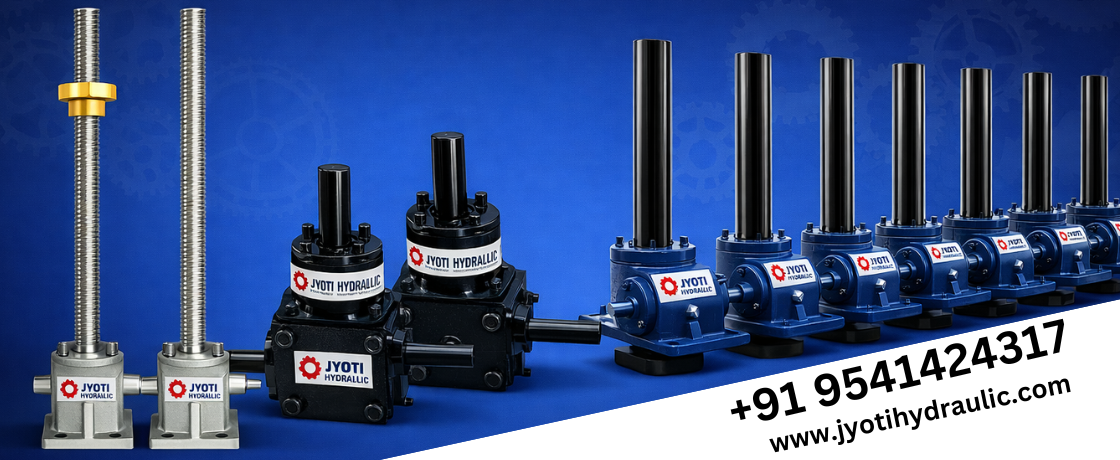
Jyoti Hydraulic, like any serious engineering brand in the lifting and motion-control space, understands that the price of a Worm Gear Screw Jack is never just a number on a quotation. In India’s visible April 2026 market, listed prices range from roughly the low five figures for lighter or simpler units to substantially higher amounts for industrial, motorized, or customized assemblies, which means buyers should treat every quote as an engineering proposal rather than a commodity price tag.
For procurement teams, OEM designers, plant engineers, and maintenance heads, this matters because two jacks with similar nominal capacities can have very different costs depending on configuration, duty cycle, screw type, mounting style, materials, and accessories. That is why comparing Worm Gear Screw Jack Manufacturers, especially Worm Gear Screw Jack Manufacturers in India, requires technical reading, not just price comparison.
Industry Overview
India’s screw jack supply landscape is broad rather than centralized. Marketplace indexes show active supplier concentration in cities such as Delhi, Mumbai, Bengaluru, Pune, Rajkot, Faridabad, Ahmedabad, and Coimbatore, and that naturally creates price variation based on whether the supplier is a direct manufacturer, an assembly house, or a channel-based seller. Trade directories also list a mix of recognizable names, including Jyoti Hydraulic, Sudarshan Gears, Simran Flowtech Industries, J. D. Automation, Maxtech Engineering, and others.
What this means for buyers is simple: the Indian market has both catalog-style offerings and engineered-to-order solutions. Some suppliers publish straightforward unit prices for standard models, while others quote only after reviewing application load, stroke, operating mode, and synchronization requirements. In practice, the more the application moves toward automation, multiple-jack lifting, anti-backlash control, or customized accessories, the faster the price departs from an entry-level catalog benchmark.
Technical Insights: Working, Design, and Specifications
At its core, a Worm Gear Screw Jack converts rotary input into controlled linear motion. The worm shaft drives the worm wheel, torque is multiplied through the gear reduction, and that motion is translated into lifting, lowering, pushing, pulling, or rolling linear movement through the screw arrangement. Standard industrial versions are commonly offered in translating screw, rotating screw, and keyed anti-rotation formats, and many designs can be mounted upright or inverted depending on the machine layout.
A translating screw type is usually chosen when the screw itself needs to move linearly while the nut remains fixed. A rotating screw design is useful where space or mounting constraints favor a fixed screw, and traveling-nut styles help reduce overall installation length in certain layouts. These configuration differences directly influence price because they affect machining, guidance, mounting hardware, and sometimes the need for additional anti-rotation or support arrangements.
Material selection is another major price driver. Indian and international product literature commonly references SG iron or cast iron housings, aluminum-bronze or phosphor-bronze load-carrying elements, hardened alloy-steel worm shafts, and optional stainless screw materials for more aggressive environments. Standard capacity ranges also vary widely by series: some catalogs show roughly 25 kN to 1200 kN, while others advertise ranges from about 0.5 ton up to 150 ton or more.
The machine-screw-versus-ball-screw decision is especially important. Machine or trapezoidal screw jacks remain attractive for slower, lower-duty, cost-sensitive applications because certain gear ratios are self-locking and can hold a load without backdriving in the absence of vibration. Ball screw jacks, however, reduce friction, improve efficiency, support more frequent cycling, and often suit higher-duty automation better, but they are not self-locking and usually need a brake or other holding mechanism.
2026 Price Guide of Worm Gear Screw Jack in India
For budgeting purposes, the visible Indian market in April 2026 suggests that simpler or lighter Worm Gear Screw Jack listings commonly appear around ₹10,000 to ₹15,000. Trade listings show examples such as manual lifting units around ₹10,000, lightweight models around ₹11,500, stainless versions around ₹12,000 to ₹12,500, black worm gear units around ₹13,000, and one trade price list placing a worm gear screw jack listing at ₹14,000.
The next pricing band is the practical mid-market zone for standard industrial builds. A New Delhi worm gear screw jack listing shows ₹19,000 per piece for a 2-ton model, while a Delhi 5-ton work gear screw jack is listed at ₹20,650 MRP with the underlying price shown as ₹17,500 plus 18% GST. Search results also show Faridabad 5-ton listings around ₹23,600, which reinforces the idea that many conventional, stock-style industrial jacks sit in the high teens to mid-twenties, depending on exact build and seller.
Once the requirement moves toward bigger capacities, electric drive, synchronized systems, or custom engineering, the range widens sharply. ExportersIndia shows HiTork marketplace listings spanning roughly ₹20,000 to ₹3 lakh per piece across multiple capacities, with delivery windows often shown as 4 to 10 weeks. TradeIndia also shows industrial worm screw jack examples around ₹55,000, and regional search snippets show some listings climbing toward ₹90,000. In other words, there is no single “standard” heavy-duty price in India; the quote becomes project-specific very quickly.
So what actually pushes the price upward? The biggest factors are capacity, stroke length, machine screw versus ball screw architecture, rotating or translating design, anti-backlash requirements, motorized versus manual drive, synchronized multi-jack linkage, corrosion-resistant materials, and accessories such as bellows, protection tubes, bevel gearboxes, limit switches, safety nuts, couplings, and trunnion bases. When buyers ignore these variables, they often compare two quotes that are not technically equivalent.
Applications in Industry
A Worm Gear Screw Jack remains popular because it serves a wide range of real industrial duties. Supplier application references repeatedly point to valve operation, steel plants, cement plants, platform lifts, stage lifts, aligning presses, turbine lift systems, solar trackers, rolling mills, oven lifters, conveyor lifts, air dampers, and even hydroelectric sluice-gate duties. That diversity is one reason the product category remains strong across Indian manufacturing and infrastructure environments.
For industrial buyers, this versatility has a direct pricing implication: the same fundamental jack platform can be adapted for lifting, holding, tilting, traversing, leveling, or synchronized motion. A solar-tracker application, for example, may prioritize environmental durability and motion consistency, while a steel or cement installation may care more about ruggedness, load holding, and resistance to contamination.
Key Benefits and Advantages
The main commercial advantage of a worm gear screw jack is controllable mechanical lifting with compact packaging and broad configuration flexibility. Machine-screw styles are often favored for their self-locking behavior in appropriate ratios, quieter operation, and better tolerance of particulates or harsher industrial surroundings, while multi-jack systems can also be mechanically linked for synchronized lifting from a single drive source.
Another major benefit is engineering adaptability. Manufacturers commonly offer upright or inverted mounting, manual or electric drive, keyed versions, anti-backlash devices, limit switches, bellows, protection tubes, motor mounts, and custom top-end fittings such as clevis, threaded, forked, or plate-style ends. That flexibility makes the product attractive for both new machine design and retrofit work.
Buying Guide: How to Choose the Right Unit
If you are evaluating Worm Gear Screw Jack Manufacturers in India or searching for a reliable Screw Jack Manufacturer in India, start with five questions: What is the exact load? What is the required stroke? How often will the jack cycle? Does the load need self-locking when power is removed? And will the load guide the screw, or do you need a keyed/anti-rotation arrangement? Those questions determine whether a simple machine screw jack will do the job or whether a higher-efficiency ball screw or a more engineered layout is justified.
Next, look beyond the headline price. Ask the manufacturer to specify housing material, bronze grade, worm shaft treatment, ratio, lubrication method, backlash approach, accessories, drive method, and whether the quotation covers only the jack or a complete system with motor, gearbox, shafts, couplings, and controls. The strongest Worm Gear Screw Jack Manufacturers are the ones that define these points clearly, because technical transparency usually predicts better service life and fewer integration surprises.
Future Trends in Screw Jack Technology: 2026 Perspective
The clearest 2026 trend is not a radical change in the basic worm gear principle, but a move toward smarter packages around it. Manufacturer literature increasingly emphasizes electric/manual drive flexibility, anti-backlash devices, limit switches, motor mounts, bellows, protection tubes, synchronized multi-jack arrangements, and special custom designs. That suggests a market moving away from standalone commodity units and toward integrated lifting systems that are easier to automate, safer to monitor, and more precise to position.
Another visible direction is the split between rugged machine-screw designs for dirty, static, or heavy load-holding environments and ball-screw designs for faster, higher-duty automated motion. At the same time, outdoor and renewable-energy use cases such as solar tracking continue to support demand for corrosion-aware, low-maintenance, application-specific screw jack assemblies. In short, 2026 buyers are rewarding manufacturers that combine mechanical reliability with better accessories, smarter controls, and stronger application engineering.
Conclusion
The real 2026 price of a Worm Gear Screw Jack in India is best understood as a range shaped by engineering detail. Entry-level and lightweight products can sit around ₹10,000 to ₹15,000, standard industrial builds often move into the high teens and twenties, and larger or more customized systems can travel far higher depending on capacity, drive, synchronization, and accessories. That is why the best buying decision is rarely the cheapest quote; it is the quote that matches the actual duty, environment, and safety expectation of your application.
FAQ Section
1) What is the typical price of a Worm Gear Screw Jack in India in 2026?
For visible 2026 budgeting, a basic or lighter listing may appear around ₹10,000 to ₹15,000, standard industrial units often fall in the ₹19,000 to ₹25,000 band, and custom or heavy-duty systems can extend from around ₹28,000 to ₹55,000 and well beyond depending on the application.
2) Why do two screw jacks with similar capacity have different prices?
Because price is influenced by more than capacity. Screw type, ratio, stroke, mounting orientation, anti-backlash requirements, materials, motorization, synchronized shafts, bellows, limit switches, safety accessories, and corrosion resistance all change manufacturing cost and system value.
3) Are worm gear screw jacks self-locking?
Many machine or trapezoidal screw jack designs are self-locking under the right conditions, especially in certain gear-ratio bands and in the absence of vibration. Ball screw jacks are generally not self-locking and require a brake or other holding arrangement.
4) Which industries commonly use worm gear screw jacks?
They are widely used in steel plants, cement plants, valve operation systems, aligning presses, stage lifts, turbine lifts, solar trackers, conveyor lifts, rolling mills, hydro applications, and other linear-motion duties that need controlled lifting or positioning.
5) What should I ask a Screw Jack Manufacturer in India before buying?
Ask for rated load, allowable duty cycle, exact stroke, screw type, self-locking behavior, mounting style, material details, lubrication method, backlash control, available accessories, and whether the quote includes only the jack or the full drive package.
6) How do I compare Worm Gear Screw Jack Manufacturers in India effectively?
Compare engineering clarity, not just catalog price. A strong manufacturer will define capacity, design type, material stack, accessories, delivery scope, and application fit clearly. That gives you a more reliable quote and usually a better long-term cost of ownership.
Get Expert Help from Jyoti Hydraulic
Need the right Worm Gear Screw Jack for your plant, machine, or lifting system? Reach out to Jyoti Hydraulic for product inquiries, technical guidance, and application-specific recommendations. Whether you want to request a quotation, compare configurations, or seek expert consultation before placing an order, the team can help you choose the right solution for capacity, stroke, duty cycle, and operating environment.
Email: info@jyotihydraulic.com
Phone: +91 9541424317
Contact Jyoti Hydraulic today to discuss your requirement and get a fast, informed quotation from an experienced industrial solutions team.


