
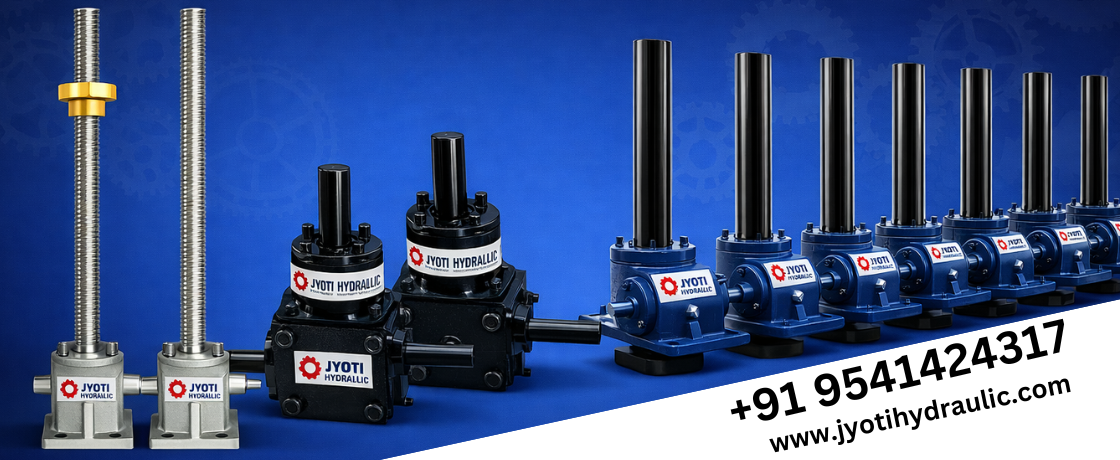
Jyoti Hydraulic knows that a lifting system is only as trustworthy as the safety logic behind its design. In real industrial environments, a Worm Gear Screw Jack does far more than move a load up or down. It supports platforms, aligns heavy equipment, positions tooling, synchronizes structures, and often works in applications where failure can damage machinery, halt production, or put people at risk. That is why safety standards matter. When buyers, plant engineers, OEMs, and project consultants evaluate a screw jack system, the real question is not only “Will it lift?” but also “Will it lift safely, repeatedly, and predictably under actual duty conditions?” For industrial screw jacks, that answer usually comes from understanding three standards ecosystems: ISO for machinery safety and risk reduction, DIN for thread and worm gear engineering precision, and AGMA for gear rating, efficiency, lubrication, and service conditions.
Introduction: Why Safety Standards Matter in Lifting Systems
A Worm Gear Screw Jack may look mechanically simple from the outside, but it combines axial load transfer, gear reduction, screw mechanics, lubrication behavior, and structural stability in one compact unit. That means a failure can come from more than one source: overloaded gears, screw buckling, thread wear, lubrication breakdown, backlash growth, misalignment, or poor installation. The standards conversation is therefore not academic. It directly affects equipment uptime, worker safety, load accuracy, and compliance readiness. ISO 12100 specifically focuses on machinery risk assessment and risk reduction, while related ISO safety standards address control-system safety, emergency stop principles, safety distances, and prevention of unexpected start-up.
Featured-snippet answer:
ISO helps define the machinery safety framework, DIN helps define thread and worm gear geometry plus load-capacity calculations, and AGMA helps rate worm gearing for torque, efficiency, service factor, lubrication, and durability. In practice, the safest industrial designs use all three together rather than relying on one rulebook alone.
Industry Overview: Why Standards Are Becoming More Important
Across India and global markets, screw jack applications are expanding because modern industry needs more precise, compact, and controllable lifting and positioning systems. That trend is being reinforced by infrastructure investment, steel-sector expansion, and industrial automation. India’s infrastructure pipeline and public capital outlay remain large, the country continues to position steel as a major strategic sector, and global factory automation continues to grow, with the International Federation of Robotics reporting strong long-term demand for industrial robots and Asia dominating new deployments. As automation and heavy-duty handling systems increase, so does the need for industrial-grade, standards-aligned screw jack solutions.
For this reason, serious OEMs and plant operators no longer treat compliance as a paperwork exercise. They treat it as design insurance. A high-performance lifting unit must not only match nominal capacity on a catalog sheet; it must also survive shock loading, side loading, duty cycles, ambient contamination, maintenance realities, and operator error. This is exactly where a standards-based selection process separates premium suppliers from risky ones.
Deep Technical Breakdown of the Standards
ISO Standards: The Safety Compliance Framework
A common mistake in the market is assuming that there is one single ISO standard covering every industrial screw jack. In reality, industrial Worm Gear Screw Jack safety is usually mapped to a combination of ISO machinery standards. ISO 12100 is the foundation because it sets out the methodology for hazard identification, risk estimation, and risk reduction during machine design. For applications with electrical or automated control logic, ISO 13849-1 addresses safety-related parts of control systems. ISO 13850 covers emergency-stop principles, ISO 13857 covers safety distances around hazardous zones, and ISO 14118 focuses on preventing unexpected start-up during servicing or human intervention. ISO 12140 is a direct example of a product-oriented screw/nut-type jack standard, but it applies to agricultural drawbar jacks rather than all industrial screw jacks.
What ISO means in practical screw jack design
For a manufacturer or project engineer, ISO usually translates into questions such as:
- What happens if the load exceeds the intended working envelope?
- Can a person reach a crush point during operation?
- What prevents unintended motion during maintenance?
- Is there a safe stop function for automated systems?
- Has the installation been designed to reduce foreseeable misuse?
This is where engineering judgment becomes critical. A compliant system typically includes:
- adequate guarding around moving parts,
- defined load limits and safety margins,
- reliable stop or isolation procedures,
- safe access clearances,
- and clear operating instructions and warning labels.
In short, ISO tells you how to think about the safety architecture of the lifting system, not just the size of the gearbox.
ISO and load calculations
From a design standpoint, ISO-driven safety thinking starts with the actual service load, not only the theoretical static load. A prudent engineer checks:
- working load,
- shock or impact factor,
- duty cycle,
- speed,
- center of gravity,
- side-load potential,
- and consequences of failure.
A practical screening formula is:
Required design load = working load × service factor
Then the screw, nut, gear train, housing, bearings, and mounting structure are validated against that design load. For longer lifting strokes, column buckling becomes a critical check, especially in compression-loaded jacks:
Euler buckling load ≈ π²EI / (K·L)²
That is why a jack that looks acceptable by pure axial capacity can still be unsafe when stroke length and end conditions are considered.
DIN Standards: The Precision Backbone of Mechanical Design
If ISO gives the safety philosophy, DIN gives the mechanical discipline. DIN standards are highly influential in screw jack engineering because they cover the geometry, profiles, tolerances, and load-capacity logic needed for predictable performance. For worm gear screw jack design, three DIN references are especially relevant: DIN 103 for ISO metric trapezoidal screw threads, DIN 3996 for load-capacity calculation of cylindrical worm gear pairs, and DIN 3975 for worm gear terminology, parameters, tooth thickness allowances, and backlash-related definitions.
Why DIN 103 matters
The lifting screw is the heart of a machine screw jack. DIN 103 defines trapezoidal screw thread profiles and tolerances that matter directly to:
- thread fit,
- backlash,
- axial load transfer,
- wear behavior,
- manufacturability,
- and repeatability across assemblies.
In practice, poor thread geometry creates a chain reaction:
increased friction, irregular lifting torque, uneven wear, heat generation, and faster loss of positional accuracy. That is why reputable Worm Gear Screw Jack Manufacturers do not treat screw machining as a commodity step. They control profile accuracy, root condition, surface finish, straightness, and nut engagement.
Why DIN 3996 matters
DIN 3996 is directly relevant to the worm gear stage. It deals with the load capacity of cylindrical worm gear pairs with rectangular crossing axes, which is central to worm gear screw jack reducer design. That means it influences how engineers evaluate tooth loading, contact conditions, thermal behavior, and durability under real operating conditions.
For buyers, the practical takeaway is simple: if the worm set is not engineered with proper rating logic, the whole jack becomes vulnerable to:
- tooth wear,
- excess heat,
- pitting,
- reduced efficiency,
- premature backlash growth,
- and ultimately failure under repeated duty.
Why DIN precision matters commercially
In the field, many failures blamed on “operator misuse” actually begin with poor dimensional control. Undersized screws, weak bronze nuts, inconsistent worm wheel geometry, and loose backlash control may still allow a jack to function initially, but not reliably over time. This is one reason knowledgeable buyers increasingly prefer experienced Worm Gear Screw Jack Manufacturers in India that can discuss thread standards, material grades, machining tolerances, and inspection practice with confidence instead of only offering low-cost quotations.
AGMA Standards: Gear Rating, Efficiency, and Durability
AGMA becomes especially important once you move from “it fits” to “it lasts.” The American Gear Manufacturers Association publishes standards that support the design, rating, application, and lubrication of worm gearing. For cylindrical worm gear reducers, ANSI/AGMA 6034-C21 provides methods for rating and design and explicitly covers power, torque, efficiency equations, thermal capacity, service factor selection, lubrication, and self-locking features. ANSI/AGMA 6022-D19 is a design manual for cylindrical wormgearing. AGMA 925-B22 focuses on tribology and lubrication-related surface distress such as wear, scuffing, and micro- or macropitting.
Why AGMA matters in a Worm Gear Screw Jack
A Worm Gear Screw Jack depends on controlled sliding contact between the worm and worm wheel. That sliding action is what makes worm gearing compact and high-ratio, but it also creates friction and heat. AGMA guidance helps engineers address:
- torque rating,
- gear efficiency,
- thermal limits,
- lubrication regime,
- service factor,
- and wear risk.
A practical engineering relationship is:
Input torque ≈ (axial load × screw lead) / (2π × overall efficiency)
If actual efficiency drops because of poor lubrication or rising friction, input torque demand increases. That extra torque raises heat, wear, and stress on the drive motor or handwheel system. This is why two jacks with the same nominal load rating may perform very differently in continuous-duty applications.
AGMA and safety factor thinking
AGMA-style thinking pushes designers to ask better questions:
- Is the duty intermittent or continuous?
- Is there shock loading?
- What ambient temperature affects thermal dissipation?
- What lubricant viscosity is suitable?
- Is self-locking required, and has it been verified under actual friction conditions?
This is crucial because “self-locking” should never be assumed casually. Wear, vibration, lubrication changes, and dynamic loading can alter real-world holding behavior. In critical applications, additional braking or locking provisions may still be necessary.
Common Safety Risks and Challenges
Even a precision-engineered unit can become unsafe if application conditions are ignored. The most common risks are familiar across industry:
1. Overloading
Catalog capacity is not permission to run at the limit every day. Real systems face shock, off-center loading, and cycle fatigue. Overloading can damage the screw, distort the housing, overload bearings, and accelerate gear wear.
2. Misalignment
A screw jack is designed mainly for axial loading. Misalignment introduces side loads, bending moments, and uneven thread contact. This is one of the fastest ways to reduce life.
3. Poor lubrication
In worm gearing, lubrication is not optional maintenance; it is part of the design envelope. AGMA 925-B22 exists because lubrication-related distress directly affects gear surface life.
4. Substandard manufacturing
Poor bronze quality, inconsistent heat treatment, inaccurate machining, and missing inspection controls can make a jack unsafe long before rated life is reached.
Applications Across Industries
Safety standards matter even more because screw jacks are used in demanding sectors, including:
- Construction: platform lifting, shuttering adjustment, bridge and structural positioning
- Steel plants: roll gap adjustment, maintenance lifting, heavy-duty alignment
- Material handling: conveyor elevation, lift tables, transfer systems
- Automation systems: synchronized positioning, actuator replacement, linear movement modules
These sectors are expanding through infrastructure spending, steel-sector growth, and automation adoption, which is exactly why dependable lifting systems and safety compliance are becoming more commercially important in India and abroad.
Benefits of Following Safety Standards
When a jack system is designed and selected with ISO, DIN, and AGMA logic in mind, the results are tangible:
- Longer service life through correct load rating and material selection
- Higher worker safety through risk reduction, guarding, stop functions, and controlled access
- Reduced downtime because wear, heat, backlash, and failure modes are better managed
- Better compliance readiness for OEM projects, audits, and export-oriented machinery
- More predictable performance in synchronized and automated systems
This is the difference between a low-price component and a precision-engineered, industrial-grade lifting solution.
Buying Guide: How to Choose the Right Worm Gear Screw Jack
When comparing products or evaluating Worm Gear Screw Jack Manufacturers, use this checklist.
Check the real load capacity
Do not ask only for rated capacity. Ask for:
- working load,
- static load,
- shock allowance,
- duty cycle limits,
- and buckling guidance for the intended stroke.
Select the right screw type
- Machine screw jacks are common, robust, and cost-effective for moderate speed and heavy load.
- Ball screw jacks offer higher efficiency and better speed for dynamic positioning, but they are usually not self-locking.
Verify the gear design basis
Ask whether the gearbox is engineered with reference to AGMA/DIN methods for worm gear rating, backlash control, and lubrication behavior. Serious suppliers will understand the question immediately.
Review material quality
The screw, nut, worm, worm wheel, housing, and bearings must be matched to the application. Bronze quality, hardened steel condition, and surface finish all matter.
Assess manufacturer credibility
The best Worm Gear Screw Jack Manufacturers in India provide more than a price list. They offer application guidance, custom stroke options, mounting configurations, synchronized systems, documentation, and after-sales support.
Ask for certifications and inspection records
Look for evidence of:
- dimensional inspection,
- material traceability,
- load testing where applicable,
- maintenance guidelines,
- and clear installation instructions.
Future Trends in Screw Jack Safety
The next generation of screw jack systems is moving toward smarter, more connected operation. ISO 13849-1 becomes more relevant as automation and control integration grow, while broader machinery safety remains anchored in ISO 12100 and related protective standards.
Key trends include:
- Smart lifting systems with sensors for load, position, and condition monitoring
- Automation integration with PLCs, synchronized actuation, and safety interlocks
- Advanced materials and coatings for improved wear resistance and corrosion performance
- Predictive maintenance driven by temperature, torque, and cycle-count monitoring
For buyers, this means the future belongs to suppliers that understand both mechanics and system safety.
Conclusion
A Worm Gear Screw Jack is not just a mechanical component. It is a safety-critical positioning and lifting device that must perform under load, under repetition, and under risk. ISO helps define safe machinery design and risk reduction. DIN helps establish thread precision, worm gear geometry, and load-capacity discipline. AGMA helps engineers rate worm gearing for torque, efficiency, lubrication, and durability. Together, they create the technical foundation for reliable lifting systems.
For buyers, the lesson is clear: do not judge a screw jack by catalog capacity alone. Judge it by engineering depth, manufacturing discipline, safety thinking, and application support. That is where Jyoti Hydraulic stands apart as a trusted partner for high-performance, custom-engineered lifting solutions.
FAQ: Safety Standards for Worm Gear Screw Jacks
1. What is the ISO standard for screw jacks?
There is not one universal ISO standard that covers every industrial screw jack. In practice, industrial systems are usually designed using a combination of ISO 12100 for machinery risk assessment, ISO 13849-1 for safety-related control systems, ISO 13850 for emergency stop principles, and other supporting standards. ISO 12140 is a direct screw/nut-type jack standard, but it is specific to agricultural drawbar jacks.
2. Why is AGMA important for worm gear screw jacks?
AGMA matters because it addresses the worm gear stage that makes the jack work. ANSI/AGMA 6034-C21 covers rating, torque, efficiency, thermal capacity, lubrication, service factors, and self-locking features, while AGMA 925-B22 addresses lubrication-related surface distress such as wear and scuffing.
3. What does DIN contribute to screw jack safety?
DIN standards help ensure precision in the screw and gear geometry. DIN 103 covers trapezoidal screw thread profiles and tolerances, DIN 3996 covers load-capacity calculation for cylindrical worm gear pairs, and DIN 3975 defines important worm gear parameters and backlash-related terminology.
4. How do I choose the right worm gear screw jack?
Start with actual working load, stroke length, duty cycle, mounting arrangement, speed, and required positional accuracy. Then verify screw type, buckling safety, gear rating, lubrication requirements, and whether self-locking or an external brake is required.
5. What safety factors should be considered?
The most important factors include overload margin, shock load, duty cycle, screw buckling risk, misalignment, lubrication condition, backlash growth, and consequences of failure. For automated systems, control-system safety and emergency-stop logic should also be reviewed under relevant ISO standards.
6. Are all worm gear screw jacks self-locking?
No. Self-locking depends on gear and screw geometry, friction conditions, wear state, lubrication, and operating dynamics. AGMA specifically discusses self-locking features in the context of wormgear reducers, which is why critical applications should not rely on assumption alone.
7. Why should buyers prefer established Worm Gear Screw Jack Manufacturers in India?
Because application support matters as much as product supply. Established manufacturers are more likely to provide load calculations, customization, technical documentation, inspection discipline, and long-term support for industrial lifting systems.
Request a Quote from Jyoti Hydraulic
Need a custom Worm Gear Screw Jack, synchronized lifting system, or expert guidance on selecting the safest configuration for your application?
Talk to Jyoti Hydraulic today for:
- Expert consultation
- Custom-engineered solutions
- Technical selection support
- Fast quotation for industrial projects
📧 info@jyotihydraulic.com
📞 +91 9541424317


