
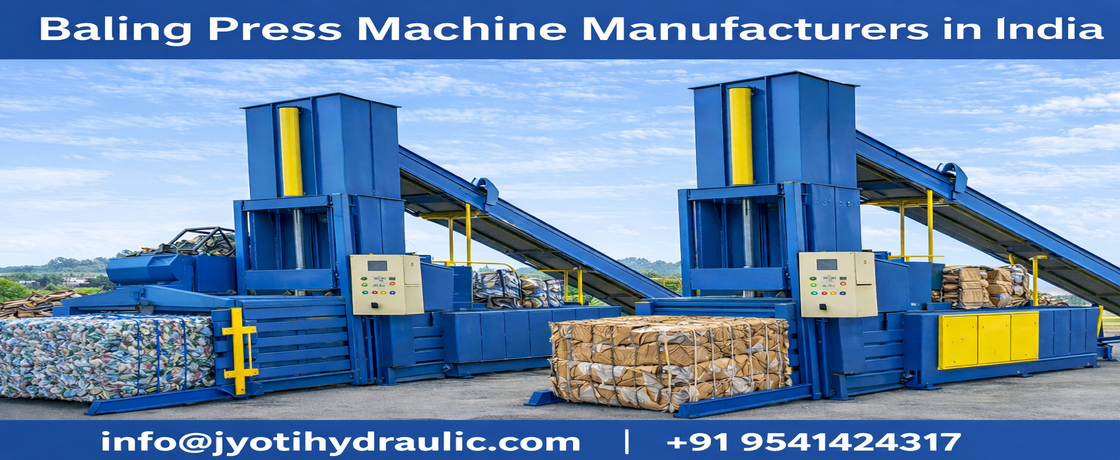
Jyoti Hydraulic delivers industrial scrap baling solutions designed for metal recycling plants, manufacturing units, foundries, fabrication workshops, automobile industries, and export-oriented recycling businesses. As industries move toward cleaner production and better scrap recovery, the demand for reliable hydraulic baling systems is increasing rapidly. A scrap baling machine is no longer just a waste-handling machine; it is a productivity tool that reduces storage space, improves scrap value, lowers transport cost, and supports sustainable industrial operations.
India has become a strong manufacturing base for hydraulic recycling machinery because of its engineering capability, cost-effective production, and ability to supply customized equipment. Businesses searching for Scrap Baling Machine Manufacturers in India, Aluminium Scrap Baling Machine Manufacturers in India, or a dependable Baling Press Machine Manufacturer now look beyond price. They need machine durability, bale density, hydraulic performance, safety, service support, and long-term operating efficiency.
Introduction to Scrap Baling Machines
A scrap baling machine compresses loose metal scrap into compact bales using hydraulic force. Loose scrap is difficult to store, unsafe to handle, and expensive to transport. When compressed into uniform bales, the same material becomes easier to stack, load, sell, melt, or recycle.
These machines are widely used for ferrous and non-ferrous scrap, including mild steel, stainless steel, aluminium, copper, brass, tin, CRC scrap, turning scrap, sheet cutting waste, and mixed production scrap. Depending on the application, scrap balers are available in manual, semi-automatic, and fully automatic models.
Industry Overview: Why Scrap Baling Is Important in 2026
The recycling sector is becoming more organized due to rising raw material costs, stricter environmental policies, and growing demand for secondary metals. Manufacturers want to recover value from every kilogram of scrap generated during production. Recycling yards also need faster processing systems to manage large volumes of incoming material.
In 2026, industries are focusing on three major priorities: space saving, energy efficiency, and material recovery. A hydraulic scrap baler directly supports all three. It converts bulky waste into dense bales, reduces repeated handling, improves dispatch planning, and helps recyclers maintain consistent feedstock for melting furnaces.
For exporters, baled scrap is especially useful because compact bales improve container loading efficiency and reduce freight cost per ton. This is one reason Indian suppliers and exporters of industrial baling systems are gaining attention in global recycling markets.
Technical Insights: How a Scrap Baling Machine Works
A scrap baling machine works on hydraulic compression technology. The machine uses a hydraulic power pack, cylinders, control valves, electric motor, oil tank, compression box, and control panel to generate high pressure.
The process usually follows these steps:
- Scrap is loaded into the compression chamber.
- Hydraulic cylinders press the material from one or more sides.
- The scrap is compressed into a dense bale.
- The bale is ejected manually or automatically.
- The finished bale is stacked, weighed, transported, or sent for melting.
The quality of a baling machine depends heavily on its hydraulic design. A strong hydraulic system ensures consistent pressure, smooth cylinder movement, reduced oil heating, and better bale density. Heavy-duty machines often use multiple cylinders to apply pressure from different directions, producing tighter and more uniform bales.
Important technical factors include pressing force, chamber size, bale size, cycle time, motor power, hydraulic oil capacity, structure thickness, machine weight, and output capacity per shift. For industrial use, the frame must be strong enough to handle repeated compression without bending, vibration, or alignment issues.
Aluminium Scrap Baling Machine: Special Technical Needs
Aluminium scrap requires a different approach compared to heavy steel scrap. Aluminium is lightweight, bulky, and often springy in loose form. It may include profiles, cans, foil waste, sheet cuttings, extrusion scrap, or automotive aluminium parts. Because of its low density, aluminium occupies large storage space before compression.
That is why companies looking for Aluminium Scrap Baling Machine Manufacturers in India should choose machines designed specifically for high-volume, low-density scrap. The machine must generate enough compression force to remove air gaps and create compact bales without damaging the hydraulic system.
A good aluminium scrap baler helps recyclers reduce storage space, increase melting efficiency, simplify loading, and improve resale value. For aluminium extrusion plants and recycling units, baling can significantly improve daily material handling efficiency.
Applications of Scrap Baling Machines
Scrap baling machines are used in many industries where metal waste is generated or processed.
Metal Recycling Plants
Recycling yards use balers to process mixed metal scrap, improve storage, and prepare material for sale or melting.
Automobile Industry
Automobile manufacturers and component suppliers generate sheet metal waste, trimming scrap, and rejected parts that can be baled efficiently.
Foundries
Foundries use baled scrap as a more manageable raw material for furnace charging and melting operations.
Fabrication Units
Cutting, punching, bending, and machining processes generate offcuts that can be compressed for better handling.
Aluminium Extrusion Plants
Extrusion scrap, profiles, and rejected sections are baled to reduce space and improve recycling returns.
Shipbreaking and Heavy Engineering
Large quantities of metal waste from dismantling and heavy fabrication can be processed using heavy-duty baling systems.
Benefits of Industrial Scrap Baling Systems
A well-designed scrap baling machine offers practical and financial benefits.
Reduced Storage Space
Loose scrap takes up unnecessary floor area. Baling converts scattered scrap into stackable blocks, improving warehouse organization.
Lower Transportation Cost
Compact bales allow more material to be loaded in trucks or containers, reducing logistics cost per ton.
Improved Scrap Value
Recyclers and foundries often prefer clean, compact, and uniform bales because they are easier to weigh, handle, and process.
Better Workplace Safety
Loose metal scrap can create sharp edges, movement hazards, and clutter. Baling improves housekeeping and reduces risk.
Faster Material Handling
Baled scrap is easier to lift with forklifts, cranes, or loaders, saving labor and time.
Sustainable Operations
Efficient scrap management supports circular economy goals by helping industries recover and reuse valuable metals.
Buying Guide: How to Select the Right Scrap Baling Machine
Before choosing a machine, buyers should evaluate their real production needs instead of selecting only by price.
First, identify the type of scrap. Steel, aluminium, copper, mixed scrap, and turning scrap may require different chamber designs and pressure capacities. Second, calculate daily or hourly scrap generation. A small workshop and a large recycling yard need very different machine capacities.
Third, check bale size and density requirements. Exporters may need specific bale dimensions for container loading, while foundries may need furnace-friendly bale sizes. Fourth, evaluate automation level. Manual models may suit low-volume users, while high-volume plants should consider semi-automatic or fully automatic systems.
Buyers should also check machine frame strength, cylinder quality, hydraulic components, motor efficiency, spare parts availability, safety features, and service support. A reliable Baling Press Machine Manufacturer should provide technical guidance, installation support, operator training, and after-sales service.
Future Trends in Scrap Baling Systems
Industrial baling systems are becoming smarter and more efficient. Future-ready machines are expected to include PLC-based controls, energy-saving hydraulic circuits, improved safety interlocks, automatic bale ejection, remote monitoring, and predictive maintenance features.
In export markets, buyers are also demanding machines with better power efficiency, longer operating life, and easier maintenance. Customization will remain important because every recycling plant handles different material types, volumes, and space conditions.
Conclusion
Scrap baling machines play a vital role in modern recycling and industrial waste management. They help businesses reduce storage space, cut transport costs, improve scrap handling, and increase material value. Whether the requirement is for steel scrap, aluminium scrap, or mixed industrial waste, choosing the right hydraulic baling system can improve both productivity and profitability.
For businesses searching for trusted Scrap Baling Machine Manufacturers in India, experienced Aluminium Scrap Baling Machine Manufacturers in India, or a reliable Baling Press Machine Manufacturer, Jyoti Hydraulic offers practical, durable, and industry-focused solutions for domestic and export markets.
FAQs
What is a scrap baling machine used for?
It is used to compress loose metal scrap into compact bales for easier storage, transportation, recycling, and melting.
Which metals can be baled?
Common materials include steel, aluminium, copper, brass, stainless steel, tin, CRC scrap, and mixed industrial metal waste.
Why is aluminium scrap baling important?
Aluminium scrap is bulky and lightweight. Baling reduces its volume, improves handling, and lowers transport cost.
How do I choose the right baling machine?
Select based on scrap type, daily volume, required bale size, hydraulic force, automation level, and service support.
Are Indian scrap baling machines suitable for export?
Yes. Many Indian manufacturers supply customized industrial baling systems for international recycling and manufacturing markets.
Contact Jyoti Hydraulic
Need a durable and efficient scrap baling machine for your industry?
📧 Email: info@jyotihydraulic.com
📞 Call: +91 9541424317
Contact Jyoti Hydraulic today to request a quotation, discuss your application, and get expert consultation for the right industrial baling solution.


