
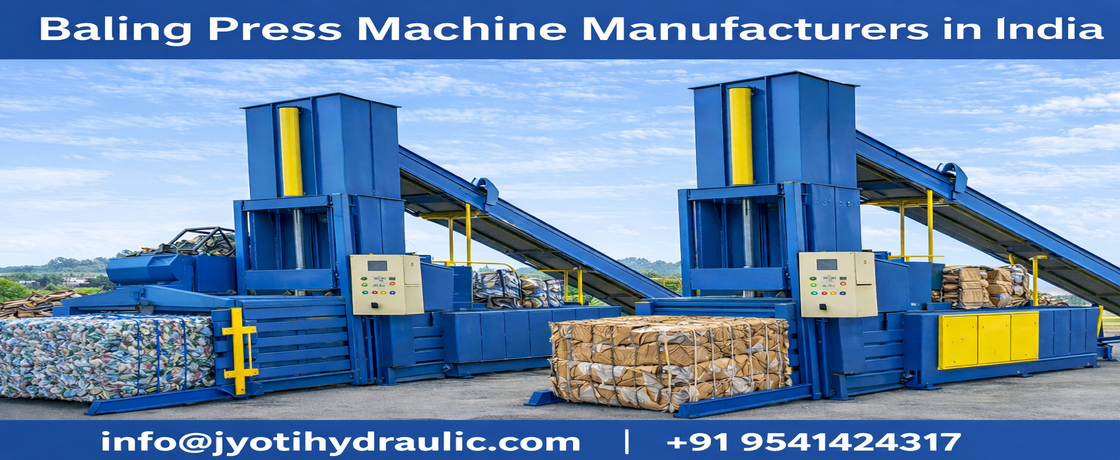
Jyoti Hydraulic understands that buying a scrap can baling machine is not just about comparing prices. For most recyclers, scrap yards, beverage can handlers, manufacturing plants, and waste management companies, the real question is this: which machine will deliver the right bale density, safe operation, lower manpower dependence, and dependable output for years—not just the first few months.
That question matters even more today because India’s recycling ecosystem is becoming more formal, compliance-driven, and capacity-focused. The Ministry of Steel has said the Steel Scrap Recycling Policy is intended to promote a circular economy, and as of 12 March 2026, 134 Registered Vehicle Scrapping Facilities across 22 States/UTs were operational, with 4,65,393 vehicles already scrapped. At the same time, India’s circular-economy framework now includes Extended Producer Responsibility for scrap of non-ferrous metals, with digital registration and certificate mechanisms designed to expand recycling capacity and formalize the sector.
So if you are searching for Scrap Can Baling Machine Manufacturers in India, comparing Scrap Baling Machine Manufacturers in India, or evaluating reliable Baling Press Machine Manufacturers, this guide will help you make a technically sound and commercially smart decision.
Overview of Scrap Can Baling Industry in India
India’s scrap can baling market sits at the intersection of recycling, logistics, and industrial cost control. Loose cans, thin-gauge metal scrap, UBCs, aluminum beverage cans, tins, and light non-ferrous scrap consume large floor space, create handling inefficiencies, and increase transportation cost per ton. A baling press solves that by densifying material into compact, stackable bundles.
The growth outlook is being supported by policy, formal recycling channels, and a broader push toward scientific scrap processing. Government responses in 2026 link recycling growth not only to the Steel Scrap Recycling Policy but also to vehicle scrappage, end-of-life rules, and organized recovery infrastructure. In parallel, India’s EPR-linked circular-economy framework for non-ferrous scrap is pushing better collection, recycling, traceability, and capacity expansion.
For buyers, that means one thing: the right baling machine is no longer a secondary utility purchase. It is now a productivity asset.
What is a Scrap Can Baling Machine?
A scrap can baling machine is a hydraulic compression system designed to compact loose scrap cans or lightweight recyclable metal into dense bales that are easier to store, transport, weigh, and sell. In industrial use, the machine applies controlled hydraulic force inside a chamber, reduces material volume, and ejects a finished bale for tying, stacking, or dispatch. Typical Indian balers are built for variable materials, different bale sizes, and manual, semi-automatic, or fully automatic operation.
Featured Snippet Answer
A scrap can baling machine is a hydraulic press that compresses loose cans and light scrap into dense, uniform bales to reduce storage space, lower transport cost, and improve recycling efficiency.
In practical terms, it is one of the most important machines in a recycling line because it turns low-density, awkward scrap into a tradable, logistics-friendly output.
Types of Baling Press Machines
Not every baler is suitable for every scrap stream. The best machine depends on volume, material behavior, labor availability, and the desired bale format.
1. Vertical Baling Press Machine
Vertical balers are popular where floor space is limited and daily volume is moderate. They are commonly used for cans, bottles, cartons, paper, textiles, and mixed dry recyclables. They are compact and often cost-effective for small to medium operations.
2. Horizontal Baling Press Machine
Horizontal balers are better for continuous or high-volume operations. They are preferred when material inflow is consistent and faster throughput is required. These are often chosen for MRFs, warehouse waste, and industrial recycling lines.
3. Double Box / Double Cylinder Balers
These are designed for improved productivity and faster handling cycles. A dual-box arrangement can reduce downtime between loading and pressing, which is useful in busy recycling operations.
4. Triple Action / Multi-Compression Balers
For metal scrap and denser industrial loads, triple-action or multi-direction compression machines produce tighter, more stable bales. These are especially relevant for ferrous and non-ferrous scrap streams where bale integrity matters.
5. Manual, Semi-Automatic, and Fully Automatic Balers
Indian manufacturers now offer the full range of automation levels. Semi-automatic and PLC-controlled models are increasingly preferred because they improve consistency, operator ease, and safety.
Quick Comparison Table
| Machine Type | Best For | Throughput Level | Space Need | Automation Potential |
|---|---|---|---|---|
| Vertical Baler | Cans, PET, cardboard, mixed recyclables | Low to medium | Low | Manual to semi-auto |
| Horizontal Baler | Continuous industrial waste streams | Medium to high | Medium to high | Semi-auto to full auto |
| Double Box Baler | Faster cycle operations | Medium | Medium | Semi-auto |
| Triple Action Baler | Metal scrap, tighter bale density | High | Medium to high | Semi-auto to automatic |
Typical Indian product configurations include pressing forces from around 10 to 250 tons, with manual, semi-automatic, and fully automatic variants available depending on application.
Key Technical Specifications & Working Principle
When comparing Scrap Baling Machine Manufacturers in India, these are the technical parameters that matter most:
Core Technical Specifications
| Specification | What It Means | Typical Market Range |
|---|---|---|
| Pressing Force | Compression power of the machine | 10–250 tons |
| Bale Weight | Output bale mass | 20–800 kg, material dependent |
| Bale Size | Finished bale dimensions | Customizable by chamber and application |
| Motor Power | Installed power load | 3–40 HP |
| Operation Mode | Manual / semi-auto / fully automatic | Application specific |
| Bale Ejection | Manual / hydraulic push / tilting / auto-eject | Model dependent |
| Frame Construction | Structural strength and machine life | Heavy-duty IS-grade steel fabrication common |
These ranges are drawn from current Indian product listings across bottle presses, pillar balers, metal balers, and triple-action machines.
How the Machine Works
- Scrap cans or light metal scrap are loaded into the chamber.
- The hydraulic cylinder drives the platen downward or sideways, depending on design.
- The material is compressed until target density is achieved.
- The bale is tied manually or via assisted mechanisms.
- The bale is ejected for stacking, storage, or dispatch.
Modern systems may also include control panels, emergency stops, interlocks, and optional PLC/HMI controls for repeatable operation. Energy-efficient designs and auto/manual modes are now common in Indian balers built for industrial duty.
Applications Across Industries
Scrap can baling machines are used far beyond the recycling yard. Common applications include:
- Aluminum can recovery units
- Beverage bottling and canning plants
- Metal scrap traders and aggregators
- Warehouse and logistics hubs
- Municipal dry waste segregation centers
- Engineering and fabrication plants
- Packaging waste recycling facilities
- Plastic, paper, and mixed recyclable handling units
Many balers in India are built to process not only cans, but also PET bottles, cardboard, paper, textiles, and selected ferrous/non-ferrous scrap depending on chamber design and tonnage.
Advantages & Business Benefits
A well-matched baling press machine delivers far more than volume reduction.
Key Advantages
- Reduces storage footprint dramatically
- Cuts transport cost per ton
- Improves housekeeping and site safety
- Enables better bale handling and stacking
- Creates more uniform, marketable scrap output
- Reduces manual labor intensity
- Supports formal recycling and compliance-driven material recovery
In operational terms, dense bales mean fewer vehicle trips, faster loading, cleaner yards, and stronger negotiation power when selling recyclable scrap. Indian baler suppliers also emphasize lower labor costs, longer service life, and 24/7 suitability in heavy-duty builds.
Step-by-Step Buying Guide
This is the section most buyers skip—and later regret.
1. Capacity Selection
Start with actual daily inflow, not your guess.
Ask:
- How many kilograms or tons of cans arrive per shift?
- Is the feed continuous or batch-based?
- Do you expect seasonal spikes?
- Will the machine run 8, 16, or 24 hours?
A machine that is too small creates bottlenecks. A machine that is too large wastes power, capital, and floor space. For small scrap yards or retail recovery points, a compact vertical baler may be enough. For industrial recyclers or larger aggregators, a horizontal or higher-tonnage baler is often more economical over time.
2. Automation Level
Choose automation based on labor skill, output consistency, and speed needs.
- Manual: Lower initial cost, but more operator dependence
- Semi-automatic: Better for most Indian SMEs
- Fully automatic / PLC-controlled: Best for high-volume, repeatable operations
Today’s market is clearly moving toward PLC/HMI-assisted operation, interlocks, and easier monitoring because that improves repeatability and reduces operator error.
3. Material Compatibility
Do not buy a “general baler” without confirming material behavior.
Check:
- Aluminum cans or tin cans?
- Clean cans or contaminated containers?
- Mixed scrap or segregated feed?
- Light-gauge metal only, or PET and cardboard too?
- Expected moisture, labels, or residual liquid?
A baler that works for cardboard may not be ideal for cans. A can baler that handles UBCs efficiently may need different chamber sizing if you also want to run PET bottles or sheet scrap.
4. Space & Installation Factors
Before ordering, confirm:
- Available floor space
- Machine height and loading clearance
- Foundation requirements
- Three-phase power availability
- Oil tank access and maintenance space
- Bale discharge area
- Forklift or hand pallet movement path
This step prevents one of the most common buying mistakes in India: ordering a high-capacity press that physically does not integrate well into the plant layout.
5. Budget Considerations
Price should be evaluated in three layers:
Initial Cost
Machine price, electricals, transport, installation, civil work, commissioning
Operating Cost
Power use, hydraulic oil, wear parts, labor, downtime risk
Lifecycle Cost
Service support, spare availability, resale value, productivity gain, bale value improvement
A cheaper machine is rarely cheaper over five years if it produces low-density bales, overheats, leaks, or lacks service support.
How to Choose the Right Manufacturer in India
When evaluating Scrap Can Baling Machine Manufacturers in India or Baling Press Machine Manufacturers, use this checklist:
Look for Engineering Strength
A serious manufacturer should be able to discuss:
- Press force calculation
- Cylinder sizing
- frame design
- hydraulic circuit logic
- duty cycle
- bale density expectations
- safety systems
Inspect Build Quality
Good signs include:
- Heavy-duty steel fabrication
- guided platen movement
- quality hydraulic cylinders and valves
- clean hose routing
- proper welding and structural stiffness
Check Control & Safety Features
Reliable manufacturers increasingly offer:
- PLC or HMI options
- emergency stops
- overload protection
- safety interlocks
- auto/manual modes
- user-friendly control panels
Ask for Application Customization
The right OEM should be willing to adapt:
- chamber size
- bale dimensions
- feed opening
- motor power
- ejection type
- automation grade
- material-specific settings
Verify Service Support
A machine is only as good as its after-sales network. Ask:
- What is the installation timeline?
- How fast are spare parts dispatched?
- Is phone/video troubleshooting available?
- Do they offer AMC or preventive maintenance support?
- Can they train operators?
Request Real Proof
Before finalizing, ask for:
- reference installations
- working videos
- trial performance data
- customer feedback
- warranty terms
- electrical and hydraulic component details
Latest Market Trends & Innovations (2026 Insights)
The Indian baling market in 2026 is being shaped by both regulation and smarter machine design.
First, policy is driving formal scrap handling. The Ministry of Steel’s 2026 update ties organized recycling to the Steel Scrap Recycling Policy and shows active vehicle scrappage infrastructure across the country. In parallel, India’s circular-economy framework now includes EPR for non-ferrous scrap, with producers, recyclers, and collection agents being brought into a more structured, portal-based compliance system.
Second, technology expectations have changed. Indian industry sources in 2026 point to clear movement toward automation and IoT integration, real-time monitoring, predictive maintenance, lower-power hydraulic systems, smart sorting integration, and modular machine layouts that can scale with business growth.
Third, buyers are demanding more from OEMs. PLC/HMI controls, safety interlocks, lower-maintenance construction, and energy-efficient operation are increasingly standard in competitive machines rather than premium extras.
In simple terms: the future belongs to balers that are safer, smarter, and easier to integrate into a formal recycling workflow.
Common Mistakes to Avoid When Buying
1. Buying by Price Alone
A low-cost machine with poor hydraulics or weak fabrication often becomes expensive very quickly.
2. Ignoring Material Characteristics
Loose cans, painted cans, PET bottles, and metal offcuts behave differently under compression.
3. Underestimating Throughput
Many buyers size the machine for today’s load and forget growth, seasonal scrap peaks, or second-shift expansion.
4. Skipping Service Evaluation
A machine without local service support can sit idle for days over a small hydraulic or electrical issue.
5. Not Checking Bale Density
The machine may run fine but still produce loose, weak, low-value bales.
6. Overlooking Safety
Emergency stops, interlocks, and operator-friendly controls are not optional in real industrial environments.
7. Failing to Plan Installation
Power supply, foundation, loading height, and bale discharge space must be checked before dispatch.
Conclusion
Choosing the right scrap can baling machine is a strategic decision. The best purchase is not the one with the lowest quotation—it is the one that matches your material, output target, floor space, labor reality, and long-term business plan.
As India’s recycling ecosystem becomes more structured and compliance-oriented, demand will continue shifting toward dependable, heavy-duty, service-backed machines from experienced Scrap Baling Machine Manufacturers in India. For serious buyers, the winning combination is clear: correct capacity, correct automation, correct engineering, and correct manufacturer support.
FAQs
1. What is the price of a scrap can baling machine in India?
Price depends on machine type, pressing force, chamber size, automation, and output capacity. Current Indian listings show compact bottle press machines around ₹2.95 lakh, pillar hydraulic balers around ₹6.5 lakh, and larger triple-action machines above ₹35 lakh, so pricing varies widely by application.
2. Which is better: a vertical baler or a horizontal baler?
A vertical baler is usually better for smaller spaces and moderate volumes. A horizontal baler is better for continuous feeding and higher throughput. The right choice depends on your daily scrap volume and labor model.
3. Can one baling press machine handle cans, PET bottles, and cardboard?
Some machines can handle multiple materials, but only if chamber design, pressing force, and bale ejection system are suitable for those materials. Many Indian balers are offered for PET, cardboard, paper, bottles, and selected metal scrap, but compatibility should always be confirmed model by model.
4. How much power does a baling press machine require?
Typical Indian hydraulic balers can range from about 3 HP for smaller bottle presses to 40 HP for heavy-duty industrial machines. Power requirement depends on tonnage, cylinder configuration, automation level, and cycle demand.
5. Is PLC automation necessary in a scrap baler?
Not always, but it is highly useful when you need repeatable cycles, safer control, easier monitoring, and better productivity. In 2026, PLC/HMI-assisted systems are increasingly preferred in India for industrial baling applications.
6. What should I check before choosing among scrap can baling machine manufacturers in India?
Check build quality, hydraulic design, safety features, automation options, customization capability, warranty terms, spare parts availability, installation support, and references from similar industries.
7. Why is bale density important?
Higher bale density reduces transport cost, improves stackability, saves storage space, and often improves resale value because the output is more uniform and easier for recyclers or mills to handle.
8. Are scrap can baling machines relevant for India’s formal recycling market in 2026?
Yes. India’s formal recycling ecosystem is being strengthened through scrap recycling policy, vehicle scrappage infrastructure, and EPR-led circular-economy systems for non-ferrous metals, all of which support better collection, processing, and densification of recyclable scrap.
Request a Quote / Get Expert Consultation
Ready to choose the right baling solution for your operation?
Whether you need help comparing models, selecting capacity, planning installation, or requesting a customized quotation, connect with an expert team that understands real industrial recycling requirements.
Contact now for:
- Product inquiries
- Custom machine recommendations
- Budget-based quotation support
- Technical consultation for your plant
📧 info@jyotihydraulic.com
📞 +91 9541424317
Get in touch today and move one step closer to a safer, more efficient, and more profitable scrap handling system.


