
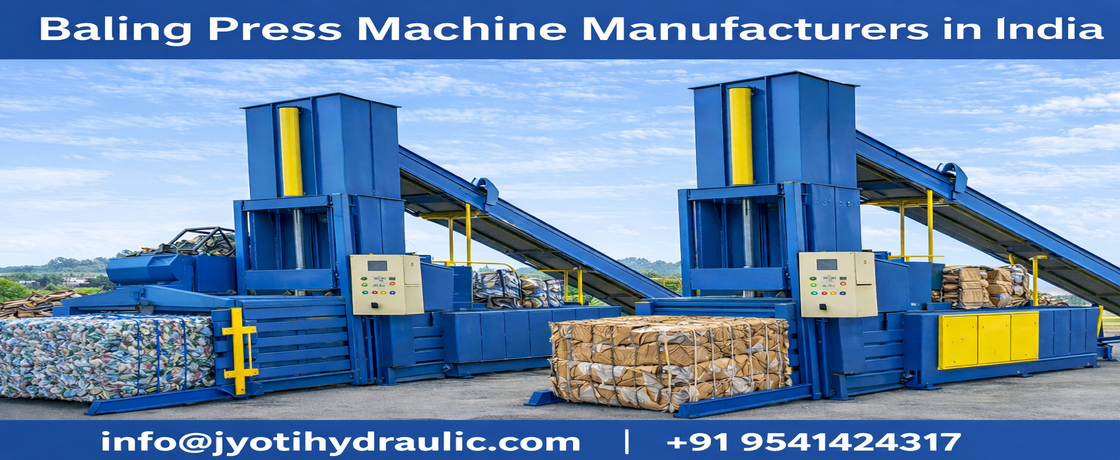
Jyoti Hydraulic supports manufacturing and recycling industries with hydraulic scrap baling solutions designed to convert loose, bulky scrap into compact and manageable bales. For factories generating metal offcuts, production waste, sheet scrap, aluminium pieces, cardboard, or other suitable recyclable materials, a scrap baling press can improve storage, material movement, and recycling operations. When comparing Scrap Baling Machine Manufacturers in India, industries should focus not only on pressing capacity but also on machine construction, hydraulic performance, safety, and suitability for the actual scrap being processed.
Growing Need for Scrap Baling in Manufacturing
Manufacturing plants can generate significant volumes of recyclable waste during cutting, stamping, fabrication, machining, and assembly processes. The major difficulty with loose scrap is its low bulk density. Even relatively lightweight material can occupy considerable floor or yard space when stored in an irregular form.
A hydraulic baling press compresses this loose scrap into dense bales. The resulting material is easier to stack, weigh, handle, and dispatch to recycling facilities.
This makes scrap baling especially useful for automotive component manufacturers, fabrication units, engineering companies, appliance manufacturers, metal processors, and dedicated recycling facilities.
How Does a Hydraulic Scrap Baling Press Work?
A scrap baling machine uses hydraulic pressure to generate controlled compression force. An electric motor drives the hydraulic pump, which circulates pressurized oil toward the hydraulic cylinder. The cylinder then moves the compression ram against the scrap placed inside the baling chamber.
As pressure increases, the loose material is compressed into a smaller volume. Depending on the machine configuration, the finished bale can then be removed or discharged for further handling.
Important components generally include:
- Heavy-duty fabricated frame
- Hydraulic cylinder and compression ram
- Hydraulic pump and motor
- Oil reservoir and filtration system
- Compression chamber
- Hydraulic valves and pressure controls
- Electrical control panel
- Emergency and operating controls
Reliable baling performance depends on how effectively these components are engineered to work together.
Benefits of Scrap Baling Machines
One of the biggest advantages of baling is better utilization of factory space. Loose scrap can occupy large storage areas, while compact bales require considerably less room.
Baling can also simplify material handling. Uniform bales are easier to organize and can be moved using suitable industrial handling equipment.
Transportation efficiency may also improve because compressed material occupies less vehicle volume. Actual savings, however, depend on bale density, material type, vehicle payload, and transportation conditions.
For manufacturing facilities, a structured baling process can additionally improve housekeeping and make scrap collection more systematic.
How to Select the Right Scrap Baling Machine
Choosing a baler only on the basis of tonnage can lead to incorrect machine selection. Experienced Baling Machine Manufacturers consider several operating factors before recommending a system.
Manufacturers should evaluate:
- Type of scrap material
- Size and shape of loose scrap
- Scrap generated per shift or day
- Required bale dimensions
- Desired production rate
- Machine duty cycle
- Hydraulic system capacity
- Loading and bale discharge method
- Automation requirements
- Service and spare-parts availability
For example, lightweight sheet-metal offcuts and heavier fabrication scrap may require different chamber designs and compression conditions despite coming from the same industry.
Providing actual scrap photographs, approximate dimensions, daily quantity, and expected bale size helps the manufacturer recommend a more practical solution.
Future of Industrial Scrap Baling
Modern baling equipment is gradually moving toward improved automation, energy-efficient hydraulic systems, PLC-based operation, and better process monitoring.
Manufacturing facilities are also integrating scrap management more closely with production lines. Conveyors, automated feeding systems, sensors, and centralized recycling areas can reduce unnecessary material handling while improving the overall recycling workflow.
Conclusion
A scrap baling press is more than a waste-volume reduction machine. When correctly selected, it becomes an important part of industrial material management by helping manufacturers organize recyclable scrap, improve storage efficiency, and simplify transportation.
Businesses evaluating Scrap Baling Machine Manufacturers should therefore choose equipment according to their actual material, volume, duty cycle, and operational requirements rather than purchasing solely on machine price or pressing tonnage.
Frequently Asked Questions
What is a scrap baling machine used for?
It is used to compress suitable loose recyclable scrap into compact bales for easier handling, storage, and transportation.
Which industries use scrap baling presses?
Metal fabrication, automotive, engineering, appliance manufacturing, recycling, and other scrap-generating industries commonly use baling machines.
How is the correct baler capacity selected?
Capacity depends on scrap material, dimensions, daily quantity, desired bale size, compression requirement, and operating frequency.
Can one baler handle every type of scrap?
Not always. Different materials have different compression characteristics, so the machine should be configured for the intended application.
Need a Scrap Baling Solution for Your Factory?
Contact Jyoti Hydraulic to discuss your scrap material, production volume, and baling requirements. Get professional guidance in selecting a suitable hydraulic baling solution for your manufacturing or recycling operation.
📧 info@jyotihydraulic.com
📞 +91 9541424317
Contact today for an expert consultation and request a quotation for your industrial scrap baling requirements.


