
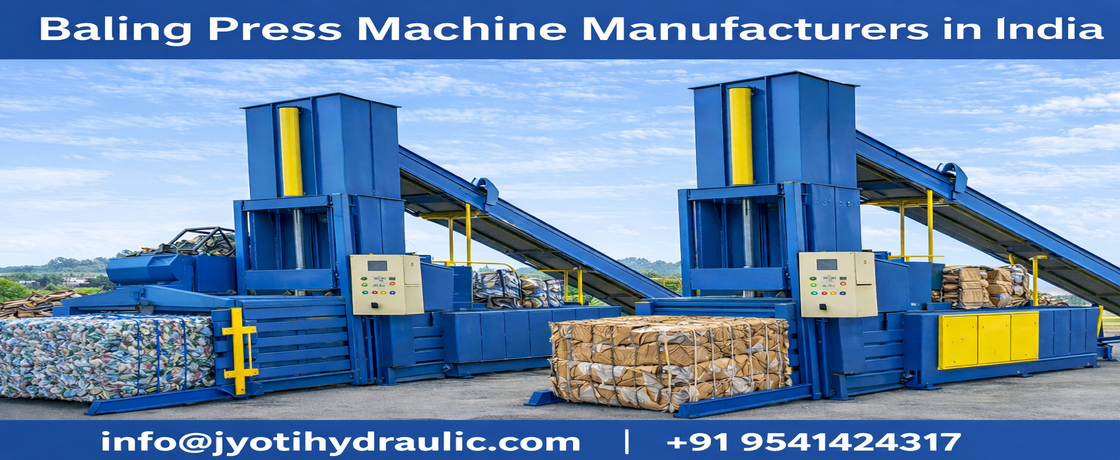
Jyoti Hydraulic manufactures hydraulic equipment that helps factories, recycling units, and scrap yards manage bulky waste efficiently. A baling press machine compresses loose materials such as metal scrap, cardboard, plastic, fabric, and aluminium cans into compact bales. These bales are easier to store, transport, weigh, and recycle.
Why Baling Press Machines Are Important
Loose industrial scrap occupies valuable floor space, creates handling problems, and increases transport expenses. In recycling facilities, large volumes of waste must also be processed every day.
A baling press converts scattered scrap into uniform blocks that can be stacked and loaded safely. For this reason, businesses prefer experienced Baling Press Machine Manufacturers who understand material behaviour, production capacity, and the required bale density.
How Does a Baling Press Machine Work?
The process begins when scrap is loaded into the compression chamber. Loading may be manual or carried out through a conveyor.
After filling, the hydraulic power pack sends pressurised oil to the cylinder. The cylinder moves a strong compression ram forward, pressing the material against the chamber wall. As pressure increases, air gaps are removed and the scrap becomes dense.
Once the required bale shape is achieved, the material may be tied with wire or strapping. This is common for paper, plastic, and textile waste. Metal bales often retain their shape because they are compressed under much higher force. The finished bale is then removed through a hydraulic ejection system.
Main Technical Components
A reliable baling press normally includes a fabricated steel chamber, heavy-duty hydraulic cylinders, hydraulic pump, oil reservoir, pressure-control valves, electric motor, compression ram, safety controls, and a bale ejection arrangement.
Machine performance depends not only on tonnage but also on frame strength, welding quality, cylinder seals, oil temperature control, and component durability. PLC controls and automatic cycle settings can improve productivity in continuous operations.
Industrial Applications
Baling machines are widely used in metal recycling yards, automobile plants, paper mills, textile factories, warehouses, packaging units, and plastic recycling facilities.
Common materials include mild-steel cuttings, aluminium cans, copper scrap, PET bottles, plastic film, corrugated boxes, waste paper, cotton, and fabric cuttings. Reputed Scrap Baling Machine Manufacturers in India can customise chamber size, compression force, loading method, and bale dimensions for different materials.
Benefits of Using a Baling Press
The main advantage is better space utilisation. Dense bales require much less storage area than loose scrap. Transportation also becomes economical because more material can be loaded into each vehicle.
Baling helps maintain a cleaner workplace, reduces manual handling, and makes scrap inventory easier to measure. Properly sorted and compacted material may also receive better value from recyclers. In high-volume plants, automation reduces labour requirements and improves cycle consistency.
How to Choose the Right Machine
Start by identifying the scrap type, daily quantity, bulk density, and desired bale size. Metal waste normally requires higher compression force than cardboard, plastic, or fabric.
Compare machine tonnage, chamber dimensions, cycle time, motor power, loading method, and floor-space requirement. Also check safety features, hydraulic component quality, spare-parts availability, warranty, and after-sales service. Selecting a machine only on price can lead to frequent breakdowns and higher operating costs.
Future Trends
Modern balers are becoming more automated and energy efficient. PLC controls, sensors, automatic feeding, bale counters, remote diagnostics, and maintenance alerts are increasingly used in large recycling operations. These features help reduce downtime and improve production control.
Conclusion
A baling press machine is a practical investment for businesses that generate large volumes of industrial scrap. It reduces waste volume, improves storage, lowers transport costs, and supports organised recycling. The best machine is one selected according to the actual material and operating conditions.
Frequently Asked Questions
What materials can a baling press compress?
It can compress metal, paper, cardboard, plastic, PET bottles, textile waste, and aluminium cans.
What is the difference between vertical and horizontal balers?
Vertical balers suit lower-volume operations, while horizontal balers are designed for faster, continuous processing.
Can the machine be customised?
Yes. Compression force, chamber size, bale dimensions, feeding system, and controls can be customised.
Request a Quotation
Contact Jyoti Hydraulic for expert consultation, machine selection support, and a customised quotation.
📞 +91 9541424317


