
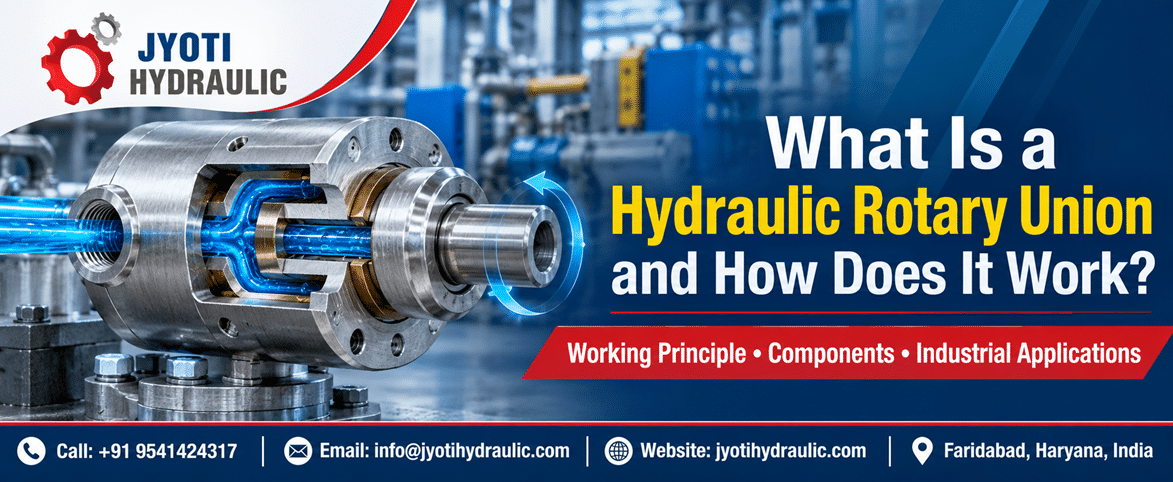
Jyoti Hydraulic understands that reliable fluid transfer is essential for the smooth operation of modern industrial machinery. In hydraulic systems where machine components rotate continuously or intermittently, transferring pressurized oil without twisting hoses, damaging seals, or interrupting operation can be challenging. This is where a Hydraulic Rotary Union becomes an important engineering component.
A hydraulic rotary union is a precision-engineered mechanical device that transfers pressurized hydraulic fluid between stationary and rotating machine parts while maintaining a sealed fluid passage. It enables equipment to rotate without twisting connected hydraulic lines or disrupting fluid supply.
From construction equipment and industrial automation to CNC machines, rotary tables, and heavy engineering systems, hydraulic rotary unions support efficient machine operation.
However, their performance depends on more than simply connecting two hydraulic pipes. Internal sealing arrangements, operating pressure, rotational speed, fluid compatibility, manufacturing precision, and installation accuracy all influence reliability.
This guide explains how hydraulic rotary unions work, their internal construction, industrial applications, technical advantages, and important considerations when selecting the right product.
Industry Overview: Why Are Hydraulic Rotary Unions Important?
Industrial machinery increasingly combines hydraulic power with rotating movement.
Hydraulic systems generate controlled force through pressurized fluid, while rotating mechanisms perform tasks such as indexing, positioning, material handling, clamping, and continuous processing.
The engineering challenge appears when hydraulic power must pass from a stationary supply line into a rotating assembly.
A conventional hose connection may tolerate limited movement, but continuous rotation can cause twisting, excessive bending, premature fatigue, and eventual hose failure.
A hydraulic rotary union solves this problem by creating a controlled rotating interface between the stationary and moving components.
It is particularly valuable in equipment requiring:
- Continuous 360-degree rotation
- Repeated clockwise and anticlockwise movement
- High-pressure hydraulic fluid transfer
- Independent hydraulic circuits
- Compact hydraulic connections
- Reliable operation during repetitive production cycles
As manufacturing equipment becomes more automated, the need for dependable rotary fluid transfer solutions continues to grow.
What Is a Hydraulic Rotary Union?
A Hydraulic Rotary Union, sometimes called a hydraulic swivel joint or rotary fluid joint, provides a sealed connection between stationary hydraulic piping and rotating equipment.
Its primary function is to allow pressurized hydraulic fluid to pass through a rotating interface while the connected machine component moves.
The device itself does not generate hydraulic pressure or drive the rotating equipment. Instead, it transfers hydraulic power supplied by an external pump or hydraulic power unit.
For example, consider a rotating industrial table equipped with hydraulically operated clamps.
The hydraulic pump remains stationary, while the table rotates to different working positions. A suitable rotary union allows pressurized oil to reach the rotating clamping system without wrapping hoses around the table.
Depending on the application, the union may contain one fluid passage or several completely independent passages.
This makes it useful in both simple hydraulic systems and complex automated machinery.
Main Components of a Hydraulic Rotary Union
The reliability of a rotary union depends on the design and interaction of its internal components.
1. Housing or Stationary Body
The housing forms the stationary section of the assembly and typically contains the fixed fluid connections.
Depending on operating conditions, manufacturers may use steel, stainless steel, aluminium, or other suitable engineering materials.
The housing must maintain structural strength, dimensional accuracy, and resistance to the operating environment.
2. Rotating Shaft or Rotor
The rotor connects to the rotating machine component.
It contains precisely machined internal fluid passages that align with the stationary supply ports through the union’s internal flow arrangement.
Its surface finish, dimensional accuracy, and alignment influence sealing performance and rotational stability.
3. Dynamic Sealing System
The sealing arrangement is one of the most critical elements.
Depending on the design, it may use:
- Engineered elastomeric or polymer seals
- Mechanical face seals
- Pressure-balanced sealing arrangements
- Hydrostatic sealing technology
Each sealing method has different pressure, speed, friction, lubrication, and leakage characteristics.
The correct seal must be selected according to the complete operating conditions rather than pressure alone.
4. Bearings or Supporting Elements
Bearings support relative rotation between the stationary and moving sections in self-supported designs.
Some rotary unions instead rely on external machine bearings or specially designed supporting surfaces.
Proper support helps control radial movement, axial displacement, and mechanical loads acting on the sealing system.
5. Fluid Ports and Internal Passages
Fluid ports connect the rotary union to the hydraulic circuit.
Single-passage designs transfer one circuit, while multi-passage designs accommodate several independent fluid paths.
6. Static Seals and Drain Connections
Static seals prevent leakage at fixed joints and interfaces.
Certain rotary union designs also incorporate drain or leakage-collection connections. These must be installed according to the manufacturer’s instructions because some sealing systems intentionally permit a controlled amount of fluid leakage for lubrication.
How Does a Hydraulic Rotary Union Work?
The working principle is based on maintaining hydraulic continuity across a rotating interface.
Although individual designs vary, the process generally follows five stages.
Step 1: Pressurized Hydraulic Oil Enters the Stationary Port
A hydraulic pump supplies oil through a fixed pipe or hose connected to the stationary housing.
The pressure and flow depend on the hydraulic circuit and the requirements of the connected equipment.
Step 2: Oil Travels Through the Internal Passage
The pressurized fluid passes through carefully machined internal channels.
These passages are designed to provide an effective flow path while maintaining separation between the moving and stationary components.
Step 3: Dynamic Seals Contain the Fluid
The sealing elements operate at the interface between the stationary housing and rotating rotor.
Their purpose is to control fluid leakage while permitting relative rotation.
Seal performance depends on pressure, speed, temperature, fluid properties, surface finish, and operating duty.
Step 4: The Rotor Turns With the Machine
As the machine rotates, the rotor moves while the housing remains stationary.
The hydraulic connection remains established throughout the permitted rotational movement.
This eliminates the need for the stationary supply hose to rotate with the equipment.
Step 5: Hydraulic Fluid Reaches the Rotating Equipment
Oil exits through the rotating connection and reaches the hydraulic actuator or other connected component.
For systems requiring more than one hydraulic line, separate internal passages may carry different pressure or return circuits.
In simple terms: A hydraulic rotary union allows a fixed hydraulic supply and a rotating machine to remain connected without forcing the hydraulic hoses to twist.
Types of Hydraulic Rotary Unions
Different machines require different flow arrangements.
Single-Passage Hydraulic Rotary Union
A single-passage rotary union provides one hydraulic flow path across the rotating interface.
It may be suitable for applications requiring a single pressurized supply or a dedicated fluid connection.
Its relatively simple construction can make it practical where installation space and circuit requirements are limited.
Dual-Passage Hydraulic Rotary Union
A dual-passage design contains two separate fluid channels.
For example, the channels may serve the two working ports of a double-acting hydraulic cylinder mounted on a rotating platform.
Each passage must maintain appropriate sealing and hydraulic isolation.
Multi-Passage Hydraulic Rotary Union
Multi-passage unions transfer several independent hydraulic circuits through one rotating assembly.
They are especially useful in automated rotary fixtures, heavy machinery, and equipment incorporating multiple hydraulic actuators.
The number and size of passages must be selected according to the machine’s functional requirements.
Technical Insights: What Determines Rotary Union Performance?
Understanding the internal construction is only the starting point. A rotary union must also be matched to the actual hydraulic system.
Operating Pressure and Pressure Spikes
A hydraulic rotary union must withstand the expected continuous operating pressure and permissible transient loads.
Pressure surges can occur during rapid valve switching, abrupt actuator movement, or changes in mechanical load.
Selecting a product only by normal pump pressure may therefore be insufficient.
The manufacturer should confirm that the assembly is suitable for the complete pressure profile.
Rotational Speed and Duty Cycle
Sealing friction generates heat during rotation.
As operating speed increases, heat generation and wear may increase depending on the seal design.
A rotary union suitable for slow, intermittent indexing may not be suitable for uninterrupted high-speed rotation.
Importantly, maximum pressure and maximum rotational speed listed separately in a catalogue are not necessarily permissible simultaneously.
Flow Capacity and Pressure Drop
The internal passage diameter affects hydraulic flow resistance.
Undersized passages can create excessive pressure loss, reduce available actuator performance, and contribute to oil heating.
The hydraulic power associated with pressure loss can be estimated using:
Power loss (kW) = Pressure drop (bar) × Flow rate (L/min) ÷ 600
For example, if a rotary union creates a pressure drop of 8 bar at a flow rate of 30 L/min:
Power loss = 8 × 30 ÷ 600 = 0.4 kW
Under steady operating conditions, this represents approximately 400 watts of hydraulic power dissipated through flow resistance.
Actual losses depend on the internal passage geometry, fluid viscosity, operating temperature, and flow conditions.
This is why passage sizing should never be based on connection thread size alone.
Seal and Fluid Compatibility
Hydraulic systems may use mineral-based hydraulic oils, water-glycol fluids, or other specialized media.
Not every sealing material is compatible with every fluid.
A suitable seal must resist chemical degradation, swelling, extrusion, and excessive friction under the intended conditions.
Fluid cleanliness is also important because abrasive contamination can damage sealing surfaces and accelerate wear.
Mechanical Alignment
Excessive shaft runout, misalignment, unsupported pipe loads, and vibration can reduce seal life.
Installation must allow the rotating element to operate without unintended bending or axial loading.
These details are particularly important in precision manufacturing equipment and heavy-duty rotating assemblies.
Industrial Applications of Hydraulic Rotary Unions
1. Construction and Earthmoving Equipment
Excavators and other rotating hydraulic machines may require fluid transfer between the stationary or lower structure and rotating upper components.
Appropriately designed hydraulic swivel assemblies enable hydraulic power transmission during rotation.
2. CNC Machines and Rotary Tables
Rotary unions supply hydraulic pressure to clamping fixtures, indexing mechanisms, and other hydraulic devices mounted on rotating machine sections.
This allows automated machining operations to continue without complicated hose arrangements.
3. Steel Plants and Heavy Engineering
Heavy industrial equipment often operates under demanding loads, vibration, and repetitive movement.
Hydraulic rotary unions can support rotating actuators and mechanisms used in material handling and production equipment.
4. Plastic and Rubber Processing Machinery
Rotating fixtures, moulding equipment, and certain processing assemblies require hydraulic actuation during movement.
Suitable rotary unions help maintain hydraulic connections within these systems.
5. Packaging and Factory Automation
Automated machines frequently require repeated rotation combined with precise hydraulic actuation.
Multi-passage rotary unions can connect several actuators through a compact rotating interface.
6. Marine and Material Handling Equipment
Hydraulic cranes, winches, cable-handling equipment, and rotating industrial platforms may use rotary unions where fluid transfer must continue during rotation.
For marine installations, corrosion resistance and environmental sealing become additional design considerations.
Key Benefits of Using a Hydraulic Rotary Union
1. Prevents hose twisting: The rotating interface removes the need for fixed hydraulic hoses to follow continuous machine rotation.
2. Supports uninterrupted fluid transfer: Properly selected unions maintain a hydraulic connection throughout the intended rotational movement.
3. Reduces maintenance-related problems: Correctly engineered rotary unions can reduce hose fatigue and avoidable failures associated with rotating connections.
4. Enables compact equipment design: Multiple hydraulic circuits can be integrated into one rotating assembly instead of relying on complicated external hose arrangements.
5. Improves operational reliability: Appropriate sealing, alignment, and installation help reduce leakage-related downtime.
6. Supports automation: Rotary unions make it easier to combine hydraulic actuation with repetitive or continuous rotating movement.
These benefits depend on proper product selection, operating conditions, and maintenance.
How to Select the Right Hydraulic Rotary Union: Practical Buying Guide
Choosing a hydraulic rotary union involves more than checking its dimensions or purchase price.
Reliable Hydraulic Rotary Union Manufacturers should be able to evaluate the actual operating requirements before recommending a configuration.
| Selection factor | What buyers should verify |
|---|---|
| Working pressure | Normal pressure, peak pressure, and expected transients |
| Rotational speed | Maximum RPM and continuous or intermittent duty |
| Flow requirement | Flow rate through each independent passage |
| Hydraulic medium | Oil type, viscosity, and seal compatibility |
| Temperature | Operating fluid temperature and ambient conditions |
| Number of passages | Required independent supply, return, and control circuits |
| Mounting arrangement | Shaft dimensions, flange, threads, and installation space |
| Operating environment | Dust, moisture, chemicals, vibration, and corrosion exposure |
| Maintenance | Drain requirements, lubrication instructions, and service accessibility |
Why Application-Based Selection Matters
Consider a rotary fixture operating with two hydraulic circuits.
A rotary union may appear suitable because it matches the operating pressure and mounting dimensions.
However, if its passages are undersized, the system may experience an unacceptable pressure drop.
Similarly, if the selected seals are designed for intermittent movement but the machine rotates continuously, excessive wear may occur.
The correct selection must satisfy all operating parameters together.
Jyoti Hydraulic, based in Faridabad, Haryana, offers hydraulic rotary union solutions with application-specific design options, including different sizes, connection arrangements, pressure requirements, and flow configurations.
Sharing complete technical requirements with the manufacturer helps avoid unnecessary modifications and improves the chances of selecting a suitable assembly.
Installation and Maintenance: How Can Rotary Union Failure Be Prevented?
Even a well-manufactured hydraulic rotary union can develop problems if it is installed incorrectly or operated outside its intended limits.
Follow Correct Installation Practices
The union should be mounted according to the approved drawing and manufacturer’s instructions.
Check alignment, fitting dimensions, rotating clearances, and pipe support before operation.
Avoid transferring unnecessary hose weight or mechanical loads to the union housing.
Where the design includes a drain connection, ensure that it is routed correctly and does not create excessive backpressure.
Maintain Hydraulic Oil Cleanliness
Contaminated hydraulic oil can damage seals and internal surfaces.
Maintain the specified filtration level, use compatible hydraulic fluid, and prevent dirt from entering during installation or maintenance.
Monitor Early Warning Signs
Common symptoms that require inspection include:
- Unusual external oil leakage
- Increasing rotational resistance
- Abnormal temperature rise
- Unexpected pressure loss
- Excessive noise or vibration
- Premature seal deterioration
Such symptoms do not always indicate a defective rotary union. Problems may also originate from misalignment, incompatible fluids, blocked drain lines, hydraulic contamination, or operating conditions outside the product rating.
Always isolate hydraulic power, relieve stored pressure, and follow the equipment’s safety procedure before inspection or maintenance.
Future Trends in Hydraulic Rotary Union Technology
Industrial equipment is moving toward higher productivity, compact construction, and more closely monitored operating conditions.
Several engineering developments are shaping rotary union technology.
Advanced Sealing Materials
Improved polymers, engineered sealing surfaces, and wear-resistant coatings are expanding the possibilities for demanding hydraulic applications.
The objective is to balance leakage control, friction, durability, and fluid compatibility.
Compact Multi-Circuit Designs
Modern automated equipment often requires multiple hydraulic functions within limited installation space.
Compact multi-passage rotary unions can reduce external piping complexity while supporting more sophisticated machine designs.
Condition Monitoring
In high-value industrial systems, temperature, leakage, vibration, and pressure monitoring can help maintenance teams identify abnormal operating conditions.
These measurements may be integrated into the wider machine monitoring system rather than directly into the rotary union.
Application-Specific Engineering
Manufacturers are increasingly expected to consider the complete machine environment, including pressure cycles, fluid properties, rotational duty, mounting constraints, and maintenance accessibility.
This approach can improve component selection and reduce avoidable operating problems.
Conclusion
A hydraulic rotary union is a critical connection between stationary hydraulic power and rotating machinery.
Its function may appear simple, but reliable performance depends on accurate machining, suitable sealing technology, proper hydraulic passage design, and careful consideration of real operating conditions.
Whether used in a rotary table, industrial automation system, construction machine, or heavy engineering application, the right rotary union helps maintain hydraulic continuity while reducing the problems associated with twisting hoses.
Selecting the correct product requires an understanding of pressure, rotational speed, flow capacity, temperature, media compatibility, and mounting design.
Jyoti Hydraulic offers hydraulic rotary union solutions for industrial requirements, including application-specific configurations. For machine manufacturers, maintenance teams, and industrial buyers, discussing the complete operating conditions before purchasing is an important step toward dependable long-term performance.
Frequently Asked Questions (FAQs)
1. What is a hydraulic rotary union used for?
A hydraulic rotary union transfers pressurized hydraulic fluid between stationary and rotating machine components. It allows hydraulic actuators or other equipment mounted on a rotating assembly to receive fluid without twisting the stationary supply hoses.
2. How does a hydraulic rotary union work?
Hydraulic oil enters through a stationary connection, passes through internal fluid channels, and exits through a rotating connection. Dynamic seals control leakage at the rotating interface while allowing the two machine sections to move relative to each other.
3. What is the difference between a hydraulic rotary union and a hydraulic swivel joint?
The terms are sometimes used interchangeably. In practice, swivel joints may refer to connections designed for limited angular movement, while rotary unions can be engineered for continuous rotation. The permitted movement depends on the specific product design.
4. Can hydraulic rotary unions operate at high pressure?
Yes. High-pressure rotary unions are available, but their permissible operating pressure depends on construction, sealing technology, rotational speed, temperature, and other application factors. Buyers should verify the rated operating envelope with the manufacturer.
5. What is the difference between single-passage and multi-passage rotary unions?
A single-passage union carries one fluid circuit across the rotating interface. A multi-passage union accommodates two or more independent circuits, allowing separate hydraulic functions to operate through the same rotating assembly.
6. Why does a hydraulic rotary union leak?
Leakage can result from worn seals, contaminated fluid, excessive pressure, incorrect installation, poor alignment, incompatible sealing materials, or mechanical damage. Some specialized hydrostatic designs also allow controlled leakage that must be collected through a designated drain.
7. Can a hydraulic rotary union rotate continuously?
Yes, provided the selected model is specifically rated for continuous rotation at the intended pressure, speed, temperature, and duty cycle. Not all rotary unions are suitable for continuous operation.
8. How long does a hydraulic rotary union last?
Service life varies according to operating pressure, rotational speed, duty cycle, fluid cleanliness, seal material, alignment, and maintenance. There is no universal lifespan applicable to every rotary union design.
9. What information is required when ordering a hydraulic rotary union?
The manufacturer generally needs operating pressure, maximum RPM, flow rate, fluid type, temperature, number of passages, mounting dimensions, connection types, and details of the working environment.
10. Where can I find Hydraulic Rotary Union Manufacturers in India?
Jyoti Hydraulic is a Faridabad-based manufacturer offering hydraulic rotary union solutions for industrial machinery. Buyers can contact the company to discuss product requirements, customization, and quotations.
Contact Jyoti Hydraulic – Request a Quotation and Expert Consultation
Looking for a hydraulic rotary union that matches your machine’s operating requirements?
An incorrect rotary union selection can lead to oil leakage, unwanted pressure losses, premature seal wear, and costly machine downtime.
At Jyoti Hydraulic, we understand the importance of selecting hydraulic components based on actual industrial operating conditions.
Whether you need a single-passage hydraulic rotary union, a high-pressure configuration, or a customized solution for your machinery, our team can help you discuss the most suitable options.
Contact Jyoti Hydraulic today to:
- Request a quotation for your hydraulic rotary union requirements.
- Get expert consultation regarding pressure, flow, speed, and mounting arrangements.
- Discuss customized solutions for industrial machines and OEM applications.
- Share technical drawings or specifications for application-based product selection.
Get in Touch With Jyoti Hydraulic
📧 Email: info@jyotihydraulic.com
📞 Call: +91 9541424317
🌐 Website: https://jyotihydraulic.com/
📍 Location: Faridabad, Haryana, India
Contact Jyoti Hydraulic today and take the next step toward reliable hydraulic fluid transfer, improved machine performance, and a solution engineered for your application.


