
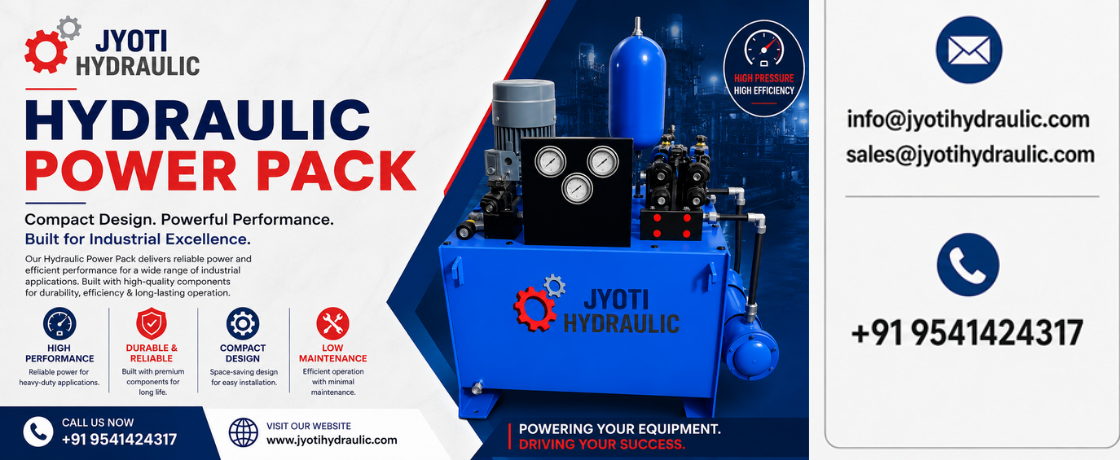
Jyoti Hydraulic manufactures reliable hydraulic solutions for industries that require high force, controlled movement and continuous machine operation. A Large Hydraulic Power Pack is an industrial unit that converts mechanical energy into hydraulic power. It supplies pressurised oil to cylinders, motors and other actuators used for lifting, pressing, clamping, bending or moving heavy loads.
Unlike a small power unit designed for a single operation, a large power pack can operate multiple hydraulic functions. Its performance depends on correct pressure, flow rate, motor capacity, reservoir size and control configuration.
Industry Overview
Heavy engineering, steel production, construction, mining, power generation and material handling industries depend heavily on hydraulic systems. These systems are preferred because they can generate substantial force from comparatively compact equipment.
Modern power packs may include PLC controls, HMI displays, variable-speed drives, proportional valves and condition-monitoring sensors. Such features improve accuracy, energy efficiency and machine safety while helping operators identify faults before they cause serious downtime.
How Does a Large Hydraulic Power Pack Work?
The electric motor drives a hydraulic pump that draws oil from the reservoir. The pump sends this oil through valves and pipelines under controlled pressure. Directional valves guide the oil towards the required actuator, while pressure and flow-control valves regulate force and operating speed.
The main components include:
- Hydraulic oil reservoir
- Electric motor or diesel engine
- Gear, vane or piston pump
- Directional and pressure-control valves
- Hydraulic manifold
- Suction, pressure and return-line filters
- Oil cooler or heat exchanger
- Pressure gauges and temperature sensors
- Electrical control panel
Pump selection is particularly important. Gear pumps are commonly used for straightforward industrial duties, while piston pumps are better suited to high-pressure or variable-flow applications. Proper filtration and cooling are equally essential because contaminated or overheated oil can damage pumps, valves and seals.
Major Industrial Applications
A Large Hydraulic Power Pack can be used with:
- Hydraulic presses and forming machines
- Rolling mills and steel-processing equipment
- Heavy lifting and material-handling systems
- Mining and construction machinery
- Marine winches and steering systems
- Dam gates and civil engineering equipment
- Cement and power plant machinery
- Hydraulic testing rigs
- Automated production lines
Every application requires a different design. A press may need stable pressure holding, whereas a lifting platform requires load-holding valves, emergency lowering and additional safety interlocks.
Benefits
Large hydraulic power units provide high force, smooth movement and accurate speed control. They can be customised for multiple operations and are suitable for both intermittent and continuous-duty applications.
A properly designed system also offers:
- Consistent machine performance
- Better production efficiency
- Protection against overloading
- Easy integration with automation
- Reduced manual effort
- Long equipment life with proper maintenance
Large Hydraulic Power Pack Price and Selection Guide
The Large Hydraulic Power Pack Price depends on its technical configuration. Pressure capacity, flow rate, motor power, pump type, tank size, valve arrangement and automation level all influence the final cost. Cooling systems, filtration, PLC controls, proportional valves and special safety features may also affect pricing.
Before requesting a quotation, provide the manufacturer with:
- Required working pressure and flow rate
- Cylinder size, stroke and operating speed
- Number of actuators
- Machine operating sequence
- Daily duty cycle
- Indoor or outdoor installation conditions
- Required control and automation level
Avoid selecting a unit only on the basis of initial price. An incorrectly sized system may suffer from slow operation, excessive heat, unstable pressure and premature component failure. Comparing component quality, service support, energy consumption and maintenance requirements gives a more realistic understanding of long-term value.
Future Trends
Modern hydraulic power packs are becoming more intelligent and energy-efficient. Variable-frequency drives and variable-displacement pumps reduce unnecessary energy consumption. Smart sensors can monitor oil temperature, pressure, level and filter condition in real time, making predictive maintenance easier and reducing unexpected breakdowns.
Conclusion
A large hydraulic power pack is the driving force behind many heavy-duty industrial machines. Correct engineering is essential for reliable pressure, controlled movement, safety and long service life. The best results come from choosing a customised system based on actual machine requirements rather than a standard ready-made configuration.
Frequently Asked Questions
Can one power pack operate multiple cylinders?
Yes. It can be designed with separate valves and circuits to control several cylinders individually or simultaneously.
Why is an oil cooler required?
It maintains the correct oil temperature during continuous operation and protects hydraulic components from heat-related damage.
Which pump is best for a large power pack?
The choice depends on pressure, flow and duty cycle. Piston pumps are commonly preferred for demanding high-pressure applications.
Can the system be automated?
Yes. PLC, HMI, sensors, VFDs and proportional valves can be integrated for automatic and precise operation.
Request a Custom Quotation
Contact Jyoti Hydraulic for a customised hydraulic power pack, competitive quotation and expert technical consultation.
📧 info@jyotihydraulic.com
📞 +91 9541424317


