
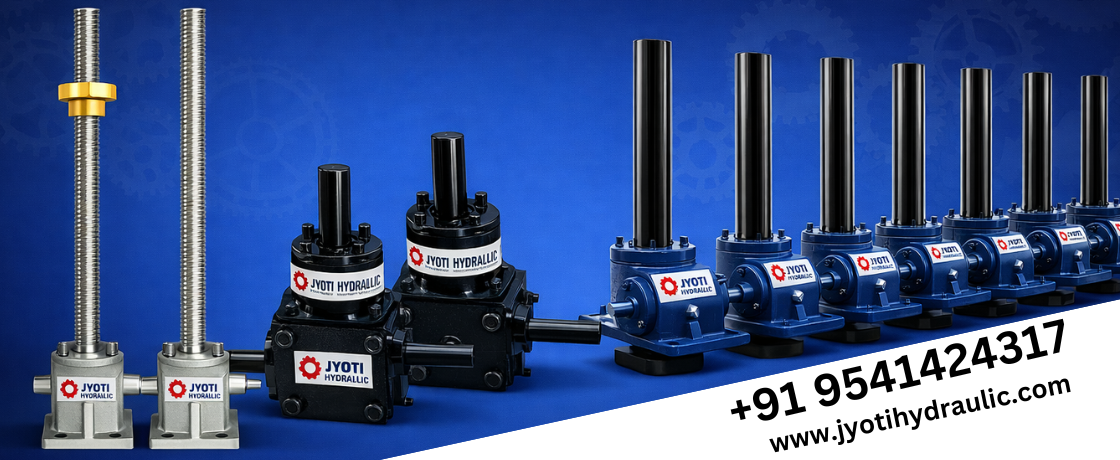
Jyoti Hydraulic understands a problem every plant engineer, OEM buyer, and maintenance head faces: when heavy loads must move with precision, a poor lifting system can cause misalignment, downtime, rework, and safety risk. That is exactly why the demand for a Worm Gear Screw Jack keeps growing across steel plants, automation lines, warehouses, construction systems, and heavy machinery. Buyers searching for Worm Gear Screw Jack Manufacturers or Worm Gear Screw Jack Manufacturers in India are no longer looking for a simple jack. They are looking for engineered reliability, controlled motion, and long service life.
A worm gear screw jack is a compact yet powerful piece of mechanical lifting equipment that converts rotary motion into precise linear movement. In real industrial use, it helps lift, lower, push, pull, tilt, and position loads where hydraulic drift, uneven movement, or unsafe manual methods are not acceptable. For industrial buyers, it is often one of the most practical load handling equipment choices because it combines control, durability, and integration flexibility in one system.
Industry Overview
India’s industrial motion and material handling solutions market is expanding as warehousing, automation, manufacturing, and infrastructure projects scale up. Grand View Research says India’s material handling equipment market generated about USD 5.4 billion in 2023 and expects it to reach USD 8.7 billion by 2030, with cranes and lifting equipment among the major segments. At the same time, Mordor Intelligence estimates India’s warehouse automation market at about USD 0.66 billion in 2026, growing strongly through 2031.
That growth matters because modern plants need lifting systems that are more precise than chain blocks and more maintenance-friendly than many fluid-power alternatives in static positioning jobs. ICEMA highlights the wider growth push in India’s equipment ecosystem, while Reuters reported that even with uneven momentum, India’s core infrastructure sectors such as steel and cement remained positive in February 2026. In plain terms, more factories, conveyors, process lines, and infrastructure-linked machines mean more need for dependable industrial screw jack systems.
What Is a Worm Gear Screw Jack?
A Worm Gear Screw Jack is a mechanical device that uses a worm gear mechanism to rotate a lifting screw or drive a lifting nut, creating controlled linear motion. It is widely used when an application needs high load capacity, compact design, repeatable positioning, and dependable holding capability.
Main Components
A typical worm gear screw jack includes:
- Housing, usually cast iron or ductile iron
- Worm shaft
- Worm wheel or drive sleeve, often bronze-based
- Lifting screw or ball screw
- Thrust bearings
- Lubrication arrangement
- Protective accessories such as boots, limit switches, couplings, and motor mounts
Screw Jack Working Principle
Here is the screw jack working principle in simple steps:
- Manual input, geared motor, servo motor, or another drive turns the worm shaft.
- The worm shaft rotates the worm wheel inside the gearbox housing.
- That rotational movement is converted into linear travel through the screw thread or ball screw assembly.
- Depending on the design, either the screw moves linearly or the nut travels along the rotating screw.
- The load is lifted, lowered, pushed, or positioned with controlled force.
This is why worm gear screw jacks are valued in engineering applications: they deliver slow, powerful, and highly controllable motion without needing a bulky power pack for every use case.
Technical Insights Every Buyer Should Know
1) Machine Screw vs Ball Screw
Not all screw jacks behave the same. The biggest technical split is between machine screw and ball screw designs.
| Type | Best Fit | Key Advantage | Important Limitation |
|---|---|---|---|
| Machine Screw Jack | Low to moderate duty, slower travel, holding loads in position | Self-locking is possible on certain ratios | Lower efficiency, more heat at higher duty |
| Ball Screw Jack | Higher speed, higher duty cycle, lower input torque | Better efficiency, faster travel, less motor power | Generally not self-locking, often needs braking/control |
Joyce/Dayton notes machine screw jacks are preferred where self-locking and lower speed are important, while Nook states ball screw jacks run at higher speed and duty cycle because rolling contact reduces friction.
2) Load Capacity and Efficiency
Load capacity depends on screw diameter, gear design, material strength, duty cycle, mounting condition, and whether the system uses a single jack or multiple synchronized jacks. Nook lists standard capacities from 1/4 ton to 100 tons in its screw jack range, while Jyoti Hydraulic states standard offerings from 1 ton to 100 ton with customization available. Simran Flowtech lists capacities from 0.5 ton to 150 ton.
Efficiency is one of the most important selection factors. Lenze says ACME or trapezoidal worm gear screw jacks are typically around 30% efficient, while ball screw jacks are commonly much higher, often in the 65% to 90% range depending on design. That is why a ball screw jack may need less motor power, but a machine screw design may still be the smarter choice where self-locking and controlled holding matter more than speed.
3) Gear Ratios
Gear ratio affects torque multiplication, lifting speed, and backdriving behavior. Nook notes that worm gear machine screw jacks in the 20:1 to 32:1 range are self-locking in the absence of vibration, while other ratios may require a brake. This is a critical point for buyers who assume all worm gear systems automatically hold load under every condition. They do not.
4) Material and Construction
Good manufacturers pay close attention to material pairing because screw jacks fail early when the housing, worm, and screw materials are poorly matched to the duty. Nook specifies ductile iron housings, alloy steel worm drives, and high-strength bronze worm gears. Simran Flowtech lists S.G. iron bodies, aluminium bronze worm gears, alloy steel worm screws, and anti-backlash options. Jyoti Hydraulic highlights alloy steel screws, bronze worm wheels, hardened worm shafts, and strong cast iron housings.
5) Performance Factors
In real projects, screw jack performance is shaped by more than rated load. Engineers should evaluate:
- Actual load direction and off-center loading
- Duty cycle and heat build-up
- Required travel length
- Speed and cycle time
- Vibration and shock loading
- Corrosive, dusty, or high-temperature environments
- Need for synchronized multi-jack operation
- Need for anti-backlash or precise positioning features
Applications Across Industries
Worm gear screw jacks are not niche products anymore. They are core mechanical lifting equipment for controlled motion in many sectors.
Construction and Infrastructure
In construction, they are used for formwork alignment, platform leveling, and equipment stabilization. When concrete forms or structural assemblies need fine height adjustment, a screw jack gives more predictable movement than improvised lifting methods. Jyoti Hydraulic specifically lists construction and infrastructure as a key served sector.
Steel Plants and Metal Processing
Steel and metal plants use screw jacks for roller adjustment, machine alignment, and lifting in harsh duty areas. A practical example is a synchronized multi-point maintenance platform: instead of manual shimming or uneven chain lifting, four mechanically connected jacks can raise the structure evenly and hold it in position.
Automation and Special Machinery
In automation, screw jacks support height adjustment, tool positioning, lift stations, and smart platforms. They are especially useful when designers want linear motion with servo compatibility and repeatability. Jyoti Hydraulic notes compatibility with electric, geared, servo, and hydraulic motor options for motorized screw jacks.
Warehousing and Conveyor Systems
Warehousing now demands smarter material handling solutions, especially as India’s warehouse automation market expands. Screw jacks are used in conveyor height correction, loading platform adjustment, gate mechanisms, and special handling fixtures where reliable vertical movement matters.
Heavy Machinery and OEM Equipment
Heavy machine builders use industrial screw jack systems in presses, testing rigs, maintenance stands, and customized load handling equipment. Here, the real benefit is predictable, repeatable motion with a clear engineering calculation behind it.
Advantages of Worm Gear Screw Jacks
Self-Locking Capability
One of the biggest advantages of many machine screw worm gear jacks is their ability to hold load without backdriving under suitable ratios and stable conditions. That reduces risk during holding and positioning tasks. But serious engineers always verify ratio, vibration, and brake requirements instead of assuming self-locking by default.
Precision Lifting
Nook lists precision-formed threads and lead tolerances around ±0.004 inch per foot on machine screw models. That level of control is why screw jacks are often chosen for leveling, alignment, and controlled vertical travel.
Heavy-Duty Performance
With robust housings, alloy steel screws, bronze gears, and hardened worms, a well-designed screw jack delivers industrial-grade reliability in demanding environments.
Cost-Efficient Lifting Solution
For many static positioning and controlled lifting jobs, screw jacks are a cost-efficient lifting solution because they are mechanically simple, durable, and easier to integrate into custom machinery than more complex motion systems. Ball screw variants can also reduce input torque and motor size in faster-duty applications.
Low Maintenance
Compared with more complex fluid-power systems in some applications, screw jacks can offer straightforward upkeep when correctly lubricated and matched to the duty cycle. Their long life comes from proper design, material selection, and maintenance discipline, not from marketing claims alone.
Top Worm Gear Screw Jack Manufacturers in India
There is no universal “best” supplier for every project. The right manufacturer depends on load, travel, environment, duty cycle, synchronization needs, and engineering support. In practice, top Worm Gear Screw Jack Manufacturers in India are defined by five things: quality systems, standards awareness, customization ability, material discipline, and application support. ISO 9001 matters because ISO says it is the world’s most widely used quality management standard and is designed to improve process control, consistency, and customer confidence. AGMA also remains a recognized reference point for gearing standards and technical publications.
Representative Indian manufacturer shortlist
| Manufacturer | Why buyers evaluate them |
|---|---|
| Jyoti Hydraulic | ISO 9001:2015-certified company; states DIN 103 trapezoidal thread compliance; offers translating, rotating, anti-backlash, manual, and motorized designs; lists 1–100 ton standard range plus customization and synchronized systems. |
Why Jyoti Hydraulic stands out
Jyoti Hydraulic stands out when the job requires consultative engineering rather than catalog selling. Its current published positioning emphasizes ISO 9001:2015 processes, DIN 103 thread standards, CNC-machined screw threads, industry-specific customization, synchronized multi-jack arrangements, and support for sectors such as steel, construction, packaging, conveyor systems, and automation. That combination matters to buyers who need a partner for engineered motion, not just a part number.
Buying Guide: How to Choose the Right Worm Gear Screw Jack
This is where purchase decisions are won or lost.
1) Define the true load requirement
Do not select on nominal capacity alone. Check static load, dynamic load, shock factor, center of gravity, and whether the load will be shared by multiple jacks. Underspecification causes failure. Overspecification drives cost and may reduce speed unnecessarily.
2) Match travel length to the application
A short lift for machine leveling is different from a long-stroke platform lift. Decide whether you need translating or rotating design, and whether the screw itself can remain exposed safely in the operating envelope. Jyoti Hydraulic and Nook both show multiple configuration paths for this reason.
3) Choose speed and duty cycle carefully
If the application runs slowly and must hold load securely, a machine screw design may be ideal. If the system cycles often and speed matters, a ball screw design may reduce power demand and improve efficiency.
4) Consider the environment
Dust, moisture, corrosive washdown, heat, and vibration all affect jack life. Ask about coatings, bellows, stainless options, lubrication, and sealing. Nook lists premium finishes and protective accessories, while Jyoti Hydraulic highlights corrosion-resistant treatment options.
5) Ask about customization
Serious industrial projects often need more than a standard unit. Look for options such as:
- Anti-backlash versions
- Multi-jack synchronization
- Bevel gearbox integration
- Couplings and line shafts
- Motor mounts
- Limit switches
- Servo compatibility
- Special screw ends or mounting patterns
6) Check documentation before buying
A reliable manufacturer should be comfortable sharing drawings, technical calculations, inspection records, and quality documentation. ISO 9001 is relevant here because its whole purpose is documented process control and continual improvement.
Future Trends
The future of screw jack systems is moving toward automation, not away from it. AGMA identifies Industrial Internet of Things, robotics, and automation as important technology focus areas, while India’s warehouse automation market continues to grow. That means more screw jacks will be integrated with sensors, encoders, control panels, servo drives, and synchronized multi-axis movement.
Another clear trend is energy-aware design. Ball screw systems can reduce input torque significantly compared with machine screw alternatives, which makes them attractive in faster-duty systems where efficiency, motor sizing, and cycle rate matter. At the same time, machine screw jacks will remain essential where ruggedness, simplicity, and holding performance are more important than speed.
Conclusion
A Worm Gear Screw Jack is far more than a simple lifting component. It is an engineered motion-control device used to lift, lower, align, position, and stabilize loads with confidence. For industrial buyers, the real value lies in selecting the right type, the right ratio, the right material build, and the right manufacturer support.
If your operation depends on safe load handling, controlled movement, and long-term uptime, then choosing the right partner among Worm Gear Screw Jack Manufacturers becomes a strategic decision. And when buyers compare Worm Gear Screw Jack Manufacturers in India, the strongest options are the ones that combine standards awareness, customization, quality discipline, and application knowledge.
FAQs
1) What is a worm gear screw jack used for?
It is used to lift, lower, push, pull, tilt, or position heavy loads in industries such as steel, construction, packaging, automation, and conveyor systems.
2) How does a screw jack work?
A screw jack converts rotary input into linear motion through a worm shaft, worm wheel, and lifting screw or nut arrangement.
3) What is the difference between ball screw and worm gear screw jack?
A ball screw jack is a type of worm gear screw jack that uses rolling balls to reduce friction, giving higher efficiency and speed. A machine screw version is typically better for lower-speed, self-locking applications.
4) Which is the best screw jack manufacturer in India?
There is no single best choice for every application. The right manufacturer depends on load, duty cycle, travel, environment, and customization needs. Buyers commonly evaluate companies such as Jyoti Hydraulic, HPP Group, Shanthi Gears, and Simran Flowtech based on engineering capability and support.
5) What factors affect screw jack performance?
Key factors include load, speed, gear ratio, duty cycle, vibration, travel length, lubrication, environmental conditions, and whether multi-jack synchronization is required.
6) Are worm gear screw jacks self-locking?
Many machine screw worm gear jacks can be self-locking, especially in certain ratios, but not all designs are. Vibration and ratio selection matter, and some setups may need a brake.
7) Can multiple screw jacks be synchronized?
Yes. Manufacturers can connect multiple jacks through line shafts, couplings, bevel gearboxes, motors, and controls for synchronized lifting.
Request a Quote
When lifting accuracy, uptime, and equipment safety are on the line, guessing is expensive. Choose a solution that is Engineered for Precision, built for Heavy-Duty Performance, and backed by application-specific support.
Talk to Jyoti Hydraulic for:
- Fast technical consultation
- Custom-designed screw jack solutions
- Load-based selection support
- Motorized and synchronized lifting systems
- Competitive project quotations
Request your quote now or discuss your application with an expert before the wrong specification costs you time and money.
📧 info@jyotihydraulic.com
📞 +91 9541424317


