
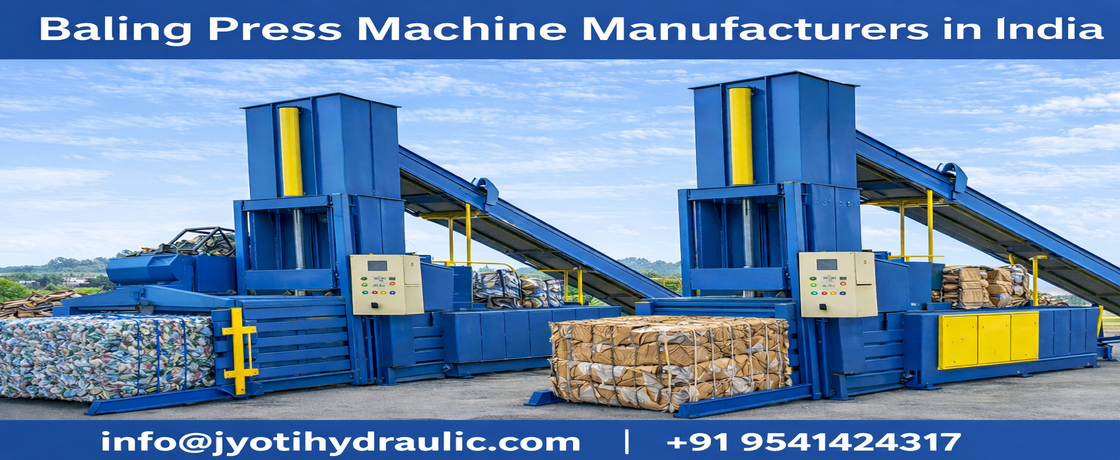
Jyoti Hydraulic provides reliable hydraulic baling solutions for industries that deal with scrap, metal waste, recycling material, and heavy industrial waste handling. In today’s recycling industry, a Baling Press Machine is not just a supporting machine; it is an essential part of efficient scrap management. It helps convert loose, bulky, and difficult-to-handle waste materials into compact bales that are easy to store, transport, and process further.
Recycling businesses, scrap yards, manufacturing units, metal processing plants, and waste management companies regularly handle large volumes of recyclable materials. Without proper compression, scrap takes up too much space, increases transportation cost, and creates handling difficulties. A baling press machine solves these problems by applying high hydraulic pressure to compress waste into dense and uniform bales.
Industry Overview
The recycling industry in India is growing rapidly due to increasing industrial production, environmental awareness, and the demand for reusable raw materials. Industries are now focusing more on reducing waste, improving material recovery, and lowering operational costs. This has increased the demand for machines that can handle scrap efficiently.
Materials such as iron scrap, steel scrap, aluminum waste, plastic, paper, cardboard, and textile waste are generated in large quantities across different industries. These materials are often irregular in shape and occupy huge storage areas. A baling press machine helps organize this waste and makes recycling operations more systematic.
This is why many businesses search for a trusted Baling Press Machine Manufacturer that can provide strong, durable, and application-based machines. Similarly, the demand for Scrap Baling Machine Manufacturers in India is increasing because recycling plants need machines that can perform continuously under heavy-duty working conditions.
Technical Working of a Baling Press Machine
A baling press machine mainly works on hydraulic pressure technology. The machine has a strong pressing chamber, hydraulic cylinders, power pack, control system, and bale ejection mechanism. When scrap material is loaded into the chamber, the hydraulic cylinder applies pressure and compresses the material into a compact block.
The process usually includes material feeding, compression, bale formation, tying, and bale removal. In metal recycling, especially iron and steel scrap, high compression force is required because the material is hard and uneven. That is why businesses often prefer machines from experienced Iron Scrap Baling Machine Manufacturers in India who understand the strength, structure, and pressure requirements of metal scrap applications.
The quality of a baling press depends on several technical factors, such as:
- Hydraulic pressure capacity
- Chamber size
- Bale density
- Motor power
- Machine body strength
- Cycle time
- Automation level
- Ease of maintenance
A well-designed machine can reduce scrap volume significantly and improve daily production efficiency.
Applications of Baling Press Machine in Recycling
A baling press machine is used in many recycling and industrial sectors. Its main role is to make waste material compact, safe, and easy to move.
1. Metal Scrap Recycling
In metal recycling, baling machines are used for compressing iron scrap, steel scrap, aluminum scrap, copper scrap, and other metal waste. Compact bales are easier to transport to melting units, foundries, and steel plants.
2. Manufacturing Units
Factories generate sheet metal cuttings, punching scrap, rejected parts, and production waste. Instead of keeping loose scrap scattered around the workplace, manufacturers use baling machines to manage it properly.
3. Automobile Scrap Recycling
Automobile workshops and vehicle dismantling units produce large amounts of metal waste. A baling press helps compress parts, sheet metal, and mixed scrap into manageable bales.
4. Plastic Recycling
Plastic bottles, films, containers, and packaging waste occupy a lot of space. Baling makes plastic recycling more economical by reducing storage and logistics costs.
5. Paper and Cardboard Recycling
Corrugated boxes, paper waste, and packaging material can be compressed into neat bales for easy handling and sale to recycling mills.
Benefits of Using a Baling Press Machine
The use of a baling press machine provides both technical and commercial benefits.
Reduces Storage Space
Loose scrap takes up large floor space. Once compressed into bales, the same material requires much less storage area. This improves factory space utilization.
Lowers Transportation Cost
Compact bales allow more material to be loaded in a truck. This reduces the number of trips and helps save transportation expenses.
Improves Workplace Safety
Loose metal scrap can cause injuries and workplace accidents. Baled scrap is easier to handle and creates a cleaner working environment.
Increases Scrap Value
Recyclers and buyers often prefer properly baled material because it is easier to weigh, load, transport, and process. This can improve the resale value of scrap.
Supports Sustainable Recycling
By making recycling more efficient, baling machines help reduce landfill waste and support better resource recovery.
Buying Guide: How to Choose the Right Baling Press Machine
Before buying a baling press machine, industries should evaluate their actual requirement. Selecting the wrong machine can lead to low productivity, higher maintenance, and poor bale quality.
First, identify the material type. Iron scrap, aluminum scrap, plastic, and paper all require different compression force. For heavy metal scrap, choose a strong hydraulic baler with a robust chamber and high-pressure capacity.
Second, check your daily scrap volume. If your plant handles large quantities, a semi-automatic or fully automatic baling machine may be more suitable. For smaller operations, a manual or basic hydraulic model may be enough.
Third, consider bale size and density. The bale should match your storage, truck loading, and buyer requirements. Also check the machine’s cycle time because faster operation increases productivity.
Finally, choose a manufacturer that provides proper installation, training, spare parts, and service support. A reliable manufacturer does not only sell the machine but also helps you select the right model for your application.
Future Trends in Recycling and Baling Machines
The future of recycling is moving toward automation, energy efficiency, and smarter waste handling. Modern baling press machines are now being designed with advanced hydraulic systems, PLC controls, touchscreen panels, and improved safety features.
In the coming years, recycling industries will prefer machines that reduce power consumption, require less manual work, and deliver consistent bale quality. Automatic feeding systems, sensor-based monitoring, and low-maintenance hydraulic designs will become more common.
As the recycling sector grows in India, the role of advanced baling machines will become even more important for scrap yards, steel plants, manufacturing units, and waste processing companies.
Conclusion
A Baling Press Machine is one of the most useful machines in the recycling industry because it converts loose and bulky scrap into compact bales. It helps reduce storage space, lower transportation cost, improve workplace safety, and increase recycling efficiency.
For industries handling iron scrap, metal waste, plastic, paper, or industrial scrap, investing in a good-quality baling press machine can improve both productivity and profitability. Choosing the right machine from an experienced manufacturer ensures long-term performance, better bale quality, and smooth recycling operations.
FAQs
1. What is a Baling Press Machine used for?
A Baling Press Machine is used to compress loose recyclable materials such as metal scrap, plastic, paper, cardboard, and industrial waste into compact bales for easy storage and transportation.
2. Which industries use baling press machines?
Baling press machines are used in scrap yards, recycling plants, automobile recycling units, metal processing industries, manufacturing units, plastic recycling plants, and paper recycling facilities.
3. Why is a baling machine important in recycling?
It reduces material volume, saves storage space, lowers transportation cost, improves handling, and makes recycling operations more organized and profitable.
4. Can a baling press machine be used for iron scrap?
Yes, heavy-duty hydraulic baling machines are widely used for iron scrap, steel scrap, and other metal waste. For this application, it is important to choose a strong machine from experienced Iron Scrap Baling Machine Manufacturers in India.
5. How do I choose the right baling press machine?
You should consider material type, daily scrap quantity, required bale size, hydraulic pressure, automation level, power consumption, and after-sales service before selecting a machine.
6. Is a hydraulic baling press suitable for heavy-duty recycling?
Yes, hydraulic baling press machines are highly suitable for heavy-duty recycling because they provide strong compression force and can handle tough scrap materials efficiently.
Contact Jyoti Hydraulic
Looking for a durable and efficient Baling Press Machine for your recycling or scrap handling business? Get expert guidance, machine selection support, and a customized quotation from Jyoti Hydraulic.
📧 Email: info@jyotihydraulic.com
📞 Call: +91 9541424317
Contact Jyoti Hydraulic today to request a quotation or speak with our experts for the right recycling solution.


