
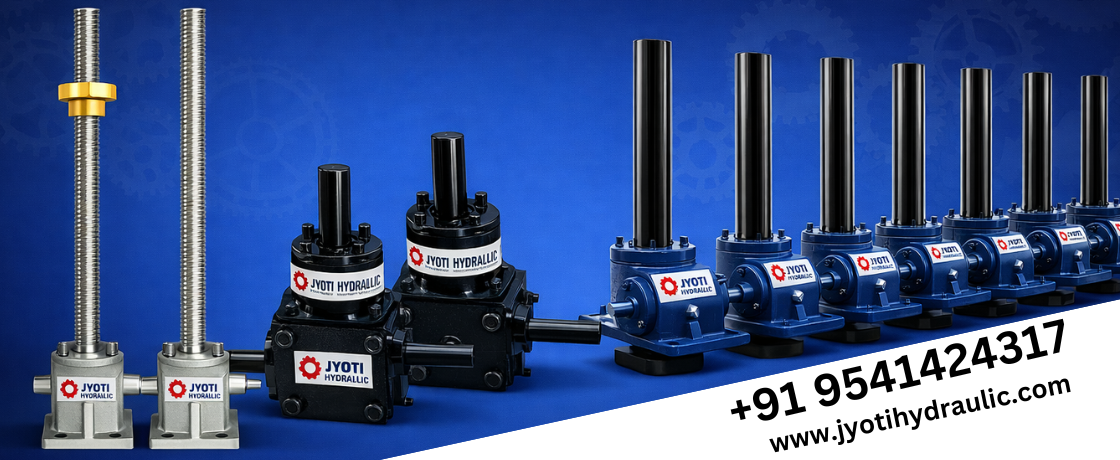
Jyoti Hydraulic stands at the forefront of India’s mechanical power transmission industry, delivering precision-engineered Worm Gear Screw Jack systems designed for demanding industrial environments. In 2026, as India’s infrastructure, heavy engineering, and automation sectors expand rapidly, the role of reliable Worm Gear Screw Jack Manufacturers in India has become strategically critical.
Industrial buyers are no longer purchasing lifting devices based solely on catalog specifications. They are investing in engineered mechanical lifting systems that must withstand continuous operation, variable loading conditions, harsh environmental exposure, and strict safety compliance requirements. Choosing the right Worm Gear Screw Jack Manufacturers directly impacts plant uptime, safety margins, and long-term capital efficiency.
This guide provides a technically grounded, engineering-led evaluation framework to help industrial decision-makers identify the most capable manufacturers in India.
What Is a Worm Gear Screw Jack?
A Worm Gear Screw Jack is a mechanical actuator that converts rotary motion into controlled linear movement. It is widely used in industrial machinery for lifting, positioning, tilting, pushing, pulling, and load-holding applications.
Working Principle and Mechanical Architecture
A typical screw jack assembly consists of:
-
Worm shaft (input drive component)
-
Worm wheel (gear reduction element)
-
Lead screw (trapezoidal or ball screw)
-
Thrust bearings (axial load support)
-
Housing (cast iron or fabricated steel body)
When torque is applied to the worm shaft via a motor, gearbox, or manual input, it rotates the worm wheel. The worm wheel, meshing with the worm shaft at a 90-degree angle, transmits rotational motion to the lead screw. Depending on the design, the screw either rotates and moves through a fixed nut or travels linearly through the housing.
The high gear reduction ratio allows substantial load amplification from relatively small input torque, making it suitable for heavy-duty lifting systems.
Self-Locking Mechanism Explained
One of the defining characteristics of a Worm Gear Screw Jack is its self-locking capability under specific design conditions.
Self-locking occurs due to:
-
Low lead angle of trapezoidal screw
-
High friction coefficient between worm and worm wheel
-
High reduction ratio
When properly designed, the system prevents reverse motion under load without requiring an external braking system. This is especially critical in vertical lifting applications in steel plants, construction systems, and heavy machinery platforms.
However, not all screw jacks are inherently self-locking. Ball screw variants offer higher efficiency but typically require braking systems. Industrial buyers must verify this distinction during technical evaluation.
Efficiency and Torque Transmission Considerations
Mechanical efficiency in worm gear systems typically ranges between 30% and 50%, depending on:
-
Surface finish of worm and wheel
-
Material pairing (e.g., EN24 hardened worm with phosphor bronze wheel)
-
Lubrication quality
-
Lead angle
-
Operating temperature
From a conceptual standpoint:
Input Torque × Gear Reduction × Mechanical Efficiency = Output Linear Force
Improper torque calculations can lead to:
-
Motor overloading
-
Gear tooth wear
-
Excessive heat generation
-
Premature bearing failure
Reputable Worm Gear Screw Jack Manufacturers in India provide torque charts, duty cycle ratings, and load performance data to support engineering validation.
Why Industrial Demand Is Growing in India
India’s industrial ecosystem in 2026 is witnessing structural transformation driven by multiple macro factors.
Infrastructure and Mega Projects
Metro rail networks, expressways, smart city developments, and renewable energy projects require synchronized mechanical lifting and positioning systems capable of operating under heavy static and dynamic loads.
Manufacturing Expansion
Under the Make in India initiative, domestic manufacturing of heavy equipment, process machinery, and industrial automation systems has increased significantly. OEMs require standardized and customizable Worm Gear Screw Jack systems integrated into their equipment platforms.
Shift from Hydraulic to Mechanical Systems
Many industries are transitioning from hydraulic lifting to mechanical screw jack systems due to:
-
Reduced maintenance complexity
-
No oil leakage risks
-
Higher positional accuracy
-
Self-locking advantage
Automation and Industry 4.0
Precision positioning systems connected to PLC-controlled drives are becoming standard. Multi-point synchronized screw jack systems are increasingly used in automated assembly lines and heavy fabrication units.
In this environment, selecting reliable Worm Gear Screw Jack Manufacturers in India becomes a strategic engineering decision.
Who Are the Best Worm Gear Screw Jack Manufacturers in India?
The best Worm Gear Screw Jack Manufacturers are characterized by engineering depth, manufacturing precision, and industrial experience rather than pricing competitiveness alone.
Key differentiators include:
-
In-house gear hobbing and shaping machines
-
CNC machining centers for tight tolerance control
-
Heat treatment facilities for hardened worm shafts
-
Controlled bronze casting or certified procurement
-
Load testing infrastructure
-
Design engineering support
-
Custom solution capability for multi-jack synchronization
Established manufacturers such as Jyoti Hydraulic combine mechanical expertise with production capability to deliver performance-driven systems suited for heavy industrial use.
Key Evaluation Criteria for Industrial Buyers
Industrial procurement teams should adopt a structured evaluation framework when shortlisting Worm Gear Screw Jack Manufacturers in India.
Manufacturing Infrastructure
Assess whether the manufacturer operates:
-
CNC turning and milling centers
-
Gear cutting and finishing equipment
-
Precision boring machines
-
Dedicated assembly and inspection stations
Manufacturing control directly impacts gear alignment, backlash, and durability.
Material Engineering
Critical components should use certified materials such as:
-
EN8, EN19, or EN24 alloy steel for worm shafts
-
Phosphor bronze for worm wheels
-
High-strength carbon or alloy steel for lead screws
Material test certificates and hardness reports should be reviewed before approval.
Heat Treatment and Surface Integrity
Controlled hardening improves wear resistance and load capacity. Grinding and finishing processes enhance contact surface quality, improving efficiency and longevity.
Quality Certifications and Documentation
Industrial buyers should verify:
-
ISO 9001 certification
-
Dimensional inspection reports
-
Load test documentation
-
Traceable batch records
Documentation ensures traceability and compliance with industrial safety standards.
Engineering and Customization Capability
Many applications require:
-
Multi-screw synchronized lifting
-
High-temperature resistant systems
-
Corrosion-resistant coatings
-
Motorized assemblies with limit switches
Manufacturers must demonstrate design consultation capability rather than only supply catalog models.
After-Sales and Technical Support
Reliable manufacturers provide:
-
Spare parts availability
-
Installation guidance
-
Maintenance support
-
Performance consultation
Long-term technical partnership is a sign of industrial maturity.
Technical Specifications Buyers Must Evaluate
Load Capacity
Screw jacks are typically classified as:
-
Light Duty: 1–10 tons
-
Medium Duty: 10–50 tons
-
Heavy Duty: 50–200+ tons
Heavy industrial plants often require custom-engineered systems exceeding standard catalog ratings.
Static vs Dynamic Load
Static load refers to maximum holding capacity. Dynamic load refers to capacity during motion. Proper safety factors, usually between 1.5 and 2.5 depending on application severity, must be applied.
Duty Cycle
Continuous operation requires different lubrication, cooling, and gear material considerations compared to intermittent operation.
Screw Type
Trapezoidal screws provide self-locking. Ball screws provide higher efficiency but require braking systems.
Mounting and Orientation
Application environment determines whether upright, inverted, flange-mounted, or clevis-end configurations are required.
Applications Across Major Industries
Steel Industry
-
Furnace door lifting
-
Roller table height adjustment
-
Slag gate control systems
Cement Plants
-
Kiln alignment
-
Raw material gate positioning
-
Heavy hopper lifting systems
Power Generation
-
Turbine alignment
-
Maintenance platforms
-
Valve actuation systems
Infrastructure and Construction
-
Bridge segment lifting
-
Heavy structural positioning
-
Shuttering system alignment
Automation and OEM Machinery
-
Height-adjustable platforms
-
Robotic base positioning
-
Synchronized machine bed lifting
Multi-point synchronized systems often integrate bevel gearboxes and drive shafts to ensure uniform lifting motion.
Comparison: Small Fabricators vs Established Manufacturers
Small workshops typically offer lower initial pricing but often lack:
-
Precision gear machining
-
Verified material sourcing
-
Load testing capability
-
Engineering design validation
-
Warranty structure
Established Worm Gear Screw Jack Manufacturers in India provide:
-
Controlled manufacturing processes
-
Certified materials
-
Engineered customization
-
Load-tested assemblies
-
Lifecycle performance assurance
While initial procurement cost may be higher, lifecycle value and reliability significantly outweigh short-term savings.
Common Buyer Mistakes to Avoid
-
Selecting vendors solely based on lowest quotation
-
Ignoring torque and efficiency calculations
-
Not verifying material composition
-
Overlooking safety factor requirements
-
Not requesting load test documentation
-
Failing to plan for scalability in future expansions
Mechanical lifting systems require engineering diligence at every stage of procurement.
Why Jyoti Hydraulic Is a Trusted Industrial Partner
Jyoti Hydraulic has built its reputation on engineering precision, robust material selection, and application-focused design. The company specializes in heavy-duty Worm Gear Screw Jack systems engineered for steel plants, infrastructure projects, automation machinery, and process industries.
Key strengths include:
-
Advanced gear machining capability
-
Certified alloy steel usage
-
Controlled heat treatment processes
-
Load-tested assemblies
-
Custom synchronized lifting solutions
-
Reliable supply chain management
-
Engineering consultation support
Rather than focusing on aggressive marketing claims, Jyoti Hydraulic emphasizes performance validation, material integrity, and long-term operational reliability.
Future Trends in Screw Jack Technology (2026–2030)
Smart Monitoring Systems
Integration of load sensors and position feedback devices enables predictive maintenance and real-time load tracking.
High-Efficiency Gear Geometry
Improved worm tooth design reduces friction losses and enhances torque transmission efficiency.
Advanced Materials
Use of corrosion-resistant alloys and specialized coatings for chemical and coastal applications is increasing.
Sustainable Manufacturing
Energy-efficient machining processes and recyclable material strategies are becoming industry priorities.
Integrated Automation
Servo-driven synchronized lifting systems will become standard in high-precision industrial environments.
Manufacturers investing in these technologies will shape the next generation of mechanical lifting systems in India.
Conclusion
Identifying the best Worm Gear Screw Jack Manufacturers in India requires technical evaluation, material verification, and lifecycle analysis. Industrial buyers must prioritize engineering capability, manufacturing precision, and long-term reliability over short-term cost savings.
As India’s industrial ecosystem expands in 2026 and beyond, partnering with experienced manufacturers such as Jyoti Hydraulic ensures access to precision-engineered mechanical lifting systems built for safety, durability, and sustained performance.
In industrial procurement, engineering confidence is the true differentiator.
FAQ’s
1. What is a Worm Gear Screw Jack?
A mechanical lifting device that converts rotary motion into linear movement using a worm gear mechanism and lead screw assembly.
2. How do I identify the best Worm Gear Screw Jack Manufacturers in India?
Evaluate manufacturing infrastructure, certified materials, load testing capability, engineering expertise, and documented quality systems.
3. What certifications should industrial buyers verify?
ISO certification, material test certificates, dimensional inspection reports, and documented load testing records.
4. What load capacity should be selected?
Select based on maximum operational load plus an appropriate safety factor, typically 1.5 to 2.5 depending on application severity.
5. Are mechanical screw jacks better than hydraulic systems?
In many industrial applications, they offer improved positional accuracy, lower maintenance requirements, and self-locking safety advantages.

