
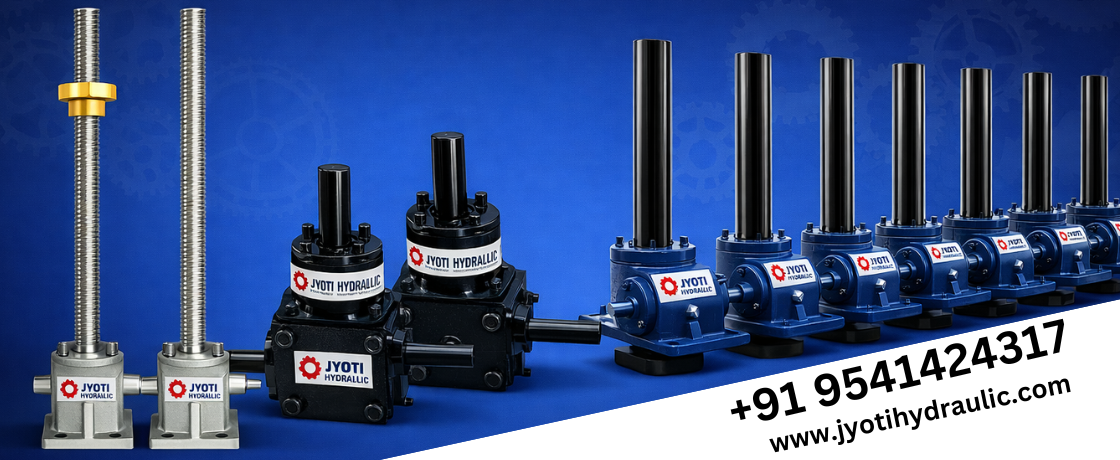
Jyoti Hydraulic understands that in manual lifting, performance alone is never enough. A well-designed Worm Gear Screw Jack must do far more than raise or lower a load—it must control motion smoothly, resist back-driving where required, maintain alignment under working conditions, and support safer handling practices across industrial environments. That is why buyers looking for dependable lifting equipment increasingly prefer products engineered around recognized manual lifting safety principles, especially when evaluating long-term reliability, operator confidence, and service life. In that context, EN 13157 matters because it is the European safety standard associated with hand-powered lifting equipment, with a focus on hazards, verification, marking, and instructions for use.
Introduction
A Worm Gear Screw Jack is a mechanical lifting and positioning device that converts rotary input into precise linear movement. In practical terms, it is used to lift, lower, tilt, align, push, or hold a load where controlled motion is more important than speed. Compared with purely hydraulic or high-speed electromechanical systems, a worm gear screw jack is valued for its rugged simplicity, repeatable motion, and suitability for manual or low-speed applications. That makes it especially useful in plants where uptime, predictable movement, and maintenance accessibility matter more than flashy automation. Technical references from established jack manufacturers also emphasize that jack design must account for input torque, duty cycle, lubrication, and load-holding behavior rather than capacity alone.
Industry Overview
Across manufacturing, fabrication, material handling, civil engineering, process plants, and machine building, lifting tasks are becoming more safety-driven and documentation-driven. Buyers are no longer choosing equipment on tonnage alone. They want traceable engineering, safer manual operation, load stability, clearer operating instructions, and predictable maintenance routines. That shift is one reason serious Worm Gear Screw Jack Manufacturers focus not only on machining quality, but also on the broader safety framework surrounding the product.
It is important to be technically accurate here: the published scope summary of EN 13157 explicitly refers to hand-powered lifting equipment such as hand chain blocks, lever hoists, jaw winches, hand-powered trolleys, drum winches, and pulley blocks, and it does not cover lifting of persons. In other words, the standard is directly tied to manual lifting safety, but a manufacturer should not casually assume every worm gear screw jack falls automatically within that exact scope without product-specific verification. A responsible engineering approach is to align a manual jack with the same safety disciplines the standard emphasizes—hazard control, marking, verification, and instructions for use—while validating the exact compliance route for the final equipment supplied.
For this reason, the best Worm Gear Screw Jack Manufacturers in India are the ones that treat standards as an engineering responsibility, not just a marketing phrase. They understand that industrial buyers need a product that performs mechanically and stands up operationally in the field.
Technical Insights: What Makes a Worm Gear Screw Jack Work
At its core, a worm gear screw jack uses a worm shaft and worm wheel arrangement to rotate a lifting screw, creating controlled linear travel. The beauty of this design lies in motion control. It allows relatively modest operator input to produce high axial force, which is why the jack is so widely used for lifting and positioning heavy components.
From an engineering perspective, several technical factors define a high-quality jack:
1. Load-holding behavior
One of the biggest advantages of machine-type screw jacks is controlled holding capability. Industry technical guidance notes that machine screw jacks at certain gear ratios can be self-locking, meaning the load does not easily reverse-drive the system under static conditions; however, vibration can change that equation, and some arrangements may still require a brake or secondary restraint. That is a critical design point in manual lifting safety.
2. Breakaway torque vs running torque
A jack may look adequately sized on paper and still feel difficult at startup if the engineer ignores breakaway torque. Technical references warn that starting torque can be two to three times the running torque because of static friction. This is exactly why experienced suppliers do not size a jack only by rated load—they also examine starting conditions, frequency of use, and operator effort.
3. Duty cycle and heat
A Worm Gear Screw Jack is excellent for controlled, intermittent service, but friction generates heat. Technical documentation for jack systems states that allowable duty cycle is limited by the unit’s ability to dissipate that heat, and excessive temperature can accelerate wear or cause unexpected failure. That means a jack chosen for occasional manual adjustment is not necessarily suitable for repeated high-frequency cycling without design review.
4. Lubrication and contamination control
A good screw jack is not truly good unless it stays healthy in service. Maintenance guidance for worm gear jack systems stresses verifying lubricant presence before use, inspecting lubrication at regular intervals, and keeping the lifting screw free of grit, dirt, and abrasive contaminants. In industry, poor lubrication is one of the fastest ways to destroy precision, increase operating effort, and shorten jack life.
5. Over-travel protection
Manual systems are often assumed to be inherently safe, but over-travel remains a real risk. Jack manuals caution that, without internal or external stops, the lifting screw can be run out of the unit. In real installations, that means the supporting structure, stroke control, and operator instructions are just as important as the jack body itself.
Why EN 13157-Relevant Safety Thinking Matters
A manual lifting device should never be treated as “simple equipment.” The BSI standard record highlights marking, instructions for use, testing conditions, verification, and hazard-related safety measures as part of the EN 13157 framework. That mindset is highly relevant when building or selecting a manual Worm Gear Screw Jack. Even where the final compliance route depends on product scope, the lesson is clear: safe manual lifting depends on more than load capacity. It depends on clear identification, usable instructions, predictable behavior, and design choices that reduce operator risk.
This is also why technical manuals for machine screw jacks explicitly warn that units are not meant for personnel support unless specially approved, and that vibration, overloads, shock loads, side loads, and poor installation can create unsafe conditions. Those warnings reinforce a broader industry truth: lifting equipment safety is a system issue, not a catalog issue.
Applications of Worm Gear Screw Jacks
A properly engineered Worm Gear Screw Jack is used in a surprisingly wide range of industrial duties. In fabrication shops, it can lift and level heavy frames during assembly. In process plants, it helps open, close, or position heavy dampers, gates, and access systems. In packaging and machine building, it is used to adjust machine height and align modules with precision. In material handling, synchronized jacks support platform lifting and structural adjustment. In infrastructure and heavy engineering, they assist with maintenance lifting, controlled alignment, and load positioning during installation work.
What makes the jack valuable in all these settings is not merely lifting power. It is the combination of slow, deliberate movement and mechanical predictability. Where sudden motion would be dangerous or inaccurate, worm gear screw jacks make engineering sense.
Benefits for Industrial Buyers
The first major benefit is precision. A jack gives fine control over travel, which is vital during alignment, tool setup, and maintenance lifting. The second is compact force generation. A relatively compact housing can deliver substantial axial force when properly sized. The third is robustness. Unlike more complex motion systems, a screw jack remains serviceable and understandable in harsh plant conditions. The fourth is safety-oriented control. Because movement is generally deliberate and low-speed, the operator has better feel and better response during manual adjustment.
For buyers comparing Worm Gear Screw Jack Manufacturers, the real advantage comes from how these benefits are engineered into the product. Material quality, screw finish, bearing support, housing strength, sealing, lubrication access, and documentation quality all affect whether the jack performs reliably over years or becomes a maintenance burden within months.
Buying Guide: How to Select the Right Worm Gear Screw Jack
When evaluating Worm Gear Screw Jack Manufacturers in India, start with the application, not the catalog. Ask these practical questions.
What is the real working load?
Do not size only for static weight. Include startup resistance, shock loading, friction, and any off-center forces.
Is the load purely vertical or does side loading exist?
Screw jacks dislike misalignment and unplanned side loads. If the structure is flexible, the mounting design matters as much as the jack rating.
How often will it operate?
A jack suitable for occasional manual adjustment may not be correct for repetitive operation because duty cycle and heat buildup change the selection.
Is self-locking required, or should a brake be added?
Self-locking depends on the exact jack type, ratio, and operating environment. Vibration and dynamic loading can change load-holding behavior.
How will the system stop at stroke limits?
Over-travel protection should be designed intentionally, not assumed.
What documentation comes with the product?
A serious manufacturer should provide load details, operating guidance, maintenance recommendations, and installation precautions consistent with safe manual lifting practice.
That is where experienced Indian manufacturers stand out. The best suppliers do not just sell a unit; they help match the jack to the application.
Future Trends
The future of the screw jack market is not about replacing mechanical systems. It is about refining them. Buyers increasingly want manual or semi-manual equipment that integrates with modern safety expectations: better sealing, better corrosion resistance, improved documentation, synchronized multi-jack systems, condition-based maintenance, and hybrid manual-to-motor-ready configurations.
Another visible trend is application-specific customization. Instead of buying a generic jack and adapting the machine around it, more industrial users now want the jack built around stroke, mounting, travel control, environment, and load path. This is especially relevant in sectors that demand repeatable positioning with low maintenance overhead.
Conclusion
A Worm Gear Screw Jack remains one of the most practical mechanical solutions for controlled lifting and positioning when safety, precision, and durability matter. But the best products are not defined by load rating alone. They are defined by how intelligently they address torque, duty cycle, lubrication, stopping limits, load-holding behavior, and safe manual operation. EN 13157 is an important reference point because it reinforces the discipline behind manual lifting safety—verification, marking, instructions, and hazard control—even while exact product applicability should always be checked carefully for the final design scope.
For buyers searching for trusted Worm Gear Screw Jack Manufacturers or dependable Worm Gear Screw Jack Manufacturers in India, the smartest choice is a supplier that combines engineering depth with application understanding. That is how safer manual lifting solutions are really built.
FAQ Section
1. What is a Worm Gear Screw Jack used for?
A Worm Gear Screw Jack is used to lift, lower, position, align, tilt, or hold loads with controlled linear motion. It is common in machine building, maintenance platforms, structural adjustment, gates, and heavy-duty industrial positioning systems.
2. Is a Worm Gear Screw Jack self-locking?
Many machine-type screw jacks can be self-locking under certain ratios and conditions, but not every design is automatically self-locking in every application. Vibration, dynamic loading, and jack configuration can affect back-driving risk, so engineering review is important.
3. Does EN 13157 directly apply to all worm gear screw jacks?
Not automatically. The standard’s published scope summary names several categories of hand-powered lifting equipment and excludes lifting of persons. A manufacturer should verify whether the exact product falls within scope and should not make blanket assumptions.
4. Why is lubrication important in a screw jack?
Lubrication reduces friction, limits wear, protects internal gear elements, and helps maintain smooth movement. Poor lubrication can increase torque demand and shorten service life.
5. What should buyers check before choosing a manufacturer?
Check load calculation support, material quality, travel and stop arrangement, duty cycle suitability, documentation quality, installation guidance, and after-sales technical support. A reliable manufacturer should understand the application, not just the part number.
6. Why choose established Worm Gear Screw Jack Manufacturers in India?
Established Indian manufacturers often provide strong customization support, competitive industrial pricing, application-specific engineering, and faster supply for domestic and export buyers. The best value comes from those who understand real plant conditions and design accordingly.
Request a Quote or Expert Consultation
Need the right Worm Gear Screw Jack for your application? Speak with the experts at Jyoti Hydraulic for technical guidance, product selection support, and a fast commercial response.
📧 info@jyotihydraulic.com
📞 +91 9541424317
Contact Jyoti Hydraulic today to request a quotation, discuss your lifting requirement, or get expert consultation for a safer and more reliable manual lifting solution.


