
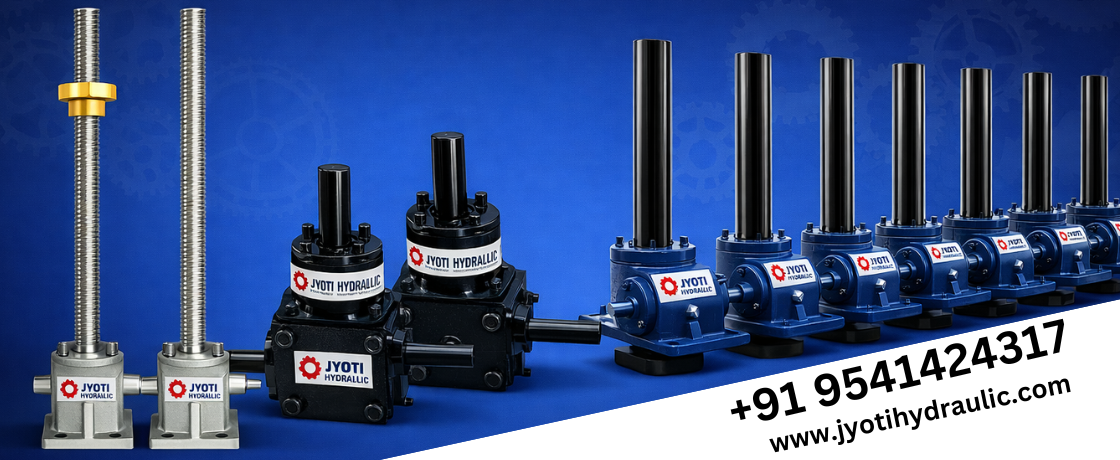
Jyoti Hydraulic brings deep practical experience in heavy-duty lifting systems, and that matters when engineers, plant managers, and procurement teams need reliable performance from a Worm Gear Screw Jack. In modern industry, screw jacks are trusted for controlled lifting, lowering, positioning, tilting, and load-holding across sectors such as material handling, steel, packaging, automation, and process plants. This guide explains how worm gear screw jack design works, how load capacity is calculated, what torque and efficiency mean in real-world use, and how to choose the right solution from trusted Worm Gear Screw Jack Manufacturers and a dependable Screw Jack Manufacturer in India.
Introduction
A worm gear screw jack is a compact mechanical lifting device that converts rotary input into linear motion. It is widely used wherever precise lifting, synchronized movement, or controlled load positioning is required. Unlike many hydraulic-only alternatives, a screw jack offers positive mechanical movement, dependable holding capability, and long service life when selected correctly.
For buyers, designers, and maintenance teams, the most important questions are usually the same:
- How much load can a screw jack lift safely?
- What torque is required to operate it?
- How efficient is the system?
- Which design is best for the application?
- How do you choose the right Worm Gear Screw Jack Manufacturers in India?
This blog answers those questions with practical explanations and industry-focused insights.
Industry Overview: Demand, Usage, and Market Relevance
The demand for mechanical lifting equipment has grown with the expansion of industrial automation, assembly lines, heavy machinery alignment systems, solar tracking systems, sluice gates, and maintenance platforms. A Worm Gear Screw Jack remains highly relevant because it offers:
- Accurate linear motion
- Controlled lifting speed
- High load-bearing potential
- Compact installation
- Long-term durability in industrial environments
In India, manufacturing, infrastructure, steel processing, warehousing, textiles, and machine building have all contributed to rising demand for quality lifting systems. This is why businesses actively search for experienced Worm Gear Screw Jack Manufacturers in India that can deliver not just a product, but engineering support, customization, and reliable after-sales service.
Today’s buyers also expect more than standard catalog products. They want:
- Application-specific design
- Better corrosion resistance
- Improved load safety
- Motorized integration
- Synchronized multi-jack systems
- Reduced maintenance requirements
That is where an expert Screw Jack Manufacturer in India can create real long-term value.
Technical Insights
Design Principles of a Worm Gear Screw Jack
A worm gear screw jack typically consists of the following key components:
- Worm shaft
- Worm wheel or gear set
- Lifting screw or translating screw
- Housing
- Bearings
- Protective boot or cover
- Top plate, clevis end, or custom mounting accessories
How the mechanism works
When the worm shaft rotates, it drives the worm wheel. This rotational motion is converted into axial motion through the lifting screw. Depending on the design, the screw may either move linearly or rotate while a traveling nut advances along the thread.
Two common design types
1. Translating screw type
In this design, the lifting screw moves up and down linearly. It is commonly used where direct lifting or pushing is required.
2. Rotating screw type
Here, the screw rotates in place while a nut moves along its axis. This is preferred where vertical space is limited.
Important design considerations
When designing or selecting a worm gear screw jack, engineers evaluate:
- Required load capacity
- Stroke length
- Duty cycle
- Input power source
- Travel speed
- Mounting orientation
- Safety factor
- Environmental conditions
- Need for self-locking
- Need for synchronized operation
A well-designed jack is not selected only by rated load. It must also withstand real operating conditions such as shock load, side load, vibration, temperature, dust, and repetitive cycling.
Load Calculation Basics
Load calculation is the foundation of correct screw jack selection. Undersizing can lead to premature wear, overheating, gear damage, or screw buckling. Oversizing may increase cost unnecessarily and reduce system efficiency.
Basic load considerations
The actual design load should include more than the static weight of the object. It should account for:
- Dead load
- Live load
- Impact load
- Dynamic factors
- Starting load
- Uneven load distribution in multi-jack systems
Simple load formula
Design Load = Actual Load × Service Factor
For example, if the actual load is 5 tons and the application includes moderate shock or intermittent heavy starts, a service factor of 1.25 to 1.5 may be applied.
So:
Design Load = 5 tons × 1.25 = 6.25 tons
In this case, selecting a jack rated only for 5 tons may not be safe for long-term operation.
Key factors affecting load capacity
Static load capacity
This is the maximum load the jack can support under stationary conditions.
Dynamic load capacity
This refers to the practical safe load during movement, where friction, speed, and shock must be considered.
Screw buckling
For long stroke applications, the screw may fail by buckling before reaching its theoretical lifting capacity. This is especially important in vertical lifting systems with unsupported screw length.
Column strength
As stroke length increases, compressive stability becomes critical. A jack with a high rated capacity may still require derating if the extension length is too large.
Practical example
Suppose an industrial platform weighs 8,000 kg and is lifted using four screw jacks in a synchronized system.
If the load is evenly distributed:
Load per jack = 8,000 / 4 = 2,000 kg
But engineers should not assume perfect distribution. If one jack carries extra load due to structural variation, a margin is required. With a suitable service factor, the selected unit may need a capacity of 2.5 to 3 tons per jack.
That is why experienced Worm Gear Screw Jack Manufacturers always ask detailed application questions before recommending a model.
Torque and Efficiency
Torque determines how much rotational effort is needed to lift the load. Efficiency determines how much of the input energy is converted into useful lifting work.
Basic torque concept
The required input torque depends on:
- Load being lifted
- Screw lead and pitch
- Gear ratio
- Friction between threads
- Gear mesh friction
- Lubrication condition
In practical terms, higher loads require more torque, but thread geometry and worm gear design also influence the force needed.
Efficiency in worm gear screw jacks
A worm gear screw jack is not a high-efficiency device compared with some rolling-element systems, but that lower efficiency can provide an important advantage: self-locking.
In many applications, self-locking helps the jack hold the load in position when power is removed. This is valuable in lifting tables, maintenance platforms, sluice gates, and height-adjustable structures.
Typical efficiency is influenced by:
- Worm gear design
- Screw thread type
- Material pairing
- Surface finish
- Lubrication
- Operating speed
Why efficiency matters
Low efficiency can mean:
- Higher power requirement
- More heat generation
- Slower continuous-duty suitability
But in controlled lifting applications, the trade-off is often worthwhile because the system offers better load holding and safer positional control.
Real-world design insight
A jack used once or twice per shift for heavy positioning may prioritize load-holding and robustness over speed. A jack used continuously in an automated line may need closer attention to duty cycle, motor sizing, and thermal performance.
Industrial Applications of Worm Gear Screw Jacks
A Worm Gear Screw Jack is used across a wide range of industries because it can lift, lower, push, pull, align, and position heavy loads with precision.
Common applications include:
- Lifting platforms and work tables
- Conveyor height adjustment
- Steel mill equipment positioning
- Paper mill roller settings
- Dam gate and sluice gate actuation
- Solar panel tracking systems
- Material handling lifts
- Packaging machinery adjustment
- Aerospace fixture positioning
- Machine tool alignment
- Heavy fabrication line movement
- Stage and auditorium lifting systems
Example use case
In a packaging plant, a screw jack may be used to fine-tune conveyor height for different carton sizes. In a steel plant, it may adjust rolling line alignment under high load conditions. In solar projects, multiple jacks can be integrated into tracking structures that require controlled angular movement over time.
This versatility is one reason buyers frequently compare multiple Worm Gear Screw Jack Manufacturers in India before making a decision.
Benefits and Advantages
A high-quality worm gear screw jack offers several operational benefits.
Key advantages
- Precise linear lifting and positioning
- Compact and rugged design
- Suitable for heavy load applications
- Can be manually operated or motorized
- Self-locking capability in many designs
- Reliable performance in harsh industrial settings
- Easy integration with gearboxes, motors, and couplings
- Long service life with proper lubrication
- Can be used in single or multiple synchronized arrangements
Business benefits
For plant operators and OEMs, these technical advantages translate into real business value:
- Better machine accuracy
- Improved safety
- Lower maintenance downtime
- Consistent load handling
- Flexible design integration
- Reduced risk of uncontrolled lowering
Buying Guide: How to Select the Right Screw Jack
Choosing the right screw jack involves more than checking the load chart.
Ask these questions before buying
1. What is the exact load?
Know the actual load, peak load, and any shock load conditions.
2. What is the stroke length?
A longer stroke may reduce safe load due to buckling limits.
3. What speed is required?
High-speed movement may affect efficiency, heating, and motor selection.
4. What is the duty cycle?
Occasional lifting and continuous operation require very different designs.
5. Is self-locking necessary?
Some applications need secure holding without brake systems.
6. Will the jack face side loads?
Screw jacks are generally designed for axial loading. Side loading should be minimized or externally guided.
7. Is synchronization required?
For lifting wide platforms, multiple jacks may need to be mechanically linked.
8. What is the environment?
Outdoor, corrosive, dusty, or high-temperature conditions may require protective features.
What to look for in a manufacturer
When comparing Worm Gear Screw Jack Manufacturers or a Screw Jack Manufacturer in India, prioritize:
- Engineering support
- Proven manufacturing capability
- Material quality
- Precision machining
- Load testing standards
- Customization options
- Timely delivery
- Service support
- Documentation and technical guidance
Internal linking suggestions
For SEO and user journey optimization, this blog can internally link to pages such as:
- Worm Gear Screw Jack Product Page
- Screw Jack Load Capacity Chart
- About Jyoti Hydraulic
- Custom Industrial Lifting Solutions
- Contact Us / Request a Quote
- Industries We Serve
Common Mistakes to Avoid
This section is important because many lifting system failures are caused by incorrect selection, not poor equipment quality.
Avoid these common mistakes
- Selecting based only on nominal load
- Ignoring service factor and shock load
- Overlooking screw buckling at long stroke
- Applying side loads without guide mechanisms
- Underestimating torque requirement
- Running beyond rated duty cycle
- Poor lubrication practices
- Choosing speed over load safety
- Not checking mounting rigidity
- Using low-quality components from unverified suppliers
A well-engineered system always balances load, travel, speed, safety, and service life.
Future Trends in Screw Jack Technology
The screw jack industry is evolving with broader automation and smarter industrial systems.
Emerging trends include:
- Motorized and automated screw jack assemblies
- IoT-based condition monitoring
- Improved sealing for harsh environments
- Better alloy and coating technologies
- Customized multi-jack synchronized systems
- Integration with PLC-controlled lifting platforms
- Energy-optimized designs for repetitive motion systems
As industries demand better precision and lower downtime, modern Worm Gear Screw Jack Manufacturers in India are moving beyond standard supply and into engineered lifting solutions tailored to exact process needs.
Conclusion
A Worm Gear Screw Jack remains one of the most dependable mechanical lifting solutions for industrial applications that require precision, load control, and robust performance. From design principles and load calculation basics to torque, efficiency, and buying considerations, the right selection depends on much more than headline lifting capacity.
Businesses that work with experienced Worm Gear Screw Jack Manufacturers gain a clear advantage in safety, durability, and application performance. Whether you are an OEM, maintenance engineer, project consultant, or procurement buyer, partnering with a trusted Screw Jack Manufacturer in India helps ensure that the lifting system performs reliably under real operating conditions.
For the best results, focus on application-specific engineering, correct load analysis, quality manufacturing, and long-term technical support.
FAQ: Worm Gear Screw Jack Design, Calculation & Load Capacity
1. What is a worm gear screw jack used for?
A worm gear screw jack is used for lifting, lowering, pushing, pulling, and positioning loads in industrial machinery, platforms, conveyors, gates, and automation systems.
2. How is worm gear screw jack load capacity calculated?
Load capacity is calculated by considering the actual load, service factor, shock conditions, screw buckling risk, stroke length, and duty cycle. Safe selection should always be based on design load, not just static weight.
3. Are worm gear screw jacks self-locking?
Many worm gear screw jacks are self-locking under specific conditions, which means they can hold a load in position without back-driving. However, this depends on thread design, efficiency, and operating conditions.
4. What factors affect torque requirement in a screw jack?
Torque depends on load, screw lead, thread friction, worm gear ratio, lubrication, and overall mechanical efficiency.
5. How do I choose the best worm gear screw jack manufacturer?
Choose a manufacturer based on engineering capability, product quality, material standards, application support, customization, testing practices, and after-sales service.
6. Why are worm gear screw jack manufacturers in India gaining demand?
Indian manufacturers are gaining demand because they offer competitive pricing, customization, industrial-grade engineering, and scalable production for domestic and export markets.
7. What is the difference between a translating screw jack and a rotating screw jack?
A translating screw jack moves the screw linearly, while a rotating screw jack keeps the screw in place and moves the load through a traveling nut. The right choice depends on available space and application design.
8. Can a worm gear screw jack be used in synchronized lifting systems?
Yes, multiple screw jacks can be mechanically connected using shafts, couplings, and gearboxes for synchronized lifting of large platforms or structures.
9. What industries commonly use screw jacks?
Industries such as steel, cement, packaging, solar, textile, power, construction, paper, warehousing, and automation widely use screw jacks.
10. What are the most common screw jack installation errors?
Common errors include side loading, wrong load estimation, poor alignment, insufficient lubrication, ignoring stroke limitations, and choosing the wrong duty rating.
Ready to Choose the Right Worm Gear Screw Jack?
Need help selecting the right model for your application? Looking for trusted Worm Gear Screw Jack Manufacturers in India with real engineering expertise?
Contact Jyoti Hydraulic today for technical guidance, product recommendations, and custom lifting solutions tailored to your industry needs.
Request a quotation, discuss your load requirements, or get expert consultation now:
📧 info@jyotihydraulic.com
📞 +91 9541424317
Choose a reliable partner for performance, safety, and long-term industrial value. Reach out to Jyoti Hydraulic and get the right screw jack solution for your project.


