
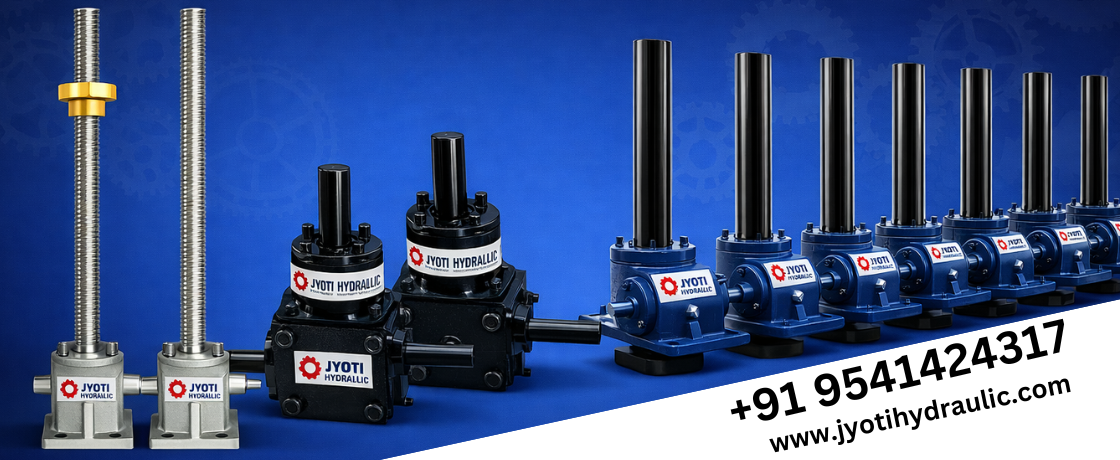
Jyoti Hydraulic has built its reputation on engineering reliability into every mechanical lifting system it manufactures. In heavy-duty industrial environments, a worm gear screw jack is often expected to operate under high loads, low speeds, harsh temperatures, and continuous or intermittent duty cycles. While design accuracy and material quality are critical, lubrication remains the single most influential factor determining efficiency, wear life, thermal stability, and long-term reliability.
This in-depth lubrication guide is written specifically for B2B industrial buyers, OEM design engineers, and EPC contractors who demand standards-backed technical clarity. Aligned with ANSI/AGMA 909-A06, this blog explains why lubrication matters, how it works inside a worm gear screw jack, what lubricant grades should be used, and how proper lubrication practices directly impact safety, performance, and lifecycle cost. As experienced Worm Gear Screw Jack Manufacturers, Jyoti Hydraulic follows globally accepted engineering practices that support both Indian and international project requirements.
How should a worm gear screw jack be lubricated as per ANSI/AGMA 909-A06?
ANSI/AGMA 909-A06 recommends selecting EP gear oils or compatible greases based on load, speed, temperature, and duty cycle. Proper viscosity, clean lubrication paths, thermal control, and condition-based relubrication are essential to minimize friction, prevent wear, and ensure long service life.
What Is ANSI/AGMA 909-A06 and Why Is It Important?
ANSI/AGMA 909-A06 is a globally respected guideline developed by the American Gear Manufacturers Association for the lubrication of worm gearing. Unlike general-purpose lubrication charts, this standard focuses on the unique operating characteristics of worm gear systems, where sliding contact dominates over rolling contact.
For industrial screw jacks, this standard is critical because:
-
Worm gears experience higher frictional losses than spur or helical gears
-
Excess heat generation can degrade lubricants rapidly
-
Bronze worm wheels require chemical compatibility with lubricants
-
Incorrect lubrication leads to scuffing, pitting, and efficiency loss
Following ANSI/AGMA 909-A06 ensures predictable performance, reduced risk of premature failure, and compliance with international engineering expectations—especially important when sourcing from Worm Gear Screw Jack Manufacturers in India for global projects.
What Is a Worm Gear Screw Jack?
A worm gear screw jack is a mechanical lifting device that converts rotary motion into linear motion using a worm and worm wheel gear set coupled with a power screw. It is widely used for lifting, lowering, positioning, and load holding in industrial applications requiring precision and reliability.
In-Depth Technology Explanation: Why Lubrication Is Critical
Worm gear screw jacks operate on a sliding contact principle. The worm (hardened steel) slides across the teeth of the worm wheel (often bronze). This sliding action generates significantly more friction than rolling gear systems.
Proper lubrication performs multiple engineering functions:
-
Creates a protective film separating metal surfaces
-
Reduces coefficient of friction and power consumption
-
Controls surface temperature at the gear mesh
-
Prevents adhesive wear, scoring, and micropitting
-
Extends bearing and seal life
ANSI/AGMA 909-A06 emphasizes that lubrication must be considered an engineering design parameter, not merely a maintenance activity.
How Does a Worm Gear Screw Jack Work? (Step-by-Step)
-
Input Drive Activation
An electric motor, gearbox, or handwheel applies rotary input to the worm shaft. -
Worm and Worm Wheel Engagement
The rotating worm slides against the worm wheel teeth, creating high torque reduction. -
Speed Reduction and Torque Multiplication
Large reduction ratios convert low input torque into high lifting force. -
Screw Rotation or Translation
Depending on design, the screw rotates or translates to create linear motion. -
Load Lifting or Positioning
The axial movement of the screw lifts, lowers, or positions the load. -
Self-Locking Effect (Design Dependent)
Friction between the worm and wheel may prevent back-driving. -
Role of Lubrication
Lubrication stabilizes friction levels, protects gear teeth, and controls heat generation.
Engineering and Manufacturing Standards Followed
High-quality worm gear screw jacks are designed and manufactured using multiple international standards:
-
ANSI/AGMA 909-A06 – Worm gear lubrication guidelines
-
DIN 3996 – Load capacity calculation for worm gears
-
ISO 6336 (Relevant Concepts) – Gear strength fundamentals
-
BIS / IS Standards – Indian material and safety compliance
-
OEM & Export QA Protocols – Application-specific testing
Jyoti Hydraulic integrates these standards into both design validation and production processes.
Lubricant Selection as per ANSI/AGMA 909-A06
What Type of Lubricant Should Be Used?
-
Extreme Pressure (EP) Gear Oils for oil-bath lubrication
-
Lithium or Lithium-Complex Greases for sealed or low-speed systems
-
Synthetic PAO Oils for high-temperature or continuous-duty applications
Viscosity Selection Guidelines
-
Low Speed / High Load: Higher viscosity oils (ISO VG 460–680)
-
Moderate Speed / Load: ISO VG 220–460
-
Cold Climate: Lower viscosity for startup performance
Material Compatibility
Lubricants must be compatible with bronze worm wheels. Overly aggressive sulfur-based additives can chemically attack bronze if not properly formulated.
Lubrication Methods Used in Worm Gear Screw Jacks
Oil Bath Lubrication
-
Common in medium to heavy-duty jacks
-
Provides continuous lubrication and cooling
-
Requires periodic oil inspection and replacement
Grease Lubrication
-
Used in low-speed or intermittently operated systems
-
Easier maintenance but limited heat dissipation
Manual or Centralized Lubrication
-
Suitable for customized or large-scale installations
-
Allows condition-based maintenance planning
Technical Specifications & Performance Factors
-
Operating Temperature Range: −10°C to +90°C (application dependent)
-
Efficiency: Strongly influenced by lubrication quality
-
Duty Cycle: Intermittent vs continuous affects lubricant life
-
Seal Design: Prevents leakage and contamination
-
Load Rating: Lubrication directly impacts allowable load
Industrial Applications & Real-World Use Cases
-
Steel plants and rolling mills
-
Cement and mining equipment
-
Power generation and boiler systems
-
Material handling and automation lines
-
Infrastructure and EPC projects
In all these industries, lubrication failures are among the top causes of mechanical downtime.
Advantages of Standards-Compliant Lubrication
-
Reduced frictional losses
-
Lower operating temperatures
-
Extended gear and bearing life
-
Consistent lifting accuracy
-
Reduced maintenance cost
-
Improved safety and reliability
Comparison with Alternative Lifting Technologies
Worm Gear Screw Jack vs Hydraulic Cylinder
-
Mechanical self-locking vs hydraulic valves
-
No risk of oil leakage under load
-
Better positional accuracy
Worm Gear Screw Jack vs Ball Screw System
-
Higher load handling capability
-
Better shock resistance
-
Lower cost for heavy-duty applications
Quality Control, Testing & Compliance at Jyoti Hydraulic
Each worm gear screw jack undergoes:
-
Gear tooth contact pattern analysis
-
Load testing under rated conditions
-
Lubrication pathway inspection
-
Noise, vibration, and thermal checks
-
Final inspection and documentation
Why Choose Jyoti Hydraulic?
-
Decades of industrial engineering expertise
-
Custom-built solutions for OEMs and EPCs
-
Export-ready manufacturing standards
-
Application-specific lubrication guidance
-
Strong technical and after-sales support
FAQs
What lubricant is recommended for worm gear screw jacks?
EP gear oils or compatible greases selected based on load and speed.
How often should lubrication be inspected?
Monthly inspections are recommended for industrial applications.
Can synthetic oils improve performance?
Yes, especially in high-temperature or continuous-duty conditions.
Does lubrication affect self-locking behavior?
Proper lubrication maintains efficiency without affecting designed self-locking.
Is ANSI/AGMA 909-A06 mandatory?
It is a globally accepted best-practice guideline.
What happens if incorrect lubricant is used?
Premature wear, overheating, and reduced service life may occur.
Are grease-lubricated jacks suitable for heavy loads?
Yes, if speed is low and grease grade is correctly selected.
Conclusion
Lubrication is the foundation of reliable worm gear screw jack performance. By following ANSI/AGMA 909-A06 and working with an experienced manufacturer, industries can significantly reduce downtime, maintenance costs, and operational risk. Contact Jyoti Hydraulic today for expert lubrication recommendations, custom-designed screw jacks, and long-term industrial support.


