
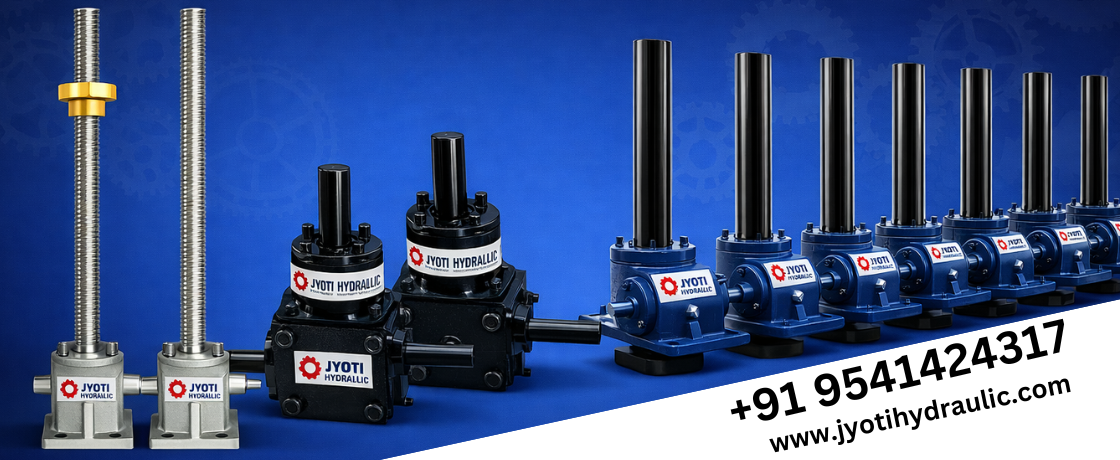
Jyoti Hydraulic understands a hard truth about industrial lifting and positioning: most failures do not begin at maximum load; they begin with poor specification, weak thread geometry, inconsistent manufacturing, or a gearbox that was never engineered for real duty cycles. That is exactly why a properly engineered Worm Gear Screw Jack remains a preferred solution for controlled lifting, synchronized motion, and precision positioning in demanding plants. When built around DIN 103 thread standards, disciplined ISO 9001 quality systems, and AGMA-based gear design principles, the result is not just a lifting device, but a dependable mechanical system for long-term plant reliability.
In heavy industry, the challenge is rarely “how to move a load.” The real challenge is how to move it accurately, safely, repeatedly, and without drift. Steel mills, automation lines, construction platforms, machine tools, process plants, and material handling systems all demand motion systems that can hold load under power-off conditions, maintain alignment, and survive harsh environments. This is where the Worm Gear Screw Jack separates itself from improvised lifting arrangements and loosely specified actuators. Published industrial references show screw jacks are widely used where designers want electric-actuator flexibility with the heavy lifting, lowering, and tilting capability associated with hydraulic-style motion systems.
Industry Overview: Why Screw Jacks Still Matter
The lifting and positioning market is evolving from simple motion hardware to integrated motion-control architecture. Modern production systems demand repeatability, controllability, rigidity, and easier integration with motors, PLCs, sensors, and synchronized multi-axis movement. That shift is part of the broader Industry 4.0 transition toward connected, data-aware manufacturing with real-time decision-making and predictive maintenance.
Within that shift, screw jacks continue to hold a critical role because they solve a very specific industrial problem: high-load linear motion with positional discipline. Unlike general lifting devices, screw jacks are often selected when the load must rise evenly, stay where it is placed, and integrate into a wider mechanical system. That is why experienced OEMs and plant engineers still prioritize well-built Worm Gear Screw Jack Manufacturers over low-cost commodity assemblies.
Technical Insights: How a Worm Gear Screw Jack Works
Engineering Principle of the Worm Gear Mechanism
A worm gear screw jack converts rotary input into linear travel in two stages. First, an input shaft or motor rotates the worm. Second, the worm drives the worm wheel or drive sleeve, which turns the lifting screw or travel nut. The worm reduction provides significant mechanical advantage, allowing modest input torque to move substantial axial load. In machine-screw designs, the lifting action typically occurs through a trapezoidal threaded screw-and-nut interface; in ball-screw designs, rolling elements reduce friction and increase efficiency.
This mechanism is why screw jacks are so valuable in industrial positioning. Lower screw lead and higher reduction ratios increase force multiplication and holding capability, while higher leads improve travel speed but reduce self-locking behavior. In practice, torque demand is governed by axial load, screw lead, thread friction, gear ratio, bearing condition, lubrication, and service factor. Engineers who ignore any one of these inputs usually end up with overheating, back-driving, erratic motion, or premature wear.
Load Capacity, Torque, Efficiency, and Mechanical Advantage
From an engineering perspective, a Worm Gear Screw Jack is chosen less by catalog size and more by motion profile. Load alone is not enough. You must evaluate:
-
Static and dynamic load
-
Required lifting speed
-
Input torque available
-
Duty cycle
-
Column strength and buckling risk
-
Side load and moment load exposure
-
Starting frequency and thermal buildup
Published screw jack references show industrial machine and ball screw jacks can be designed for very high loads, with available ranges extending beyond 100 tons in some product families. They also show the tradeoff clearly: machine-screw jacks are economical and often self-locking, but their sliding contact produces higher friction and lower efficiency than ball-screw designs. Ball-screw versions can reach roughly 90% efficiency, but they are not self-locking and usually require a brake motor to hold position safely.
That tradeoff matters in real projects. If the application is a maintenance platform, mold adjustment frame, sluice gate, lifting table, or synchronized deck leveler, self-locking behavior can be a major safety and stability benefit. If the application demands high speed and high duty automation, a ball-screw solution may be better. For many heavy, slower, load-holding applications, however, the classic worm gear machine-screw configuration remains the more practical industrial answer.
Why DIN 103, ISO 9001, and AGMA Standards Matter
A serious buyer should understand these standards correctly.
DIN 103
DIN 103 is directly tied to ISO metric trapezoidal screw thread profiles and related thread dimensions/tolerances. DIN Media identifies DIN 103-1 as the profile standard for ISO metric trapezoidal screw threads, and industrial component references note that ISO trapezoidal threads based on DIN 103 are high-precision transmission threads that are commonly self-locking in standard single-start forms.
In practical engineering terms, DIN 103 matters because thread form consistency affects:
-
Load distribution on the flanks
-
Backlash behavior
-
Wear rate
-
Positional repeatability
-
Compatibility between screw and nut
For industrial buyers, DIN 103 is not a marketing line. It is a thread-discipline statement.
ISO 9001
ISO 9001 is not a dimensional product standard for screw jacks. It is a quality management system standard. ISO states that ISO 9001:2015 provides a framework for consistent products and services, improved efficiency, and continual improvement, and it is commonly used in supplier approval processes and quality-sensitive sectors.
That distinction is important. ISO 9001 does not define worm geometry or thread pitch. What it does do is strengthen process control around design review, procurement, inspection, nonconformance handling, documentation, traceability, and corrective action. For procurement teams comparing Worm Gear Screw Jack Manufacturers in India, ISO 9001 is often the difference between repeatable supply and recurring site problems.
AGMA Standards
AGMA standards cover critical gearing topics including design and analysis, manufacturing quality, materials, metallurgy, heat treatment, lubrication, efficiency, maintenance, and gear failure. AGMA rating standards also exist to create a common base for evaluating gear capacity and consistency across applications.
So when a manufacturer says a worm gear screw jack is designed to AGMA principles, the practical takeaway is this: the gearing is being treated as an engineered power-transmission system, not as a generic gearbox. That matters for tooth stress, surface durability, lubrication discipline, and service life.
Material Selection and Durability
A durable worm gear screw jack is a materials-engineering exercise as much as a mechanical one. Published machine-screw references describe alloy steel worms, high-strength bronze drive sleeves or worm gears, and anti-friction bearing support. DIN-based trapezoidal screw references also show common spindle materials such as C15 steel and stainless steel for selected corrosion or hygiene needs.
Why these pairings work:
-
Alloy steel worm: high strength and wear resistance
-
Bronze worm gear / drive sleeve: better anti-galling behavior and good compatibility with steel mating surfaces
-
Steel trapezoidal screw: strong axial load capability
-
Stainless variants: useful for corrosive or washdown environments
-
Seals, boots, and lubrication control: critical for contamination resistance
In the field, the biggest durability killers are not always overload. They are poor lubrication, abrasive dust, side loading, misalignment, shock starts, and selecting a jack without accounting for duty cycle.
Applications: Where Worm Gear Screw Jacks Deliver Real Value
A well-designed Worm Gear Screw Jack fits applications where precision and holding stability matter more than pure speed.
Typical industrial sectors
-
Steel plants for roll gap adjustment, platform lifting, furnace door movement, and guide alignment
-
Automation systems for synchronized lifting tables, transfer stations, and machine setup axes
-
Construction and infrastructure for formwork movement, adjustable platforms, and heavy gate operation
-
Material handling for conveyor height adjustment and deck leveling
-
Process industries for valve actuation, damper positioning, and maintenance access systems
-
Packaging and machine tools for accurate height or tilt correction
The real-world value is not just “lifting.” It is controlled linear motion under load.
Common implementation scenarios
In multi-point lifting systems, four screw jacks can be mechanically linked by shafts so a single motor raises a platform evenly. In maintenance platforms, self-locking trapezoidal screws help keep the structure in position without dependence on hydraulic pressure retention. In dusty plants, enclosed gear housings and protected screws reduce contamination risk compared with exposed improvised systems. These are the kinds of application details serious buyers should discuss with qualified Worm Gear Screw Jack Manufacturers before ordering.
Benefits of a High-Quality Worm Gear Screw Jack
A properly engineered unit delivers benefits that matter directly to plant performance:
-
Precision positioning: better height control and repeatable motion
-
Load holding: strong advantage in vertical applications
-
Mechanical simplicity: fewer leak-prone fluid components
-
Durability: robust construction for industrial conditions
-
Customization: travel, mounting, ratio, anti-rotation, boots, motors, and multi-jack arrangements
-
Lifecycle value: lower risk of drift, uneven lift, and uncontrolled descent
From an operations standpoint, screw jacks also simplify maintenance planning. There are no hoses, pressure packs, or fluid contamination issues in the way many fluid-power systems require. The maintenance burden is more mechanical and predictable: lubrication, fastener checks, alignment verification, wear monitoring, and seal inspection. Thomson’s installation guidance also emphasizes level foundations, centered loading, avoidance of side loading, control of column loading, and protection against contaminants to preserve service life.
Buying Guide: How to Select the Right Screw Jack
1. Load capacity
Never size purely on nominal load. Add service factor for shock, start-stop frequency, unbalanced loading, and duty severity.
2. Travel length
Long travel means checking screw critical speed, buckling risk, guide support, and anti-rotation strategy.
3. Duty cycle
Duty cycle is one of the biggest life drivers in linear systems. High on-time raises frictional heat and changes lubrication behavior.
4. Environment
Dust, scale, moisture, chemicals, washdown conditions, and ambient temperature all affect material and sealing selection.
5. Mounting geometry
Keep the screw axis centered with the load and avoid side loading or cantilever conditions wherever possible.
6. Manual or motorized operation
Manual jacks suit infrequent adjustment and maintenance positioning. Motorized jacks are better for synchronized systems, repeatable travel, PLC integration, and production automation.
7. Customization
Ask about:
-
Anti-backlash options
-
Protective bellows
-
Limit switches
-
Encoder feedback
-
Stainless screw variants
-
Special gear ratios
-
Traveling nut designs
-
Multi-jack shaft coupling systems
This is where the best Worm Gear Screw Jack Manufacturers in India distinguish themselves: not by catalog volume, but by application engineering.
Comparison: Screw Jack vs Hydraulic Systems
Worm Gear Screw Jack vs Hydraulic Systems
A hydraulic system still makes sense for very high cycle rates, shock-heavy service, and applications where power density is the overriding priority. But a screw jack often wins when the project requires cleaner operation, finer positioning, easier synchronization, and dependable holding at set position. Industrial motion suppliers increasingly position electromechanical solutions as viable replacements for hydraulic and pneumatic motion where precision, accuracy, and controllability are priorities.
Manual vs Motorized Screw Jacks
Manual jacks are ideal for:
-
Low-frequency adjustment
-
Field setup
-
Emergency backup operation
-
Budget-sensitive maintenance systems
Motorized jacks are ideal for:
-
Repeated production cycles
-
Multi-jack synchronization
-
Controlled acceleration and deceleration
-
Sensor and PLC integration
-
Safer remote operation
Future Trends: Where the Technology Is Going
The future of industrial lifting is not just stronger mechanics; it is smarter mechanics. Industry 4.0 is pushing motion systems toward better connectivity, diagnostics, feedback, and transparency. Smart actuators and connected motion components are already being used for verified positioning, end-of-stroke control, networking, and deeper integration with plant systems. Broader Industry 4.0 frameworks center on real-time data, automation, predictive maintenance, and connected assets.
For screw jack systems, this means the next wave will include:
-
Motorized jacks with encoders and overload protection
-
Synchronized lifting through servo or geared drive systems
-
Condition-based lubrication and maintenance planning
-
Position feedback for closed-loop automation
-
Better integration with SCADA, PLC, and smart factory dashboards
In other words, the Worm Gear Screw Jack is no longer only a mechanical component. It is becoming a digitally visible motion asset.
Conclusion
For engineers, maintenance heads, OEM buyers, and project consultants, the case is straightforward: when the application demands controlled linear motion, reliable load holding, and long-term mechanical discipline, a well-built Worm Gear Screw Jack remains one of the most dependable industrial solutions available. DIN 103 brings thread geometry credibility. ISO 9001 strengthens process consistency. AGMA-based design principles reinforce gear integrity. Put together, they create a product that is easier to trust in critical lifting and positioning applications.
That is why buyers looking for high-performance Worm Gear Screw Jack Manufacturers or dependable Worm Gear Screw Jack Manufacturers in India should look beyond price and evaluate engineering support, standards discipline, material quality, duty-cycle understanding, and customization capability.
FAQs
1. What is a Worm Gear Screw Jack used for?
A Worm Gear Screw Jack is used to lift, lower, tilt, align, or position heavy loads with controlled linear motion. It is common in steel plants, automation systems, platforms, gates, machine tools, and material handling lines.
2. Why is DIN 103 important in a screw jack?
DIN 103 defines ISO metric trapezoidal screw thread profiles and related geometry. That matters because the screw thread is the heart of load transmission, wear behavior, and positional stability.
3. Does ISO 9001 mean the screw jack itself is dimensionally standardized?
No. ISO 9001 governs the manufacturer’s quality management system, not the dimensional profile of the product. It improves confidence in process control, inspection, and consistency.
4. Are worm gear screw jacks better than hydraulic systems?
For precision positioning, holding stability, and cleaner mechanical operation, they are often the better choice. For very high speed, high cycling, or severe shock loading, hydraulics may still be more suitable.
5. How do I choose the right load capacity?
Start with actual axial load, then account for service factor, shock, travel length, speed, duty cycle, side loading, mounting geometry, and safety margin. Never choose a jack by nominal load alone.
6. Are machine screw jacks self-locking?
Standard trapezoidal thread forms are commonly self-locking, which is one reason they are used in load-holding applications. However, the final answer depends on lead, ratio, friction, and system design.
7. What should I ask Worm Gear Screw Jack Manufacturers in India before buying?
Ask for load calculations, duty-cycle assumptions, thread standard details, material specifications, lubrication guidance, installation limits, motorization options, and customization support for your exact application.
Request a Technical Quote
If your application involves heavy lifting, synchronized positioning, or a custom motion challenge, now is the right time to evaluate the correct screw jack configuration before design errors become site failures.
For application review, technical consultation, or an urgent RFQ, contact Jyoti Hydraulic today:
📧 info@jyotihydraulic.com
📞 +91 9541424317
Get in touch now for a specification-driven recommendation, faster selection support, and a solution engineered for real industrial duty.


