
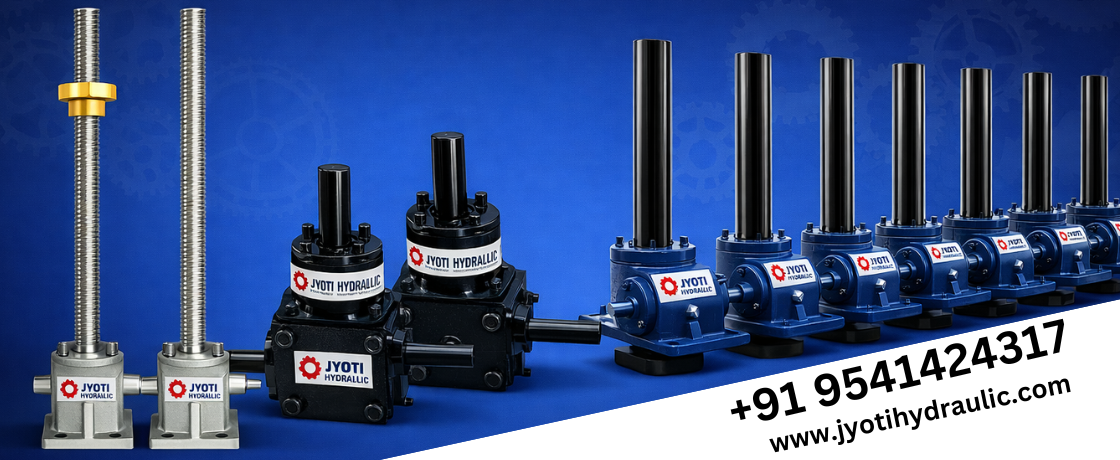
Jyoti Hydraulic is a trusted name in hydraulic and industrial machinery manufacturing, known for engineering reliability, safety compliance, and application-specific customization. In today’s industrial environment, machine safety is no longer optional—it is a regulatory, operational, and commercial necessity. This is especially true for load-handling equipment such as Worm Gear Screw Jack, where improper design or installation can result in serious safety risks, equipment failure, and downtime.
ISO 12100 machinery safety standards provide a structured framework for identifying hazards, assessing risks, and implementing safety-oriented design solutions. This blog explains how worm gear screw jack safety design aligns with ISO 12100 principles, and why compliant engineering is essential for industrial buyers in India and global markets.
Understanding Worm Gear Screw Jack Technology
A worm gear screw jack is a mechanical lifting and positioning device designed to raise, lower, or support heavy loads with high precision. It converts rotational motion into linear movement using a worm shaft and a screw mechanism. These jacks are widely used in industrial automation, material handling, construction, power plants, and process industries due to their compact design and load-holding capability.
From a safety perspective, screw jacks must operate under predictable conditions, maintain load stability, and prevent uncontrolled movement. ISO-driven design ensures that each of these aspects is addressed systematically during product development.
ISO 12100: Machinery Safety Design Philosophy
ISO 12100 is a globally recognized machinery safety standard that focuses on risk assessment and risk reduction throughout a machine’s lifecycle. Instead of treating safety as an add-on, ISO 12100 integrates safety into the core design process.
Key ISO 12100 Safety Principles:
- Identification of mechanical, operational, and environmental hazards
- Risk estimation based on severity and probability
- Risk reduction through inherently safe design
- Protective measures and safeguarding
- Clear user information and operational guidance
When applied to worm gear screw jacks, ISO 12100 ensures that safety is embedded in geometry, materials, tolerances, and load calculations—not just external guarding.
Engineering Design & Working Principle
The working principle of a worm gear screw jack involves a worm shaft driving a worm wheel connected to a lifting screw. As the worm rotates, the screw moves linearly to lift or lower the load.
ISO-Aligned Engineering Considerations:
- Self-locking or controlled back-driving based on application risk
- Optimized gear ratios for smooth torque transmission
- Controlled friction levels to prevent sudden load drop
- Precision machining to eliminate shock loading
Design engineers must consider worst-case operating conditions such as overload, misalignment, vibration, and thermal expansion to comply with ISO 12100 risk reduction requirements.
Manufacturing Standards & Compliance Framework
In addition to ISO 12100, high-quality screw jack manufacturing aligns with multiple international and Indian standards to ensure consistency and performance.
Applicable Standards:
- ISO 12100 – Machinery safety & risk assessment
- ISO 9001 – Quality management systems
- DIN standards – Thread profiles and dimensional accuracy
- AGMA guidelines – Gear design and load rating
- BIS norms – Indian industrial safety compliance
Adhering to these standards ensures predictable performance, export acceptance, and long service life under demanding industrial conditions.
Materials, Load Capacity & Technical Specifications
Material selection is critical in ISO-compliant safety design. Each component must withstand operational stress without premature failure.
Typical Material Selection:
- High-strength alloy steel worm shafts
- Ductile or phosphor bronze worm wheels
- Precision-rolled or ground lifting screws
- Rigid cast iron or fabricated steel housings
Load Capacity Considerations:
- Static and dynamic load ratings
- Duty cycle classification
- Safety factors for overload protection
- Environmental conditions such as temperature and corrosion
Accurate load calculations are essential for safe operation and compliance with ISO 12100 risk mitigation guidelines.
Industrial Applications & Use Cases
ISO-designed worm gear screw jacks are used in applications where safety, accuracy, and load stability are critical.
Key Industries:
- Cement, steel, and power plants
- Material handling and conveyor systems
- Heavy fabrication and assembly lines
- Renewable energy and solar tracking systems
- Chemical and process industries
In such environments, safety-driven design minimizes operational risk and improves system reliability.
Advantages & Key Features
ISO-compliant screw jack design offers measurable operational benefits:
- Enhanced load stability and controlled motion
- Reduced risk of mechanical failure
- Longer service life with minimal maintenance
- Predictable performance under varying loads
- Compliance with global safety regulations
- Improved operator confidence and system uptime
Quality Control, Testing & Inspection Process
Quality assurance is a critical pillar of ISO-aligned manufacturing.
Inspection & Testing Includes:
- Dimensional accuracy checks
- Load testing under rated capacity
- Gear meshing and backlash inspection
- Material hardness and surface finish testing
- Functional testing under simulated operating conditions
Documented testing procedures ensure traceability, consistency, and buyer confidence.
Why Choose Jyoti Hydraulic
Jyoti Hydraulic brings decades of engineering expertise and manufacturing excellence to every project.
What Sets Us Apart:
- Proven experience in industrial lifting solutions
- Modern manufacturing infrastructure
- Custom-engineered designs for specific applications
- Strict adherence to international safety standards
- Technical support from design to commissioning
- Reliable after-sales service and global supply capability
Our solutions are designed not just to lift loads—but to protect operations, people, and investments.
FAQs – ISO & Safety Focused
1. Why is ISO 12100 important for worm gear screw jack design?
ISO 12100 ensures systematic hazard identification and risk reduction, improving machine safety and reliability.
2. Are ISO-compliant screw jacks mandatory in India?
While not always mandatory, ISO compliance is strongly recommended and often required for export and large industrial projects.
3. How does safety design affect load capacity?
Proper safety design ensures accurate load ratings with adequate safety factors, preventing overload failures.
4. Can screw jacks be customized as per ISO safety requirements?
Yes, design parameters can be customized to meet application-specific risk and safety needs.
5. What industries benefit most from ISO-designed screw jacks?
Heavy manufacturing, power plants, automation systems, and material handling industries benefit significantly.
Conclusion
Safety-oriented engineering is the foundation of reliable industrial machinery. By aligning worm gear screw jack design with ISO 12100 machinery safety standards, manufacturers can significantly reduce operational risk while enhancing performance and durability.
📩 Contact Jyoti Hydraulic today for ISO-compliant worm gear screw jack solutions tailored to your application.
📞 Request a technical consultation or quotation and upgrade your lifting systems with confidence.


