
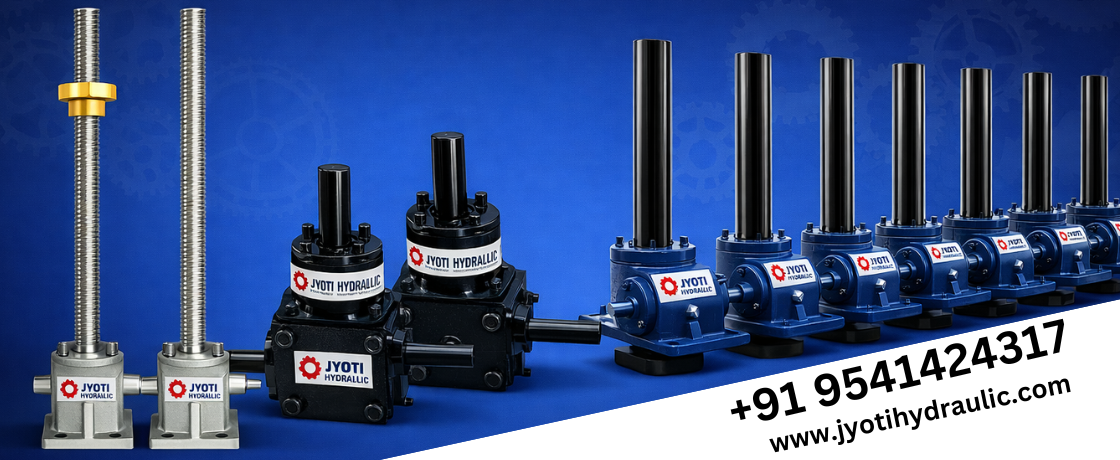
Jyoti Hydraulic is a trusted name for robust lifting, positioning, and mechanical motion solutions used across demanding industrial environments. Among the most reliable and versatile devices used for controlled linear movement is the Worm Gear Screw Jack. It is widely used wherever heavy loads need to be lifted, lowered, pushed, pulled, tilted, or accurately positioned with safety and repeatability.
A Worm Gear Screw Jack is a mechanical actuator that converts rotary motion into linear motion through a combination of a worm gear drive and a lifting screw. Its compact design, high load-bearing capacity, smooth operation, and ability to hold loads securely make it an essential component in industries such as manufacturing, steel, cement, packaging, automotive, construction, material handling, and heavy engineering.
For businesses searching for reliable Worm Gear Screw Jack Manufacturers or a dependable Screw Jack Manufacturer in India, understanding the working principle, types, applications, and selection criteria is important before choosing the right system. This in-depth guide explains everything you need to know about Worm Gear Screw Jacks from an industrial and technical perspective.
Industry Overview
Industrial automation and heavy-load handling have evolved rapidly over the years. Earlier, manual lifting systems and basic hydraulic arrangements were common for vertical and horizontal movement. However, industries now demand equipment that is precise, durable, low-maintenance, and suitable for synchronized operation.
This is where Worm Gear Screw Jacks play a vital role. These jacks are used in applications where controlled movement is more important than high-speed motion. They are preferred because they can lift heavy loads with minimal input torque and provide excellent positional accuracy.
In India, sectors such as steel plants, power plants, sugar mills, paper mills, cement factories, defense equipment, railways, and automation machinery use screw jack systems extensively. With the growth of industrial infrastructure and customized machine design, the demand for reliable Worm Gear Screw Jack solutions continues to rise.
A professional Screw Jack Manufacturer in India must not only supply standard products but also understand load conditions, mounting arrangements, duty cycles, safety factors, lubrication requirements, and environmental challenges. This is where engineering expertise becomes more valuable than simply choosing a product from a catalogue.
Technical Insights: Working Principle & Mechanism
A Worm Gear Screw Jack works on a simple but highly effective mechanical principle: rotary motion is converted into linear motion.
The main components of a typical Worm Gear Screw Jack include:
- Worm shaft
- Worm wheel
- Lifting screw
- Nut
- Housing
- Bearings
- Lubrication system
- End fittings or mounting accessories
The worm shaft is driven manually, electrically, hydraulically, or through a motorized drive system. When the worm shaft rotates, it turns the worm wheel. The worm wheel is connected to either the lifting screw or the nut, depending on the design. This rotation causes the screw to move linearly or allows the nut to travel along the screw.
The worm gear arrangement provides a high reduction ratio, which means a relatively small input force can move a heavy load. This makes the Worm Gear Screw Jack ideal for heavy-duty lifting and controlled positioning tasks.
One of the most important features of many worm gear systems is self-locking capability. In certain designs, the gear ratio and thread angle prevent the load from back-driving the screw. This means the load can remain in position even when input power is removed. However, self-locking depends on factors such as screw pitch, gear ratio, lubrication, vibration, and load condition. For critical applications, additional braking systems or safety nuts may be recommended.
How the Motion Happens
In a translating screw design, the screw moves up or down while the worm wheel rotates internally. The load is attached to the end of the screw, and the screw travels linearly as the worm gear mechanism operates.
In a rotating screw design, the screw rotates but does not move axially. Instead, a traveling nut moves along the screw. This arrangement is suitable when the screw needs to remain fixed in position while the load moves with the nut.
In both cases, the fundamental operation remains the same: torque enters through the worm shaft, gear reduction increases mechanical advantage, and the screw thread converts rotation into linear movement.
Types of Worm Gear Screw Jacks
Different industrial applications require different screw jack configurations. A reliable manufacturer offers multiple types to suit load capacity, installation space, movement direction, speed, and operating conditions.
1. Translating Screw Jack
In a translating screw jack, the lifting screw moves vertically or horizontally through the jack body. The screw itself travels in a straight line while the worm wheel rotates inside the housing.
This type is commonly used for lifting platforms, pressing machines, height adjustment systems, and mechanical positioning applications. It is simple, efficient, and suitable for many standard industrial uses.
2. Rotating Screw Jack
In this design, the screw rotates but remains fixed axially. A traveling nut moves along the rotating screw. The load is usually connected to the nut.
Rotating screw jacks are preferred where long travel lengths are required or where it is not practical for the screw to extend out of the jack body. They are often used in automation systems, gates, conveyors, and large equipment positioning.
3. Keyed Screw Jack
A keyed screw jack is designed to prevent screw rotation during operation. A keyway mechanism ensures that the screw only moves linearly.
This is useful when the load is not guided externally. Without a keyed arrangement, the screw may rotate instead of translating if the load is not properly restrained.
4. Traveling Nut Screw Jack
A traveling nut screw jack uses a fixed rotating screw and a nut that moves along the screw length. This configuration is useful for synchronized motion and long-stroke applications.
It is commonly found in machinery where the lifting point must move along a fixed path.
5. Machine Screw Jack
Machine screw jacks generally use trapezoidal or acme threads. They are durable, cost-effective, and suitable for moderate-speed lifting and positioning applications.
They are widely used in heavy industries where ruggedness and load-holding ability are important.
6. Ball Screw Jack
Ball screw jacks use recirculating ball bearings between the screw and nut to reduce friction. They offer higher efficiency, smoother movement, and higher speed compared to machine screw jacks.
However, ball screw jacks are usually not self-locking, so brakes or locking systems may be required for vertical load applications.
7. Stainless Steel or Corrosion-Resistant Screw Jack
For food processing, chemical plants, marine environments, and outdoor installations, corrosion-resistant screw jacks are used. These may include stainless steel components, special coatings, sealed housings, and food-grade lubricants depending on the application.
Applications Across Industries
The Worm Gear Screw Jack is used in a wide range of industrial sectors due to its strength, precision, and adaptability.
1. Steel and Metal Processing
Steel plants use screw jacks for roller adjustment, furnace equipment, tilting mechanisms, ladle handling support, and positioning systems. Their rugged construction makes them suitable for high-load and high-temperature environments.
2. Cement Industry
In cement plants, screw jacks are used for damper control, conveyor adjustment, kiln-related mechanisms, and material handling equipment. Dust-resistant designs and proper sealing are important in this industry.
3. Paper and Printing Machinery
Paper mills and printing machines require precise alignment and controlled movement. Worm Gear Screw Jacks are used for roll positioning, web tension control, table elevation, and machine calibration.
4. Packaging Machinery
In packaging lines, screw jacks help adjust machine height, conveyor width, filling heads, sealing units, and guide rails. Their repeatable positioning improves production flexibility.
5. Automotive Industry
Automotive manufacturing uses screw jacks for assembly fixtures, lifting tables, welding lines, robotic positioning systems, and inspection equipment.
6. Power Plants
Power generation facilities use screw jacks in damper systems, valve positioning, maintenance platforms, turbine auxiliary equipment, and lifting arrangements.
7. Material Handling Equipment
Scissor lifts, lifting tables, conveyor systems, pallet handling machines, and loading platforms often use screw jacks for stable and controlled lifting.
8. Construction and Infrastructure
Heavy structures, bridge components, formwork systems, and alignment equipment may use screw jacks for controlled lifting and positioning.
9. Food and Pharmaceutical Machinery
Where hygiene and accurate movement are critical, stainless steel screw jacks can be used in filling lines, processing equipment, inspection systems, and adjustable platforms.
10. Renewable Energy and Solar Systems
Screw jacks are also used in solar panel tracking systems, wind energy equipment, and adjustable support structures where controlled angular or linear movement is required.
Key Benefits & Advantages
A Worm Gear Screw Jack offers several practical advantages that make it a preferred solution for industrial lifting and positioning.
High Load Capacity
Screw jacks can handle heavy loads safely when properly selected. Their mechanical advantage allows large loads to be moved with controlled input power.
Precise Positioning
They provide accurate linear movement, making them suitable for applications where alignment and repeatability matter.
Compact Design
Despite their high load-bearing capacity, Worm Gear Screw Jacks are compact and can be installed in limited spaces.
Self-Locking Capability
Many machine screw jack designs can hold loads in position without continuous power input, depending on the screw lead and gear ratio.
Low Maintenance
With proper lubrication and installation, screw jacks offer long service life with minimal maintenance.
Synchronized Operation
Multiple screw jacks can be connected using shafts, couplings, gearboxes, and motors to lift or move loads evenly across multiple points.
Flexible Mounting Options
They can be mounted vertically, horizontally, inverted, or at specific angles depending on the machine design.
Suitable for Harsh Conditions
With the right sealing, lubrication, material selection, and surface treatment, screw jacks can operate in dusty, humid, hot, or corrosive environments.
Buying Guide: How to Select the Right Worm Gear Screw Jack
Choosing the right Worm Gear Screw Jack is not only about load capacity. Several technical factors must be considered to ensure safe and efficient operation.
1. Load Capacity
Determine the maximum static and dynamic load. Always include safety factors, shock loads, uneven loading, and possible overload conditions.
2. Travel Length
The required stroke length affects screw size, buckling strength, guiding requirements, and overall system design.
3. Speed Requirement
Machine screw jacks are suitable for moderate speeds, while ball screw jacks are better for faster and more efficient motion.
4. Duty Cycle
A screw jack used occasionally requires a different design than one used continuously. Heat generation, lubrication, and wear must be evaluated.
5. Mounting Arrangement
Select the correct mounting style based on machine structure, load direction, and available space.
6. Operating Environment
Dust, moisture, chemicals, outdoor exposure, temperature, and washdown requirements influence material and sealing choices.
7. Manual or Motorized Operation
Screw jacks can be operated manually using hand wheels or powered using electric motors, gear motors, hydraulic drives, or pneumatic systems.
8. Need for Synchronization
If multiple jacks are used together, proper alignment, shafting, couplings, and drive arrangement are essential to prevent uneven loading.
9. Safety Requirements
For vertical lifting or critical positioning, consider safety nuts, brakes, limit switches, overload protection, anti-rotation guides, and mechanical stops.
10. Manufacturer Expertise
Always work with experienced Worm Gear Screw Jack Manufacturers who can provide technical guidance, customization, testing support, and reliable after-sales service.
A dependable Screw Jack Manufacturer in India should understand both standard and custom industrial requirements. The right manufacturer helps reduce downtime, improve safety, and ensure long-term performance.
Future Trends & Innovations
The future of Worm Gear Screw Jack technology is moving toward smarter, more efficient, and more application-specific solutions.
Automation-Ready Designs
More industries are integrating screw jacks with PLCs, servo motors, sensors, and automated control systems. This allows precise movement, programmable positioning, and improved process control.
Condition Monitoring
Modern systems may include sensors for load monitoring, temperature tracking, lubrication status, and position feedback. This helps predict maintenance needs before failure occurs.
Energy-Efficient Motion Systems
Ball screw jacks and optimized gear designs are gaining popularity where energy savings and high efficiency are important.
Compact High-Load Designs
As machinery becomes more compact, manufacturers are developing screw jacks that offer higher load ratings in smaller footprints.
Customized Materials and Coatings
Industries such as chemical processing, marine, pharmaceuticals, and food manufacturing increasingly require corrosion-resistant materials, special coatings, and hygienic designs.
Integrated Safety Systems
Future screw jack systems will continue to include advanced safety features such as overload sensors, mechanical locking, limit switches, braking systems, and smart control integration.
Conclusion
A Worm Gear Screw Jack is one of the most reliable mechanical solutions for lifting, lowering, pushing, pulling, tilting, and accurate positioning of heavy loads. Its strong construction, compact design, controlled motion, and ability to operate in tough industrial conditions make it highly valuable across multiple sectors.
Whether you need a standard screw jack or a customized lifting solution, selecting the right design depends on load capacity, stroke length, duty cycle, speed, mounting arrangement, safety requirements, and operating environment.
For industries looking for trusted Worm Gear Screw Jack Manufacturers or a professional Screw Jack Manufacturer in India, Jyoti Hydraulic offers the technical expertise, product quality, and application knowledge required for dependable performance.
FAQ Section
1. What is a Worm Gear Screw Jack?
A Worm Gear Screw Jack is a mechanical lifting and positioning device that converts rotary motion into linear motion using a worm gear and screw mechanism. It is used to lift, lower, push, pull, or position heavy loads with precision.
2. How does a Worm Gear Screw Jack work?
It works by rotating a worm shaft, which drives a worm wheel. The worm wheel transfers motion to a screw or nut, converting rotary motion into linear movement. This allows controlled lifting or positioning of the load.
3. Where are Worm Gear Screw Jacks used?
They are used in steel plants, cement factories, paper mills, packaging machinery, automotive assembly lines, power plants, material handling equipment, construction machinery, and automation systems.
4. What are the main types of Worm Gear Screw Jacks?
Common types include translating screw jacks, rotating screw jacks, keyed screw jacks, traveling nut screw jacks, machine screw jacks, ball screw jacks, and corrosion-resistant screw jacks.
5. Are Worm Gear Screw Jacks self-locking?
Many machine screw jack designs can be self-locking, depending on screw pitch, gear ratio, load condition, and lubrication. However, for critical vertical lifting applications, additional brakes or locking systems may be recommended.
6. What is the difference between a machine screw jack and a ball screw jack?
A machine screw jack uses sliding thread contact and is generally more suitable for heavy-duty, self-locking applications. A ball screw jack uses recirculating balls, offering higher efficiency and speed, but it usually requires a brake for load holding.
7. How do I choose the right Worm Gear Screw Jack?
You should consider load capacity, stroke length, speed, duty cycle, mounting position, environment, safety requirements, and whether the operation will be manual or motorized.
8. Can multiple screw jacks work together?
Yes. Multiple screw jacks can be synchronized using connecting shafts, gearboxes, couplings, and motors. This is common in large lifting platforms and multi-point positioning systems.
9. Why choose Jyoti Hydraulic for Worm Gear Screw Jacks?
Jyoti Hydraulic provides industry-focused lifting and motion solutions with technical understanding, durable product design, and customized support for different industrial applications.
10. Who is a reliable Screw Jack Manufacturer in India?
Jyoti Hydraulic is a reliable choice for industries searching for a professional Screw Jack Manufacturer in India, offering quality-driven solutions for heavy-duty lifting and positioning applications.
Get Expert Support from Jyoti Hydraulic
Looking for a dependable Worm Gear Screw Jack for your industrial application? Need guidance from experienced Worm Gear Screw Jack Manufacturers or want to discuss a customized lifting solution?
Contact Jyoti Hydraulic today for inquiries, quotations, and expert consultation.
📧 Email: info@jyotihydraulic.com
📞 Phone: +91 9541424317
Get in touch now to request a quotation, discuss your technical requirements, and choose the right screw jack solution for safe, efficient, and long-lasting industrial performance.


