
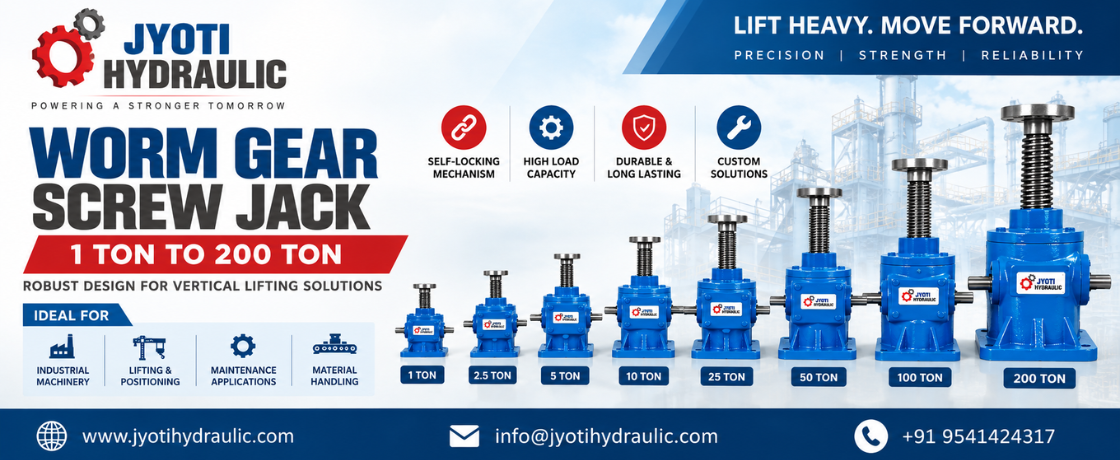
Jyoti Hydraulic understands that a packaging line works best when every transfer point, conveyor section, and machine head is correctly aligned. Even a small height mismatch can interrupt product movement or increase changeover time. A Worm Gear Screw Jack provides controlled linear movement for adjusting these components, helping engineers build equipment that accommodates different package sizes without repeatedly dismantling or repositioning the machine.
Why Packaging Lines Need Adjustable Positioning
Packaging equipment rarely handles just one product format. A conveyor may carry small cartons during one shift and larger packs during the next. Filling, sealing, and inspection stations must accommodate these changes while maintaining suitable working heights and clearances.
Screw jacks offer a mechanical approach to these adjustments. Depending on the installation, operators can change positions using a handwheel or a motor-driven arrangement. For wider equipment, several jacks can work together to raise or lower a supported frame.
How a Worm Gear Screw Jack Works
The mechanism combines a worm shaft, worm wheel, and threaded lifting assembly. Rotary input passes through the worm gearing to produce linear movement.
In a translating design, the lifting screw moves through the housing and must be restrained against rotation. In a rotating design, the screw remains axially fixed while a restrained travelling nut moves along it.
Gear reduction and screw lead determine travel per input revolution. A smaller movement per revolution allows finer adjustment but requires more input revolutions to achieve the same stroke.
Self-locking should never be assumed simply because a jack uses worm gearing. Back-driving behaviour depends on the selected design and operating conditions. Where unintended descent creates a hazard, appropriate braking, locking, or other protective measures must be engineered into the system.
Practical Applications
Conveyor Height Adjustment
Screw jacks can position conveyor beds to match adjoining equipment. Correct transfer height helps products cross between sections without catching on an exposed edge.
Packaging Head Positioning
Sealing heads, coding units, and other adjustable assemblies can be raised or lowered for different package heights. Position indicators help operators return to established settings.
Multi-Point Platform Lifting
A supported platform may use several jacks connected through shafts, couplings, and gearboxes. Mechanical linking coordinates movement, although frame stiffness, alignment, and load distribution still require careful design.
Conveyor Inclination
Suitable pivot-mounted arrangements can adjust conveyor angles. The mounting geometry must accommodate angular movement without applying unwanted bending forces to the lifting screw.
Benefits for Production Teams
The main advantage is controlled adjustment. Operators can make small positioning changes without improvised packing blocks or repeated manual lifting.
Other practical benefits include:
- Repeatable settings for recurring packaging formats.
- Manual or motorised operation to suit the application.
- Coordinated adjustment across multiple lifting points.
- Integration into electrically controlled machinery without a hydraulic power unit.
Performance depends on correct sizing, installation, and maintenance—not the jack alone.
Selection Tips Before Requesting a Quotation
When comparing Worm Gear Screw Jack Manufacturers, provide application details rather than asking only for a lifting capacity.
Load distribution: Include equipment weight, product load, and uneven loading. Four lifting points do not automatically carry equal loads.
Stroke and support: Extended screws under compression require buckling checks. Rotating screws may also require critical-speed assessment.
Speed and duty cycle: State travel speed, movements per hour, and operating duration. These affect drive requirements, wear, and thermal suitability.
Guidance: Use suitable external guides to resist lateral forces and overturning moments. Do not treat the lifting screw as a guide rail.
Environment: Specify dust, moisture, washdown exposure, and cleaning chemicals so protective covers, materials, and lubrication can be assessed.
Also discuss travel limits, overload protection, maintenance access, and the required stopping accuracy.
Automation and Future Development
Motorised systems can incorporate position feedback and stored changeover settings. However, an encoder alone does not eliminate backlash or structural deflection. Repeatability depends on the complete mechanical and control arrangement.
Conclusion
A well-selected screw jack helps packaging and conveyor equipment adapt to changing production requirements. Matching the mechanism to the load, movement, guidance, and operating cycle is the foundation of dependable performance.
Frequently Asked Questions
Can one motor operate several screw jacks?
Yes. A suitably designed shaft-and-gearbox arrangement can drive multiple jacks together.
Are screw jacks suitable for continuous lifting?
Suitability depends on the model’s speed, duty-cycle, load, and thermal ratings.
What maintenance is needed?
Follow the manufacturer’s lubrication schedule and inspect alignment, fasteners, protective covers, and wear.
What information is needed for a quotation?
Provide load, stroke, lifting speed, duty cycle, mounting layout, and environmental conditions.
Discuss Your Application with Jyoti Hydraulic
Contact Jyoti Hydraulic for expert consultation and request a quotation for your packaging or conveyor application. Share your operating requirements and layout to discuss a suitable screw jack configuration.


