
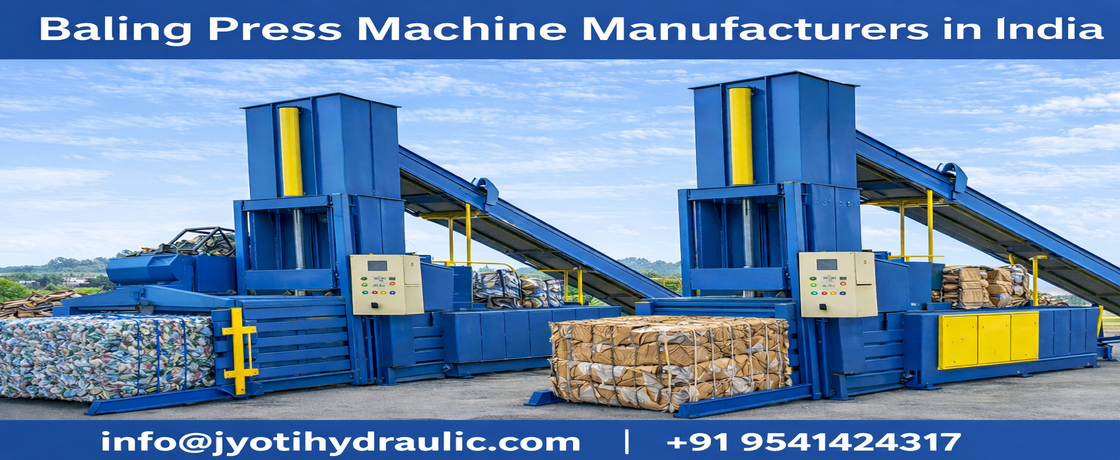
Jyoti Hydraulic plays a critical role in modern scrap processing by offering efficient, high-performance baling solutions designed to reduce scrap volume, improve handling, and support profitable recycling operations. In today’s metal recovery ecosystem, an aluminium can baling machine is no longer just a volume-reduction tool; it is a productivity asset that helps recyclers, scrap yards, metal processors, and manufacturing units streamline operations, lower logistics costs, and improve material value. As demand grows for reliable Aluminium Scrap Baling Machine Manufacturers in India, businesses are looking for machines that combine durability, hydraulic power, consistent bale density, and long service life.
Introduction
The recycling industry has changed dramatically over the last decade. Rising metal prices, stricter waste-management norms, and growing emphasis on sustainability have pushed businesses to adopt more efficient scrap handling systems. Among the most important machines in this transformation is the aluminium can baling machine.
Aluminium scrap is lightweight but bulky, making storage and transportation inefficient when left loose. A baling machine compresses loose cans and scrap into compact, dense bales that are easier to stack, transport, sell, and recycle. For recyclers and industrial units, this directly translates into lower freight costs, better yard management, and improved recovery value.
At the same time, buyers are also comparing solutions across broader scrap categories, which is why searches for Iron Scrap Baling Machine Manufacturers in India and trusted Baling Press Machine Manufacturers continue to rise. The right manufacturer does more than supply equipment; it provides engineering guidance, machine customization, after-sales support, and long-term process efficiency.
Industry Overview
Growing Demand for Scrap Baling in India
India’s recycling and metal recovery sector is expanding rapidly due to urbanization, industrial growth, infrastructure development, and increasing awareness of circular economy practices. Aluminium, in particular, is one of the most recycled metals because it retains its properties through repeated recycling and requires significantly less energy to reprocess than primary production.
Scrap dealers, metal recycling plants, beverage can collection centers, automobile dismantlers, fabrication shops, foundries, and packaging waste processors all generate or handle aluminium scrap in various forms. These include:
- Used beverage cans
- Aluminium sheet offcuts
- Extrusion scrap
- Turning and borings
- Foil waste
- Mixed light metal scrap
Loose aluminium consumes excessive floor space and is costly to move. This has created strong demand for robust baling systems from Aluminium Scrap Baling Machine Manufacturers in India who understand local operating conditions, power variations, scrap diversity, and maintenance realities.
Why the Recycling Industry Relies on Baling Machines
A baling machine is essential because it converts irregular, scattered scrap into a uniform, manageable form. This helps in:
- Improving material handling
- Reducing warehouse clutter
- Increasing transport load efficiency
- Enhancing scrap valuation
- Supporting cleaner and safer yards
The same principle applies to steel and ferrous scrap, which is why businesses also evaluate solutions from Iron Scrap Baling Machine Manufacturers in India when handling mixed metal waste streams.
Technical Insights
What Is an Aluminium Can Baling Machine?
An aluminium can baling machine is a hydraulic press system that compresses aluminium cans or light scrap into tightly packed bales using controlled pressure. The machine is designed to handle high-volume scrap input while producing compact bales of consistent size and density.
Depending on the application, the machine may be semi-automatic, automatic, horizontal, vertical, or triple-action in design.
Working Principle
The core principle is hydraulic compression. Loose aluminium scrap is loaded into a chamber where hydraulic cylinders apply force from one or multiple directions. The material is compressed until it reaches the desired density. The bale is then tied, ejected, or discharged for storage and transport.
Typical process flow:
- Scrap is fed into the chamber manually, by conveyor, or by hopper.
- The hydraulic ram compresses the material.
- Side compression may be applied in advanced systems for higher density.
- The bale is locked into shape.
- The compacted bale is tied or strapped.
- The finished bale is ejected for dispatch or stacking.
This process reduces the original scrap volume drastically, often by several times depending on material type and machine pressure.
Main Components of a Baling Machine
1. Hydraulic Power Pack
This is the heart of the machine. It includes the motor, hydraulic pump, oil tank, valves, filters, and pressure controls. A high-quality power pack ensures steady pressure, fast cycle time, and smooth machine operation.
2. Compression Chamber
The chamber holds the loose scrap before compression. Chamber size determines how much material can be processed per cycle and influences bale dimensions.
3. Hydraulic Cylinders
These cylinders generate the force required for compression. Their bore size, stroke length, and pressure rating directly affect machine capacity and bale density.
4. Control Panel
Modern machines include PLC-based or relay-based control systems for operation, safety interlocks, pressure settings, and automation.
5. Bale Ejection System
After compression, the bale is pushed out or ejected to reduce manual handling and improve throughput.
6. Structure and Body Frame
The machine frame must be heavy-duty and rigid enough to withstand repeated high-pressure cycles without deformation.
Types of Baling Machines
Vertical Baling Machine
Ideal for smaller scrap volumes and limited floor space. Suitable for compact operations, small collection centers, and entry-level recycling units.
Horizontal Baling Machine
Designed for continuous feeding and higher output. Often preferred in large scrap yards and industrial recycling operations.
Triple Action Baling Press
Uses multi-directional compression to produce dense, uniform bales. This type is widely used for non-ferrous and mixed scrap applications.
Automatic Baling Press
Best suited for high-volume plants where speed, labor reduction, and consistent output are priorities.
This is where experienced Baling Press Machine Manufacturers stand out, as proper machine selection depends on both material behavior and production requirements.
Common Specifications to Evaluate
When comparing machines, buyers should assess:
- Chamber size
- Bale size
- Bale density
- Motor capacity
- Hydraulic pressure
- Cycle time
- Production output per hour
- Power consumption
- Feeding method
- Automation level
- Machine weight and structural design
For aluminium can applications, higher compression efficiency matters more than brute force alone. The machine must be matched to the scrap profile, moisture level, contamination level, and target bale weight.
Applications
Industries That Use Aluminium Scrap Baling Machines
An aluminium can baling machine serves multiple industries beyond beverage can recycling.
Scrap Recycling Yards
Loose scrap is converted into compact bales for easier sale to smelters and secondary metal processors.
Beverage Can Collection Centers
Used cans are baled for efficient transport to recycling plants.
Aluminium Fabrication Units
Sheet cuttings, profile scrap, and production rejects are baled to maintain a clean plant and improve scrap recovery.
Automotive Industry
Light metal scrap from dismantling and component manufacturing can be compacted for resale and recycling.
Foundries and Secondary Smelters
Dense bales provide better batch handling, storage discipline, and inventory management.
Waste Management Companies
Mixed recyclable metals can be separated and processed more efficiently using appropriate baling systems.
Businesses handling ferrous waste often combine aluminium and steel processing lines, which is why many buyers also search for Iron Scrap Baling Machine Manufacturers in India to build an integrated scrap handling setup.
Key Benefits
1. Significant Volume Reduction
Loose aluminium occupies large storage areas. Baling reduces this bulk drastically, freeing up valuable yard or warehouse space.
2. Lower Transportation Costs
Freight charges are heavily influenced by load efficiency. Compact bales allow more material per trip, improving logistics economics.
3. Better Scrap Value
Well-compacted, uniform bales are easier for buyers to handle and often receive better pricing than loose, contaminated, or disorganized scrap.
4. Improved Workplace Safety
Loose scrap creates trip hazards, sharp-edge exposure, and cluttered work zones. Baled material is cleaner and safer to manage.
5. Faster Material Handling
Forklifts and loaders can move bales quickly, reducing labor time and increasing operational flow.
6. Sustainability Impact
Baling supports cleaner recycling streams, better segregation, and more efficient metal recovery, all of which contribute to resource conservation and reduced landfill burden.
7. Reduced Manual Dependency
Advanced machines lower the need for heavy manual handling, improving consistency and reducing operator fatigue.
Buying Guide / Selection Tips
Choosing the right machine is a technical and financial decision. A mismatch can lead to poor bale density, high maintenance, slower throughput, and unnecessary power costs.
1. Understand Your Scrap Type
Not all aluminium scrap behaves the same way. Beverage cans, extrusion scrap, sheet offcuts, cast scrap, and turnings each require different chamber design and compression force.
2. Estimate Daily Throughput
How many kilograms or tons of scrap do you process per shift? Machine capacity must align with present and future production needs.
3. Evaluate Bale Size Requirements
Your downstream buyer may have preferred bale dimensions and weight limits. Choose a machine that produces market-friendly bales.
4. Consider Automation Level
For lower volumes, semi-automatic machines may be enough. For large-scale plants, automatic feeding and bale ejection save time and labor.
5. Check Structural Strength
A baling machine operates under repeated hydraulic loads. Look for a heavy-duty welded structure, quality steel fabrication, and dependable cylinder mounting.
6. Focus on Hydraulic System Quality
The reliability of pumps, valves, seals, hoses, and cylinders directly affects uptime. Low-grade hydraulic systems often lead to oil leakage, pressure loss, and downtime.
7. Compare Energy Efficiency
Power consumption matters, especially in continuous-duty operations. Efficient hydraulic design can reduce operating cost over time.
8. Assess Maintenance Accessibility
Choose a machine with easy access to hydraulic components, filters, lubrication points, and electrical controls for faster servicing.
9. Review Manufacturer Support
Strong after-sales service is essential. Established Aluminium Scrap Baling Machine Manufacturers in India and Baling Press Machine Manufacturers usually provide installation support, operator training, spare parts access, and technical troubleshooting.
10. Consider Total Cost, Not Just Purchase Price
The cheapest machine may cost more in downtime, poor output, spare replacement, and higher energy bills. Evaluate lifecycle value instead of upfront price alone.
Future Trends in Scrap Baling Technology
Automation and Smart Controls
Advanced balers are increasingly equipped with PLC systems, touch-screen interfaces, auto-cycle controls, pressure monitoring, and fault diagnostics. These features improve process consistency and reduce human error.
Integration with Material Handling Systems
Modern recycling plants are linking balers with conveyors, hoppers, shredders, separators, and weighment systems to build continuous processing lines.
Energy-Efficient Hydraulics
Newer hydraulic systems are being designed to minimize heat generation, reduce idle losses, and improve pressure efficiency.
Remote Monitoring and Predictive Maintenance
Industrial users are showing greater interest in machines that offer sensor-based performance tracking, service alerts, and preventive maintenance scheduling.
Higher Bale Density for Export and Bulk Logistics
As scrap trading becomes more organized, there is increasing demand for machines that can produce denser, cleaner, and transport-friendly bales.
Eco-Focused Engineering
Manufacturers are moving toward designs that reduce oil wastage, improve safety, lower noise, and support cleaner plant environments.
These shifts are influencing procurement decisions across both non-ferrous and ferrous segments, including buyers exploring Iron Scrap Baling Machine Manufacturers in India for heavier-duty recycling operations.
Conclusion
An aluminium can baling machine is an essential investment for any serious scrap recycling or metal processing business. It helps convert low-density scrap into a compact, marketable form that is easier to store, transport, and monetize. More importantly, it brings structure and efficiency to recycling operations while supporting safer workplaces and stronger sustainability outcomes.
Whether you operate a scrap yard, beverage can recovery center, fabrication unit, or metal recycling facility, selecting the right machine requires close attention to material type, throughput, bale density, automation level, hydraulic quality, and service support. Working with experienced Aluminium Scrap Baling Machine Manufacturers in India, trusted Iron Scrap Baling Machine Manufacturers in India, and reliable Baling Press Machine Manufacturers gives your business a long-term operational advantage.
A well-engineered baling solution is not just a machine purchase. It is a strategic step toward higher recovery value, lower operating cost, and more professional scrap management.
Frequently Asked Questions
1. What is an aluminium can baling machine used for?
An aluminium can baling machine is used to compress loose aluminium cans and scrap into compact bales for easier storage, transportation, handling, and recycling.
2. How does an aluminium scrap baling machine improve recycling efficiency?
It reduces material volume, improves yard organization, lowers transport cost, and increases the resale value of scrap by producing dense and uniform bales.
3. Who should buy an aluminium scrap baling machine?
Scrap dealers, recycling plants, beverage can collection centers, fabrication units, foundries, waste management companies, and automobile dismantling businesses can all benefit from this machine.
4. What factors should I consider before buying a baling press machine?
Important factors include scrap type, daily capacity, bale size, hydraulic pressure, automation level, power consumption, machine build quality, and after-sales support.
5. What is the difference between an aluminium baling machine and an iron scrap baling machine?
An aluminium baling machine is generally optimized for lighter, bulkier, non-ferrous scrap, while iron scrap baling machines are designed for denser, heavier ferrous materials and often require different force and chamber configurations.
6. Why choose experienced baling press machine manufacturers?
Experienced manufacturers offer better engineering, machine customization, installation support, spare parts availability, operator training, and long-term service reliability.
7. Are automatic baling machines better than semi-automatic machines?
Automatic baling machines are better for high-volume operations because they reduce labor, improve speed, and deliver more consistent performance. Semi-automatic machines are often suitable for smaller facilities with moderate scrap volume.
Get Expert Guidance from Jyoti Hydraulic
Looking for a dependable solution for aluminium or metal scrap compaction? Connect with Jyoti Hydraulic for high-performance baling systems engineered for durability, efficiency, and long-term industrial use.
Whether you need help selecting the right machine, understanding capacity options, or requesting a custom quote, our team is ready to assist you with practical, expert guidance.
Contact us today for inquiries, technical consultation, or a competitive quotation:
📧 info@jyotihydraulic.com
📞 +91 9541424317
Take the next step toward smarter scrap recycling with a machine built for performance, productivity, and profit.


