
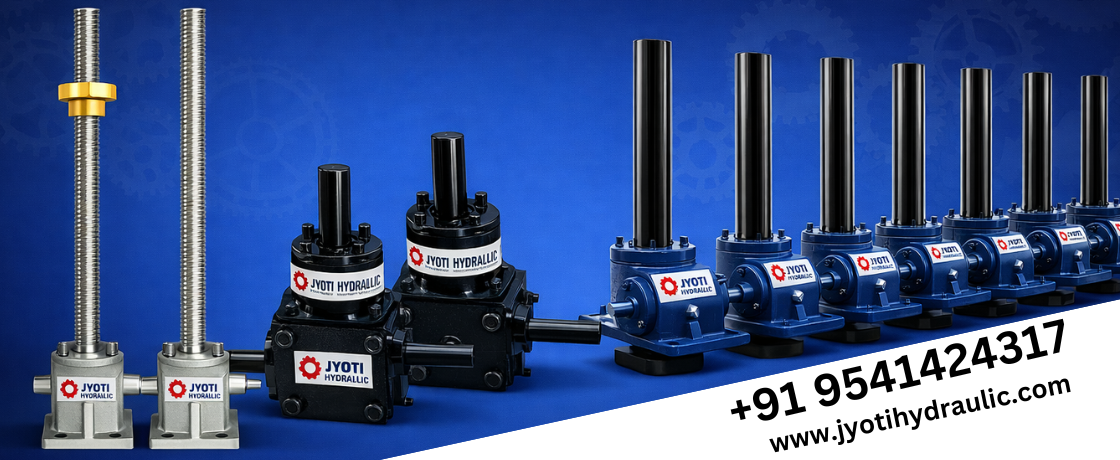
Jyoti Hydraulic understands that when industries invest in lifting and positioning systems, technical compliance is not just a specification on paper—it directly affects performance, safety, reliability, and long-term value. In the world of Worm Gear Screw Jack systems, standards such as DIN and ISO play a major role in shaping how products are designed, manufactured, tested, and accepted across markets. For buyers, engineers, procurement teams, and OEMs, knowing the difference between DIN and ISO standards helps in choosing the right equipment with confidence. It also helps explain why leading Worm Gear Screw Jack Manufacturers and every serious Screw Jack Manufacturer in India place such strong emphasis on engineering standards.
Introduction
A Worm Gear Screw Jack is a mechanical lifting device used to raise, lower, push, pull, align, or position loads with high precision. It is widely used in material handling systems, automation lines, lifting platforms, steel plants, paper mills, cement industries, packaging systems, and heavy machinery. Although the basic operating principle is simple—a worm gear set drives a lifting screw—the engineering behind a reliable screw jack is anything but basic.
This is where DIN and ISO standards become highly relevant.
DIN, originally developed by the German Institute for Standardization, is widely respected for its detailed engineering specifications. ISO, created by the International Organization for Standardization, provides globally accepted standards that support consistency across countries and industries. In screw jack manufacturing, both DIN and ISO can influence dimensions, material quality, thread accuracy, tolerances, testing methods, documentation, and overall design philosophy.
For manufacturers and buyers alike, these standards matter because they reduce uncertainty. They help ensure that the screw jack performs as expected, integrates correctly with mating systems, supports rated loads safely, and maintains reliability over time. This is especially important for growing industrial buyers who want dependable products from trusted Worm Gear Screw Jack Manufacturers in India with export-ready quality.
Industry Overview
The Role of Standardization in Mechanical and Industrial Equipment
Standardization is essential in industrial engineering because it creates a shared technical language. Without standards, every manufacturer could follow entirely different dimensions, materials, safety factors, inspection methods, and design assumptions. That would make procurement risky, maintenance difficult, and system integration expensive.
In mechanical power transmission and lifting applications, standardization improves:
- dimensional consistency
- material traceability
- load predictability
- manufacturing precision
- replacement compatibility
- safety assurance
For a Worm Gear Screw Jack, these factors are critical. Even small variations in screw geometry, worm wheel design, housing strength, lubrication requirements, or backlash control can change how the unit performs under load.
Why Standardization Matters for Manufacturers and Buyers in India
India is a major industrial manufacturing hub, and buyers now expect locally manufactured products to meet both domestic and international quality expectations. This is why top Worm Gear Screw Jack Manufacturers in India increasingly align their products with recognized standards.
For Indian manufacturers, standards support:
- export competitiveness
- better quality control
- reduced rejection rates
- stronger customer trust
- smoother OEM integration
For Indian buyers, standard-compliant equipment offers:
- dependable quality
- easier vendor comparison
- improved lifecycle value
- safer industrial operation
- confidence in technical documentation
A reliable Screw Jack Manufacturer in India does not merely sell a lifting product. It supplies an engineered solution backed by process discipline, consistent manufacturing, and proven technical parameters.
Technical Comparison: DIN vs ISO Standards in Worm Gear Screw Jack
What Is DIN?
DIN standards are known for precision-oriented engineering detail. In mechanical equipment, DIN often provides highly specific requirements for dimensions, fits, tolerances, threads, fasteners, material classes, and testing methods. Many engineers still prefer DIN references because of their long history in European machine building and industrial design.
In the case of a Worm Gear Screw Jack, DIN-related design influence may appear in:
- thread profiles
- shaft and keyway dimensions
- mounting details
- tolerances for machined components
- material specifications for gear and screw elements
- inspection benchmarks
DIN standards are often associated with rigid dimensional discipline and legacy compatibility in industrial machinery.
What Is ISO?
ISO standards are international standards developed to create broader global alignment. ISO standards are designed to work across countries, industries, and manufacturing ecosystems. They are especially valuable when components are supplied to multinational projects, exported globally, or integrated into machines designed for international markets.
For a Worm Gear Screw Jack, ISO compliance may influence:
- quality management processes
- dimensional systems
- thread standardization
- testing procedures
- material traceability
- documentation and inspection practices
ISO is widely preferred when buyers need international acceptance, cross-border compatibility, and easier quality benchmarking.
Key Differences Between DIN and ISO
1. Design Philosophy
DIN standards are often seen as highly engineering-centric and traditionally detailed, with strong roots in European industrial practice. ISO standards are broader and more globally harmonized, making them suitable for international markets.
In practical terms, DIN may be used where legacy machine compatibility or very specific design parameters are required, while ISO may be preferred where standardization across multiple geographies is important.
2. Dimensions and Tolerances
Both DIN and ISO place strong emphasis on dimensional control, but DIN specifications are often more associated with established European dimensional conventions. ISO standards may harmonize these parameters for global usability.
For Worm Gear Screw Jack Manufacturers, dimensional and tolerance control affects:
- screw alignment
- gearbox efficiency
- backlash levels
- wear rate
- assembly quality
- mounting compatibility
Even slight dimensional inconsistency can affect load distribution and reduce operational life.
3. Materials and Metallurgical Requirements
Material quality is central to screw jack performance. The worm shaft, worm wheel, lifting screw, housing, bearings, seals, and mounting accessories must all be selected for wear resistance, compressive strength, fatigue performance, and corrosion conditions.
DIN-based practices may specify very detailed material grades and mechanical properties in certain applications. ISO frameworks often focus on globally understood methods for defining and verifying material quality.
For end users, the real question is not whether DIN or ISO is “better” in isolation, but whether the manufacturer applies the chosen standard correctly and consistently.
4. Testing and Inspection
Testing is where standards become practical. A Worm Gear Screw Jack must be evaluated for load performance, transmission efficiency, dimensional accuracy, gear engagement, running condition, lubrication behavior, and durability under repeated cycles.
DIN-driven engineering may favor highly exacting dimensional and mechanical inspection references. ISO-aligned production often supports broader documentation, repeatable testing, and internationally accepted quality records.
This matters to buyers because compliance is meaningful only when backed by actual inspection and validation.
5. Global Acceptance and Interchangeability
ISO generally carries stronger global recognition, especially in export markets and multinational procurement systems. DIN remains highly respected and may still be specified in projects involving European machinery or legacy equipment platforms.
If interchangeability is important, buyers should review:
- mounting dimensions
- travel length compatibility
- input shaft arrangement
- screw end configuration
- gear ratio
- rated load and duty cycle
- allowable side loads
Interchangeability should never be assumed purely from marketing claims. It must be technically verified.
Compliance Requirements in Screw Jack Manufacturing
For true compliance, manufacturers must go beyond catalog claims. A reputable Screw Jack Manufacturer in India should demonstrate control over:
- raw material selection
- machining accuracy
- heat treatment practices
- thread quality
- gear manufacturing precision
- assembly inspection
- load testing
- documentation and traceability
This is why buyers should work with experienced Worm Gear Screw Jack Manufacturers that understand both standard interpretation and real-world application engineering.
Technical Insights: How Standards Affect Performance
Load Capacity
A screw jack’s rated load is only reliable if the underlying design parameters are controlled. Standards influence thread geometry, core diameter, material yield strength, housing strength, and gear tooth integrity. When standards are followed properly, the rated capacity becomes more trustworthy.
Durability
Durability depends on correct material pairing, surface finish, lubrication quality, gear meshing accuracy, and thermal behavior. Standard-compliant manufacturing reduces premature wear, thread deformation, and gear damage.
Safety
Safety is one of the strongest arguments for standards. In lifting and positioning systems, failure can damage expensive equipment or endanger personnel. Standardization helps reduce design ambiguity and supports safer operation under specified conditions.
Real-World Engineering Considerations
In actual plant conditions, screw jacks face more than static vertical loads. They may experience:
- shock loads
- uneven loading
- side thrust
- high duty cycles
- exposure to dust, moisture, or chemicals
- synchronization demands in multi-jack systems
A technically sound Worm Gear Screw Jack must be selected not only by nominal load but also by real operating conditions. Standards create a foundation, but engineering judgment completes the picture.
Applications of Worm Gear Screw Jacks
A Worm Gear Screw Jack is used across a wide range of industries, including:
Material Handling Systems
Used in lift tables, conveyors, pallet handling platforms, and vertical adjustment systems.
Steel and Heavy Engineering
Applied in rolling mills, maintenance platforms, die handling equipment, and structural alignment tasks.
Packaging and Automation
Used for height adjustment, machine positioning, synchronized lifting, and controlled linear motion.
Paper, Cement, and Process Plants
Installed in gates, dampers, valves, heavy covers, maintenance assemblies, and positioning mechanisms.
Renewable Energy and Specialized Machinery
Useful in tracking systems, testing rigs, industrial platforms, and custom motion systems.
In all these applications, standards play a critical role because the consequences of misalignment, overload, or incompatibility can be significant.
Benefits of Following DIN and ISO Standards
Quality Assurance
Standard-compliant manufacturing improves consistency and reduces variability from one unit to another.
Global Compatibility
ISO-oriented production especially supports international project acceptance, export readiness, and easier integration.
Reliability
Better dimensional control and material discipline result in smoother operation and longer service life.
Safety
Standards support predictable behavior, better load security, and reduced failure risk in industrial use.
Professional Documentation
Serious buyers value technical drawings, load charts, material records, and test documentation. Standards help structure this information.
Buying Guide: How to Choose Between DIN and ISO-Compliant Screw Jacks
Choosing between DIN and ISO alignment should be based on application needs rather than assumption.
Check the Load Requirement
Always calculate actual operating load, not just theoretical maximum. Include shock factors and uneven load scenarios.
Review the Application Environment
Corrosive, dusty, humid, or high-temperature conditions require careful material and sealing choices.
Evaluate Machine Compatibility
If the screw jack must fit into an existing European machine platform, DIN-based dimensional compatibility may be important. If the product is for broader international integration, ISO-aligned compliance may offer more flexibility.
Ask About Customization
Many industrial systems require customized travel length, mounting arrangement, anti-rotation design, motorized input, or protective boot options.
Verify Certification and Inspection
Do not rely only on brochure language. Ask the manufacturer about quality systems, material checks, testing procedures, and technical documentation.
Choose an Experienced Manufacturer
The best results come from working with knowledgeable Worm Gear Screw Jack Manufacturers in India that understand application engineering, not just component production.
Future Trends in Standards and Screw Jack Engineering
The future of screw jack manufacturing is moving toward greater precision, traceability, and smart integration.
Key trends include:
Increased International Harmonization
More industries are moving toward globally consistent standards to simplify sourcing and interoperability.
Precision Manufacturing
Advanced CNC machining, controlled heat treatment, and tighter inspection systems are improving product consistency.
Automation Integration
Modern screw jacks are increasingly paired with motors, sensors, encoders, and synchronized control systems.
Application-Specific Engineering
Industries now demand more customization based on duty cycle, environment, space limits, and control requirements.
Stronger Quality Documentation
Customers increasingly expect inspection records, load validation, material traceability, and long-term reliability assurance.
For every forward-looking Screw Jack Manufacturer in India, the future lies in combining robust standard compliance with application-driven engineering.
Conclusion
DIN and ISO standards both play an important role in the design and manufacturing of a Worm Gear Screw Jack. DIN is often associated with precise engineering conventions and legacy European compatibility, while ISO supports broader international acceptance and standardization. The right choice depends on the machine design, end-use environment, customer requirements, and market expectations.
What matters most is not simply whether DIN or ISO is mentioned, but whether the manufacturer genuinely follows disciplined engineering, material control, dimensional accuracy, and performance testing. That is what ensures quality, safety, and long service life.
For buyers comparing suppliers, working with trusted Worm Gear Screw Jack Manufacturers and established Worm Gear Screw Jack Manufacturers in India is the smartest path. A reliable manufacturing partner brings not just products, but engineering clarity, technical support, and dependable performance.
FAQs
1. What is the difference between DIN and ISO standards in a Worm Gear Screw Jack?
DIN standards are traditionally associated with detailed German engineering specifications, while ISO standards are internationally harmonized for global compatibility. In a Worm Gear Screw Jack, this can affect dimensions, tolerances, materials, testing methods, and acceptance in different markets.
2. Why are standards important when buying from Worm Gear Screw Jack Manufacturers?
Standards help ensure product consistency, performance reliability, dimensional accuracy, and safety. Reputable Worm Gear Screw Jack Manufacturers use standards to maintain quality and improve compatibility with industrial systems.
3. Are ISO-compliant screw jacks better than DIN-compliant screw jacks?
Not necessarily. The better option depends on your application. DIN may suit legacy or European-style systems, while ISO is often preferred for international projects. What matters most is how well the manufacturer implements the chosen standard.
4. How do standards affect load capacity and durability in a screw jack?
Standards influence material selection, thread geometry, tolerance accuracy, inspection quality, and testing procedures. These factors directly affect rated load capacity, wear resistance, operating smoothness, and overall service life.
5. How can I identify the right Screw Jack Manufacturer in India?
Choose a Screw Jack Manufacturer in India with strong engineering expertise, technical documentation, manufacturing consistency, customization capability, and a clear quality control process. Industry experience and responsive support also matter.
6. Do Worm Gear Screw Jack Manufacturers in India offer customized standard-compliant solutions?
Yes, many experienced Worm Gear Screw Jack Manufacturers in India provide customized solutions based on load, stroke length, mounting type, environmental conditions, and automation requirements while maintaining quality and compliance standards.
7. Where are worm gear screw jacks commonly used?
They are used in material handling systems, heavy engineering, steel plants, packaging machinery, automation lines, paper mills, cement plants, lifting platforms, and synchronized machine adjustment systems.
Need Expert Guidance on the Right Worm Gear Screw Jack?
When precision, safety, and long-term performance matter, trust Jyoti Hydraulic for technically sound and application-focused solutions. Whether you need help selecting the right Worm Gear Screw Jack, comparing DIN vs ISO compliance, or sourcing from reliable Worm Gear Screw Jack Manufacturers in India, our team is ready to assist.
Contact us today for expert consultation, product inquiries, and competitive quotations.
Request a quote now and get the right solution tailored to your industrial requirement.
📧 info@jyotihydraulic.com
📞 +91 9541424317
Choose Jyoti Hydraulic as your trusted Screw Jack Manufacturer in India for quality-driven engineering, dependable support, and high-performance industrial lifting solutions.


