
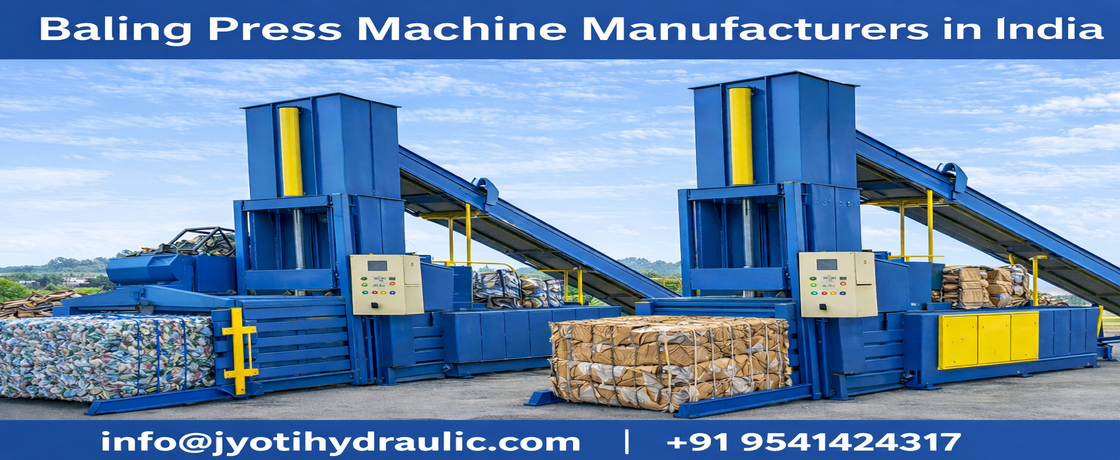
Jyoti Hydraulic is one of the names buyers trust when they start comparing baling press machines in India, because choosing the right machine is not only about getting a lower price—it is about getting the right output, long-term durability, and dependable after-sales support. For scrap dealers, recyclers, warehouses, paper units, plastic processors, and manufacturing plants, a baling press machine helps convert loose waste into compact, high-density bales that are easier to store, transport, and sell.
If you are searching for Baling Press Machine Manufacturers in India or Scrap Baling Machine Manufacturers in India, you are probably asking the same question most serious buyers ask first: What is the actual baling press machine price in India in 2026? The answer depends on the machine type, capacity, automation level, application, and material you want to bale. In India, entry-level hydraulic balers can start from around ₹1.5 lakh to ₹2.5 lakh, while large industrial automatic balers can go from ₹25 lakh to ₹65 lakh or more depending on the specification.
Introduction
Buying a baling press machine is a business decision, not just an equipment purchase. A low-cost machine may look attractive on paper, but if it gives slow cycles, low bale density, high oil heating, or frequent downtime, it becomes expensive in the long run. On the other hand, the right baler can reduce labor effort, cut storage costs, improve scrap value, and make your operation far more efficient.
That is why this guide goes beyond basic price talk. It explains what affects pricing, which industries use baling machines, how machine specifications change the quote, and how to choose the right model based on your application.
Industry Overview in India
India’s recycling and waste-handling ecosystem is growing steadily, and that is creating strong demand for baling equipment across multiple sectors. Waste handling is no longer seen as only a housekeeping activity. Today, it is linked to cost recovery, sustainability goals, compliance, and overall operational efficiency.
The India waste management market is projected to continue expanding through the coming years, and the broader recycling equipment segment is also expected to grow as more companies invest in organized waste processing, plastic recovery, metal scrap handling, and industrial recycling systems. That creates a clear opportunity for reliable Baling Press Machine Manufacturers in India to serve a fast-evolving market.
For businesses in paper recycling, corrugated packaging, PET bottle collection, garment waste, textile processing, aluminum scrap, and metal recovery, baling machines are becoming essential rather than optional.
Baling Press Machine Price in India
Now let us come to the most important part: price.
1. Vertical Baling Press Machine Price
Vertical balers are usually the first choice for small and medium businesses. These machines are suitable for paper, cardboard, plastic film, PET bottles, cloth waste, and similar dry recyclable materials.
Approximate price range in India:
- Small vertical baler: ₹1.5 lakh to ₹2.5 lakh
- Medium vertical baler: ₹2.5 lakh to ₹4.5 lakh
- Heavy-duty vertical baler: ₹4.5 lakh onwards
These machines are ideal for businesses that want a compact footprint, lower initial investment, and simple operation. They are commonly used in warehouses, retail distribution centers, carton recycling units, and smaller scrap handling operations.
2. Semi-Automatic Baling Press Machine Price
Semi-automatic balers are preferred by businesses that have moved beyond basic waste handling and now need better production speed and more consistent bale quality.
Approximate price range in India:
- Entry-level semi-automatic baler: ₹6 lakh to ₹10 lakh
- Mid-range semi-automatic baler: ₹10 lakh to ₹18 lakh
- Higher capacity semi-automatic baler: ₹18 lakh to ₹28 lakh
This category is often selected by paper mills, recycling centers, plastic waste handlers, and industrial scrap units that need a stronger balance between cost and productivity.
3. Fully Automatic Horizontal Baler Price
Fully automatic horizontal balers are designed for large-scale and continuous operations. These are best suited for plants that process high volumes daily and want faster throughput, lower manpower dependency, and consistent bale size.
Approximate price range in India:
- Standard automatic horizontal baler: ₹25 lakh to ₹40 lakh
- High-capacity fully automatic baler: ₹40 lakh to ₹65 lakh+
If your business runs a high-volume recycling line, paper recovery system, or industrial waste segregation plant, this segment usually offers the highest long-term value even though the upfront investment is higher.
4. Scrap Baling Machine Price in India
When it comes to metal scrap, MS scrap, aluminum scrap, turning scrap, or mixed industrial scrap, pricing depends heavily on machine force, chamber size, and compression type.
Approximate price range in India:
- Small scrap baler: ₹4 lakh to ₹8 lakh
- Medium-duty scrap baler: ₹8 lakh to ₹15 lakh
- Heavy-duty scrap baler: ₹15 lakh to ₹30 lakh or more
This is why buyers often compare multiple Scrap Baling Machine Manufacturers in India before finalizing a machine. Metal scrap requires stronger construction, more hydraulic force, and better wear resistance than paper or plastic waste applications.
What Affects the Price of a Baling Press Machine?
The price of a baling press machine in India is influenced by several technical and commercial factors.
Machine Type
A vertical baler is usually more affordable than a horizontal baler. Automatic machines are costlier than semi-automatic and manual systems.
Capacity and Tonnage
A 20-ton or 30-ton machine will naturally cost less than a 60-ton, 100-ton, or 120-ton machine. Higher tonnage means higher compression force and denser bales.
Material Type
Paper and plastic balers are generally more economical than metal scrap balers. Scrap baling machines need stronger bodies, higher hydraulic pressure, and more rugged chambers.
Bale Size and Output
Larger bale size, higher density, and faster cycle time increase the machine cost.
Build Quality
Cylinder quality, hydraulic power pack, valves, seals, motor brand, control panel, and machine body thickness all have a major effect on both price and performance.
Automation Level
PLC controls, auto-eject systems, conveyor feeding, and auto-tying features can significantly increase price but also improve productivity.
Technical Insights You Should Know
A hydraulic baling press machine works by compressing loose material inside a chamber using hydraulic force. Once the material is compacted, it is tied into a bale and ejected for storage or transport.
Main Components
- Hydraulic cylinder
- Power pack
- Electric motor
- Control panel
- Pressing chamber
- Bale ejector
- Tying arrangement
- Oil tank and piping system
Technical Factors That Change Pricing
- Hydraulic pressure
- Chamber dimensions
- Motor HP
- Cycle time
- Bale weight
- Number of compression actions
- Oil cooling system
- Safety interlocks
- Automation controls
A buyer who only compares machine price without checking these technical details can easily end up with a machine that does not suit the actual application.
Applications of Baling Press Machines
Baling press machines are used in a wide range of industries in India.
Major Industries Using Balers
- Paper and packaging industry
- Plastic recycling units
- PET bottle processing centers
- Textile and garment industries
- Metal scrap yards
- Warehouses and logistics hubs
- Municipal solid waste handling centers
- Manufacturing plants
- Retail distribution facilities
Real Use Cases
A warehouse may use a baler to compress cardboard cartons and improve storage space. A textile unit may bale cloth cutting waste for easier disposal or resale. A scrap dealer may use a hydraulic scrap baler to compact loose metal into dense blocks that are easier to load and transport.
Benefits of Installing a Baling Press Machine
Better Scrap Value
Compact bales are easier to handle and usually fetch better resale value than loose scrap.
Lower Storage Cost
A baler dramatically reduces the volume of waste material, helping you save valuable floor space.
Easier Transportation
Dense, uniform bales are much easier to load, stack, and dispatch.
Improved Workplace Cleanliness
Loose waste makes a facility look unorganized. A baler improves housekeeping and operational discipline.
Lower Labor Dependency
Semi-automatic and automatic machines reduce manual handling and improve daily productivity.
Stronger Sustainability Image
Businesses that manage waste efficiently are better positioned in terms of compliance, brand value, and environmental responsibility.
Buying Guide: How to Choose the Right Baling Press Machine
If you want to invest smartly, ask these questions before buying:
- What material do you want to bale?
- How much waste do you generate per day?
- Do you need a vertical or horizontal machine?
- What bale weight do you want?
- Is your operation low-volume, medium-volume, or high-volume?
- Do you need manual, semi-automatic, or fully automatic operation?
- What is your budget for machine plus installation?
Smart Buying Tips
Choose a vertical baler if your volume is moderate and space is limited.
Choose a semi-automatic baler if your output is growing and you need faster cycle times.
Choose a fully automatic horizontal baler if you run a large recycling or scrap processing operation.
Mistakes to Avoid
- Buying the cheapest machine without comparing specifications
- Ignoring future production expansion
- Choosing the wrong tonnage
- Not checking service support
- Overlooking spare parts availability
- Failing to ask about power consumption and maintenance needs
Among the top Baling Press Machine Manufacturers in India, the real difference often comes from machine reliability, engineering quality, and after-sales support—not just the quotation amount.
Future Trends in 2026 and Beyond
The future of baling press machines in India is moving toward automation, smart controls, and higher operating efficiency. More buyers now prefer machines with:
- PLC-based control panels
- Better hydraulic efficiency
- Faster cycle time
- Lower maintenance requirement
- Safer operation
- Custom design for specific materials
As recycling infrastructure continues to improve in India, demand for advanced baling systems is expected to rise further. That means buyers should think long term and invest in a machine that supports both current needs and future growth.
Conclusion
The baling press machine price in India is not fixed by one simple number. It depends on machine type, capacity, automation, application, and build quality. A small business may get started with a compact hydraulic baler at a modest investment, while a large recycling facility may require a fully automatic high-capacity machine for long-term operational efficiency.
The best decision is always to choose a machine that matches your material, daily volume, space, and growth plan. That is the smartest way to get both performance and return on investment.
If you are comparing Scrap Baling Machine Manufacturers in India or planning to buy from trusted Baling Press Machine Manufacturers in India, focus on engineering strength, bale quality, after-sales support, and real suitability for your operation.
FAQs
1. What is the starting price of a baling press machine in India?
The starting price usually begins from around ₹1.5 lakh to ₹2.5 lakh for smaller hydraulic balers, depending on size and application.
2. What is the price of a scrap baling machine in India?
Scrap baling machine prices generally start from around ₹4 lakh and can go above ₹25 lakh, depending on tonnage, automation, and material type.
3. Which baler is better for paper and cardboard waste?
A vertical or semi-automatic baler is usually a good choice for paper and cardboard waste, depending on daily volume.
4. Is a fully automatic baling press worth the cost?
Yes, for high-volume operations, a fully automatic baler can reduce labor cost, improve output, and deliver more consistent bale quality.
5. What factors increase the price of a baling machine?
Machine type, tonnage, automation level, hydraulic quality, bale size, material type, and customization all affect the final price.
6. How do I choose the right baling press machine manufacturer in India?
Look for product quality, experience, customization ability, service support, spare parts availability, and transparent guidance based on your application.
7. Why do prices vary so much between different machines?
Because balers are built for different materials, capacities, and operating conditions. A machine for cardboard waste is very different from a heavy-duty metal scrap baler.
Contact Jyoti Hydraulic for the Right Solution
If you are planning to buy a baling press machine and want expert guidance on the right model, right capacity, and right price, Jyoti Hydraulic is ready to help.
Whether you need a machine for paper, plastic, PET bottles, textile waste, cardboard, or metal scrap, our team can help you choose the most suitable solution for your business.
Contact us today for expert guidance, a customized quotation, and a machine recommendation based on your exact requirement.
📧 info@jyotihydraulic.com
📞 +91 9541424317


