
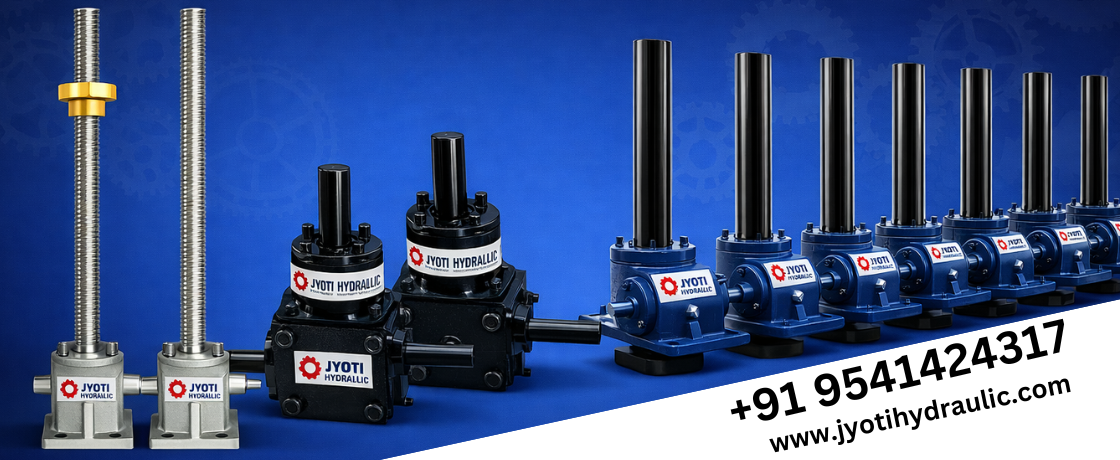
Jyoti Hydraulic brings decades of practical lifting and motion-control insight to one of the most reliable mechanical systems used in modern industry: the Worm Gear Screw Jack. From lifting heavy machine beds to adjusting conveyor heights and synchronizing industrial platforms, this compact device converts rotary input into precise linear motion with impressive load-handling capability. For buyers evaluating equipment suppliers, system designers comparing lifting mechanisms, and businesses searching for dependable Worm Gear Screw Jack Manufacturers or experienced Worm Gear Screw Jack Manufacturers in India, understanding how this mechanism works is essential before making an investment.
Introduction
A worm gear screw jack is a mechanical lifting device designed to raise, lower, position, push, pull, or support loads with accuracy. It is widely used where controlled movement, high load capacity, and dependable positioning matter more than speed. In many industries, the screw jack is preferred because it is robust, compact, and easy to integrate into manual, motorized, or automated systems.
When engineers, OEMs, and plant managers look for a reliable Screw Jack Manufacturer in India, they usually want more than just a product. They need application guidance, load calculations, mounting support, and long-term performance. That is why the best systems are chosen not only by capacity, but also by gear design, screw type, duty cycle, safety factor, and operating environment.
This guide explains exactly how a worm gear screw jack works, what its core components are, where it is used, how to select the right model, and what future innovations are shaping this proven industrial technology.
What is a Worm Gear Screw Jack?
A Worm Gear Screw Jack is a mechanical actuator that uses a worm shaft and worm wheel gear arrangement to convert rotary input into linear movement of a lifting screw or translating screw. In simple terms, when the input shaft rotates, the worm gear system turns the screw slowly but powerfully, allowing heavy loads to be lifted or positioned with precision.
The basic principle is straightforward:
- Rotary motion enters through a handwheel, motor, or gearbox
- A worm shaft drives a worm wheel inside the housing
- The worm wheel rotates the lifting screw or nut
- The screw moves upward or downward depending on the design
Because the worm gear creates a large reduction ratio, the system multiplies torque and produces high lifting force. This makes screw jacks ideal for industrial applications where controlled movement is critical.
How Does a Worm Gear Screw Jack Work?
Step-by-Step Explanation with Examples
Understanding the working cycle of a worm gear screw jack becomes easier when broken into stages.
1. Input Power is Applied
The process begins when rotary input is applied to the jack. This can come from:
- A manual handwheel
- An electric motor
- A geared motor
- A line shaft connecting multiple jacks
For example, in a packaging plant, an operator may use a motorized drive to raise a conveyor frame to align with a filling machine.
2. The Worm Shaft Rotates
The input shaft is connected to a hardened worm shaft. This worm resembles a threaded screw and meshes with a worm wheel inside the gearbox housing. As the worm rotates, it drives the worm wheel at a reduced speed.
This reduction is crucial. It allows the system to trade speed for force, which is why screw jacks can lift very heavy loads with controlled motion.
3. The Worm Wheel Transfers Motion
The worm wheel is mounted around or connected to the lifting screw mechanism. Once rotated by the worm shaft, it causes the lifting screw to either rotate or travel linearly, depending on the design.
There are two common designs:
Rotating Screw Type
The screw rotates and the load moves through an attached nut or guided structure.
Translating Screw Type
The screw itself moves up and down while the housing remains stationary.
Example: In a dam gate lifting system, a translating screw jack may be used so the screw rises vertically and directly lifts the sluice gate.
4. Linear Motion Lifts or Positions the Load
As the screw rotates against the internal thread or nut, linear movement occurs. This movement can lift, lower, push, tilt, align, or hold a load in place.
Consider a steel fabrication machine table that must be leveled on four corners. Four worm gear screw jacks connected by shafts can lift all corners evenly when one motor turns the system. This ensures smooth parallel movement and accurate positioning.
5. Load is Held Securely
One of the major reasons industries use worm gear screw jacks is load holding. In many configurations, the worm gear arrangement offers self-locking characteristics, especially at lower efficiencies and under appropriate conditions. This means the load does not back-drive easily when power is removed.
That makes the system useful for applications like:
- Maintenance platforms
- Height-adjustable workstations
- Industrial gates
- Press adjustment systems
However, self-locking should never replace a full safety review. Factors like vibration, wear, lubrication, screw lead, and external forces must always be considered.
Key Components and Technical Working Principle
A high-quality worm gear screw jack depends on precision-engineered components working together.
Housing
The outer body protects internal parts and absorbs load-related stresses. It is typically made of cast iron, ductile iron, or fabricated steel depending on duty requirements.
Worm Shaft
This is the driving element. It is usually hardened and machined for durability, precise meshing, and long service life.
Worm Wheel
The worm wheel mates with the worm shaft and provides gear reduction. It is often made from bronze or a compatible wear-resistant material.
Lifting Screw
This screw converts rotational motion into linear travel. It may be trapezoidal or ball screw based on application requirements.
Thrust Bearings
Bearings support axial loads and reduce friction where needed.
Protective Boot or Bellows
These help protect the screw from dust, moisture, metal chips, and contaminants.
Lubrication System
Proper lubrication is essential for gear efficiency, heat control, and wear reduction.
Technical Working Principle
The worm and worm wheel create a high-ratio gear pair. Because the worm shaft typically has fewer starts than the worm wheel has teeth, each input revolution results in a small output movement. That small output movement translates into strong linear force at the screw.
This is why screw jacks are not designed for high speed. Their strength lies in controlled movement, precise positioning, and load-bearing performance.
Industry Overview & Market Demand
The market for mechanical lifting systems continues to grow as manufacturing, infrastructure, warehousing, process plants, and automation systems demand more precise and dependable motion solutions. Industries increasingly want equipment that is durable, easy to maintain, and compatible with motorized control.
This has increased demand for reliable Worm Gear Screw Jack Manufacturers who can provide:
- Standard and customized load capacities
- Corrosion-resistant options
- Multiple mounting configurations
- Synchronized multi-jack systems
- Integration with PLC and motor drives
India has emerged as a strong manufacturing hub for industrial power transmission and lifting solutions. Businesses searching for Worm Gear Screw Jack Manufacturers in India often value the combination of engineering capability, competitive pricing, custom fabrication, and after-sales technical support. Choosing an experienced Screw Jack Manufacturer in India can significantly improve project reliability and lifecycle value.
Applications Across Industries
Worm gear screw jacks are used in a wide range of sectors because they are versatile and adaptable.
Material Handling
Used to raise platforms, align conveyors, and adjust transfer heights.
Steel and Heavy Engineering
Used in roll gap adjustment, machine support, and furnace door lifting systems.
Water Treatment and Infrastructure
Common in sluice gate lifting, valve operation, and flow-control systems.
Packaging and Food Processing
Useful for hygienic height adjustment of filling lines, feeders, and inspection units.
Solar and Renewable Energy
Used in tracker adjustment mechanisms and maintenance positioning systems.
Automotive and Assembly Lines
Used for fixture positioning, lifting jigs, and ergonomic workstations.
Theater, Stage, and Special Purpose Equipment
Used where stable, synchronized vertical movement is required.
Real-World Example
A pharmaceutical packaging line may require periodic height changes when switching bottle sizes. A motorized worm gear screw jack system can raise the entire guide rail and conveyor section smoothly, reducing setup time and improving accuracy.
Advantages / Benefits of Using Worm Gear Screw Jacks
There are many reasons industries continue to use this mechanism.
- High load-carrying capacity in a compact footprint
- Precise linear positioning
- Excellent reliability in demanding environments
- Easy manual or motorized operation
- Suitable for single and multiple jack systems
- Strong mechanical advantage through gear reduction
- Low maintenance when properly selected and lubricated
- Potential self-locking behavior in many applications
- Easy integration into custom machinery
For engineers comparing actuation methods, a worm gear screw jack often offers a practical balance between performance, simplicity, and cost.
Selection Guide / Buying Tips
Choosing the right screw jack requires more than checking load capacity alone.
Define the Load Clearly
Consider static load, dynamic load, shock load, and safety factor.
Identify Travel Requirement
How far does the load need to move? Stroke length affects screw selection and stability.
Check Duty Cycle
Frequent operation generates more heat and wear. Continuous-duty applications need careful sizing.
Decide the Speed Requirement
Screw jacks are designed for controlled movement, not rapid travel. Match speed expectations with gear ratio and motor selection.
Review Mounting Orientation
Vertical, horizontal, inverted, and wall-mounted configurations may all affect performance.
Evaluate Environmental Conditions
Dust, chemicals, outdoor exposure, washdown requirements, and temperature all matter.
Choose the Right Screw Type
Trapezoidal screws are robust and economical. Ball screws offer higher efficiency and speed but may require braking.
Consider Synchronization Needs
For large platforms, multiple jacks may need to operate together through shafts, couplings, bevel gearboxes, or electronic controls.
When working with experienced Worm Gear Screw Jack Manufacturers in India, buyers should ask for load calculations, dimensional drawings, material specifications, and application recommendations before finalizing the order.
Maintenance Tips
Proper maintenance extends service life and improves safety.
Lubricate Regularly
Use the recommended grease or oil grade for gears and screws.
Inspect for Wear
Check screw threads, bearings, seals, and gear teeth for signs of damage.
Protect Against Contamination
Use boots, covers, and seals in dusty or wet conditions.
Monitor Alignment
Misalignment in multi-jack systems can increase load imbalance and premature wear.
Avoid Overloading
Exceeding rated load reduces efficiency and may damage components.
Check Fasteners and Mounting
Loose foundations or brackets can affect lifting accuracy and safety.
Preventive maintenance is especially important in mission-critical systems such as gates, lifting platforms, and production machinery.
Future Trends & Innovations in Screw Jack Technology
The screw jack industry is evolving with modern manufacturing and automation demands.
Smarter Automation Integration
More screw jacks are being paired with servo motors, sensors, encoders, and PLC-based position control.
Better Materials and Surface Treatments
Advanced coatings, alloy steels, and corrosion-resistant finishes are improving life in harsh environments.
Compact High-Performance Designs
Manufacturers are developing more compact housings with improved torque density.
Condition Monitoring
Predictive maintenance systems can track load cycles, temperature, vibration, and lubrication intervals.
Custom Engineered Solutions
Modern buyers increasingly need application-specific designs rather than off-the-shelf products.
As industries adopt smarter machinery, the role of knowledgeable Screw Jack Manufacturer in India partners becomes even more important. Design support, application matching, and long-term service now influence buying decisions as much as price.
Conclusion
A Worm Gear Screw Jack works by converting rotary input into controlled linear motion through a worm shaft, worm wheel, and lifting screw arrangement. Its core strength lies in torque multiplication, precise movement, dependable load handling, and integration flexibility across countless industries. Whether used for lifting machine platforms, adjusting conveyors, operating gates, or synchronizing industrial structures, this mechanism remains one of the most trusted solutions in mechanical motion control.
For companies evaluating Worm Gear Screw Jack Manufacturers, the right choice depends on more than catalog capacity. Engineering support, material quality, customization capability, and after-sales reliability all matter. Businesses seeking trusted Worm Gear Screw Jack Manufacturers in India or a dependable Screw Jack Manufacturer in India should prioritize technical expertise and application-focused guidance to achieve long-term performance.
FAQ Section
1. What is the main purpose of a worm gear screw jack?
Its main purpose is to lift, lower, position, push, or support loads by converting rotary motion into linear motion with high force and control.
2. Is a worm gear screw jack self-locking?
Many worm gear screw jacks offer self-locking behavior under suitable conditions, but this depends on efficiency, screw lead, lubrication, wear, vibration, and load conditions. A proper safety assessment is always required.
3. What is the difference between a worm gear screw jack and a hydraulic jack?
A worm gear screw jack is a mechanical actuator that provides precise positioning and load holding through gears and screws, while a hydraulic jack uses fluid pressure and is often better suited for very high-force, shorter-stroke lifting tasks.
4. Where are worm gear screw jacks commonly used?
They are commonly used in material handling, steel plants, water treatment systems, packaging lines, renewable energy systems, machine building, and industrial automation.
5. How do I choose the right screw jack capacity?
You should evaluate load, stroke length, duty cycle, operating speed, mounting orientation, environmental conditions, and required safety factor. Consulting a qualified manufacturer is strongly recommended.
6. Why are worm gear screw jacks preferred in synchronized lifting systems?
Because multiple jacks can be connected mechanically or electrically to lift large platforms evenly, making them ideal for applications where accurate parallel motion is essential.
7. How often should a screw jack be maintained?
Maintenance frequency depends on duty cycle, environment, load, and operating conditions. Regular inspection and lubrication should be part of a preventive maintenance program.
Contact Us for Expert Support
Looking for a reliable partner for industrial lifting and positioning solutions? Connect with Jyoti Hydraulic for product inquiries, custom requirements, technical guidance, and application-specific recommendations. Whether you want to compare models, speak with an expert, or request a competitive quotation, our team is ready to help.
Contact us today for inquiries, quotations, and expert consultation.
📧 info@jyotihydraulic.com
📞 +91 9541424317


