
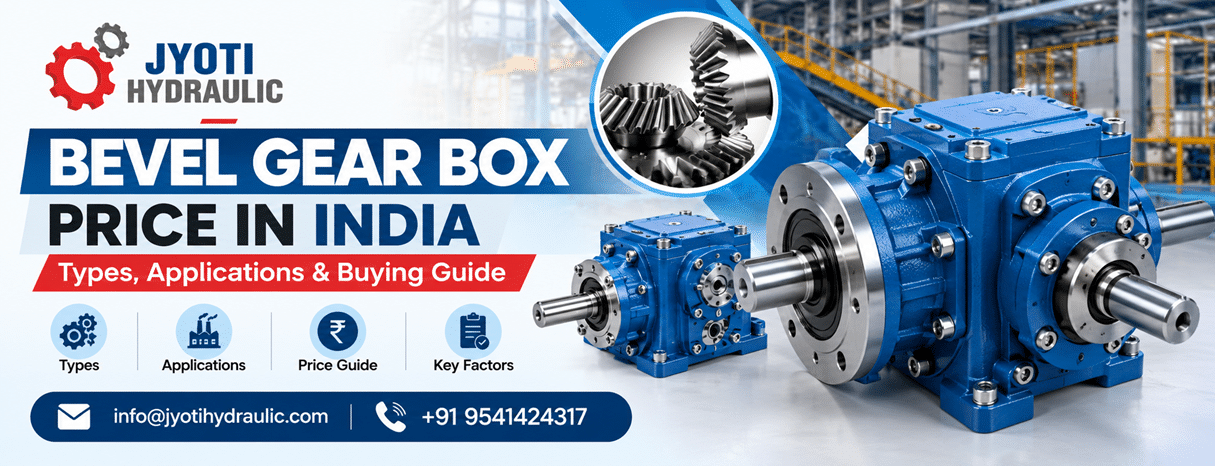
Jyoti Hydraulic provides engineered power-transmission solutions for industries where reliable torque transfer, accurate motion control, and long service life are essential. A bevel gear box is widely used when rotational power must be transmitted between intersecting shafts, most commonly at a 90-degree angle. However, selecting the right gearbox involves much more than comparing its purchase price. Gear geometry, torque capacity, reduction ratio, material quality, bearing arrangement, lubrication, duty cycle, and installation conditions all influence performance and total operating cost.
For buyers comparing Bevel Gear Box Manufacturers in India, understanding these technical factors can prevent premature gear wear, overheating, excessive backlash, and unexpected production downtime.
Industry Overview of Bevel Gear Boxes in India
India’s manufacturing, material-handling, automation, process equipment, agriculture, and infrastructure sectors use bevel gearboxes extensively. Their compact right-angle transmission arrangement makes them especially useful where motors and driven equipment cannot be installed on the same shaft line.
Demand is also increasing for application-specific gearboxes rather than standard off-the-shelf units. Industries increasingly require customized shaft configurations, higher torque density, better sealing, improved efficiency, and gearboxes capable of operating continuously under demanding plant conditions.
As a result, experienced Bevel Gear Box Manufacturers in India focus not only on gearbox dimensions but also on load characteristics, operating speed, service factor, environmental conditions, and expected equipment life.
What Determines Bevel Gear Box Price in India?
There is no single fixed price for a bevel gearbox because engineering requirements differ significantly between applications. A small gearbox used in light machinery will have a completely different cost structure from a heavy-duty unit designed for conveyors, mixers, industrial drives, or continuous processing equipment.
Major price factors include:
- Gearbox size and required output torque
- Input and output RPM
- Gear reduction ratio
- Straight, spiral, or other bevel gear configuration
- Gear and shaft material
- Heat treatment and tooth finishing
- Housing construction
- Bearing quality and arrangement
- Lubrication and sealing system
- Shaft orientation and mounting arrangement
- Required service factor
- Standard versus customized design
A lower initial quotation does not necessarily mean lower ownership cost. Insufficient torque capacity or poor-quality gearing can result in tooth damage, bearing failure, vibration, leakage, and expensive machine stoppages.
Types of Bevel Gear Boxes
Straight Bevel Gear Box
Straight bevel gears use straight teeth extending toward the gear apex. They are relatively simple and economical and can perform efficiently in moderate-speed applications.
They are commonly selected for machines where operating speed, noise level, and shock loading remain within controlled limits.
Spiral Bevel Gear Box
Spiral bevel gears have curved teeth that engage progressively. This produces smoother transmission, better load distribution, reduced vibration, and improved performance at higher speeds.
Spiral bevel gearboxes are often preferred for demanding industrial equipment requiring continuous operation and higher torque transmission.
Right-Angle Bevel Gear Box
A right-angle bevel gearbox changes the direction of power transmission, generally by 90 degrees. This arrangement helps machine designers achieve compact layouts while maintaining efficient mechanical power transfer.
Customized Bevel Gear Box
Standard units cannot always meet specific shaft, torque, space, or mounting requirements. Customized gearboxes can be engineered with special ratios, shaft extensions, housing configurations, mounting positions, materials, and sealing arrangements.
Technical Factors That Affect Performance
Correct gearbox selection begins with torque rather than motor power alone. Output torque depends on motor power, speed reduction, efficiency, and operating load.
The actual application must also be evaluated for shock loads. A gearbox driving a steady rotary mechanism experiences very different stresses from one operating a loaded conveyor, mixer, crusher auxiliary system, or frequently starting machine.
Other critical considerations include tooth contact pattern, backlash, shaft alignment, bearing preload, lubrication viscosity, operating temperature, and housing rigidity.
Even a properly designed gearbox can experience premature failure if misalignment creates uneven tooth loading. Similarly, incorrect lubrication can increase friction and temperature while accelerating gear and bearing wear.
A reliable manufacturer therefore evaluates the complete operating condition instead of recommending a gearbox purely from dimensional compatibility.
Major Applications
Bevel gearboxes are used across numerous industrial systems, including:
- Conveyor and material-handling equipment
- Packaging machinery
- Textile equipment
- Agricultural machinery
- Food-processing machines
- Industrial mixers and agitators
- Machine tools
- Special-purpose machines
- Automation systems
- Printing and paper machinery
- Process plants
- Lifting and positioning mechanisms
Their ability to redirect mechanical power efficiently makes them particularly valuable where machine space is limited or drive orientation must be changed.
Benefits of Using a Quality Bevel Gear Box
A properly engineered bevel gearbox provides compact power transmission while supporting reliable torque transfer between intersecting shafts.
Its major advantages include efficient right-angle transmission, compact machine design, high torque capability, precise power transfer, multiple shaft configurations, dependable industrial operation, and suitability for customized drive systems.
High-quality gear manufacturing also improves tooth contact and reduces vibration. When combined with correctly selected bearings and lubrication, this contributes to longer gearbox life and lower maintenance requirements.
How to Select the Right Bevel Gear Box
Before requesting a quotation, buyers should provide complete operating information to the manufacturer.
Important parameters include motor power in kW or HP, input RPM, required output RPM, required gear ratio, estimated output torque, number of operating hours per day, frequency of starting and stopping, type of driven equipment, shaft orientation, mounting position, ambient operating conditions, and expected shock load.
The service factor is particularly important. Selecting a gearbox only according to nominal torque can be risky where equipment experiences frequent starts, impact loads, reversing operation, or long working hours.
When evaluating Bevel Gear Box Manufacturers, buyers should also consider manufacturing capability, material selection, quality control, machining accuracy, technical support, customization capability, spare availability, and after-sales assistance rather than comparing price alone.
Maintenance Tips for Longer Gearbox Life
Regular maintenance significantly influences gearbox reliability. Oil level should be checked according to the maintenance schedule, while seals and shaft areas should be inspected for leakage.
Unusual noise, vibration, or increasing operating temperature should never be ignored. These may indicate misalignment, bearing deterioration, lubrication problems, or abnormal gear tooth contact.
Coupling alignment and mounting bolt tightness should also be checked periodically, especially on equipment subjected to vibration or fluctuating loads.
Future Trends in Bevel Gearbox Technology
Industrial gearbox technology is moving toward higher efficiency, increased torque density, improved metallurgy, advanced surface finishing, and application-specific engineering.
Condition monitoring is also becoming increasingly important. Temperature and vibration monitoring can help maintenance teams identify developing mechanical problems before they result in unexpected gearbox failure.
As Indian industries adopt greater automation and higher machine utilization, demand for durable, precisely manufactured gearboxes is expected to continue growing.
Conclusion
The right bevel gearbox should be selected on engineering suitability rather than purchase price alone. Torque, speed, ratio, operating hours, load variation, gear quality, lubrication, and mounting conditions all determine whether a gearbox will provide dependable long-term performance.
Working with technically experienced Bevel Gear Box Manufacturers in India helps businesses obtain a gearbox correctly matched to the actual machine instead of relying on an undersized or unsuitable standard unit.
Frequently Asked Questions
1. What is the price of a bevel gear box in India?
Bevel gearbox prices vary according to size, torque capacity, ratio, material, gear type, manufacturing accuracy, and customization requirements. A technical specification is normally required before an accurate quotation can be prepared.
2. What information is required to select a bevel gearbox?
Motor power, input RPM, required output RPM, gear ratio, torque, operating hours, driven machine type, shaft arrangement, mounting orientation, and working environment are the most important parameters.
3. Which is better: straight bevel or spiral bevel gearing?
Straight bevel gears can be suitable for moderate-speed applications, while spiral bevel gears generally provide smoother engagement, lower noise, and better load distribution for demanding operating conditions.
4. Can bevel gearboxes be customized?
Yes. Shaft dimensions, ratios, mounting arrangements, housing configurations, materials, and other features can be engineered according to machine requirements.
5. Why should service factor be considered while selecting a gearbox?
Service factor provides additional capacity for operating conditions such as shock loading, frequent starts, long running hours, and fluctuating loads. Correct service-factor selection can significantly improve gearbox reliability.
6. How can I get a quotation for a bevel gear box?
Share your motor power, RPM, reduction ratio, torque requirement, shaft arrangement, application details, and operating conditions with Jyoti Hydraulic. The technical team can recommend a suitable configuration based on your application.
Request a Bevel Gear Box Quotation
Looking for a reliable bevel gearbox for a new machine, replacement application, or customized industrial drive?
Contact Jyoti Hydraulic for technical guidance, gearbox selection, customization support, and a competitive quotation. Discuss your application with experienced professionals and get a solution designed around your actual operating requirements.
📞 +91 9541424317
Contact Jyoti Hydraulic today to request a quotation or get expert consultation for your bevel gearbox requirements.


