
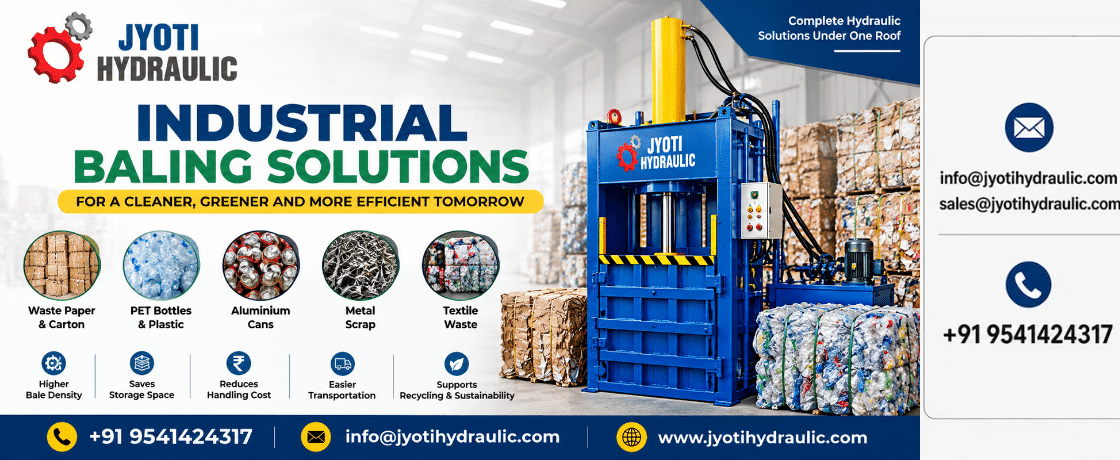
Jyoti Hydraulic understands that purchasing an industrial baling machine is not simply a matter of comparing machine prices. The real decision involves material type, daily scrap volume, compression force, bale density, power consumption, labour requirements, loading method and expected operating hours. In 2026, Indian recycling plants, manufacturing units, warehouses, scrap yards and packaging businesses are increasingly looking for baling equipment that reduces waste-handling costs while delivering reliable long-term performance.
For businesses comparing Baling Machine Manufacturers, understanding what influences the final machine price is therefore more useful than choosing equipment based only on the lowest initial quotation.
Industry Overview: Why Industrial Baling Machines Matter
Industrial facilities generate large quantities of loose recyclable material. Cardboard boxes, waste paper, PET bottles, plastic film, textile waste, aluminium cans and metal scrap occupy considerable floor and transport space when handled without compaction.
A hydraulic baling machine applies controlled compression to these loose materials and converts them into compact, manageable bales. The result is easier material storage, faster loading, improved housekeeping and more efficient transportation to recyclers or processing facilities.
Baling systems are commonly used in:
- Scrap recycling facilities
- Automobile and engineering industries
- Corrugated box and packaging plants
- Warehouses and distribution centres
- Printing and publishing units
- Textile factories
- Plastic recycling plants
- Municipal and commercial waste facilities
- Metal processing units
- Paper recycling operations
Jyoti Hydraulic offers vertical baling press configurations from 5 ton through 50 ton and above, with options based on material type and required bale characteristics. Its published machine features include hydraulic power packs, high-pressure cylinders, safety locking systems, adjustable bale sizes and manual or semi-automatic controls.
Industrial Baling Machine Price in India in 2026
There is no universal price for an industrial baling press because two machines with the same nominal tonnage may have completely different chamber sizes, hydraulic circuits, motor ratings, automation levels and production capacities.
As a practical 2026 market reference, Indian supplier listings show 50-ton hydraulic scrap balers around ₹2.8 lakh, 80-ton configurations around ₹3.85–4.5 lakh and certain 100-ton hydraulic machines around ₹4.85 lakh. Larger or more specialised machines can cost substantially more; current market listings include jumbo machines around ₹7.5 lakh and high-output scrap balers at approximately ₹15 lakh or above.
Industry marketplace data updated in September 2026 also illustrates the broad spread in pricing, with listed double-action, triple-action, PET bottle, paper and other industrial baling systems ranging from a few lakh rupees to considerably higher values depending on configuration.
These figures should be treated only as indicative market references, not as Jyoti Hydraulic quotations. Final pricing depends on the required specification, customization, accessories, taxes, transportation, installation and commercial terms.
What Determines the Price of a Baling Machine?
1. Compression Force
Machine tonnage directly influences the hydraulic cylinder, structural frame and power-pack design.
A light-duty carton baler does not require the same compression force as equipment processing steel, aluminium or mixed industrial scrap. Higher forces usually require stronger cylinders, reinforced chambers and more powerful hydraulic systems.
Selecting excessive tonnage unnecessarily increases capital and operating costs, while selecting too little capacity can result in poor bale density and slow production.
2. Material Being Baled
Material behaviour under compression is one of the most important engineering considerations.
Cardboard and paper are comparatively easy to compress. PET bottles and plastic film can expand after pressure is released. Textile waste behaves differently again, while metal scrap requires heavy-duty structural construction and significantly greater compression force.
Experienced Scrap Baling Machine Manufacturers therefore design the machine around the actual scrap rather than recommending equipment based only on tonnage.
3. Chamber and Bale Dimensions
Large loading chambers allow operators to process greater volumes per charging cycle. However, they also affect machine dimensions, structural loading and hydraulic requirements.
The buyer should determine the desired bale dimensions according to:
- Storage racks or floor space
- Forklift capacity
- Truck or container dimensions
- Recycler requirements
- Maximum acceptable bale weight
A correctly sized bale can improve both material handling and vehicle utilisation.
4. Hydraulic Power Pack
The hydraulic system is effectively the working heart of a baling press.
Important components include the pump, electric motor, hydraulic cylinder, control valves, oil reservoir, filtration system, pressure controls, seals and hoses. Component quality influences cycle time, temperature control, reliability and maintenance requirements.
A machine that costs slightly less initially but continuously suffers from oil leakage, overheating or valve failure can become significantly more expensive over its working life.
5. Automation Level
Manual machines generally involve more operator intervention for loading, tying and bale removal.
Semi-automatic systems can improve productivity, while PLC-controlled or automated installations may incorporate:
- Automated compression cycles
- Conveyor feeding
- Bale ejection
- Interlocked safety gates
- Sensors
- HMI controls
- Cycle counters
- Fault indications
Automation increases capital cost but can be financially justified where daily waste volumes are high.
6. Production Capacity and Duty Cycle
Buyers should never select a baler solely from its maximum pressing force.
Ask how many kilograms or tonnes must actually be processed per hour or per shift.
A machine operating occasionally in a warehouse experiences a very different duty cycle from one working continuously inside a commercial recycling plant. Frame design, hydraulic cooling, reservoir capacity, motor rating and component selection should match the intended workload.
Carton and Corrugated Box Baling Solutions
Cardboard is bulky but relatively lightweight, making storage and transportation inefficient when boxes remain loose.
A suitable carton baler compresses corrugated material into dense rectangular bales that are easier to stack, move and sell to recyclers. Businesses searching for a Carton Baling Machines Manufacturer should consider bale weight, chamber opening, loading convenience and tying arrangement rather than focusing only on pressing tonnage.
Current Indian market listings illustrate how specification influences price: a 30-ton hydraulic scrap press intended for corrugated boxes has been listed at around ₹2.2 lakh, while a 65-ton paper-scrap baling configuration has appeared around ₹2.95 lakh. Actual commercial quotations will vary by design and supplier.
Major Benefits of Industrial Baling Equipment
Reduced Storage Requirement
Loose recyclable waste consumes valuable production and warehouse space. Compaction allows substantially more material to be stored within the same area.
Lower Transportation Cost
Dense, regularly shaped bales use truck and container space more efficiently, helping reduce the number of waste movements required.
Improved Material Handling
Uniform bales are easier to stack, count, weigh and transport using material-handling equipment.
Cleaner Working Environment
Removing loose cardboard, plastic and production scrap from operational areas improves organisation and housekeeping.
Better Recycling Workflow
Segregated and compacted material can be handled more efficiently throughout collection, storage and recycling operations.
Reduced Manual Handling
Correctly selected semi-automatic and automatic systems can reduce repeated manual movement of bulky waste.
Technical Checklist Before Buying a Baling Machine
Before requesting quotations from Baling Machine Manufacturers, prepare accurate operating information.
A serious supplier should understand:
Material: What exactly will be compressed?
Daily quantity: How many kilograms or tonnes are generated per shift?
Bulk density: Is the waste light and bulky or heavy and dense?
Required bale weight: What bale weight can your workers, forklift or downstream recycler handle?
Compression force: What pressure is necessary to achieve the required bale density?
Cycle time: How quickly must each compression cycle be completed?
Electrical supply: Confirm available voltage, phase and connected load.
Loading method: Manual loading, conveyor feeding or mechanical loading?
Operating hours: Intermittent production or continuous multi-shift use?
Available floor space: Include loading, maintenance and bale-removal clearance.
Automation: Manual, semi-automatic or PLC-based control?
Service support: Check installation assistance, spare-part availability and technical support.
Jyoti Hydraulic states that its baling equipment can be customized for bale size, pressure capacity, motor power and automation, with PLC control available as an option on relevant configurations.
How to Compare Two Baling Machine Quotations Correctly
Suppose Supplier A quotes ₹3.8 lakh and Supplier B quotes ₹4.3 lakh. The ₹3.8 lakh machine is not automatically the more economical purchase.
Compare:
- Actual pressing force
- Cylinder bore and stroke
- Bale chamber dimensions
- Structural construction
- Motor and pump specification
- Bale weight
- Cycle time
- Electrical consumption
- Control system
- Safety provisions
- Hydraulic component quality
- Warranty conditions
- Installation support
- Spare availability
- Expected maintenance requirements
The correct purchasing question is not simply, “What is the machine price?”
It is:
“What will it cost us to produce each tonne of properly compacted material over the machine’s working life?”
That approach leads to a much more reliable industrial investment decision.
Selecting the Right Machine for Your Application
For cardboard and paper, vertical balers often provide an efficient solution where floor space is limited and waste volume is moderate.
For PET bottles and plastics, consider chamber size, material rebound and bale tying requirements.
For high-volume recycling operations, horizontal or more automated systems can improve throughput and reduce manual handling.
For metal scrap, robust structural construction, higher compression force and heavy-duty hydraulic components become particularly important.
For mixed industrial waste, discuss the material composition carefully with the manufacturer because one machine configuration may not perform equally well with every waste stream.
Future Trends in Industrial Baling Technology
Industrial baling technology is gradually moving toward smarter, more energy-conscious systems.
PLC and HMI-Based Operation
More plants are adopting programmable controls to achieve repeatable compression cycles, easier fault diagnosis and improved operator control.
Sensor-Based Safety
Door interlocks, position sensors and pressure monitoring can help create safer, more controlled operating sequences.
Energy-Efficient Hydraulics
Manufacturers are increasingly focusing on improving hydraulic circuit efficiency to reduce unnecessary power consumption and oil heating.
Integrated Material Handling
For large recycling facilities, balers can increasingly be combined with conveyors, sorting equipment and automated feeding arrangements.
Maintenance-Focused Design
Easy access to filters, valves, cylinders and wear components can reduce maintenance time and help improve equipment availability.
For industrial buyers, these developments mean future purchasing decisions are likely to focus increasingly on total operating cost and productivity, rather than only on machine tonnage.
Why Work With an Experienced Baling Machine Manufacturer?
Baling equipment handles substantial hydraulic forces. Manufacturing quality therefore matters at every level—from the welded structure and cylinder alignment to hydraulic plumbing, controls and safety mechanisms.
An experienced manufacturer can evaluate the material, recommend suitable compression force, determine practical bale dimensions and configure the hydraulic system around the intended production load.
Jyoti Hydraulic manufactures baling solutions for applications including waste paper, corrugated cartons, plastic scrap, PET bottles, textile waste, aluminium cans and other industrial recyclable materials. The company also lists installation assistance, technical support, spare-parts availability and maintenance guidance among its support services.
Frequently Asked Questions
1. What is the price of a hydraulic baling machine in India in 2026?
There is no fixed industry-wide price. Current Indian market listings show many medium-capacity configurations in roughly the ₹2–5 lakh region, while larger, higher-output and more automated scrap baling systems may cost ₹8 lakh, ₹15 lakh or considerably more. Specification, material, tonnage, chamber size and automation should always be considered before comparing quotations.
2. Which capacity baling machine should I buy?
Capacity should be selected according to the type of scrap, volume generated per day, required bale density, desired bale weight and operating hours. Buying solely by tonnage is not recommended.
3. Can one baling machine handle different materials?
Some machines can handle several compatible materials, but the ideal hydraulic force, chamber configuration and tying system can vary considerably. Always inform the manufacturer about every material you intend to process.
4. Is a vertical baler suitable for cartons?
Yes. Vertical balers are widely used for cardboard, corrugated boxes and waste paper, particularly where space is limited and material volumes are moderate.
5. What maintenance does a hydraulic baling machine require?
Routine maintenance generally includes checking hydraulic oil, filters, seals, hoses, fittings, cylinder condition, electrical connections and safety systems. Maintenance intervals should follow the manufacturer’s machine-specific recommendations.
6. Is a higher-tonnage baler always better?
No. Excess capacity can increase purchase price and power requirements without delivering meaningful benefits. The machine should be matched to the actual material and production target.
7. Should I choose a manual or automatic baling system?
Manual and semi-automatic machines are often practical for moderate volumes. Higher-throughput plants may benefit from automated feeding, PLC controls and automatic bale handling because labour savings and productivity gains can justify the additional investment.
Conclusion
Selecting an industrial baling solution in 2026 requires more than finding the lowest quoted price. Compression force, bale dimensions, material characteristics, cycle time, hydraulic design, automation, energy consumption and after-sales support all influence the real return on investment.
A correctly engineered baling machine can reduce the space occupied by loose waste, improve transportation efficiency, simplify material handling and create a more organised recycling process. For businesses comparing Baling Machine Manufacturers, Scrap Baling Machine Manufacturers or a dependable Carton Baling Machines Manufacturer, the best starting point is a detailed evaluation of the actual waste stream and required production capacity.
Request a Baling Machine Quotation from Jyoti Hydraulic
Need help selecting the right baling machine for cardboard, paper, plastic, PET bottles, textile waste or industrial scrap?
Contact Jyoti Hydraulic for a machine recommendation based on your material, daily capacity, bale-size requirement and operating conditions. Request a quotation or speak with an expert before finalising your investment.
📞 +91 9541424317
Contact Jyoti Hydraulic today to request a quotation and get expert consultation for an industrial baling solution designed around your application.


