
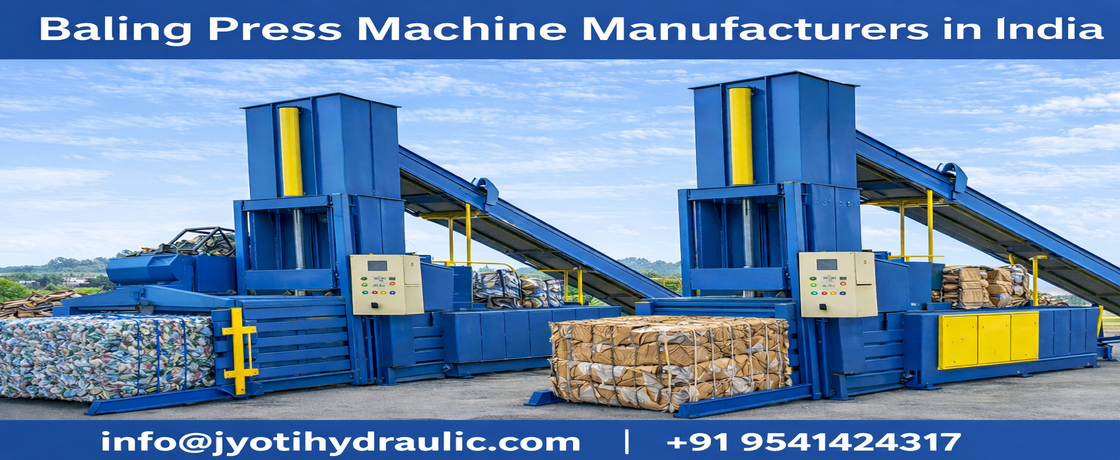
Jyoti Hydraulic delivers advanced hydraulic baling press machine solutions for industries that need reliable, high-force scrap compaction, better material handling, and cost-effective recycling operations. In today’s industrial environment, waste is no longer treated as a burden only; it is also a recoverable resource. Whether it is iron scrap from fabrication units, aluminum waste from manufacturing plants, plastic waste from packaging lines, or paper waste from warehouses, every recyclable material requires systematic handling before it can enter the recycling chain efficiently.
A Hydraulic Baling Press Machine is an industrial compression system used to convert loose scrap and waste material into dense, compact, and easy-to-handle bales. The machine uses hydraulic force to press bulky materials into a fixed bale size, reducing volume and improving storage, transportation, and resale value. For businesses dealing with high volumes of scrap, this machine becomes an important part of daily operations.
India is witnessing strong growth in recycling, metal processing, automobile dismantling, packaging, logistics, and manufacturing sectors. As a result, the demand for dependable Baling Press Machine Manufacturers, experienced Iron Scrap Baling Machine Manufacturers in India, and technically capable Scrap Baling Machine Manufacturers in India is increasing rapidly. Industrial buyers today are not only looking for low-cost machines; they want durable construction, high bale density, energy efficiency, automation, safety, and dependable after-sales support.
This complete guide explains hydraulic baling press machine technology, applications, benefits, pricing factors, buying tips, and future trends to help business owners make the right investment decision.
What Is a Hydraulic Baling Press Machine?
A Hydraulic Baling Press Machine is a heavy-duty industrial machine designed to compress scrap materials into compact bales using hydraulic pressure. Instead of storing loose scrap in large piles, businesses can compress the material into uniform blocks that are easier to stack, load, transport, and recycle.
The machine is commonly used for:
- Iron scrap
- Steel scrap
- Aluminum scrap
- Copper waste
- Paper waste
- Cardboard waste
- Plastic scrap
- Textile waste
- Tin and metal sheet waste
- Industrial process waste
Loose scrap occupies a large area and is difficult to handle manually. Once compressed into bales, the same material becomes easier to weigh, store, transport, and sell to recycling units. This is why hydraulic balers are widely used in scrap yards, recycling plants, manufacturing units, automobile industries, warehouses, and metal processing factories.
Growing Demand for Scrap Management and Recycling Solutions in India
India’s industrial growth has created a continuous flow of recyclable waste. Manufacturing plants, fabrication workshops, construction sites, vehicle dismantling yards, logistics hubs, packaging companies, and municipal recycling facilities generate large quantities of scrap every day.
Without proper compaction equipment, this waste leads to:
- Poor space utilization
- Higher labor dependency
- Increased transportation cost
- Safety hazards
- Material loss
- Inefficient recycling operations
Hydraulic baling machines solve these problems by converting loose material into dense bales. This allows industries to handle scrap more professionally and profitably.
The recycling industry in India is also becoming more organized. Businesses now understand that compacted scrap has better handling value than loose material. Metal recyclers prefer dense bales because they can be loaded easily into trucks, containers, furnaces, and processing units. This has increased demand for reliable Scrap Baling Machine Manufacturers in India who can supply machines suitable for Indian working conditions.
Industry Overview: Hydraulic Baling Machines in India
Current Market Demand
The demand for hydraulic baling machines in India is rising due to several industrial and commercial factors. Manufacturing companies are producing more scrap. Recycling companies are expanding capacity. Warehouses are trying to reduce packaging waste volume. Automobile scrap yards are upgrading from manual handling to mechanical compaction. Metal industries are focusing on organized scrap recovery.
Hydraulic balers are now used not only by large recycling plants but also by medium and small-scale businesses. Companies that earlier depended on manual scrap collection are now investing in compact baling systems to save space and improve profitability.
Role of Recycling Industries in Manufacturing and Waste Management
Recycling industries form an important bridge between waste generation and raw material recovery. In metal recycling, scrap is collected, sorted, compacted, transported, melted, and reused. In paper and plastic recycling, waste is compressed into bales before being sent for reprocessing.
Hydraulic baling press machines help recycling units maintain a continuous workflow. They reduce the volume of waste, improve loading efficiency, and make material movement more systematic. In many industries, baling is the first step toward organized recycling.
Importance of Choosing Reliable Manufacturers
The quality of a hydraulic baling press machine depends heavily on the manufacturer’s engineering capability. A poorly designed machine may face hydraulic leakage, frame bending, slow cycle time, frequent breakdowns, high power consumption, or poor bale density.
Reliable Baling Press Machine Manufacturers focus on:
- Strong fabricated structure
- Correct hydraulic cylinder sizing
- Efficient power pack design
- Proper pressure control
- Operator safety
- Long machine life
- Service-friendly construction
- Customization according to scrap type
For heavy-duty metal scrap applications, choosing professional Iron Scrap Baling Machine Manufacturers in India is especially important because iron and steel scrap require higher compression force and stronger machine construction.
Technical Insights into Hydraulic Baling Press Machines
Working Principle of a Hydraulic Baling Press Machine
The working principle of a hydraulic baling press machine is based on Pascal’s law, where pressure applied to hydraulic fluid is transmitted equally throughout the system. The machine converts electrical energy into hydraulic energy and then into mechanical compression force.
The process generally works as follows:
- Scrap material is loaded into the compression chamber.
- The operator activates the machine through a control panel or lever system.
- The electric motor drives the hydraulic pump.
- The pump sends pressurized hydraulic oil to the cylinder.
- The hydraulic cylinder moves the ram forward.
- The ram compresses the scrap inside the chamber.
- The material is compacted into a bale.
- The bale is tied, strapped, or ejected depending on machine design.
- The ram returns to its original position for the next cycle.
In automatic machines, feeding, compression, bale tying, and ejection can be controlled through PLC-based systems for faster and more consistent output.
Main Components of a Hydraulic Baling Press Machine
1. Main Frame
The frame is the backbone of the machine. It must withstand repeated compression loads without deformation. Heavy-duty balers use high-quality steel plates, reinforced side walls, and precision welding to maintain structural strength.
2. Compression Chamber
The compression chamber holds the scrap during the pressing cycle. Its size determines the maximum feeding volume and final bale dimensions. For iron and metal scrap, the chamber must be wear-resistant and strong enough to handle sharp and irregular materials.
3. Hydraulic Cylinders
Hydraulic cylinders generate pressing force. Cylinder bore size, rod diameter, stroke length, seal quality, and mounting arrangement directly affect machine performance. Heavy scrap balers often use multi-cylinder systems for uniform compression.
4. Hydraulic Power Pack
The hydraulic power pack includes:
- Electric motor
- Hydraulic pump
- Oil tank
- Directional control valves
- Pressure relief valve
- Filters
- Oil level indicator
- Cooling arrangement
- Pressure gauge
The power pack controls pressure generation and movement of the hydraulic ram.
5. Control Panel
The control system may be manual, semi-automatic, or fully automatic. Advanced machines include:
- PLC controls
- Emergency stop button
- Overload protection
- Limit switches
- Cycle counter
- Digital pressure display
- Safety interlocks
6. Bale Ejection System
After compression, the bale must be removed safely and efficiently. Depending on the model, bale ejection may be manual, hydraulic, or fully automatic.
Types of Hydraulic Baling Press Machines
Vertical Hydraulic Baling Press Machine
Vertical balers are compact machines where the ram moves from top to bottom. These are commonly used for paper, plastic, cardboard, textile waste, and light industrial scrap.
Best Suitable For:
- Warehouses
- Retail distribution centers
- Printing units
- Packaging industries
- Small recycling businesses
Key Advantages:
- Low floor space requirement
- Easy operation
- Economical investment
- Suitable for moderate scrap volume
Horizontal Hydraulic Baling Press Machine
Horizontal balers compress material from the side and are used for higher production requirements. They are suitable for continuous feeding and large-volume recycling operations.
Best Suitable For:
- Large recycling plants
- Paper mills
- Plastic recycling units
- Metal scrap yards
- Industrial waste handling units
Key Advantages:
- Higher productivity
- Better automation options
- Continuous feeding
- Larger bale output
- Reduced labor requirement
Triple Action Scrap Baling Press
Triple action balers compress scrap from three directions to produce dense and uniform bales. These machines are widely used in heavy metal recycling and iron scrap applications.
Best Suitable For:
- Iron scrap
- Steel scrap
- Aluminum scrap
- Automobile scrap
- Sheet metal waste
This type of machine is commonly supplied by specialized Iron Scrap Baling Machine Manufacturers in India for heavy-duty industrial use.
Hydraulic Scrap Bundling Machine
Scrap bundling machines are used where metal scrap needs to be compressed into compact bundles instead of standard rectangular bales. These machines are useful for foundries, steel plants, and metal recycling units.
Machine Capacity, Pressure Force, Bale Size and Power Consumption
Machine Capacity
Machine capacity is usually selected based on daily scrap generation and required bale output. Small units may need a 10-ton to 30-ton machine, while large scrap yards may require 100-ton, 150-ton, or higher-capacity systems.
Typical capacity ranges include:
- 10 Ton to 25 Ton: Light-duty waste compaction
- 30 Ton to 60 Ton: Medium industrial scrap
- 75 Ton to 125 Ton: Metal scrap and recycling plants
- 150 Ton and above: Heavy-duty iron and steel scrap processing
Pressure Force
Pressure force determines how tightly the material is compressed. Higher pressure produces higher bale density. Iron scrap and steel scrap require significantly higher force compared to cardboard or plastic waste.
The right pressure depends on:
- Material hardness
- Scrap thickness
- Required bale density
- Chamber size
- Production speed
- End-use of compressed material
Bale Size
Bale size is important for storage, transportation, and furnace feeding. A well-designed machine produces bales that are uniform, stable, and easy to stack.
Common bale dimensions may vary depending on customer requirements. Customized bale sizes are useful for businesses that need compatibility with specific truck loading patterns, container sizes, or melting furnace openings.
Automation Features
Modern hydraulic balers may include:
- Automatic feeding conveyor
- PLC-based operation
- Auto compression cycle
- Auto bale ejection
- Bale length control
- Motor overload protection
- Sensor-based safety systems
- Remote diagnostics
- Energy-saving hydraulic controls
Automation reduces manual effort and increases productivity, especially in high-volume recycling plants.
Power Consumption
Power consumption depends on motor rating, hydraulic pump efficiency, working pressure, cycle time, and machine usage. A machine that is poorly designed may consume more electricity even if its output is low.
Energy-efficient machines use:
- Properly matched motor and pump combinations
- Efficient hydraulic circuits
- Low-friction cylinders
- Pressure relief control
- Optimized cycle timing
- Optional servo hydraulic systems
For buyers, energy efficiency should be considered along with machine price because electricity cost affects long-term operating expenses.
Applications of Hydraulic Baling Press Machines
Iron Scrap Recycling
Iron scrap recycling is one of the most demanding applications for baling machines. Iron scrap is heavy, sharp, irregular, and difficult to handle manually. Hydraulic balers compress it into dense bales that are easier to load, transport, and melt.
Businesses looking for Iron Scrap Baling Machine Manufacturers in India should focus on machine strength, hydraulic pressure, cylinder design, and chamber durability.
Metal Industries
Metal industries generate scrap during cutting, punching, shearing, machining, forming, and fabrication processes. Hydraulic balers help compact:
- Steel sheet scrap
- Aluminum profiles
- Copper waste
- CNC turning scrap
- MS scrap
- Stainless steel scrap
Automobile Scrap Yards
Automobile dismantling yards handle vehicle panels, body parts, engine scrap, sheet metal, and mixed metallic waste. Baling machines reduce scrap volume and improve yard organization.
Warehouses and Packaging Industries
Warehouses generate large volumes of cardboard, plastic wrapping, packaging sheets, and paper waste. Vertical and horizontal balers help these facilities maintain clean working areas and reduce disposal costs.
Paper Recycling
Paper mills and recycling centers use balers to compress newspapers, cartons, office paper, books, and corrugated boxes into transport-ready bales.
Plastic Recycling
Plastic waste such as PET bottles, HDPE containers, plastic films, and packaging material can be compressed into bales for recycling plants.
Aluminum and Non-Ferrous Scrap
Aluminum scrap has good resale value but requires proper compaction for transportation. Hydraulic balers help improve handling and reduce storage space for non-ferrous metals.
Benefits of Using a Hydraulic Baling Press Machine
Space-Saving Operation
Loose scrap occupies a large area. Once compacted, the same scrap can be stored in a much smaller space. This is especially useful for factories, warehouses, and scrap yards where floor area is valuable.
Reduced Transportation Cost
Transportation cost is often calculated based on truckload utilization. Loose scrap fills space quickly but may not reach the maximum weight capacity of a vehicle. Baled scrap improves load density, reducing the number of trips required.
Faster Scrap Handling
Hydraulic balers make scrap handling more systematic. Workers can load, compress, stack, and dispatch scrap more efficiently. This reduces time loss and improves workflow.
Improved Workplace Safety
Scattered scrap can cause injuries, fire hazards, and movement restrictions. Baling creates a cleaner and safer workplace by organizing waste material into compact units.
Better Recycling Efficiency
Recycling plants prefer uniform bales because they are easier to sort, transport, store, and process. Higher bale density can also improve resale value in many scrap categories.
Higher Profitability
A hydraulic baler is not only a waste management machine; it is also a profit-improving asset. By reducing logistics cost, labor dependency, storage area, and handling time, it improves the overall economics of scrap management.
Hydraulic Baling Press Machine Price Guide in India
Factors Affecting Hydraulic Baling Machine Price
The price of a hydraulic baling press machine in India depends on multiple technical and commercial factors.
1. Machine Capacity
Higher-capacity machines require stronger frames, larger hydraulic cylinders, bigger motors, and advanced power packs. Therefore, a 100-ton scrap baler will cost significantly more than a small vertical baler.
2. Type of Material
Machines for paper and plastic waste are generally lighter than machines used for iron or steel scrap. Heavy-duty scrap balers need reinforced construction, increasing cost.
3. Automation Level
Manual machines are more affordable but require more labor. Semi-automatic machines provide better productivity. Fully automatic machines cost more but deliver higher output and consistency.
4. Hydraulic System Quality
Pump brand, valve quality, cylinder design, seal material, oil filtration, and cooling systems influence both price and performance.
5. Bale Size and Chamber Dimensions
Customized bale size or chamber design may increase fabrication and engineering cost.
6. Electrical and Control System
PLC control, touchscreen panels, sensors, overload protection, and safety systems add to machine cost but improve reliability and ease of operation.
7. Installation and Transportation
Large machines may require special foundation work, transport planning, unloading equipment, and installation support.
Capacity-Wise Price Overview
The following is a general pricing idea for hydraulic baling machines in India. Actual cost depends on design, capacity, customization, and manufacturer specifications.
| Machine Type / Capacity | Approximate Price Range |
|---|---|
| Small Vertical Baler | ₹2 Lakh – ₹5 Lakh |
| Medium Hydraulic Baler | ₹5 Lakh – ₹12 Lakh |
| Heavy-Duty Scrap Baler | ₹12 Lakh – ₹25 Lakh |
| Triple Action Metal Scrap Baler | ₹18 Lakh – ₹40 Lakh |
| Fully Automatic Baling Line | ₹25 Lakh and above |
Industrial buyers should avoid choosing a machine only on the basis of low price. A cheaper machine with weak structure or poor hydraulic components may lead to higher maintenance cost and production loss.
Manual vs Semi-Automatic vs Fully Automatic Machines
Manual Hydraulic Baling Machine
Manual machines are suitable for small businesses with limited scrap volume. They require operator involvement for feeding, cycle operation, tying, and bale removal.
Suitable For:
- Small scrap dealers
- Shops
- Small warehouses
- Low-volume recycling units
Semi-Automatic Hydraulic Baling Machine
Semi-automatic machines reduce manual effort and improve cycle consistency. These machines are suitable for medium-scale operations.
Suitable For:
- Medium recycling units
- Manufacturing plants
- Packaging companies
- Metal processing workshops
Fully Automatic Hydraulic Baling Machine
Fully automatic balers are designed for continuous production. They may include conveyor feeding, automatic compression, bale tying, bale ejection, and PLC operation.
Suitable For:
- Large recycling plants
- High-volume scrap yards
- Paper mills
- Plastic recycling industries
- Automobile scrap processing units
Complete Buying Guide for Hydraulic Baling Press Machines
1. Select the Right Machine Capacity
Before purchasing a machine, calculate your average daily scrap generation. Consider both current and future requirements. Buying an undersized machine can slow down operations, while buying an oversized machine may increase investment unnecessarily.
2. Match the Machine with Scrap Material
Different materials require different compression force. Paper and plastic need lower pressure, while iron and steel scrap require heavy-duty construction and higher hydraulic force.
3. Check Hydraulic Power Requirements
Evaluate:
- Motor horsepower
- Pump capacity
- Working pressure
- Oil tank capacity
- Cylinder bore size
- Cooling requirement
- Cycle time
A well-balanced hydraulic system ensures efficient and smooth operation.
4. Decide Automation Level
If labor cost is high or scrap volume is large, semi-automatic or fully automatic machines may provide better long-term returns. Automation improves productivity and reduces operator fatigue.
5. Evaluate Bale Density
Bale density affects storage and transportation efficiency. Ask the manufacturer about expected bale weight and density for your specific material.
6. Inspect Build Quality
Look for:
- Heavy-duty frame
- Quality welding
- Strong chamber plates
- Reliable hydraulic cylinders
- Proper alignment
- Durable wear plates
- Safety guarding
7. Check Maintenance Requirements
A good machine should allow easy access to hydraulic components, electrical panels, filters, lubrication points, and wear parts.
8. Consider Energy Efficiency
Energy-efficient machines reduce operating costs. Ask about motor rating, cycle time, hydraulic circuit design, and power-saving options.
9. Verify Manufacturer Reputation
Choose experienced Baling Press Machine Manufacturers with proven knowledge of industrial applications. A reliable manufacturer understands material behavior, hydraulic engineering, machine safety, and service requirements.
10. Ensure After-Sales Service Support
After-sales support is essential for long-term machine performance. Confirm availability of:
- Installation support
- Operator training
- Spare parts
- Maintenance guidance
- Technical troubleshooting
- Service visits
Why Choose Jyoti Hydraulic?
Industrial Manufacturing Expertise
Jyoti Hydraulic understands the practical challenges of scrap handling and recycling industries. The company designs hydraulic baling press machines for demanding industrial conditions where strength, reliability, and consistent performance are essential.
Quality-Focused Machine Design
Machines are manufactured with attention to:
- Structural strength
- Hydraulic efficiency
- Long service life
- Operator safety
- Stable bale output
- Low maintenance requirements
Custom Machine Solutions
Every industry has different scrap characteristics. Jyoti Hydraulic offers customized solutions based on:
- Scrap type
- Required bale size
- Daily production volume
- Automation preference
- Available floor space
- Power availability
- Loading and unloading method
Experience Across Multiple Industries
Jyoti Hydraulic serves different industrial sectors including metal recycling, automobile scrap yards, packaging units, warehouses, paper recycling, plastic recycling, and manufacturing industries.
Strong Service and Customer Support
A machine is only as reliable as the support behind it. Jyoti Hydraulic focuses on customer satisfaction through technical guidance, installation assistance, and dependable service support.
For businesses searching for trusted Scrap Baling Machine Manufacturers in India or specialized Iron Scrap Baling Machine Manufacturers in India, Jyoti Hydraulic offers practical engineering solutions backed by industrial experience.
Future Trends in Hydraulic Baling Press Machines
Smart Automation
Future baling machines will use advanced control systems to improve cycle speed, reduce operator error, and increase production consistency. PLC-based systems, touchscreen controls, and sensor-driven operations are becoming more common.
Energy-Efficient Hydraulic Systems
Energy-saving technology will play a major role in machine selection. Servo hydraulic systems, efficient pumps, and optimized pressure controls can reduce electricity consumption without compromising output.
IoT-Enabled Industrial Machinery
IoT-enabled baling machines can provide real-time data on:
- Machine running hours
- Production count
- Hydraulic pressure
- Oil temperature
- Maintenance alerts
- Fault history
This helps businesses plan preventive maintenance and reduce downtime.
Growing Recycling and Sustainability Demand
As industries move toward sustainable production and circular economy models, demand for recycling machinery will continue to rise. Hydraulic baling machines will remain essential for waste reduction, raw material recovery, and industrial resource efficiency.
Conclusion
A Hydraulic Baling Press Machine is a valuable investment for any business dealing with scrap, recyclable waste, or industrial by-products. It improves space utilization, reduces transportation cost, increases workplace safety, and makes recycling operations more profitable.
Choosing the right machine requires careful evaluation of capacity, pressure force, automation level, material compatibility, power consumption, maintenance needs, and manufacturer reliability. Working with experienced Baling Press Machine Manufacturers ensures that the machine is engineered for real industrial performance, not just basic compression.
For iron scrap, metal waste, paper, plastic, aluminum, and industrial recycling applications, Jyoti Hydraulic provides dependable and customized hydraulic baling solutions for modern Indian industries. Businesses looking for reliable Iron Scrap Baling Machine Manufacturers in India and trusted Scrap Baling Machine Manufacturers in India can benefit from expert guidance, quality manufacturing, and strong service support.
Frequently Asked Questions
1. What is the price of a hydraulic baling press machine in India?
The price of a hydraulic baling press machine in India depends on machine capacity, automation level, hydraulic pressure, bale size, material type, and customization. Small vertical balers may start from around ₹2 lakh, while heavy-duty and fully automatic machines can cost ₹25 lakh or more.
2. How do I choose the right capacity baling press machine?
To choose the right capacity, calculate your daily scrap volume, material type, required bale size, operating hours, and future expansion needs. Heavy metal scrap requires higher tonnage than paper or plastic waste.
3. Can one hydraulic baling machine process different types of scrap?
Yes, some machines can process multiple materials such as paper, plastic, aluminum, and light metal scrap. However, heavy iron scrap requires a stronger machine specifically designed for metal compression.
4. What maintenance is required for a hydraulic baling press machine?
Regular maintenance includes checking hydraulic oil, cleaning filters, inspecting hoses, tightening electrical connections, lubricating moving parts, checking cylinder seals, and monitoring hydraulic pressure.
5. What is the difference between manual, semi-automatic, and fully automatic balers?
Manual balers require more operator involvement. Semi-automatic machines reduce manual work and improve productivity. Fully automatic machines include automated feeding, compression, tying, and ejection systems for high-volume operations.
6. How much power does a hydraulic baling machine consume?
Power consumption depends on motor size, hydraulic pump capacity, working pressure, cycle time, and machine usage. Heavy-duty machines consume more power, but energy-efficient hydraulic systems can reduce operating cost.
7. Is a hydraulic baling machine suitable for iron scrap recycling?
Yes, hydraulic baling machines are widely used for iron scrap recycling. For best results, choose a heavy-duty machine from experienced Iron Scrap Baling Machine Manufacturers in India with strong frame construction and high-pressure hydraulic systems.
8. Do hydraulic baling machines require special installation?
Large hydraulic baling machines may require proper foundation, electrical connection, oil filling, alignment checking, and operator training. Reliable manufacturers provide installation guidance and technical support.
9. What bale size should I choose for my industry?
Bale size should be selected based on transportation method, storage area, material type, furnace requirement, and buyer preference. Custom bale sizes are available for specific industrial needs.
10. Why is manufacturer selection important when buying a scrap baling machine?
Manufacturer selection affects machine quality, performance, maintenance cost, spare parts availability, and after-sales service. Trusted Scrap Baling Machine Manufacturers in India provide better engineering, durable machines, and long-term support.
Contact Jyoti Hydraulic for Expert Consultation
Planning to buy a high-performance Hydraulic Baling Press Machine in India? Get expert guidance, customized machine recommendations, and a quotation based on your actual scrap handling requirements.
Contact Jyoti Hydraulic today for reliable industrial baling solutions.
📧 info@jyotihydraulic.com
📞 +91 9541424317


