
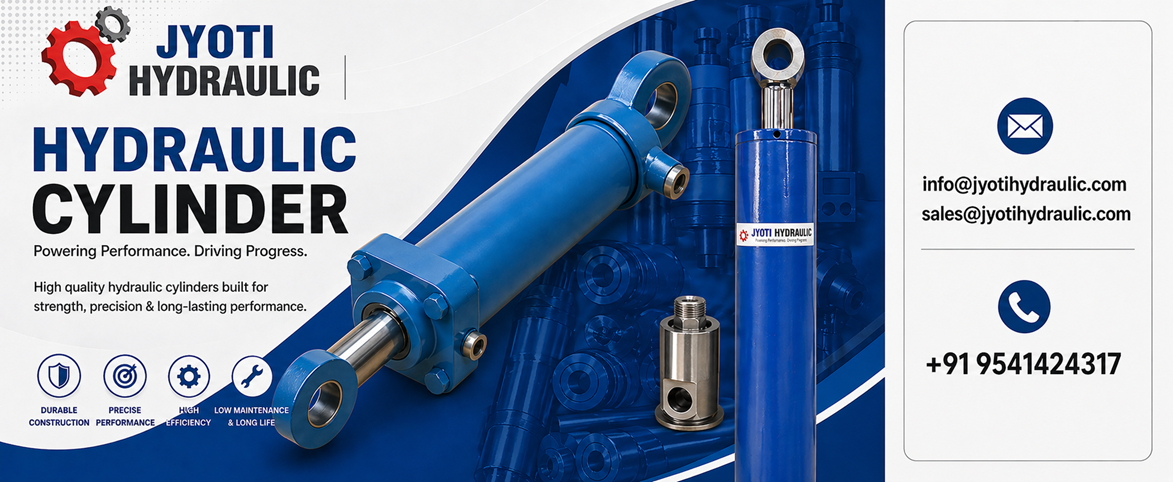
Jyoti Hydraulic stands among the trusted names in the Indian hydraulic engineering sector, offering reliable hydraulic cylinder solutions for heavy-duty industrial applications. In today’s competitive manufacturing environment, industries need equipment that can deliver high force, controlled motion, long service life, and consistent performance under demanding working conditions. Hydraulic cylinders fulfill this requirement by converting hydraulic energy into powerful linear movement with accuracy, stability, and strength.
From construction machinery and steel plants to agricultural equipment, material handling systems, automation lines, and heavy engineering machines, hydraulic cylinders are used wherever controlled lifting, pushing, pulling, pressing, clamping, tilting, or positioning is required. Because of this wide usage, the demand for a dependable Hydraulic Cylinder Manufacturer in India has increased significantly across industrial sectors.
India has developed strong capabilities in hydraulic cylinder manufacturing due to improved machining technologies, skilled engineering resources, advanced sealing systems, better raw material availability, and growing industrial infrastructure. Today, buyers do not only look for a standard hydraulic cylinder; they look for application-specific design, correct material selection, leakage-free operation, long fatigue life, and dependable after-sales support.
This detailed guide explains the Indian hydraulic cylinder industry, major cylinder types, working principles, technical design factors, industrial applications, quality considerations, customization needs, future trends, and how industrial buyers can select the right manufacturer for their requirements.
Overview of the Hydraulic Cylinder Industry in India
The hydraulic cylinder industry in India has expanded rapidly because hydraulic systems are essential in almost every heavy-duty industrial operation. Indian manufacturers are now producing cylinders for construction equipment, machine tools, plastic processing machines, mobile hydraulics, mining equipment, agricultural machinery, marine systems, power plants, cement plants, and steel processing lines.
Earlier, many industries depended heavily on imported hydraulic components for precision applications. However, Indian manufacturers have improved their capabilities in CNC machining, deep hole boring, tube honing, rod grinding, hard chrome plating, welding technology, seal selection, pressure testing, and custom design engineering. This has helped India become a strong manufacturing base for hydraulic cylinders.
A professional Hydraulic Cylinder Manufacturer in India now focuses on much more than fabrication. The process involves engineering calculations, material analysis, pressure rating selection, tolerance control, seal compatibility, surface finish inspection, and real-world application understanding.
Why the Indian Hydraulic Cylinder Market Is Growing
Several factors are driving demand for high-quality hydraulic cylinders in India:
- Growth in construction and infrastructure development
- Expansion of steel, cement, power, and mining industries
- Rising demand for automated production machines
- Increased use of hydraulic systems in agriculture equipment
- Growth of material handling and logistics equipment
- Replacement of worn-out imported cylinders with Indian alternatives
- Need for customized cylinders for special-purpose machines
Hydraulic cylinders are preferred because they provide high force in compact designs. Compared to purely mechanical systems, they offer smoother motion, better controllability, higher load capacity, and easier integration with automated systems.
Role of Industrial Hydraulic Cylinder Manufacturers in India
Experienced Industrial Hydraulic Cylinder Manufacturers in India support industries by designing cylinders that match specific load conditions, operating pressure, installation space, stroke requirement, mounting position, speed, temperature, duty cycle, and environmental exposure.
A cylinder used in a hydraulic press is different from one used in an excavator. A cylinder used in marine applications requires corrosion protection, while a steel plant cylinder must tolerate heat, shock loads, and continuous operation. This is why industry-specific expertise is extremely important.
Types of Hydraulic Cylinders
Hydraulic cylinders are available in different designs depending on the application, load direction, mounting method, stroke requirement, and working pressure. Selecting the correct type is essential for performance, safety, and durability.
Single Acting Hydraulic Cylinders
Single acting hydraulic cylinders use hydraulic pressure to move the piston in one direction. The return movement happens through gravity, spring force, or an external load.
Common Applications
- Hydraulic jacks
- Tipping trailers
- Dump bodies
- Lifting platforms
- Agricultural implements
- Simple clamping systems
Benefits
- Simple construction
- Lower cost
- Easy installation
- Suitable for basic lifting and pushing applications
- Reduced hydraulic circuit complexity
Single acting cylinders are useful where force is required only in one direction. However, they are not suitable where controlled movement is needed in both extension and retraction.
Double Acting Hydraulic Cylinders
Double acting hydraulic cylinders use hydraulic pressure for both forward and return movements. Oil enters one side of the piston to extend the rod and enters the opposite side to retract it.
Because of their higher control and versatility, Double Acting Hydraulic Cylinder Manufacturers in India supply these cylinders for a wide range of industrial machines.
Key Features
- Controlled extension and retraction
- Higher operational efficiency
- Better motion accuracy
- Suitable for horizontal and vertical installation
- Capable of handling heavy loads in both directions
Common Applications
- Hydraulic presses
- Injection molding machines
- Earthmoving equipment
- Steel rolling mills
- Material handling machinery
- Machine tools
- Industrial automation systems
Double acting cylinders are especially important in machines where the return stroke must be powered, controlled, and repeatable.
Telescopic Hydraulic Cylinders
Telescopic cylinders consist of multiple nested stages that extend one after another. They are used where long stroke length is needed but installation space is limited.
Typical Uses
- Dump trucks
- Tipper trailers
- Mobile cranes
- Garbage compactors
- Material lifting systems
- Special-purpose vehicles
These cylinders are compact when retracted and offer extended reach during operation.
Tie Rod Hydraulic Cylinders
Tie rod cylinders use external steel rods to hold the end caps and barrel together. They are commonly used in industrial machinery where maintenance and repair access are important.
Advantages
- Easy disassembly
- Convenient maintenance
- Good for medium-duty applications
- Suitable for factory automation systems
- Economical design
Tie rod cylinders are widely used in machine tools, packaging machines, production equipment, and light-to-medium industrial applications.
Welded Hydraulic Cylinders
Welded hydraulic cylinders have end caps welded directly to the barrel. This creates a compact and strong structure suitable for heavy-duty and mobile hydraulic applications.
Advantages
- High strength
- Compact design
- Better resistance to shock loads
- Suitable for harsh environments
- Longer service life in rugged applications
Welded cylinders are commonly used in mining machines, construction equipment, heavy lifting systems, agricultural equipment, and industrial machinery.
Mill Duty Hydraulic Cylinders
Mill duty cylinders are designed for severe industrial environments. They are usually built with heavy-duty barrels, large piston rods, strong mounting arrangements, and robust sealing systems.
Common Industries
- Steel plants
- Rolling mills
- Foundries
- Power plants
- Heavy engineering units
- Cement plants
These cylinders are designed for continuous operation, high side loads, vibration, heat, and impact.
Custom Hydraulic Cylinders
Many industrial applications cannot use standard cylinders. Custom cylinders are designed according to machine geometry, load condition, stroke length, pressure rating, mounting style, environmental conditions, and operational requirements.
Custom options may include:
- Special bore and rod diameter
- Non-standard stroke length
- Clevis, flange, trunnion, foot, or spherical bearing mounts
- High-temperature seals
- Stainless steel construction
- Position sensors
- Cushioning arrangement
- Corrosion-resistant coatings
- Special rod plating or surface treatment
A skilled Hydraulic Cylinder Manufacturer in India helps industries develop cylinders that fit their exact machines rather than forcing them to adapt to standard products.
Technical Insights & Working Principle
Hydraulic cylinders work on the principle of fluid power. When pressurized hydraulic oil enters the cylinder chamber, it applies pressure on the piston surface. This pressure creates linear force and moves the piston rod.
The basic force formula is:
Force = Pressure × Area
This means the output force depends mainly on hydraulic pressure and piston area. A larger bore size produces higher force at the same pressure.
Main Components of a Hydraulic Cylinder
Cylinder Barrel
The barrel is the main pressure-containing body. Its inner surface must be accurately honed to ensure smooth piston movement, proper seal contact, and reduced internal leakage.
Important barrel qualities include:
- Accurate internal diameter
- Smooth surface finish
- Proper wall thickness
- High pressure resistance
- Straightness and roundness
Piston
The piston separates the cylinder into two pressure chambers. It carries piston seals and wear rings that control internal leakage and guide movement.
Piston Rod
The piston rod transfers force to the external load. It must resist bending, buckling, corrosion, surface wear, and impact damage.
Key rod requirements include:
- High tensile strength
- Accurate diameter
- Smooth ground finish
- Hard chrome plating
- Corrosion resistance
- Sufficient rod diameter for buckling resistance
Seals
Seals are critical for leakage prevention and pressure retention. Poor seal selection can cause oil leakage, pressure drop, jerky movement, contamination entry, and premature failure.
Common seals include:
- Piston seals
- Rod seals
- Wiper seals
- Buffer seals
- O-rings
- Guide rings
Seal material must be selected according to pressure, oil type, temperature, speed, and operating environment.
End Caps
End caps close both ends of the cylinder and support ports, bearings, seals, and mounting arrangements. Their strength is important for pressure safety.
Ports
Ports allow hydraulic oil to enter and exit the cylinder chambers. Port size affects oil flow, cylinder speed, pressure drop, and heat generation.
Bearings and Wear Rings
Wear rings guide the piston and rod while preventing metal-to-metal contact. They reduce friction, improve alignment, and increase cylinder life.
Working of a Double Acting Hydraulic Cylinder
In a double acting cylinder, hydraulic oil is supplied alternately to both sides of the piston.
During extension, pressurized oil enters the cap end of the cylinder. The piston moves forward and the rod extends. Oil from the rod end returns to the tank.
During retraction, pressurized oil enters the rod end. The piston moves backward and the rod retracts. Oil from the cap end returns to the tank.
This controlled movement makes double acting cylinders ideal for applications requiring accurate motion in both directions.
Important Technical Design Factors
A reliable cylinder design requires careful engineering calculation. Important parameters include:
Bore Diameter
The bore diameter determines the force output. Higher load applications need larger bore sizes.
Rod Diameter
Rod diameter affects column strength and resistance to bending or buckling. Long-stroke cylinders need special attention to rod stability.
Stroke Length
Stroke length defines how far the cylinder rod travels. Incorrect stroke selection can cause machine misalignment, overtravel, or insufficient movement.
Working Pressure
Industrial hydraulic cylinders are commonly designed for different pressure ranges depending on application severity. The cylinder must be suitable for normal operating pressure and pressure spikes.
Mounting Style
Mounting style affects load direction, alignment, side loading, and stress distribution. Common mounting options include:
- Front flange mount
- Rear flange mount
- Clevis mount
- Trunnion mount
- Foot mount
- Lug mount
- Spherical bearing mount
Cushioning
Cushioning slows the piston near the end of stroke to reduce shock, noise, vibration, and mechanical impact. It is especially useful in high-speed cylinders.
Side Load Consideration
Hydraulic cylinders are designed primarily for axial loads. Excessive side load causes rod bending, seal wear, barrel scoring, and premature failure.
Operating Temperature
High-temperature environments require special seals, suitable hydraulic oil, and proper surface treatment.
Industrial Applications
Hydraulic cylinders are used across industries because they can produce high force with compact design and accurate control.
Construction Equipment
Hydraulic cylinders are essential in construction machinery such as:
- Excavators
- Backhoe loaders
- Bulldozers
- Cranes
- Concrete pumps
- Road rollers
- Graders
They perform digging, lifting, steering, boom movement, bucket tilting, and stabilizing functions.
Steel and Metal Processing
Steel plants require extremely rugged cylinders because machines operate under heat, vibration, scale, dust, heavy loads, and continuous duty cycles.
Applications include:
- Rolling mills
- Furnace doors
- Billet handling
- Shearing machines
- Hydraulic presses
- Ladle handling systems
- Coil processing lines
Mill duty cylinders are commonly used in these environments.
Manufacturing and Machine Tools
Manufacturing units use hydraulic cylinders for:
- Clamping
- Pressing
- Forming
- Punching
- Bending
- Lifting
- Feeding
- Positioning
Industries such as automotive, plastics, metal fabrication, packaging, and special-purpose machine building depend on hydraulic cylinders for reliable production output.
Agriculture Equipment
Hydraulic cylinders improve agricultural productivity in:
- Tractors
- Harvesters
- Loaders
- Seed drills
- Tipping trailers
- Hydraulic ploughs
- Sprayers
They help operators lift, tilt, control, and adjust equipment efficiently.
Mining and Earthmoving
Mining cylinders must handle harsh conditions such as dust, impact, overload, vibration, and abrasive contamination.
Applications include:
- Drilling rigs
- Rock breakers
- Dump trucks
- Loaders
- Crushers
- Excavation machines
For such applications, heavy-duty rods, strong barrels, reinforced mountings, and superior sealing systems are essential.
Material Handling Systems
Hydraulic cylinders are widely used in:
- Scissor lifts
- Dock levelers
- Forklifts
- Hydraulic stackers
- Conveyor systems
- Lifting platforms
- Industrial trolleys
They improve load handling safety and efficiency.
Marine and Offshore Systems
Marine hydraulic cylinders require corrosion resistance due to exposure to moisture, salt, and harsh weather.
Applications include:
- Steering systems
- Hatch covers
- Deck cranes
- Winches
- Offshore lifting equipment
- Shipyard machinery
Stainless steel rods, protective coatings, and marine-grade seals are often recommended.
Advantages & Performance Benefits
Selecting a high-quality hydraulic cylinder provides major operational benefits.
High Force Output
Hydraulic cylinders can produce very high linear force from a compact assembly. This makes them suitable for heavy machinery and industrial equipment.
Smooth Motion Control
Hydraulic systems allow controlled acceleration, deceleration, speed adjustment, and positioning.
Compact Design
Compared to mechanical systems of similar force capacity, hydraulic cylinders require less space.
Durability in Harsh Conditions
Properly designed industrial cylinders can operate in dust, heat, vibration, high load, and outdoor environments.
Better Productivity
Reliable cylinders reduce machine breakdowns, improve cycle times, and support continuous production.
Load Holding Capability
With proper valves and seals, hydraulic cylinders can hold heavy loads safely in position.
Custom Engineering Flexibility
Hydraulic cylinders can be designed according to exact application requirements, making them suitable for standard and special-purpose machines.
How to Choose the Right Hydraulic Cylinder Manufacturer
Choosing the right manufacturer is a major decision for industrial buyers, OEMs, project contractors, maintenance teams, and machine builders.
Check Engineering Knowledge
A good manufacturer should understand hydraulic calculations, load conditions, pressure ratings, material selection, seal behavior, and application requirements.
Evaluate Manufacturing Infrastructure
Look for capabilities such as:
- CNC turning
- Precision boring
- Tube honing
- Rod grinding
- Welding
- Chrome plating coordination
- Assembly facilities
- Pressure testing setup
Ask About Customization
Industrial machines often require special designs. The manufacturer should be able to customize bore, stroke, rod size, mounting, material, seals, and pressure rating.
Review Quality Testing Process
Reliable cylinders should undergo:
- Dimensional inspection
- Weld inspection
- Surface finish checking
- Seal fitment inspection
- Hydrostatic pressure testing
- Leakage testing
- Stroke movement testing
Consider Industry Experience
Manufacturers with experience in steel, construction, agriculture, mining, and automation understand practical field challenges better than general fabricators.
Check After-Sales Support
Technical guidance, spare seal kits, repair support, and replacement assistance are important for long-term machine reliability.
Compare Value, Not Only Price
The cheapest cylinder may lead to leakage, breakdown, rod bending, seal failure, and production loss. Industrial buyers should focus on performance, durability, engineering quality, and lifecycle cost.
Importance of Quality, Material & Customization
A hydraulic cylinder works under pressure, load, friction, temperature variation, and repeated motion. Even small design or manufacturing errors can cause failure.
Material Quality
Material selection affects strength, fatigue life, corrosion resistance, and pressure capacity.
Common material considerations include:
- Seamless honed tubes for barrels
- EN-grade or alloy steel rods
- Hard chrome plated piston rods
- High-strength end caps
- Quality seal materials
- Wear-resistant guide elements
Surface Finish
Surface finish directly affects seal life and leakage performance. A rough surface damages seals, while an overly smooth surface may not retain enough lubrication. Proper grinding, honing, and polishing are essential.
Seal Selection
Seals must match the working conditions. Factors include:
- Pressure level
- Oil compatibility
- Rod speed
- Temperature range
- Contamination exposure
- Application duty cycle
Poor seal selection is one of the most common causes of hydraulic cylinder failure.
Welding Quality
Welded cylinders need strong and defect-free weld joints. Poor welding can cause cracks, leakage, distortion, and safety risks.
Alignment Accuracy
The piston, rod, barrel, and mounting points must be accurately aligned. Misalignment causes side loading, uneven seal wear, rod scoring, and premature breakdown.
Customization for Real Working Conditions
A standard cylinder may not perform well in a demanding application. Customization helps match the cylinder to real operating conditions.
Examples include:
- High-temperature seals for steel plants
- Corrosion-resistant rods for marine equipment
- Heavy-duty mounting for mining machines
- Long-stroke design with buckling protection
- Cushioning for high-speed operation
- Special coatings for outdoor equipment
- Integrated sensors for automation
This is why selecting experienced Industrial Hydraulic Cylinder Manufacturers in India is important for application-critical systems.
Common Causes of Hydraulic Cylinder Failure
Understanding failure causes helps industries improve machine uptime and maintenance planning.
Seal Failure
Seal failure may happen due to heat, contamination, incorrect installation, chemical incompatibility, or excessive pressure.
Rod Scoring
Rod scoring occurs when dirt enters through damaged wipers or when the rod surface is exposed to abrasive particles.
Internal Leakage
Internal leakage reduces cylinder force and causes slow or drifting movement.
Barrel Wear
Improper lubrication, contamination, and misalignment can damage the barrel’s internal surface.
Rod Bending
Rod bending occurs when the cylinder is overloaded, misaligned, or exposed to side loads.
Mounting Failure
Weak or incorrect mounting can cause cracks, vibration, and unsafe operation.
Contaminated Hydraulic Oil
Contaminated oil damages seals, valves, pumps, and internal cylinder surfaces. Filtration is critical for system health.
Maintenance Tips for Longer Cylinder Life
Industrial users can extend hydraulic cylinder life with proper maintenance practices.
- Keep hydraulic oil clean and properly filtered
- Inspect rods regularly for scratches and rust
- Replace damaged wiper seals promptly
- Check mounting pins and bushings
- Avoid side loading
- Monitor oil temperature
- Check for external leakage
- Use correct hydraulic oil grade
- Avoid overpressure conditions
- Schedule preventive maintenance
A well-maintained hydraulic cylinder improves equipment reliability and reduces unexpected downtime.
Future Trends in Hydraulic Cylinder Technology
Hydraulic cylinder technology is evolving with industrial automation, digital monitoring, energy efficiency, and sustainability requirements.
Smart Hydraulic Cylinders
Smart cylinders include position sensors, pressure sensors, and electronic feedback systems. These are useful in automation, robotics, mobile equipment, and precision machinery.
Predictive Maintenance
Sensor-based monitoring helps detect pressure variation, temperature rise, seal wear, and abnormal motion before failure occurs.
Energy-Efficient Designs
Modern cylinders are being designed with low-friction seals, improved surface finish, optimized porting, and better fluid flow characteristics to reduce energy loss.
Advanced Coatings
New rod coatings improve corrosion resistance, wear resistance, and service life in harsh operating conditions.
Lightweight Cylinder Construction
Industries such as mobile equipment and aerospace-related engineering are exploring lighter materials without compromising strength.
Integration with Industry 4.0
Hydraulic systems are increasingly connected with PLCs, IoT devices, data analytics platforms, and automated control systems.
Environment-Friendly Hydraulic Systems
The future will see greater use of biodegradable hydraulic fluids, leak-prevention designs, recyclable materials, and cleaner manufacturing methods.
Why Jyoti Hydraulic Is a Trusted Choice
Jyoti Hydraulic focuses on practical engineering, durable construction, and application-oriented hydraulic cylinder solutions. Industrial buyers need more than a product; they need technical guidance, correct design selection, and dependable performance.
Key Strengths
- Custom hydraulic cylinder manufacturing
- Heavy-duty industrial design capability
- Focus on quality material and precision machining
- Solutions for multiple industries
- Technical support for application selection
- Manufacturing knowledge for standard and special-purpose cylinders
- Support for industrial buyers, OEMs, and maintenance teams
Whether the requirement is for a double acting cylinder, heavy-duty welded cylinder, industrial press cylinder, lifting cylinder, or fully customized hydraulic solution, Jyoti Hydraulic provides engineering-focused support for reliable operation.
Conclusion
Hydraulic cylinders are essential components in modern industrial machinery. They provide controlled linear motion, high force output, reliable performance, and excellent adaptability across industries. From construction and mining to manufacturing, steel, agriculture, marine, and automation, hydraulic cylinders continue to power critical operations.
India has become a strong hub for hydraulic cylinder manufacturing due to its engineering capabilities, skilled workforce, cost-effective production, and growing industrial demand. However, the performance of a hydraulic system depends greatly on the quality of its cylinders.
Choosing the right Hydraulic Cylinder Manufacturer in India ensures better machine efficiency, reduced downtime, safer operation, and longer equipment life. Buyers should evaluate technical expertise, material quality, customization capability, testing procedures, and after-sales support before finalizing a manufacturer.
For businesses looking for reliable hydraulic solutions, working with experienced Double Acting Hydraulic Cylinder Manufacturers in India and specialized Industrial Hydraulic Cylinder Manufacturers in India can make a significant difference in performance, productivity, and lifecycle cost.
FAQ Section
1. What does a hydraulic cylinder do?
A hydraulic cylinder converts hydraulic fluid pressure into linear mechanical force. It is used for lifting, pushing, pulling, pressing, clamping, tilting, and positioning heavy loads in industrial machinery.
2. Why are hydraulic cylinders widely used in industrial applications?
Hydraulic cylinders are preferred because they generate high force from compact designs, offer smooth motion control, support heavy-duty operations, and can be customized for different machines.
3. What is the difference between single acting and double acting hydraulic cylinders?
A single acting cylinder uses hydraulic pressure in one direction, while the return movement happens through gravity, spring, or external load. A double acting cylinder uses hydraulic pressure for both extension and retraction, giving better control in both directions.
4. Where are double acting hydraulic cylinders used?
Double acting cylinders are used in hydraulic presses, excavators, injection molding machines, steel plants, machine tools, construction equipment, and automation systems where controlled movement is required in both directions.
5. How do I select the right hydraulic cylinder?
You should consider bore size, stroke length, rod diameter, working pressure, mounting style, load direction, operating temperature, duty cycle, speed, and environmental conditions.
6. Why is customization important in hydraulic cylinders?
Customization ensures that the cylinder matches the exact machine requirement. It improves fitment, performance, safety, durability, and operating efficiency.
7. What materials are commonly used in hydraulic cylinders?
Hydraulic cylinders commonly use seamless honed tubes, carbon steel, alloy steel, stainless steel, hard chrome plated rods, bronze or composite guide rings, and high-performance sealing materials.
8. What causes hydraulic cylinder leakage?
Leakage may be caused by worn seals, damaged rods, contaminated oil, excessive pressure, poor surface finish, incorrect seal selection, or misalignment.
9. How can hydraulic cylinder life be increased?
Cylinder life can be increased by using clean hydraulic oil, proper filtration, correct alignment, regular inspection, good-quality seals, proper mounting, and preventive maintenance.
10. Why choose an Indian hydraulic cylinder manufacturer?
Indian manufacturers offer strong engineering capabilities, cost-effective solutions, customization, faster communication, local support, and products suitable for demanding industrial applications.


