
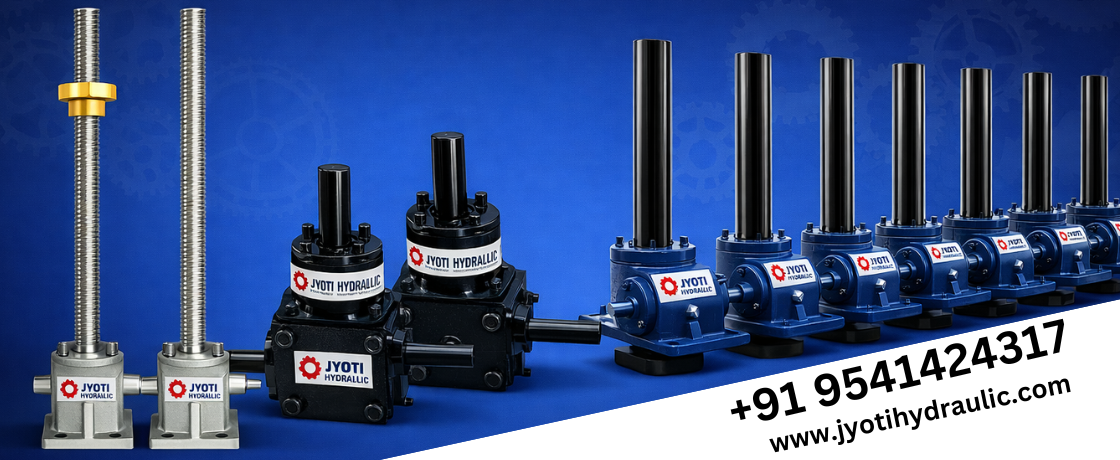
Jyoti Hydraulic understands that a reliable lifting system is essential for maintaining smooth industrial operations. A Worm Gear Screw Jack is widely used for lifting, lowering, positioning, and supporting heavy loads with controlled movement. Although the mechanism is durable, incorrect selection, poor lubrication, misalignment, or overloading can cause premature failure.
How a Worm Gear Screw Jack Works
A worm gear screw jack converts rotary input from a motor or handwheel into linear movement. The worm shaft rotates the worm wheel, which moves the lifting screw or travelling nut.
This arrangement provides high mechanical advantage, accurate positioning, and controlled load movement. However, the internal gears and screw threads operate under continuous friction, making correct installation and lubrication extremely important.
Common Problems and Practical Solutions
1. Unusual Noise or Vibration
Grinding, knocking, or excessive vibration may indicate insufficient lubrication, worn bearings, damaged gears, or incorrect alignment.
How to fix it:
Stop the equipment and inspect the gearbox, bearings, mounting bolts, and screw alignment. Apply the recommended lubricant and replace worn parts before restarting the system.
2. Slow or Uneven Movement
A screw jack may move slowly because of contaminated threads, excessive friction, low motor speed, or a bent lifting screw.
How to fix it:
Clean and lubricate the screw, verify the motor RPM, and check the screw for bending. A permanently deformed screw should be replaced rather than repaired.
3. Jack Fails to Lift the Load
This usually happens when the system is overloaded, the lifting capacity has been incorrectly calculated, or the internal threads are worn.
How to fix it:
Confirm the actual load, required safety factor, operating speed, and duty cycle. Reliable Screw Jack Manufacturers can help select the correct model based on real working conditions.
4. Gearbox Overheating
Overheating can result from continuous operation, excessive speed, poor lubrication, or operation beyond the rated capacity.
How to fix it:
Provide suitable rest intervals, check the lubricant level, and reduce the operating load or speed. For frequent operation, select a model designed for a higher duty cycle.
5. Oil or Grease Leakage
Leakage is commonly caused by worn seals, excessive lubricant, or damaged sealing surfaces.
How to fix it:
Replace defective seals and fill the gearbox only to the recommended level. Regularly inspect the housing for cracks or surface damage.
6. Lifting Screw Jamming
Dust, rust, damaged threads, and poor alignment can prevent smooth screw movement.
How to fix it:
Do not force the jack to move. Clean the threads, remove corrosion, check alignment, and replace heavily damaged components.
7. Uneven Movement in a Multi-Jack System
Multiple screw jacks may lose synchronization because of shaft misalignment, coupling wear, or uneven load distribution.
How to fix it:
Check connecting shafts, gearboxes, couplings, and load balance. All lifting points should move at the same speed and carry a properly distributed load.
Applications and Benefits
Worm gear screw jacks are used in material-handling systems, steel plants, packaging machines, conveyors, assembly lines, maintenance platforms, solar positioning systems, and special-purpose machinery.
Their main benefits include high load capacity, accurate positioning, compact construction, controlled movement, easy synchronization, and low maintenance when operated correctly.
How to Select the Right Screw Jack
Before purchasing, evaluate:
- Maximum load and required safety factor
- Lifting stroke and operating speed
- Duty cycle and mounting position
- Environmental conditions
- Motorized or manual operation
- Number of synchronized lifting points
- Availability of service and spare parts
Choosing an experienced manufacturer is important because incorrect sizing can reduce performance and equipment life.
Future of Screw Jack Technology
Modern screw jack systems are increasingly integrated with servo motors, encoders, load sensors, automated controls, and condition-monitoring systems. These developments improve positioning accuracy, safety, and preventive maintenance planning.
Conclusion
Most worm gear screw jack problems can be prevented through correct selection, accurate alignment, proper lubrication, and regular inspection. Early attention to noise, overheating, leakage, or uneven movement can prevent costly breakdowns and extend the working life of the system.
Frequently Asked Questions
What causes a worm gear screw jack to fail?
Common causes include overloading, inadequate lubrication, misalignment, damaged threads, and continuous operation beyond the rated duty cycle.
How often should a screw jack be lubricated?
The lubrication interval depends on load, operating frequency, speed, and environmental conditions. Follow the manufacturer’s maintenance recommendations.
Can a screw jack be used for synchronized lifting?
Yes. Multiple screw jacks can be connected through shafts, couplings, and gearboxes to lift large platforms evenly.
Contact Jyoti Hydraulic
Need help selecting a reliable Worm Gear Screw Jack for your industrial application? Contact Jyoti Hydraulic for product recommendations, customized solutions, quotations, and expert technical consultation.
📧 info@jyotihydraulic.com
📞 +91 9541424317
Share your load, stroke, speed, and installation requirements with our team to receive the most suitable lifting solution.


