
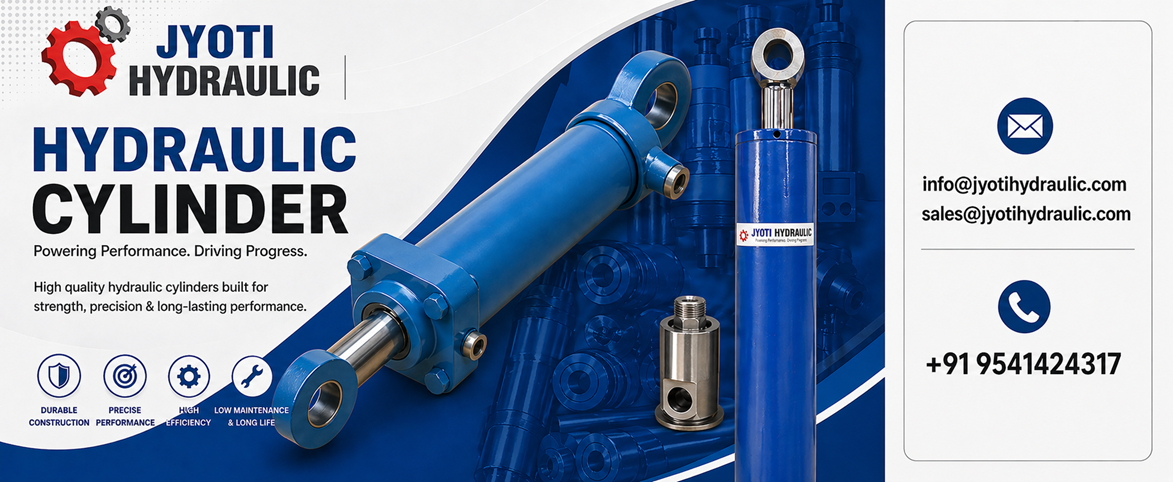
Jyoti Hydraulic manufactures dependable hydraulic cylinders for industrial machines that require controlled movement, high force, and consistent operation. Hydraulic cylinders may look simple from the outside, but their performance depends on accurate engineering, correct material selection, reliable sealing, and proper compatibility with the hydraulic system. This guide explains how hydraulic cylinders work, where they are used, and what buyers should consider before choosing one.
What Is a Hydraulic Cylinder?
A hydraulic cylinder is a mechanical actuator that converts hydraulic fluid pressure into straight-line movement. It is commonly used to lift, push, pull, clamp, tilt, press, or position heavy components.
Inside the cylinder barrel, a piston is connected to a piston rod. When pressurized hydraulic oil enters the cylinder, it acts against the piston surface and forces the piston to move. This movement extends or retracts the piston rod, allowing the machine to perform useful work.
The force generated by a hydraulic cylinder mainly depends on the system pressure and the effective piston area. A larger bore generally produces greater force, while the hydraulic oil flow rate influences the cylinder’s operating speed.
Role of Hydraulic Cylinders in Modern Industry
Hydraulic cylinders are widely used because they can generate substantial force from a comparatively compact assembly. They are especially valuable in applications where electric or purely mechanical actuators may become too large, complicated, or difficult to control.
Construction equipment, steel plants, agricultural machinery, material-handling systems, industrial presses, mining equipment, and automated production lines all depend on hydraulic cylinders.
As industries adopt heavier machinery and more automated processes, the demand for application-specific cylinders is increasing. Established Industrial Hydraulic Cylinder Manufacturers now focus not only on load capacity but also on operating cycles, alignment, temperature, contamination, corrosion, and maintenance accessibility.
Main Parts of a Hydraulic Cylinder
A typical hydraulic cylinder contains several precision-engineered components:
- Cylinder barrel: Holds the piston and hydraulic fluid while resisting internal pressure.
- Piston: Separates the internal pressure chambers and converts fluid pressure into movement.
- Piston rod: Transfers the force generated inside the cylinder to the machine.
- Cylinder head and base: Close both ends of the barrel and support the internal assembly.
- Seals: Prevent internal pressure loss, external oil leakage, and contaminant entry.
- Bushes and wear rings: Guide moving components and reduce metal-to-metal contact.
- Hydraulic ports: Allow controlled oil entry and return.
The quality of each component affects leakage control, movement accuracy, load stability, and service life.
How Does a Hydraulic Cylinder Work?
Hydraulic cylinders operate according to Pascal’s law, which explains how pressure applied to a confined fluid is transmitted throughout the fluid.
A hydraulic pump draws oil from a reservoir and supplies it under pressure. Directional valves guide this oil into the required side of the cylinder. The pressure pushes the piston, causing the rod to extend or retract. Oil from the opposite chamber then returns to the reservoir.
Flow-control valves regulate movement speed, while pressure-relief valves protect the system against excessive pressure.
Single Acting and Double Acting Cylinders
A single acting cylinder receives hydraulic pressure from one side only. Its return movement is completed through gravity, a spring, or an external load. These cylinders are commonly found in lifting tables, jacks, and tipping arrangements.
A Double Acting Hydraulic Cylinder uses hydraulic pressure for both extension and retraction. It has two fluid ports, giving the operator better control over force, speed, and direction.
Double acting designs are preferred for machinery that requires repeated, controlled movement, including hydraulic presses, excavators, injection moulding machines, steel-processing equipment, and automated material-handling systems.
Common Industrial Applications
Hydraulic cylinders are used in a broad range of operations:
- Lifting and lowering construction equipment
- Opening and closing industrial gates
- Operating hydraulic presses and compactors
- Tilting dump trucks and trailers
- Clamping components during manufacturing
- Moving agricultural attachments
- Controlling mining and drilling equipment
- Positioning rolls in steel and paper plants
- Operating cranes, loaders, and handling systems
Each application may require a different bore, stroke, rod diameter, mounting arrangement, seal material, and pressure rating.
Benefits of Hydraulic Cylinders
Hydraulic cylinders offer several practical advantages:
- High force output from a compact design
- Smooth and controlled linear movement
- Reliable performance under heavy loads
- Flexible mounting and customization options
- Effective operation in continuous-duty machinery
- Easy integration with hydraulic valves and control systems
- Long working life when correctly selected and maintained
They can also be designed for unusual stroke lengths, restricted installation spaces, high temperatures, corrosive environments, or special mounting conditions.
How to Select the Right Hydraulic Cylinder
Before placing an order, buyers should evaluate the actual working conditions rather than selecting a cylinder only by price.
Important factors include:
- Required pushing or pulling force
- Maximum hydraulic pressure
- Bore and piston rod diameter
- Required stroke length
- Operating speed and duty cycle
- Mounting style and available space
- Working temperature and environment
- Possibility of side loading
- Seal and hydraulic oil compatibility
- Maintenance and spare-part availability
Working with an experienced Hydraulic Cylinder Manufacturer in India helps reduce problems such as rod bending, seal failure, leakage, uneven movement, and premature wear.
Future of Hydraulic Cylinder Technology
Modern hydraulic cylinders are becoming more intelligent and energy efficient. Position sensors, pressure monitoring devices, improved sealing systems, corrosion-resistant coatings, and condition-monitoring technology are increasingly being integrated into industrial designs.
These developments allow maintenance teams to identify wear early, improve machine accuracy, reduce unexpected downtime, and plan servicing more effectively.
Conclusion
A hydraulic cylinder is a critical power-transmission component used to create controlled linear force. Its reliability depends on correct sizing, precision manufacturing, suitable sealing, proper alignment, and regular maintenance.
Whether the requirement is for a standard cylinder, a Double Acting Hydraulic Cylinder, or a customized solution, buyers should choose manufacturers with strong design knowledge and practical application experience. Jyoti Hydraulic develops hydraulic cylinders according to machine load, pressure, stroke, mounting, and operating conditions.
Frequently Asked Questions
What is the main function of a hydraulic cylinder?
It converts pressurized hydraulic oil into linear movement for lifting, pressing, pushing, pulling, or positioning a load.
Why are double acting cylinders commonly used?
They use hydraulic pressure during both extension and retraction, providing better control and faster repeated operation.
Can a hydraulic cylinder be customized?
Yes. Bore size, stroke, rod diameter, mounting, seals, ports, pressure capacity, and construction materials can be customized.
What causes hydraulic cylinder leakage?
Worn seals, damaged rods, contaminated oil, incorrect alignment, excessive pressure, and poor surface finishing are common causes.
How can cylinder service life be improved?
Use clean hydraulic oil, maintain correct alignment, avoid side loading, inspect seals regularly, and operate within the specified pressure range.
Get the Right Hydraulic Cylinder for Your Application
Jyoti Hydraulic provides technically suitable hydraulic cylinder solutions for industrial machinery, material handling, manufacturing, agriculture, construction, and other heavy-duty applications.
Contact our team to discuss your operating requirements, request a competitive quotation, or receive expert guidance for selecting a standard or customized hydraulic cylinder.
+91 9541424317


