
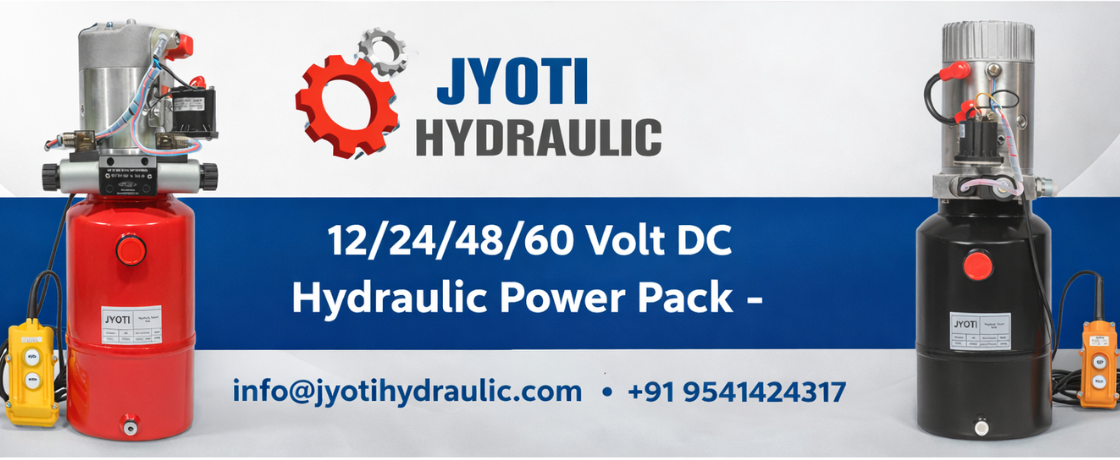
Jyoti Hydraulic understands that modern machines need power systems that are compact, reliable, and easy to integrate. A DC Hydraulic Power Pack is one such solution. It is widely used where hydraulic force is required but a continuous AC power supply is not practical. From tippers and scissor lifts to mobile equipment and industrial machinery, these units help convert electrical energy from a DC source into controlled hydraulic power.
In 2026, buyers are no longer looking only at price. They want better efficiency, longer service life, safe operation, compact design, and application-specific performance. This guide explains how DC hydraulic power packs work, where they are used, what benefits they offer, and how to choose the right model for your requirement.
Industry Overview
Hydraulic systems continue to play an important role in manufacturing, construction, material handling, agriculture, automotive service, and mobile equipment. The reason is simple: hydraulics can generate high force in a compact space.
A DC Hydraulic Power Pack is especially useful in equipment that works on batteries or vehicle-mounted power sources. This makes it suitable for mobile applications such as dump trailers, loading platforms, hydraulic lifts, tailgates, tippers, and portable machines.
At the same time, industries are demanding smaller and more efficient systems. This has increased the use of the Compact Hydraulic Power Pack, especially where machine design has limited space. For heavy-duty production lines and continuous-use machinery, the Industrial Hydraulic Power Pack remains essential due to its strength, durability, and ability to handle demanding workloads.
Technical Insights
A DC hydraulic power pack is a self-contained hydraulic unit. It usually includes a DC motor, hydraulic pump, oil tank, valves, filters, pressure relief valve, fittings, and electrical controls.
The working process is straightforward. When the DC motor starts, it drives the hydraulic pump. The pump draws oil from the reservoir and sends it into the hydraulic circuit under pressure. Valves control the oil direction, flow, and pressure. This pressurized oil then moves a hydraulic cylinder or motor to perform lifting, pushing, pulling, pressing, tilting, or rotating action.
The performance of the power pack depends on several technical factors:
- Motor voltage, commonly 12V, 24V, or 48V DC
- Pump flow rate
- Maximum pressure rating
- Reservoir capacity
- Valve type
- Duty cycle
- Oil filtration quality
- Heat management
A well-designed unit should deliver stable pressure, smooth movement, low noise, and safe performance under actual working conditions.
Common Applications
DC hydraulic power packs are used across many industries because they are easy to install and suitable for mobile use.
Common applications include:
- Dump trailers and tippers
- Scissor lifts and goods lifts
- Dock levelers
- Battery-operated stackers
- Tail lifts and vehicle-mounted platforms
- Agricultural equipment
- Hydraulic ramps
- Mini cranes
- Portable maintenance equipment
- Automotive service lifts
- Industrial clamping and lifting systems
For small machines, a Compact Hydraulic Power Pack is often the preferred choice because it saves space and keeps the equipment lightweight. For large production setups, an Industrial Hydraulic Power Pack is selected when higher pressure, larger oil capacity, and continuous operation are required.
Key Benefits
A DC hydraulic power pack offers several practical advantages.
First, it supports mobility. Since it can run on battery power, it is ideal for machines that operate away from fixed power connections.
Second, it provides high force in a small package. This is why it is used in lifting and loading applications where compact size and strong output are both important.
Third, it allows controlled movement. With the right valve arrangement, users can manage lifting speed, lowering speed, pressure, and direction with accuracy.
Fourth, it reduces installation complexity. A power pack is a complete unit, so it can be mounted directly on equipment with proper hydraulic connections.
Fifth, it can improve productivity. Fast cycle time, reliable lifting, and smooth performance help reduce downtime.
Finally, a quality hydraulic power pack is durable. With proper oil, filtration, and maintenance, it can perform consistently for years.
Buying Guide: How to Choose the Right DC Hydraulic Power Pack
Choosing the right power pack requires more than selecting a standard model. The system must match the application.
1. Understand the Load Requirement
Start with the weight or force the machine needs to handle. A power pack that is too small may fail under load, while an oversized system can waste energy and increase cost.
2. Check Pressure Rating
Pressure decides how much force the hydraulic system can generate. Light-duty systems may require lower pressure, while industrial machinery may need higher pressure. Always select a pressure rating with a suitable safety margin.
3. Calculate Flow Requirement
Flow rate affects speed. If the flow is too low, the cylinder will move slowly. If it is too high, the system may become inefficient or difficult to control.
4. Select the Correct DC Voltage
12V units are common in small mobile machines. 24V systems are widely used in material handling and vehicle-mounted equipment. Higher voltage options may be used for specialized applications.
5. Choose Single-Acting or Double-Acting Operation
A single-acting power pack sends oil in one direction, and the return movement happens by gravity or spring force. A double-acting unit powers both extension and retraction, making it suitable for applications needing controlled movement in both directions.
6. Consider Reservoir Size
The oil tank should be large enough to supply the cylinder and control oil temperature. Too little oil can cause heating, aeration, and performance problems.
7. Review Duty Cycle
Some machines run occasionally, while others operate repeatedly throughout the day. The motor, pump, and reservoir must be selected according to actual working frequency.
8. Look for Safety Features
Important safety elements include pressure relief valve, overload protection, quality seals, proper filtration, and electrical protection.
9. Prefer Customization When Needed
Standard units are useful, but many machines need customized mounting, valve arrangement, tank size, pressure setting, or control options. Working with an experienced manufacturer helps avoid performance issues.
Future Trends in 2026
Hydraulic power packs are becoming smarter and more efficient. In 2026, industries are focusing on compact designs, energy-saving motors, better sealing systems, low-noise operation, and improved filtration. Battery-powered machinery is also increasing, which will further raise demand for DC-based hydraulic solutions.
Smart monitoring may become more common in advanced systems. Sensors for pressure, temperature, oil level, and operating hours can help users plan maintenance before breakdowns happen.
Conclusion
A DC Hydraulic Power Pack is a practical and powerful solution for mobile, compact, and industrial hydraulic applications. It offers strong performance, controlled movement, easy installation, and dependable operation. Whether you need a Compact Hydraulic Power Pack for a small machine or an Industrial Hydraulic Power Pack for a demanding application, the right selection depends on load, pressure, flow, voltage, reservoir size, duty cycle, and safety requirements.
Choosing the correct hydraulic power pack in 2026 can improve machine performance, reduce downtime, and increase long-term reliability. Jyoti Hydraulic provides application-focused guidance and quality hydraulic solutions for different industrial needs.
FAQs
1. What is a DC Hydraulic Power Pack?
A DC Hydraulic Power Pack is a hydraulic unit powered by a direct current motor. It generates hydraulic pressure to operate cylinders, lifts, tippers, platforms, and other hydraulic equipment.
2. Where is a DC hydraulic power pack used?
It is used in dump trailers, scissor lifts, dock levelers, stackers, tail lifts, agricultural machines, automotive lifts, and mobile hydraulic equipment.
3. What is the benefit of a Compact Hydraulic Power Pack?
A Compact Hydraulic Power Pack saves space, reduces machine weight, and provides reliable hydraulic power in small or restricted installations.
4. What is the difference between single-acting and double-acting power packs?
Single-acting units power movement in one direction. Double-acting units provide hydraulic power in both directions for better control.
5. How do I choose the right hydraulic power pack?
Check load capacity, pressure, flow rate, voltage, reservoir size, working cycle, valve type, and safety features before selecting a model.
6. Can Jyoti Hydraulic provide customized hydraulic power packs?
Yes, Jyoti Hydraulic can provide hydraulic power pack solutions based on specific machine and industry requirements.
Contact Jyoti Hydraulic
Need the right DC Hydraulic Power Pack, Compact Hydraulic Power Pack, or Industrial Hydraulic Power Pack for your application?
Get expert support from Jyoti Hydraulic for product selection, customization, and quotation.
📧 info@jyotihydraulic.com
📞 +91 9541424317
Contact today to request a quotation, discuss your application, or get expert hydraulic consultation.


